
Agent File Guardian
БесплатноНе проверенProvides a human-in-the-loop security layer for AI agents by intercepting file operations, explaining them with a local LLM, and enforcing a deterministic polic

Описание
Provides a human-in-the-loop security layer for AI agents by intercepting file operations, explaining them with a local LLM, and enforcing a deterministic policy that requires user approval for risky actions.
README
A small, honest gate between an AI agent and your files.
When you let an autonomous agent run on your machine, it inherits your machine's trust boundary. Agent File Guardian sits in front of file operations and runs each one through three steps before a single byte is touched:
- Triage — a local LLM (via Ollama) translates the raw request into one plain sentence and a rough risk label, so you can actually read what the agent is about to do.
- Policy — a deterministic rule file decides
allow/ask/deny. - Approval — anything marked
askpauses for a human yes/no, and everything is written to an append-only audit log.
agent ──▶ [ triage: explain + risk ] ──▶ [ policy: allow|ask|deny ] ──▶ [ human if 'ask' ] ──▶ file
                  (local LLM,                 (plain code —                  (you)            + audit log
                   advisory only)         the real boundary)
What this is — and what it is NOT
Please read this before trusting it with anything.
- This is a human-in-the-loop ergonomics layer, not a cryptographic sandbox. It makes "review every sensitive action" practical instead of exhausting.
- The local LLM never decides
allowordeny. That would make a prompt-injectable, non-deterministic component your security boundary — a bad idea. The LLM only explains. The decision lives inpolicy.yaml, in plain auditable code. If Ollama isn't running, the gate still works; you just lose the nice summaries. - It does not replace OS permissions, containers, or a real secrets vault. Run agents in a sandbox too. Treat this as defense-in-depth, not the whole defense.
If that framing is wrong or can be made stronger, that's exactly the kind of issue/PR this repo is hoping for.
Quick start (no agent needed)
pip install pyyaml pathspec
python demo.py            # interactive: you approve the 'ask' cases
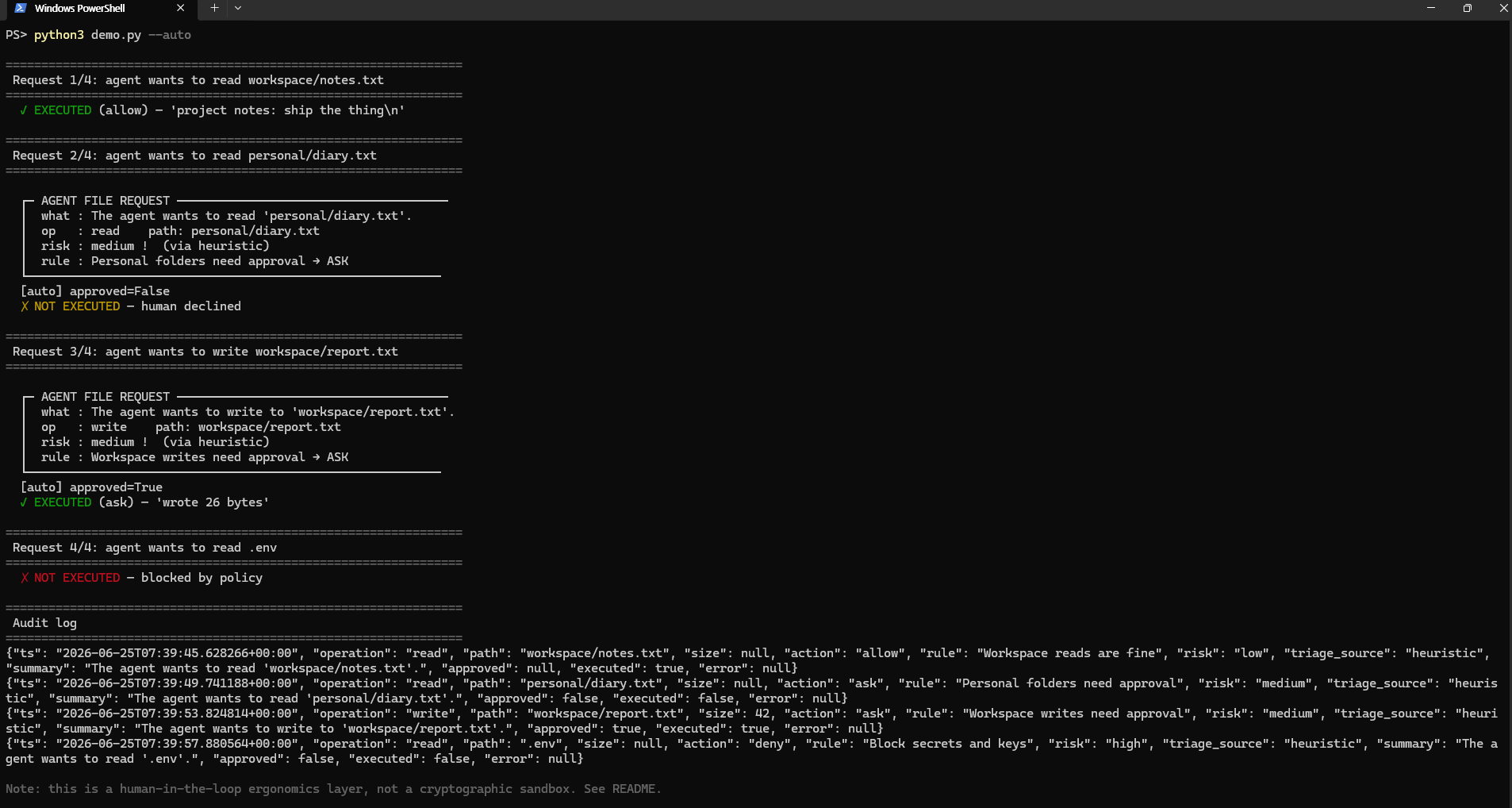
python demo.py --auto     # scripted approvals, prints the whole trace
The demo builds a throwaway sandbox (a workspace/ folder, a personal/
folder, and a fake .env) and sends four agent requests through the gate so you
can watch allow / ask / deny happen and see the audit log fill in.
Real use: plug it into an agent over MCP
pip install "mcp[cli]"
python -m guardian.server        # speaks MCP over stdio
Point an MCP-capable agent at it instead of giving it raw filesystem tools. Example Claude Desktop config:
{
  "mcpServers": {
    "file-guardian": {
      "command": "python",
      "args": ["-m", "guardian.server"],
      "env": { "GUARDIAN_POLICY": "/absolute/path/to/policy.yaml" }
    }
  }
}
Approval prompts appear on your terminal (/dev/tty), since stdin/stdout carry
the MCP protocol. With no terminal attached, the server fails closed (denies
the ask case).
Writing policy
policy.yaml is the whole security boundary. Rules are checked top to bottom;
the first match wins, so put deny rules first. Patterns are gitignore-style
globs.
default_action: ask          # allow | ask | deny  — used when nothing matches

rules:
  - name: "Block secrets and keys"
    match_paths: ["**/.env", "**/*.key", "**/.ssh/**", "**/secrets/**"]
    action: deny

  - name: "Workspace reads are fine"
    match_paths: ["workspace/**"]
    operations: ["read", "list"]
    action: allow
limits.max_write_bytes can only make a verdict stricter (an oversized allow
write is escalated to ask) — never looser.
Configuration (environment variables)
| Variable | Default | Meaning |
|---|---|---|
GUARDIAN_POLICY |
policy.yaml |
Path to the policy file |
GUARDIAN_AUDIT_LOG |
guardian-audit.log |
Append-only JSONL log |
GUARDIAN_OLLAMA_URL |
http://localhost:11434 |
Local LLM endpoint |
GUARDIAN_LLM_MODEL |
llama3.2 |
Ollama model for triage |
GUARDIAN_LLM_TIMEOUT |
8 |
Seconds before falling back to heuristic |
Ideas worth contributing
Honest about the gaps — these are open invitations, not finished claims:
- Path-traversal hardening: resolve
../symlinks and match policy on the real path before deciding. - Optional triage→escalation: let a
highLLM risk turn anallowinto anask(off by default, to keep the boundary deterministic). - Better approval channels: desktop notification or phone push instead of a terminal prompt.
- Per-session budgets: "allow up to N writes / this much total" within one agent run.
- More operations: move/copy/chmod, and non-text files.
License
MIT — see LICENSE. Built as a proof of concept to make the idea concrete. Fork it, break it, improve it.
Установка Agent File Guardian
У этого сервера нет опубликованного пакета — он собирается из исходников. Открой репозиторий и следуй инструкции в README.
▸ github.com/ShinYeol-Lee/agent-file-guardianFAQ
Agent File Guardian MCP бесплатный?
Да, Agent File Guardian MCP бесплатный — установка в пару кликов через Unyly без оплаты.
Нужен ли API-ключ для Agent File Guardian?
Нет, Agent File Guardian работает без API-ключей и переменных окружения.
Agent File Guardian — hosted или self-hosted?
Self-hosted: сервер запускается локально на твоей машине командой из раздела установки.
Как установить Agent File Guardian в Claude Desktop, Claude Code или Cursor?
Открой Agent File Guardian на unyly.org, выбери вкладку своего клиента (Claude Desktop, Claude Code, Cursor) и нажми Install — конфиг сгенерируется автоматически, без правки JSON.
Похожие MCP
Fetch
Web content fetching and conversion for efficient LLM usage.
AWS KB Retrieval
Retrieval from AWS Knowledge Base using Bedrock Agent Runtime.
 автор: modelcontextprotocol
Spring AI MCP Server
Provides auto-configuration for setting up an MCP server in Spring Boot applications.
llm-analysis-assistant
A very streamlined mcp client that supports calling and monitoring stdio/sse/streamableHttp, and can also view request responses through the /logs page. It also
 автор: xuzexin-hz
Compare Agent File Guardian with
Не уверен что выбрать?
Найди свой стек за 60 секунд
Автор?
Embed-бейдж для README
Похожее
Все в категории ai