
AIConductor
БесплатноНе проверенOrchestrates multi-stakeholder feature refinement and development execution workflows for AI-assisted software teams.

Описание
Orchestrates multi-stakeholder feature refinement and development execution workflows for AI-assisted software teams.
README
An open-source Model Context Protocol (MCP) server that orchestrates multi-stakeholder feature refinement and development execution workflows for AI-assisted software teams.
License: MIT CI Docker Node.js TypeScript
Overview
AIConductor gives your AI coding agent a structured, auditable pipeline — from raw feature idea to merged code. It exposes 39 MCP tools that any MCP-compatible agent (Claude, Copilot, Cursor, Cline, etc.) can call to drive tasks through two workflows:
- Feature Refinement — Break a feature into discrete tasks, then route each task through a sequential stakeholder approval chain before any code is written.
- Development Execution — Drive approved tasks through a Developer → Code Reviewer → QA lifecycle with full audit history.
Features
| Multi-Stakeholder Reviews | Product Director → Architect → UI/UX Expert → Security Officer approval chain |
| Development Pipeline | Developer → Code Reviewer → QA → Done with NeedsChanges feedback loops |
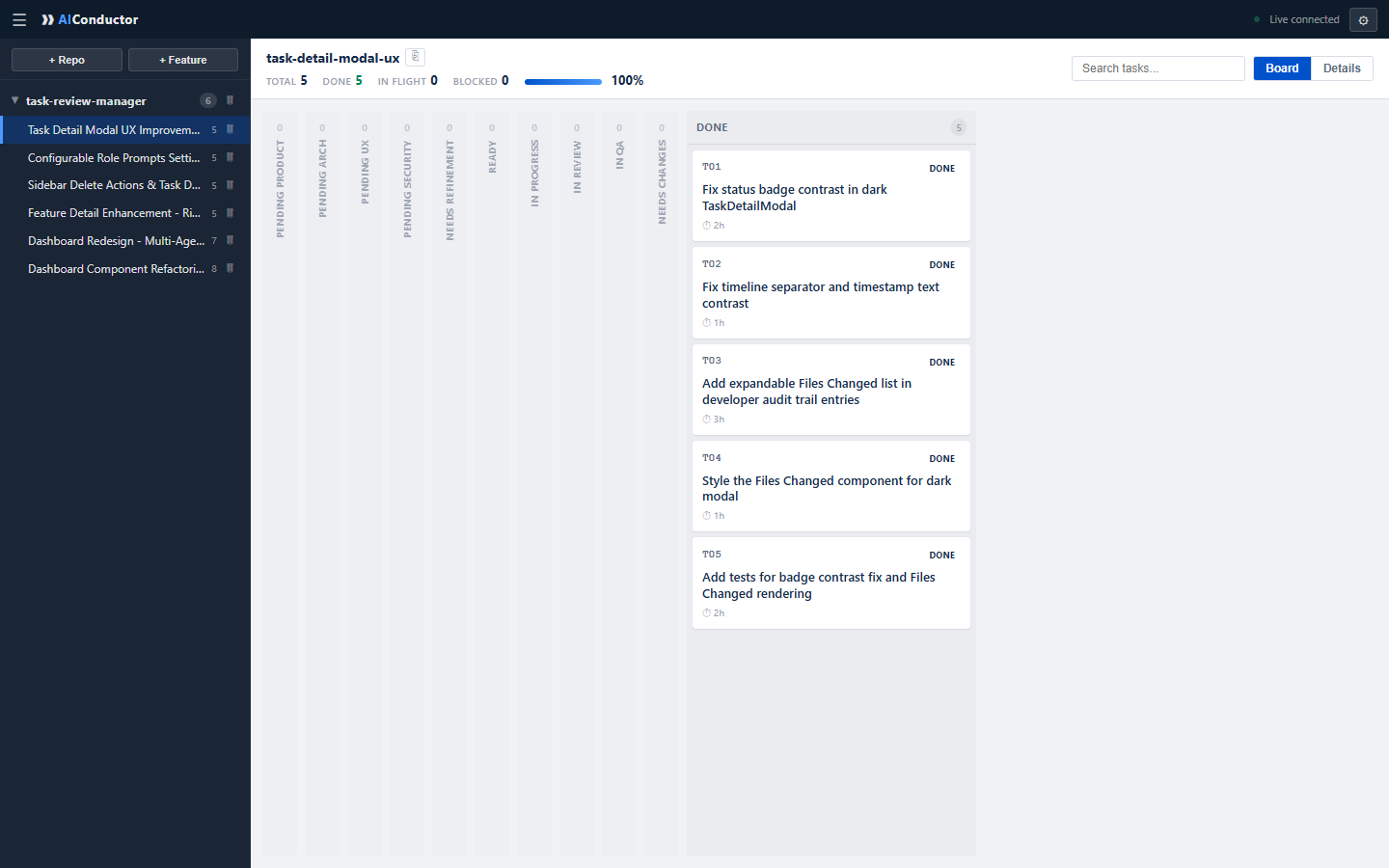
| Real-time Dashboard | Kanban board at localhost:5111 with live WebSocket updates |
| Multi-Repository | Manage tasks across multiple codebases from a single server |
| Refinement Reports | Generate markdown/HTML/JSON reports of the full refinement process |
| Workflow Checkpoints | Save and restore workflow state; rollback the last stakeholder decision |
| Task Execution Planning | Dependency analysis with parallelisation suggestions |
| Zero External Dependencies | Everything persisted in a local SQLite database |
Prerequisites
- Docker and Docker Compose
- An MCP-compatible AI agent (Claude Desktop, VS Code Copilot, Cursor, Cline, etc.)
Quick Start
git clone https://github.com/your-org/aiconductor.git
cd aiconductor
docker compose up -d
The MCP server and dashboard are now running. Connect your AI agent by adding the following to your MCP config:
Claude Desktop — ~/Library/Application Support/Claude/claude_desktop_config.json
{
  "mcpServers": {
    "aiconductor": {
      "command": "docker",
      "args": ["exec", "-i", "-e", "DISABLE_DASHBOARD=true", "aiconductor-mcp", "node", "dist/bundle.js"]
    }
  }
}
VS Code — .vscode/mcp.json or user settings
{
  "mcp.servers": {
    "aiconductor": {
      "command": "docker",
      "args": ["exec", "-i", "-e", "DISABLE_DASHBOARD=true", "aiconductor-mcp", "node", "dist/bundle.js"]
    }
  }
}
Restart your agent. Open the dashboard at http://localhost:5111.
Workflows
Two slash-command workflows are included in .github/prompts/ and can be invoked directly from your agent.
/refine-feature — Feature Refinement
Turns a plain-text feature description into stakeholder-approved, implementation-ready tasks.
Feature Description
  │
  ├─ Scope determination & context gathering
  ├─ Attachment analysis (images, docs, spreadsheets)
  ├─ Clarification questions
  ├─ SMART acceptance criteria generation
  ├─ Test scenario generation
  ├─ Task breakdown (5–8 tasks)
  │
  └─ Batched stakeholder review cycle
       │
       ├─ Product Director  →  Architect  →  UI/UX Expert  →  Security Officer
       │        │                  │               │                  │
       │     reject             reject          reject             reject
       │        └──────────────────┴───────────────┴──────────────────┘
       │                                  ▼
       │                         NeedsRefinement → restart
       │
       └─ All tasks reach ReadyForDevelopment ✓
Tasks are processed in batches per role — a single role adoption covers all tasks in one pass, dramatically reducing context overhead.
/dev-workflow — Development Execution
Drives ReadyForDevelopment tasks through implementation to Done.
ReadyForDevelopment
  └─→ InProgress ─→ InReview ─→ InQA ─→ Done ✓
           │             │          │
           └─────────────┴──────────┘
                    NeedsChanges → back to InProgress
Each stage is handled by a distinct role: Developer (implements & tests), Code Reviewer (approves or requests changes), QA (verifies acceptance criteria).
Dashboard
Open http://localhost:5111 in your browser.
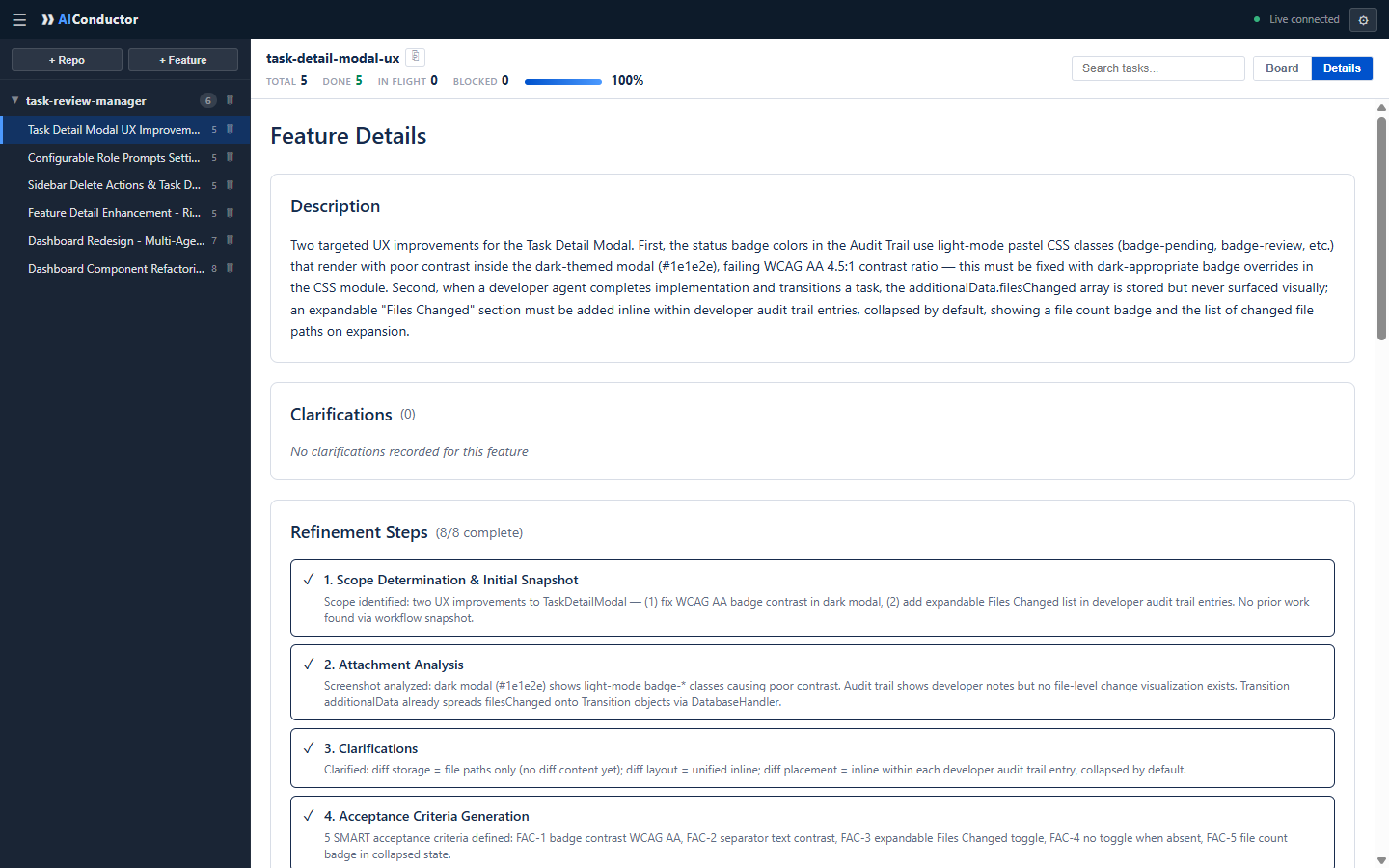
| Kanban Board | Feature Details |
|---|---|
 |
 |
- Kanban board — Task cards arranged by workflow status; empty columns collapse to a slim strip so all columns fit on screen without horizontal scrolling
- Real-time updates — WebSocket connection pushes task state changes instantly to all open browser tabs
- Detail panel — Per-feature acceptance criteria, test scenarios, clarifications, and refinement step progress
- Multi-repo switcher — Switch between registered repositories from the sidebar
- Reviewer presence — See which reviewers are currently active on a feature
MCP Tools Reference
Orchestration
| Tool | Description |
|---|---|
get_next_step |
Returns the next role, system prompt, and required output fields for a task — the primary orchestration driver |
get_workflow_snapshot |
Compressed overview of all task statuses and roles for a feature (~5 KB vs ~50 KB for full fetch) |
get_task_execution_plan |
Dependency analysis with optimal execution order and parallelisable phases |
get_similar_tasks |
Find comparable tasks from past features to aid estimation |
get_workflow_metrics |
Cycle time, throughput, and bottleneck statistics |
Stakeholder Reviews
| Tool | Description |
|---|---|
add_stakeholder_review |
Submit an approve/reject review with role-specific structured fields |
validate_review_completeness |
Pre-flight check that all required fields are present before submitting |
get_task_status |
Current status, completed/pending reviews, and allowed transitions |
get_review_summary |
Completion percentage and stakeholder progress across all tasks |
validate_workflow |
Dry-run validation — check if a transition can proceed |
rollback_last_decision |
Undo the most recent stakeholder decision on a task |
Development Pipeline
| Tool | Description |
|---|---|
transition_task_status |
Move a task through development stages (InProgress → InReview → InQA → Done) |
batch_transition_tasks |
Transition multiple tasks atomically in a single call |
get_next_task |
Get the next task to work on, optionally filtered by status |
get_tasks_by_status |
List all tasks matching a specific status |
verify_all_tasks_complete |
Assert every task in a feature has reached Done |
update_acceptance_criteria |
Mark individual acceptance criteria as verified |
batch_update_acceptance_criteria |
Verify multiple criteria in one call |
Feature & Task Management
| Tool | Description |
|---|---|
create_feature |
Create a new feature with slug, name, and description |
update_feature |
Update feature metadata (name, description) |
get_feature |
Load full feature data including all tasks, criteria, and scenarios |
list_features |
List all features in a repository with task counts |
delete_feature |
Remove a feature and all associated tasks, reviews, and transitions |
add_task |
Add a task to a feature with acceptance criteria and test scenarios |
update_task |
Modify task properties (title, description, criteria, scenarios, dependencies) |
delete_task |
Remove a task and all its data |
Refinement Tracking
| Tool | Description |
|---|---|
update_refinement_step |
Record progress through the 8-step refinement workflow |
get_refinement_status |
Full refinement progress including step completion and criteria |
add_feature_acceptance_criteria |
Add feature-level acceptance criteria (before tasks are created) |
add_feature_test_scenarios |
Add feature-level test scenarios |
add_clarification |
Record a clarification question and answer |
add_attachment_analysis |
Store analysis results for an attached file or design |
generate_refinement_report |
Export the full refinement process as markdown, HTML, or JSON |
Checkpoint Management
| Tool | Description |
|---|---|
save_workflow_checkpoint |
Save current workflow state with a description |
list_workflow_checkpoints |
List all saved checkpoints for a feature |
restore_workflow_checkpoint |
Resume from a previously saved checkpoint |
Repository Management
| Tool | Description |
|---|---|
register_repo |
Register a new repository namespace |
list_repos |
List all registered repositories with task counts |
get_current_repo |
Auto-detect the repository from the current working directory |
Stakeholder Roles
| Role | Focus Areas | Key Output Fields |
|---|---|---|
| Product Director | Market fit, user value, acceptance criteria quality | marketAnalysis, competitorAnalysis, quickSummary |
| Architect | Technical feasibility, design patterns, technology choices | technologyRecommendations, designPatterns |
| UI/UX Expert | Usability, accessibility, user behaviour | usabilityFindings, accessibilityRequirements, userBehaviorInsights |
| Security Officer | Security requirements, compliance, risk assessment | securityRequirements, complianceNotes |
Project Structure
src/
├── index.ts                 # MCP server — tool definitions and request handling
├── AIConductor.ts     # Business logic for all workflow operations
├── WorkflowValidator.ts     # State machine — validates transitions and returns role prompts
├── DatabaseHandler.ts       # SQLite CRUD operations
├── rolePrompts.ts           # System prompts for each stakeholder role
├── websocket.ts             # WebSocket server — real-time event broadcasting
├── dashboard.ts             # Express web server (port 5111)
├── types.ts                 # TypeScript interfaces
└── client/                  # React SPA (Vite)

.github/prompts/
├── refine-feature.prompt.md # Feature refinement workflow
└── dev-workflow.prompt.md   # Development execution workflow
Database:
- Docker:
/data/tasks.db(persistent volumetask-review-data) - Local:
./tasks.dbin project root
Local Development
npm install
npm run dev          # Watch mode — recompiles on change
npm run build        # Production build (server + client)
npm test             # Run all tests with coverage
npm run lint         # TypeScript and code quality lint
npm run dashboard    # Start dashboard standalone (port 5111)
To rebuild the Docker image after code changes:
docker compose up -d --build
CI/CD Pipeline
All pull requests automatically run through our GitHub Actions CI workflow, which includes:
- Build — TypeScript compilation with
npm run build - Lint — Code quality checks with
npm run lint - Test — Jest tests with coverage tracking via
npm test - Coverage — Coverage metrics uploaded to Codecov
See CONTRIBUTING.md for details on running these checks locally, understanding failures, and our branch protection rules.
Configuration
| Variable | Default | Description |
|---|---|---|
DATABASE_PATH |
./tasks.db |
SQLite file location (/data/tasks.db in Docker) |
To reset all data:
docker compose down -v && docker compose up -d
License
MIT
Установка AIConductor
У этого сервера нет опубликованного пакета — он собирается из исходников. Открой репозиторий и следуй инструкции в README.
▸ github.com/MohanTn/AIConductorFAQ
AIConductor MCP бесплатный?
Да, AIConductor MCP бесплатный — установка в пару кликов через Unyly без оплаты.
Нужен ли API-ключ для AIConductor?
Нет, AIConductor работает без API-ключей и переменных окружения.
AIConductor — hosted или self-hosted?
Self-hosted: сервер запускается локально на твоей машине командой из раздела установки.
Как установить AIConductor в Claude Desktop, Claude Code или Cursor?
Открой AIConductor на unyly.org, выбери вкладку своего клиента (Claude Desktop, Claude Code, Cursor) и нажми Install — конфиг сгенерируется автоматически, без правки JSON.
Похожие MCP
Gmail
Read, send and search emails from Claude
 автор: Google
Slack
Send, search and summarize Slack messages
 автор: Slack
Runbear
No-code MCP client for team chat platforms, such as Slack, Microsoft Teams, and Discord.
Discord Server
A community discord server dedicated to MCP by [Frank Fiegel](https://github.com/punkpeye)
Compare AIConductor with
Не уверен что выбрать?
Найди свой стек за 60 секунд
Автор?
Embed-бейдж для README
Похожее
Все в категории communication