
Beatlyzer
БесплатноНе проверенEnables AI agents to analyze audio files, extracting tempo, key, beat drops, volume surges, high tones, loudness, brightness, and structure, and returning struc

Описание
Enables AI agents to analyze audio files, extracting tempo, key, beat drops, volume surges, high tones, loudness, brightness, and structure, and returning structured JSON and visualizations.
README
Audio analysis that machines (and humans) can read.
Point beatlyzer at an .mp3 (or .wav, .flac, .ogg, .m4a, …) and it produces:
- a structured, LLM-friendly JSON description of the track,
- a rich terminal summary,
- an annotated multi-panel visualization (PNG) marking beat drops, volume surges, high tones, brightness, structure and the spectrogram,
- an optional Markdown report.
It's designed so a vision- or text-capable AI model can "understand" a song: what it sounds like, how it's structured, where the energy peaks, and exactly when the interesting moments happen.
Example
beatlyzer demo.wav produces this four-panel analysis:
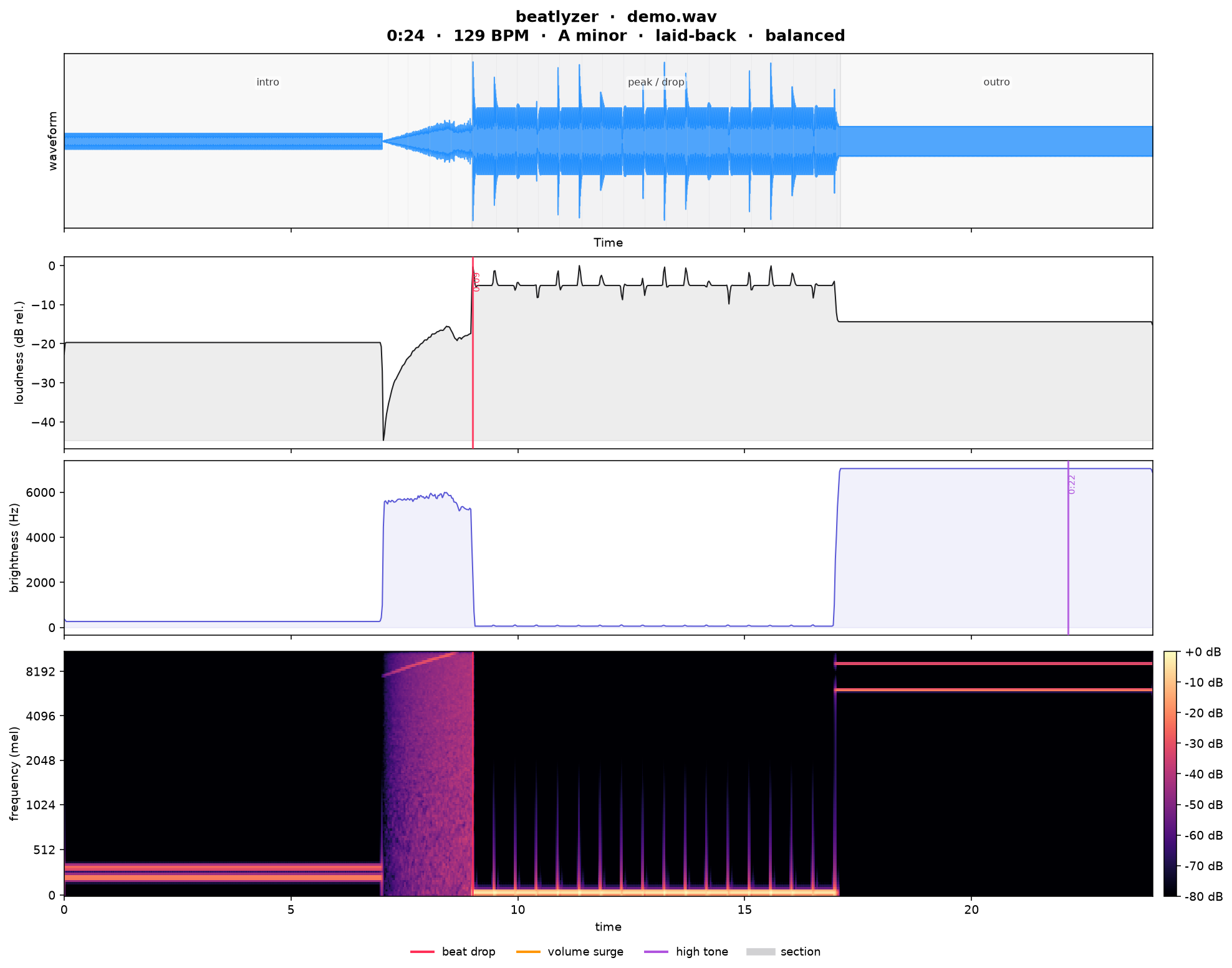
Alongside the PNG it writes a machine-readable
demo.beatlyzer.json and a
demo.beatlyzer.md report — both included here. Regenerate
the demo input yourself with python scripts/make_sample.py demo.wav.
What it detects
| Signal | How | Output |
|---|---|---|
| Tempo & beats | librosa beat tracking | BPM + beat grid |
| Key | Krumhansl-Schmuckler chroma correlation | e.g. F minor |
| Beat drops | sharp rises into loud, bass-heavy passages, snapped to beats | timeline events |
| Volume surges | crescendos / hits (loudness jumps that aren't drops) | timeline events |
| High tones | spectral-centroid + treble-energy peaks | timeline events |
| Loudness & dynamics | RMS in dB relative to peak | avg / peak / dynamic range |
| Brightness | spectral centroid | dark ↔ airy |
| Structure | agglomerative clustering of timbre+harmony | intro → build → drop → outro |
Install
Requires Python 3.9+ (3.10+ for the MCP server). For mp3/m4a/aac decoding
you need ffmpeg on your PATH (sudo dnf install ffmpeg /
brew install ffmpeg / apt install ffmpeg).
As a global CLI tool — recommended, no venv to manage
The cleanest way to get beatlyzer (and beatlyzer-mcp) available everywhere
is pipx or uv, which each
install the tool into their own isolated environment and put the commands on
your PATH — you never create or activate a virtualenv yourself:
# pipx
pipx install 'git+https://github.com/Profazia/beatlyzer.git'
pipx inject beatlyzer mcp          # add the MCP server extra

# or uv
uv tool install 'beatlyzer[mcp] @ git+https://github.com/Profazia/beatlyzer.git'

# run once without installing anything permanent:
uvx --from 'git+https://github.com/Profazia/beatlyzer.git' beatlyzer song.mp3
Note:
librosa/numbamay lag the newest Python release. If a build fails, pin the interpreter:pipx install --python python3.12 ....
From a clone (development)
pip install -e ".[dev,mcp]" # editable install with test + MCP deps
This installs the beatlyzer and beatlyzer-mcp commands.
Usage
# analyze a file — writes <name>.beatlyzer.{png,json,md} next to it
beatlyzer song.mp3

# choose an output directory and open the image when done
beatlyzer track.wav -o out/ --open

# only the machine-readable JSON, printed to stdout, no files, no chatter
beatlyzer mix.flac --format json --print-json --quiet
Don't have a file handy? Generate a demo track:
python scripts/make_sample.py sample.wav
beatlyzer sample.wav --open
Options
-o, --output-dir DIR     Where to write outputs (default: next to the input)
-f, --format CHOICE      all | png | json | md | none   (default: all)
    --stem NAME          Base name for output files (default: input name)
    --sr INT             Analysis sample rate (default: 22050)
    --dpi INT            PNG resolution (default: 140)
    --open               Open the PNG when finished
    --quiet              Suppress the terminal summary
    --print-json         Print the JSON summary to stdout
-V, --version            Show version
Run as a module too: python -m beatlyzer song.mp3.
The AI-readable JSON
<name>.beatlyzer.json follows the beatlyzer.analysis/v1 schema. Feed it
straight to an LLM — it's self-describing (see the ai_notes field):
{
  "schema": "beatlyzer.analysis/v1",
  "metadata": { "duration_hms": "0:24", "tempo_bpm": 128.0, "estimated_key": "A minor", ... },
  "loudness":  { "average_db": -18.4, "dynamic_range_db": 31.2, "description": "wide dynamics" },
  "brightness":{ "average_centroid_hz": 2680.0, "description": "balanced" },
  "sections":  [ { "label": "intro", "start_hms": "0:00", "energy_level": "low" }, ... ],
  "events": [
    { "time_hms": "0:09", "type": "beat_drop",  "strength_0_1": 1.0, "bass_share": 0.71,
      "description": "Beat drop at 0:09 — energy surges into a loud, bass-heavy section." },
    { "time_hms": "0:17", "type": "high_tone",  "strength_0_1": 0.93, "centroid_hz": 6011.0, ... }
  ],
  "energy_profile": [ { "t": 0.0, "energy": 0.05, "loudness_db": -34.1, "brightness": 0.2 }, ... ],
  "summary_text": "This 0:24 track is a high-energy piece at 128 BPM in A minor. ...",
  "ai_notes": "Times are seconds from the start. 'loudness' is dB relative to the track's peak ..."
}
The visualization
<name>.beatlyzer.png is a four-panel figure sharing one time axis:
- Waveform with shaded structural sections and a faint beat grid.
- Loudness (dB) with beat drops (red) and volume surges (orange).
- Brightness (spectral centroid) with high-tone peaks (purple).
- Mel spectrogram with drop lines overlaid.
Use it as an MCP server
beatlyzer ships an MCP server so AI agents — Claude Code, Claude Desktop, Cursor, etc. — can analyze audio directly. It runs over stdio and exposes three tools:
| Tool | Returns |
|---|---|
analyze_audio(file_path, sample_rate=22050) |
full structured JSON summary |
describe_audio(file_path) |
a short prose description |
visualize_audio(file_path, output_path=None, dpi=140) |
the annotated PNG, as an image the model can see |
Make sure the mcp extra is installed (pipx inject beatlyzer mcp, or
pip install 'beatlyzer[mcp]'), then register the server.
Claude Code:
claude mcp add beatlyzer beatlyzer-mcp
Claude Desktop / any MCP client (claude_desktop_config.json or equivalent):
{
  "mcpServers": {
    "beatlyzer": {
      "command": "beatlyzer-mcp"
    }
  }
}
If beatlyzer-mcp isn't on the client's PATH, use the absolute path (e.g.
~/.local/bin/beatlyzer-mcp, or the one printed by pipx list). A ready-made
snippet lives in examples/mcp-config.json.
Then just ask the model things like "analyze ~/Music/track.mp3 and tell me where the beat drops are" or "visualize this song."
As a library
from beatlyzer import analyze_file
from beatlyzer.report import build_result_dict

result = analyze_file("song.mp3")
print(result.summary_text)
print([e.time for e in result.drops])
doc = build_result_dict(result)   # the JSON-ready dict
How the detection works (short version)
Every detector smooths a feature track, measures how it transitions (mean energy after a moment minus mean before), then keeps prominent, well-separated peaks and snaps them to the nearest beat:
- Drops blend overall RMS with sub-250 Hz bass energy and additionally require the landing passage to be genuinely loud — a build-up that fizzles isn't a drop.
- Surges track loudness jumps and are de-duplicated against drops.
- High tones combine the spectral centroid with the >4 kHz energy share.
These are transparent heuristics, not a trained model — fast, dependency-light,
and explainable. Tune thresholds in src/beatlyzer/events.py.
Development
pip install -e ".[dev]"
pytest
License
MIT — see LICENSE.
Установка Beatlyzer
У этого сервера нет опубликованного пакета — он собирается из исходников. Открой репозиторий и следуй инструкции в README.
▸ github.com/Profazia/beatlyzerFAQ
Beatlyzer MCP бесплатный?
Да, Beatlyzer MCP бесплатный — установка в пару кликов через Unyly без оплаты.
Нужен ли API-ключ для Beatlyzer?
Нет, Beatlyzer работает без API-ключей и переменных окружения.
Beatlyzer — hosted или self-hosted?
Self-hosted: сервер запускается локально на твоей машине командой из раздела установки.
Как установить Beatlyzer в Claude Desktop, Claude Code или Cursor?
Открой Beatlyzer на unyly.org, выбери вкладку своего клиента (Claude Desktop, Claude Code, Cursor) и нажми Install — конфиг сгенерируется автоматически, без правки JSON.
Похожие MCP
Omni Video
An MCP server that transforms LLM-enabled IDEs into professional video editors by pre-processing footage into text proxies, generating motion graphics via HTML/
 автор: buildwithtaza
ARA
Generate images, video and audio from any AI agent — one connector.
 автор: ARA
YouTube
Transcripts, channel stats, search
 автор: YouTube
EverArt
AI image generation using various models.
 автор: modelcontextprotocol
Compare Beatlyzer with
Не уверен что выбрать?
Найди свой стек за 60 секунд
Автор?
Embed-бейдж для README
Похожее
Все в категории media