loading…
/ru
Весь каталог
What
Bicameral
БесплатноНе проверенA provenance-aware decision ledger that maps meeting transcripts and PRDs to code symbols to track implementation and drift. It enables developers to maintain i

Описание
A provenance-aware decision ledger that maps meeting transcripts and PRDs to code symbols to track implementation and drift. It enables developers to maintain institutional memory by linking historical context and architectural decisions directly to the evolving codebase.
README
Bicameral MCP
PyPI version Python License: MIT CI Lint + Types Secret scan CodeQL Security Scan
AI agents ship code fast. They forget what your team agreed — and requirement gaps surfaced mid-implementation are buried under thousands of lines of code.
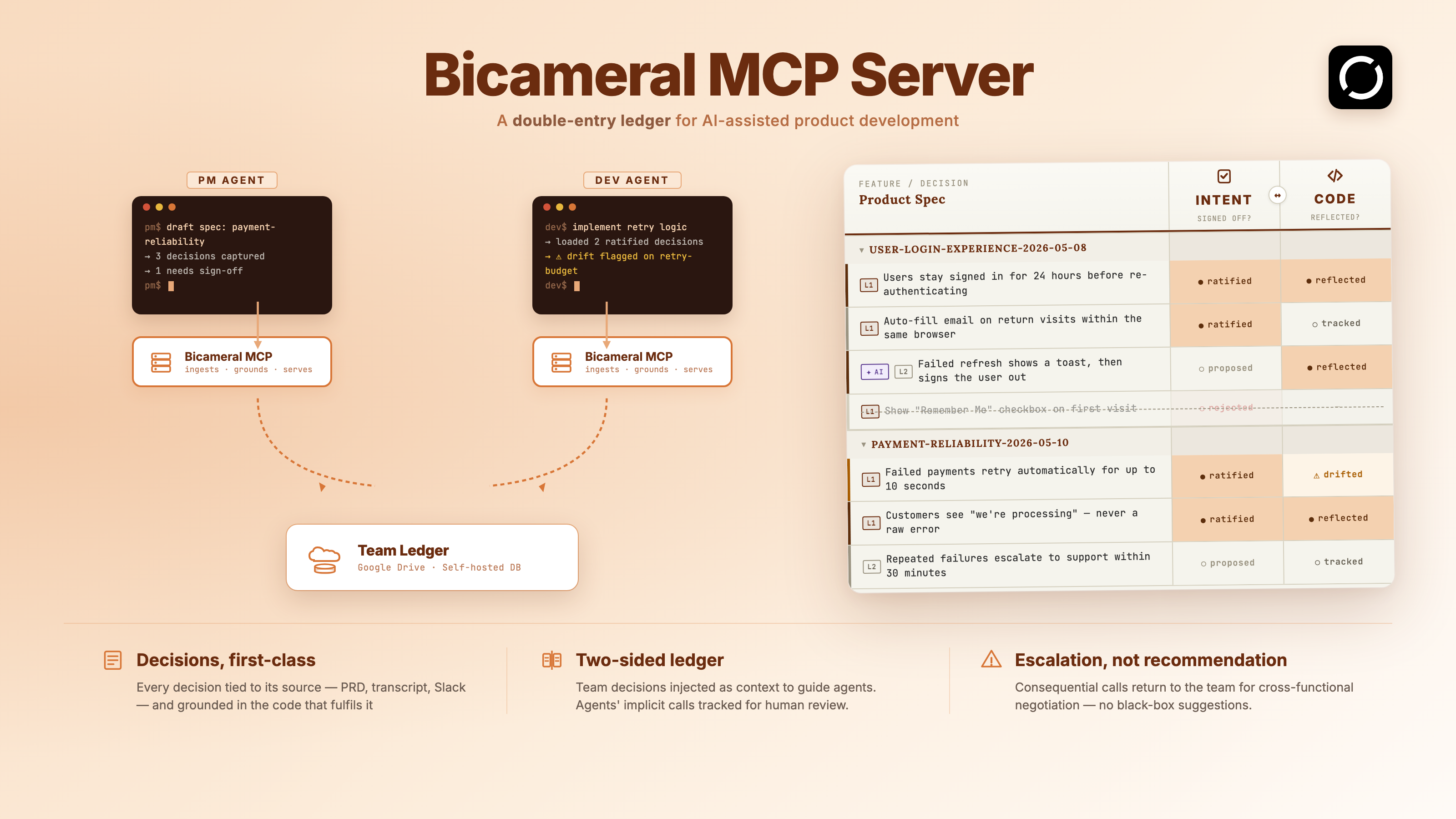
Bicameral MCP is a spec compliance layer for AI-assisted engineering. Local-first; runs as an MCP server. It ingests your meeting transcripts, PRDs, and Slack threads, captures any mid-implementation decision that was not discussed, to be ratified async by your product owner, and pins each one to the code that implements it — so your agent finds out the moment it drifts from either the written spec or the spoken one.
| Maturity | Published on PyPI; local-first MCP server; Solo + Team modes (setup wizard picks at install) |
| Footprint | Embedded SurrealDB in-process — no separate server, no daemon; install via uv or pip |
| Trust boundary | The OS user account. Code, decisions, and transcripts stay on your machine unless you opt into Team mode (which shares an append-only event file via a substrate you own) |
| Assurance | Phase-gated regression suite on real adapters (memory://); sociable handler/ledger tests; lint+types and secret-scan CI gates. Broader security/governance gates tracked in #557 |
Quickstart
# Recommended: uv (single static binary, no Python prerequisite)
curl -LsSf https://astral.sh/uv/install.sh | sh    # one-line install if you don't have uv
uv tool install bicameral-mcp
bicameral-mcp setup
# Alternative: plain pip (installs into your current Python env)
pip install bicameral-mcp
bicameral-mcp setup
# Windows: substitute the uv installer line with PowerShell
powershell -ExecutionPolicy ByPass -c "irm https://astral.sh/uv/install.ps1 | iex"
The setup wizard detects your repo, registers the MCP server with Claude Code, installs a git hook that auto-syncs the ledger after every commit, and adds a session-end hook that catches mid-session decisions you didn't explicitly ingest. Restart Claude Code and you're done.
Verify:
bicameral-mcp --smoke-test
How It Feels
Before implementing a feature, your agent runs bicameral.preflight and surfaces:
(bicameral surfaced — checking Stripe webhook context)

📌 3 prior decisions in scope:
  ✓ Idempotency via Redis SETNX with 24h TTL
    src/middleware/idempotency.ts:checkIdempotencyKey:42-67
    Source: Sprint 14 planning · Ian, 2026-03-12

  ⚠ DRIFTED: Trust Stripe event.created, not server time
    src/handlers/webhook.ts:processEvent:80-92
    Drift evidence: switched to Date.now() in PR #287

~ 1 AI-surfaced question (no human source yet):
  • Should we deduplicate by event.id or (account_id, event.id)?
    Source: Slack #payments 2026-03-20
See it in motion — the loop in three beats:
1. Ingest (PM or dev). A transcript, PRD, or Slack thread comes in; bicameral extracts decisions and writes them to the ledger.
https://github.com/user-attachments/assets/e74ae39f-dd99-485b-8122-8c5211478eb1
2. Preflight (auto). Before the agent edits code, bicameral surfaces prior decisions, drifted regions, and open questions for the file in scope.
https://github.com/user-attachments/assets/8a0fdfb8-fc9a-49fc-9521-e5b5faf8646a
3. Ratify async (product owner). The product owner reviews captured proposals and ratifies or rejects them on their own cadence. Drift tracking activates on ratification.
https://github.com/user-attachments/assets/206e269e-49d6-407d-b338-ab3f2a2c70ec

Solo or Team mode
Bicameral runs in two modes; the setup wizard asks you which one at install time.
| Solo | Team | |
|---|---|---|
| Best for | Individual builders; small projects with one decision-maker | Multiple people writing decisions for the same codebase (PMs, designers, multiple engineers) |
| Where decisions live | Local SurrealDB at .bicameral/ledger.db; not shared |
One append-only <your-email>.jsonl per teammate; replicated via a remote substrate you provision |
| Who can ingest | You | Anyone on the shared substrate (PM ingests a PRD, dev pulls and surfaces it on preflight) |
| What gets shared | Nothing leaves your machine | Decision payloads, canonical IDs, signoffs. No source code |
| How replication works | N/A | Pull-only on tool invocation (~30 s freshness). No daemons, no webhooks, no central server |
| Failure if remote is down | N/A | Falls back to local; resync next call. No blocking |
Team-mode remote substrate
Team mode replicates events through a substrate you provision and own — nothing routes through a Bicameral-operated server, and your decision data never crosses our infrastructure. The wizard supports two backends:
| Backend | Substrate | Setup |
|---|---|---|
| Google Drive (default) | A folder in your team's Google account. Each teammate writes to their own <email>.jsonl; everyone reads the rest. |
3-minute one-time OAuth client setup, then Create-or-Join in the wizard. |
| Local folder (advanced) | A directory mounted on every teammate's machine (NFS, Dropbox, syncthing). | One prompt for the path. |
S3, Dropbox-native, and Box backends are on the roadmap but not yet shipped — we deliberately ship Drive first, validate the model with paying teams, then extend.
The Drive integration is scoped to drive.file — the Bicameral CLI on your
machine can only touch files it creates inside the team folder; the rest of your
Drive (other folders, Google Docs, shared files) is invisible to the CLI.
Decision data flows your-CLI ↔ Google directly; Bicameral the company does
not receive copies of your files. We do see aggregate OAuth telemetry (API
request counts, OAuth consent records — not contents) as the OAuth app
publisher, the same way any OAuth-using tool's vendor does. Token cache lives
at ~/.bicameral/google-drive-token.json, mode 0600. Full security posture
and operator walkthrough: docs/team-mode-setup.md.
Slash Commands
After setup, Claude Code gets these slash commands:
| Command | When to use |
|---|---|
/bicameral-ingest |
Paste a transcript, PRD, or Slack thread to track its decisions |
/bicameral-preflight |
Surface relevant decisions and drift before implementing |
/bicameral-history |
See all tracked decisions grouped by feature area |
/bicameral-dashboard |
Open the live decision dashboard in your browser |
/bicameral-reset |
Wipe and replay the ledger (emergency use) |
The agent also fires these automatically — preflight before any code change, ingest when you paste a document.
What setup writes to your repo
| File | What it is |
|---|---|
.mcp.json |
MCP server config for Claude Code |
.bicameral/config.yaml |
Mode (solo/team), guided-mode flag, and (in team mode) team.backend + team.folder_id/team.remote_root + team.role |
.bicameral/ledger.db |
Local SurrealDB decision ledger (solo mode) |
.bicameral/events/<email>.jsonl |
Append-only event log per teammate (team mode) |
~/.bicameral/google-drive-token.json |
Drive OAuth token cache, mode 0600 (team mode + Drive backend only) |
.gitignore entry |
Ignores .bicameral/ in solo mode |
.claude/settings.json |
PostToolUse hook (auto-sync after commits) + SessionEnd hook (capture mid-session decisions) |
skills/bicameral-*/SKILL.md |
Canonical slash-command definitions (.claude/skills/bicameral-* are symlinks for the Claude Code resolver — never edit directly) |
All data stays local. The embedded SurrealDB runs in-process — no separate server.
MCP Tools Reference
13 tools across two categories
Decision Ledger
| Tool | Purpose |
|---|---|
bicameral.ingest |
Ingest a transcript, PRD, or Slack export into the ledger |
bicameral.preflight |
Pre-flight: surface prior decisions and drift before coding |
bicameral.search |
Search past decisions by topic |
bicameral.brief |
Full brief for a feature area (decisions, drift, divergences, gaps) |
bicameral.history |
Read-only snapshot of all decisions grouped by feature |
bicameral.link_commit |
Sync a commit — update content hashes, re-evaluate drift |
bicameral.drift |
Detect drift for decisions touching a specific file |
bicameral.judge_gaps |
Run the business-requirement gap rubric on a topic |
bicameral.resolve_compliance |
Write back caller-LLM compliance verdicts |
bicameral.ratify |
Record product sign-off on a decision |
bicameral.update |
Check for and apply recommended version updates |
bicameral.reset |
Wipe the ledger for the current repo (dry-run by default) |
bicameral.dashboard |
Start the local dashboard server and return its URL |
Code Locator
| Tool | Purpose |
|---|---|
validate_symbols |
Fuzzy-match symbol name hypotheses against the code index |
get_neighbors |
1-hop structural graph traversal (callers, callees, imports) |
Privacy & Compliance
We take privacy seriously. Bicameral runs entirely on your laptop — code, decisions, and transcripts never leave the machine unless you explicitly opt into team mode (which only shares an append-only event file via your existing git remote). Telemetry is anonymous integers + tool names only — opt out with BICAMERAL_TELEMETRY=0. The full posture (host-trust model, acceptable use, install-trust model, audit log, diagnose output, ledger export, availability stance) is in docs/policies/; reporting + supply-chain attestation in SECURITY.md.
License
MIT
Repository boundary
bicameral-mcp is the agent-facing tool surface. It exposes local Bicameral actions to coding agents: ingest, preflight, bind, review-command emission, and local run loops.
It is not the source-specific integration repo, the local bot runtime, or the hosted code graph. See docs/adr/0001-mcp-repository-boundary.md.
Как установить
Выполни в терминале:
claude mcp add bicameral-mcp -- npx 
