
Calllens
БесплатноНе проверенEnables LLM clients to answer identity-aware questions about customer calls using a multi-tenant B2B call analytics platform with role-based access.

Описание
Enables LLM clients to answer identity-aware questions about customer calls using a multi-tenant B2B call analytics platform with role-based access.
README
Production-grade AI engineer portfolio project.
Multi-tenant B2B call analytics platform that exposes cross-call intelligence via an MCP server — so any LLM client (Claude Desktop, Codex, Copilot) can answer identity-aware questions about your customer calls.
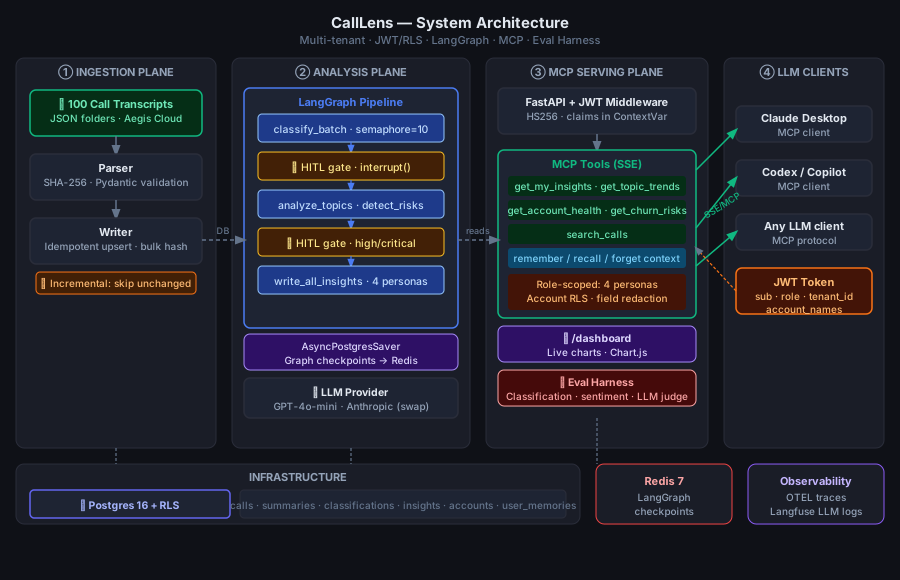
What it does
100 real B2B SaaS call transcripts → LangGraph analysis pipeline → Postgres (with RLS) → MCP server → role-aware answers in any LLM.
Ask Claude Desktop "Which accounts are at churn risk this quarter?" as a sales manager and get a different answer than a support lead asking the same question — same data, different framing, different authorization.
Key engineering features
| Feature | Implementation |
|---|---|
| Multi-tenancy | Postgres Row-Level Security; SET app.tenant_id per connection |
| Identity-aware MCP | JWT claims (role + account_names) thread through ContextVar into every tool |
| LangGraph pipeline | 6-node graph with 2 HITL interrupt gates; AsyncPostgresSaver checkpointing |
| Idempotent ingestion | SHA-256 content hash per call folder; single bulk hash query; skip-on-match |
| Persistent memory | remember_context / recall_context / forget_context tools per JWT sub |
| Eval harness | Rule-based oracle + LLM-as-judge; regression guard with baseline JSON |
| Observability | OTEL tracing (FastAPI + pipeline nodes); Langfuse LLM call logging; structlog JSON |
| Live dashboard | /dashboard — Chart.js charts pulling real-time data from Postgres |
Architecture
┌─────────────────┐   ┌──────────────────────┐   ┌─────────────────────┐
│  ① INGESTION    │   │   ② ANALYSIS PLANE   │   │  ③ MCP SERVING      │
│                 │   │                      │   │                     │
│  100 transcripts│──▶│  LangGraph pipeline  │──▶│  FastAPI + JWT      │
│  Parser (SHA256)│   │  ├─ classify_batch   │   │  MCP Tools (SSE)    │
│  Idempotent     │   │  ├─ 🛑 HITL gate     │   │  Role-scoped tools  │
│  upsert         │   │  ├─ analyze_topics   │   │  Postgres RLS       │
│                 │   │  ├─ detect_risks     │   │  /dashboard         │
│                 │   │  ├─ 🛑 HITL gate     │   │                     │
└─────────────────┘   │  └─ write_insights   │   └──────────┬──────────┘
                      └──────────────────────┘              │ SSE/MCP
                                                            ▼
                                               Claude Desktop · Codex · Copilot
MCP tools
| Tool | Roles | What it returns |
|---|---|---|
get_my_insights |
all | Persona-specific insights (support, sales, product, eng) |
get_topic_trends |
all | Top topics ranked by frequency + avg sentiment |
get_account_health |
all except eng_lead | Account stats; financials redacted unless sales_manager |
get_churn_risks |
sales_manager only | High-risk accounts from the AI analysis |
search_calls |
all | Keyword search across summaries; call types filtered by role |
remember_context |
all | Save a memory keyed to your JWT sub |
recall_context |
all | Retrieve your last N memories across sessions |
forget_context |
all | Delete a specific memory (own only) |
Role permission matrix
                     get_my  topic  account  churn  search  memory
support_lead           ✓      ✓       ✓        ✗      ✓       ✓
sales_manager          ✓      ✓       ✓        ✓      ✓       ✓
product_manager        ✓      ✓       ✓        ✗      ✓       ✓
eng_lead               ✓      ✓       ✗        ✗      ✓       ✓
get_account_health additionally redacts contract_value, renewal_date, arr, csm_owner for non-sales roles.
Observability dashboard
Live at http://localhost:8001/dashboard when the MCP container is running.
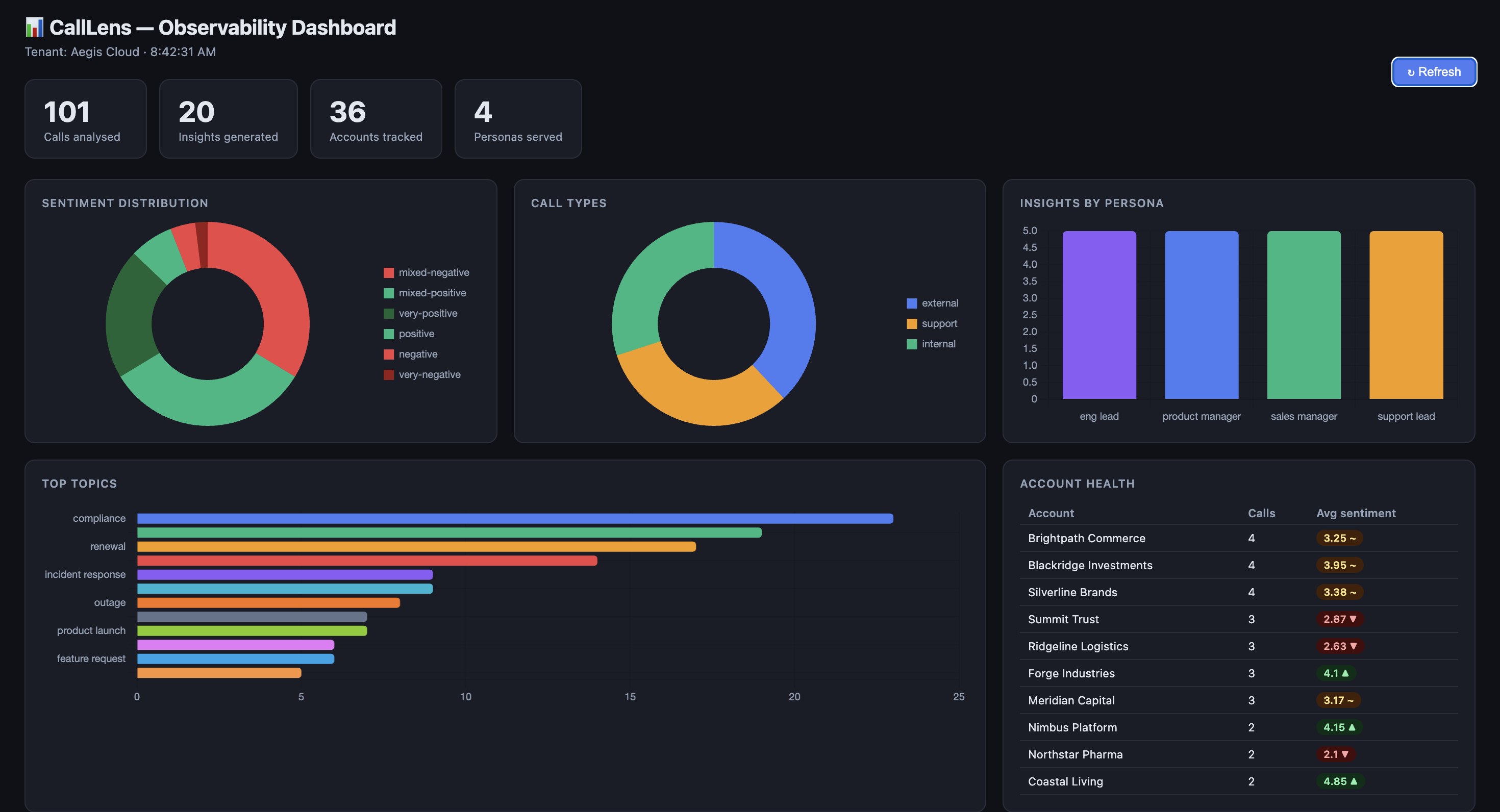
Metrics endpoint: GET /api/metrics — JSON, no auth required.
Charts included:
- Sentiment distribution (donut) — 6-level taxonomy: very-negative → very-positive
- Call type breakdown (donut) — external / support / internal
- Top topics (horizontal bar) — ranked by call frequency
- Insights by persona (bar) — 4 personas
- Account health table — avg sentiment score per account with risk badges
Eval harness
make eval           # accuracy + coverage gate — free, DB queries only
make eval-judge     # LLM-as-judge quality gate — uses API credits
make eval-reset     # clear baseline for a fresh run
Current baseline metrics (Aegis Cloud dataset, 100 calls):
| Metric | Score | Threshold |
|---|---|---|
| Classification accuracy | 100% | ≥ 75% |
| Sentiment direction accuracy | 64% | ≥ 60% |
| Insight type coverage | 100% | 100% |
The baseline is saved to tests/evals/baseline_metrics.json on first run. Subsequent runs fail if any metric regresses more than 5%.
Quick start
Prerequisites
- Docker + Docker Compose
OPENAI_API_KEY(or Anthropic key)
1 — Configure
cp .env.example .env
# Edit .env: set OPENAI_API_KEY
2 — Start infrastructure
docker compose up -d postgres redis
3 — Ingest transcripts
docker compose run --rm --entrypoint calllens-ingest app
# Output: New: 100 / Updated: 0 / Skipped: 0 / Errors: 0
4 — Run the analysis pipeline
make pipeline-run
# Runs all 6 LangGraph nodes; pauses at HITL gates if any uncertain calls
5 — Start the MCP server
make mcp-up
# Server at http://localhost:8001
# Dashboard at http://localhost:8001/dashboard
6 — Generate test tokens
make mcp-token
# Prints JWT tokens for all 4 personas
7 — Connect Claude Desktop
Add to claude_desktop_config.json:
{
  "mcpServers": {
    "calllens": {
      "url": "http://localhost:8001/mcp/sse",
      "headers": {
        "Authorization": "Bearer <your_sales_manager_token>"
      }
    }
  }
}
Then ask: "Which accounts are at churn risk? What actions should I take this week?"
Project structure
calllens/
├── src/calllens/
│   ├── ingestion/        # Parser, writer, idempotent CLI
│   ├── agents/           # LangGraph graph, nodes, prompts, state
│   ├── mcp/              # FastMCP server, JWT auth, tools, dashboard
│   ├── eval/             # Metrics oracle, LLM-as-judge
│   ├── observability/    # OTEL setup, structlog
│   └── llm/              # Provider factory with Langfuse callback
├── tests/
│   ├── unit/             # Parser tests
│   ├── integration/      # DB ingestion tests
│   └── evals/            # Accuracy gate, LLM judge, regression guard
├── migrations/           # Postgres schema with RLS policies
├── docs/
│   └── architecture.svg
└── docker-compose.yml
Makefile reference
make up               # Start Postgres + Redis
make ingest           # Run ingestion CLI
make pipeline-run     # Run the full LangGraph pipeline
make pipeline-review  # Review a specific batch BATCH_ID=...
make mcp-up           # Start MCP server on :8001
make mcp-token        # Generate JWT tokens for all personas
make eval             # Run the accuracy eval suite
make eval-judge       # Run LLM-as-judge quality eval
make smoke            # Quick DB sanity check
make psql             # Open Postgres shell
Environment variables
| Variable | Required | Description |
|---|---|---|
OPENAI_API_KEY |
Yes | LLM provider key |
JWT_SECRET |
Yes (prod) | HS256 signing secret |
LANGFUSE_PUBLIC_KEY |
No | LLM observability (cloud.langfuse.com) |
LANGFUSE_SECRET_KEY |
No | LLM observability |
OTEL_EXPORTER_OTLP_ENDPOINT |
No | OTLP endpoint (e.g. Jaeger) |
LLM_PROVIDER |
No | openai (default) or anthropic |
LLM_MODEL |
No | gpt-4o-mini (default) |
Design decisions
Why Postgres + RLS instead of a vector DB?
The 100-call dataset fits entirely in Postgres. Adding a vector DB adds ops cost without meaningful recall improvement at this scale. Semantic search can be layered on with pgvector when needed.
Why LangGraph instead of a simple loop?
HITL (human-in-the-loop) interrupt gates are the hard part. LangGraph's interrupt() + AsyncPostgresSaver gives durable, resumable checkpoints — the pipeline can pause, wait for human corrections, and resume without re-running completed nodes.
Why MCP instead of a REST API?
MCP makes the analytics available to any LLM client without building a custom chat UI. The role-scoped tools and RLS-enforced DB queries mean the LLM gets only what the authenticated user is allowed to see.
Why JWT ContextVar instead of passing claims as arguments?
MCP tools have fixed signatures defined by the server. Threading claims through function arguments would pollute every tool signature. ContextVar gives clean per-request scoping in async code without changing the tool interface.
Установить Calllens в Claude Desktop, Claude Code, Cursor
unyly install calllens-mcpСтавит в Claude Desktop, Claude Code, Cursor и VS Code — сам разбирается с npx, uvx и сборкой из исходников.
Впервые? Поставь CLI: curl -fsSL https://unyly.org/install | sh
Или настроить вручную
Выполни в терминале:
claude mcp add calllens-mcp -- uvx --from git+https://github.com/DesharajuDeepthi/calllens-v1 calllensFAQ
Calllens MCP бесплатный?
Да, Calllens MCP бесплатный — установка в пару кликов через Unyly без оплаты.
Нужен ли API-ключ для Calllens?
Нет, Calllens работает без API-ключей и переменных окружения.
Calllens — hosted или self-hosted?
Self-hosted: сервер запускается локально на твоей машине командой из раздела установки.
Как установить Calllens в Claude Desktop, Claude Code или Cursor?
Открой Calllens на unyly.org, выбери вкладку своего клиента (Claude Desktop, Claude Code, Cursor) и нажми Install — конфиг сгенерируется автоматически, без правки JSON.
Похожие MCP
Fetch
Web content fetching and conversion for efficient LLM usage.
AWS KB Retrieval
Retrieval from AWS Knowledge Base using Bedrock Agent Runtime.
 автор: modelcontextprotocol
Spring AI MCP Server
Provides auto-configuration for setting up an MCP server in Spring Boot applications.
llm-analysis-assistant
A very streamlined mcp client that supports calling and monitoring stdio/sse/streamableHttp, and can also view request responses through the /logs page. It also
 автор: xuzexin-hz
Compare Calllens with
Не уверен что выбрать?
Найди свой стек за 60 секунд
Автор?
Embed-бейдж для README
Похожее
Все в категории ai