
Claude Code Telegram Kit
БесплатноНе проверенEnables sending properly rendered Markdown messages to Telegram and remotely resetting Claude Code's context, addressing gaps in Anthropic's official Telegram c

Описание
Enables sending properly rendered Markdown messages to Telegram and remotely resetting Claude Code's context, addressing gaps in Anthropic's official Telegram channel.
README
Your context is full. You're on the subway. The Claude Code session is still running on your VPS.
To clear it, you go home and open a laptop.
This kit removes that trip. Anthropic's official Telegram Channel keeps inbound, untouched. The kit takes the outbound and control half.
Research-preview infrastructure. Review the security model before connecting it to a machine with valuable data.
What it does
- Deterministic Telegram controls expose
/usage,/sessions,/model,/rename,/reset, and/resume N. Privileged lifecycle changes act on the systemd-managed Claude Code process while official pairing, attachments, and permission relay stay intact. - Final delivery distinguishes confirmed, rejected, and unknown outcomes. An unknown outcome is never retried.
- CommonMark/GFM canonicalization is deterministic; transport routing is explicit and capability-gated across Rich Message, MarkdownV2, and plain text.
- No fork of the official plugin, and no second
getUpdatesconsumer.
The difficult boundary is retaining official Channel ownership while controlling a process the sidecar did not start. Read-only status, listing, and title operations stay unprivileged; reset, resume, and model mutations cross a peer-UID-checked socket into a root broker that derives fixed helper and systemd arguments.
Architecture
Telegram
  -> telegram@claude-plugins-official     # sole inbound poller
  -> Claude Code
     -> lifecycle hooks
        -> telegram-renderer MCP            # bind/progress/final/artifacts
     -> UserPromptSubmit hook
        -> session-control MCP              # user-space status/list/title
           -> root socket broker            # capabilities/reset/resume/model only
              -> fixed systemd/helper argv  # PID 1 owns reset execution
The renderer and control MCPs reuse the official Channel's token and access.json authority. They require dmPolicy: allowlist, secure 0600 state files, and exact destination membership.
Progress disclosure
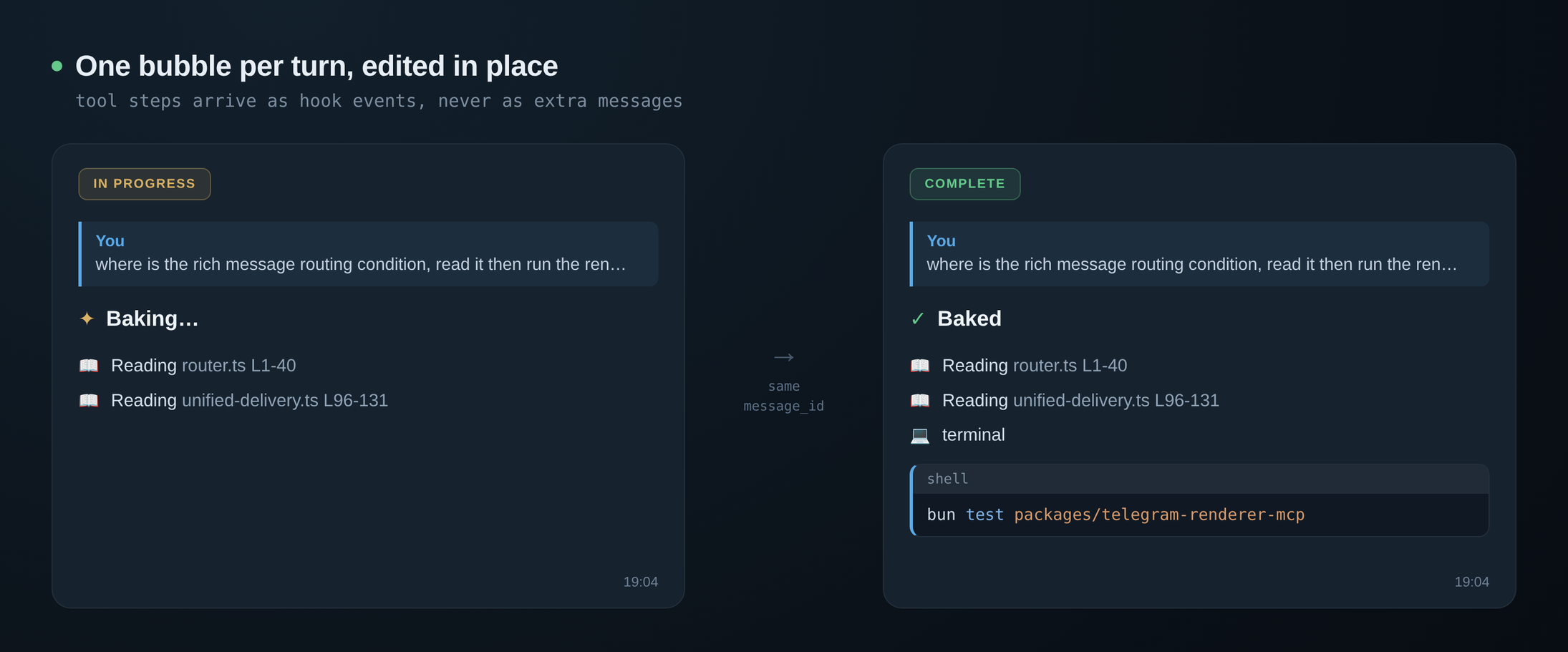
Tool names map to a fixed allowlist of human labels, so a vendor-controlled tool name never reaches Telegram. Spinner and completion verbs are drawn as a pair from the turn key, so a turn that starts Baking… ends Baked. Command previews remove only a simple leading cd <dir> && wrapper and elide from the middle, keeping the operation head and target tail.
Disclosure is configurable as safe, all, or verbose. Every accepted preview field is bounded; credential-shaped values are replaced with fixed markers before truncation or delivery.
Rendering
| Official Channel | With this kit |
|---|---|
 |
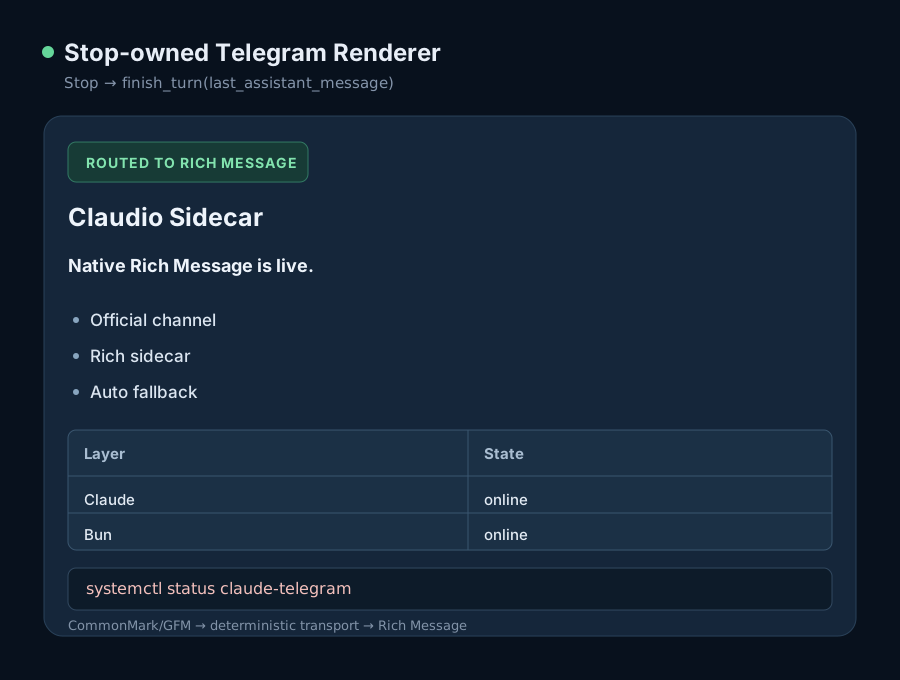 |
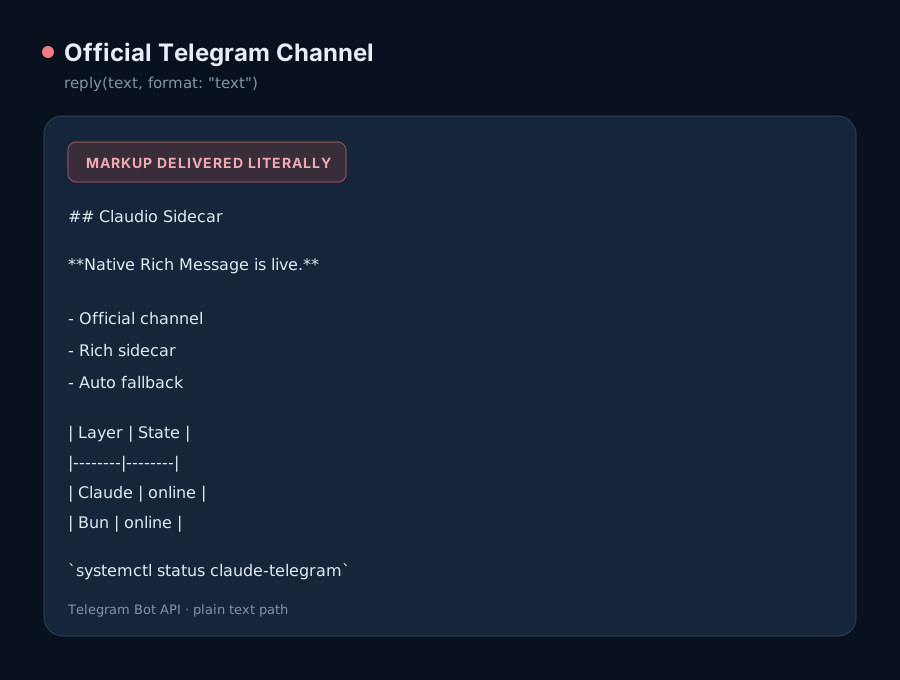
The same Markdown document, both paths. The official reply tool defaults to format: "text", so markup arrives literal; its markdownv2 mode requires the caller to produce Telegram-specific escaping. Here Claude returns ordinary CommonMark/GFM and the Stop hook passes last_assistant_message to the internal renderer, which picks the transport deterministically. (Figures are deterministic renderings, not device screenshots.)
What it deliberately doesn't do
- No progress bubble for control commands.
/resetkills the process beforeStopcan close the bubble, and a bubble that can never close is worse than none. - No retry on an unknown delivery outcome.
- No arbitrary Bot API method tool, and no arbitrary shell command tool.
- Normal hook receipts are empty. The sole exception is a proven oversized final, which blocks Stop once with a fixed bounded request for a shorter replacement.
- The model never receives a confirmation code, session UUID, transcript path, helper path, service, or unit name.
Requirements
- Linux with systemd and procfs mounted at
/proc - Claude Code 2.1.235 or newer
- Bun 1.3.14 or newer
- Python 3.11 or newer
- Anthropic's official telegram@claude-plugins-official Channel plugin, already paired and working
Quickstart
This kit attaches to a Channel that already works. It never installs, replaces, or reconfigures one.
Set up Anthropic's official telegram@claude-plugins-official Channel first by following the Channels guide, and confirm you can message Claude Code from Telegram and get a reply. Only then install anything here.
git clone https://github.com/project-tharsis/claude-code-telegram-kit
cd claude-code-telegram-kit
git checkout --detach v0.3.0
bun install --frozen-lockfile
bun run check

sha=$(git rev-parse HEAD)
python3 scripts/deploy_local.py install --repo . --ref "$sha" --bun "$(command -v bun)"
Then copy examples/.mcp.json, examples/telegram-settings.json, and examples/CLAUDE.md into your Claude project, replacing USER and, if you choose a different workspace, updating the exact workspace/session-directory pair consistently in the service and both MCP environments. Merge examples/access-ux.json into the official Channel's access.json to enable the initial 👀 acknowledgement. Send a message that uses tools, then a GFM table: Telegram should show one silent progress bubble, the final table should use Rich Message, and the inbound reaction should become 👍 without a model-facing reply tool call.
examples/CLAUDE.md guides model behavior; it is not an authorization boundary. The permission deny list, exact hook schemas, Channel envelope parsing, and destination allowlist remain the enforcement layer.
The renderer package remains self-contained, but automatic final delivery requires the supplied Hook configuration. /model, /reset, and /resume N additionally need the root helper, installed separately from the same exact commit by the procedure in the session-control README.
For production deployment, rollback, and verification, follow the operations runbook rather than this section.
Design invariants
These five define the blast radius:
- One Telegram
getUpdatesconsumer per bot token. - No arbitrary Bot API method tool.
- No arbitrary shell command tool.
- Timeouts, 429s, 5xx responses, and unknown outcomes never trigger a resend.
- PID 1 owns reset execution before the Claude process is terminated.
The complete set is in docs/design-invariants.md.
Repository layout
packages/
  shared/                  Telegram authority validation
  telegram-renderer-mcp/   Markdown renderer and MCP server
  session-control-mcp/     Reset controller, MCP server, root helper
examples/                  Generic Claude, MCP, systemd, and reset config
scripts/                   Versioned local install and rollback
Why Telegram only
Telegram is the only target in this release because edit-in-place progress, inbound reaction lifecycle, and a plain HTTP Rich delivery surface are load-bearing parts of the contract, not interchangeable conveniences. This is a deliberate scope choice, not a claim that every other platform is incapable of the design.
Those properties are:
editMessageTexton bot-authored messages. The single in-place progress bubble exists because of this. Without it, tool disclosure is either silence or a wall of new messages.setMessageReactionon the user's own inbound message, which is how a turn acknowledges itself (👀to👍) without sending anything at all.- A plain HTTP Bot API, including native Rich Messages, with no second gateway connection for the outbound sidecars. The official Channel still owns pairing and inbound updates.
iMessage has no general bot API; Discord and Slack expose different message and lifecycle primitives. The sidecar boundary is narrow enough to port, but a second target must implement the same edit, reaction, authority, and unknown-outcome contracts rather than weaken them behind a lowest-common-denominator abstraction.
Installation model
Do not run production from a mutable development checkout. Install an exact commit into a versioned release directory:
~/.local/share/claude-code-telegram-kit/
  releases/<git-sha>/
  current -> releases/<git-sha>
  previous -> releases/<previous-sha>
scripts/deploy_local.py extracts a Git archive with a Python 3.11-compatible no-link/no-traversal extractor, installs production dependencies, verifies the release receipt, and atomically swaps current/previous. It never installs root-owned files.
python3 scripts/deploy_local.py status
python3 scripts/deploy_local.py rollback
Keep Telegram credentials and allowlists under Claude's state directory, and keep reset configuration root-owned under /etc/claude-code-telegram-kit/.
Session reset
The local recovery authority is:
sudo claude-code-session-reset \
  --config /etc/claude-code-telegram-kit/reset.json \
  --action reset \
  --current-session-id <exact-current-session-uuid>
The optional Telegram control router runs as a deterministic UserPromptSubmit hook before the LLM. /usage, /sessions, and /model status execute immediately. /model <alias> and the four exact model labels switch immediately because the operation is allowlisted, private-chat only, reversible, and verified after restart; 5 · Cancel only removes the keyboard. /reset and /resume N require a second exact, single-use confirmation command within 60 seconds. It cannot recover a Claude process that is already unable to receive messages; keep the local helper available as the break-glass path.
Development
bun install --frozen-lockfile
bun run check
bun audit
Security
Read SECURITY.md before deployment. Never commit bot tokens, chat IDs, transcripts, service-specific paths, or live reset configuration.
Upstream
The two original gaps that motivated this kit remain open upstream:
- anthropics/claude-code#39684 — no way to clear or reset context remotely
- anthropics/claude-code#36622 and claude-plugins-official#774 — requesting a MarkdownV2
parse_mode
Project status
The code is extracted from a live, verified deployment, then generalized into a clean-room public repository. APIs may change before 1.0.0.
This release is source-only. Workspace packages are marked private and are not published to npm; install from an exact Git commit with the versioned deploy script.
License
Apache-2.0. See LICENSE, NOTICE, and THIRD_PARTY_NOTICES.md. Release procedure: RELEASING.md.
This project is independent and is not endorsed by Anthropic or Telegram.
Установка Claude Code Telegram Kit
У этого сервера нет опубликованного пакета — он собирается из исходников. Открой репозиторий и следуй инструкции в README.
▸ github.com/project-tharsis/claude-code-telegram-kitFAQ
Claude Code Telegram Kit MCP бесплатный?
Да, Claude Code Telegram Kit MCP бесплатный — установка в пару кликов через Unyly без оплаты.
Нужен ли API-ключ для Claude Code Telegram Kit?
Нет, Claude Code Telegram Kit работает без API-ключей и переменных окружения.
Claude Code Telegram Kit — hosted или self-hosted?
Self-hosted: сервер запускается локально на твоей машине командой из раздела установки.
Как установить Claude Code Telegram Kit в Claude Desktop, Claude Code или Cursor?
Открой Claude Code Telegram Kit на unyly.org, выбери вкладку своего клиента (Claude Desktop, Claude Code, Cursor) и нажми Install — конфиг сгенерируется автоматически, без правки JSON.
Похожие MCP
Gmail
Read, send and search emails from Claude
 автор: Google
Slack
Send, search and summarize Slack messages
 автор: Slack
Runbear
No-code MCP client for team chat platforms, such as Slack, Microsoft Teams, and Discord.
Discord Server
A community discord server dedicated to MCP by [Frank Fiegel](https://github.com/punkpeye)
Klavis AI
Open Source MCP Infra. Hosted MCP servers and MCP clients on Slack and Discord.
Work90210/APIFold
Turn any REST API into a hosted MCP server. 18 free public servers (GitHub, Stripe, Slack, OpenAI, Notion, and more) — no setup required, bring your own API key
 автор: Work90210
arikusi/deepseek-mcp-server
MCP server for DeepSeek AI with chat, reasoning, multi-turn sessions, function calling, thinking mode, and cost tracking.
 автор: arikusi
hashgraph-online/hashnet-mcp-js
MCP server for the Registry Broker. Discover, register, and chat with AI agents on the Hashgraph network.
 автор: hashgraph-online
profullstack/mcp-server
A comprehensive MCP server aggregating 20+ tools including SEO optimization, document conversion, domain lookup, email validation, QR generation, weather data,
 автор: profullstack
WayStation-ai/mcp
Seamlessly and securely connect Claude Desktop and other MCP hosts to your favorite apps (Notion, Slack, Monday, Airtable, etc.). Takes less than 90 secs.
 автор: waystation-ai
Compare Claude Code Telegram Kit with
Не уверен что выбрать?
Найди свой стек за 60 секунд
Автор?
Embed-бейдж для README
Похожее
Все в категории communication