
Concurrent Playwright
БесплатноНе проверенAn MCP server that runs concurrent, session-isolated Playwright browser contexts, so many agents can each drive their own browser at the same time without colli

Описание
An MCP server that runs concurrent, session-isolated Playwright browser contexts, so many agents can each drive their own browser at the same time without colliding.
README
An MCP server that runs concurrent, session-isolated Playwright browser contexts, so many agents can each drive their own browser at the same time without colliding.
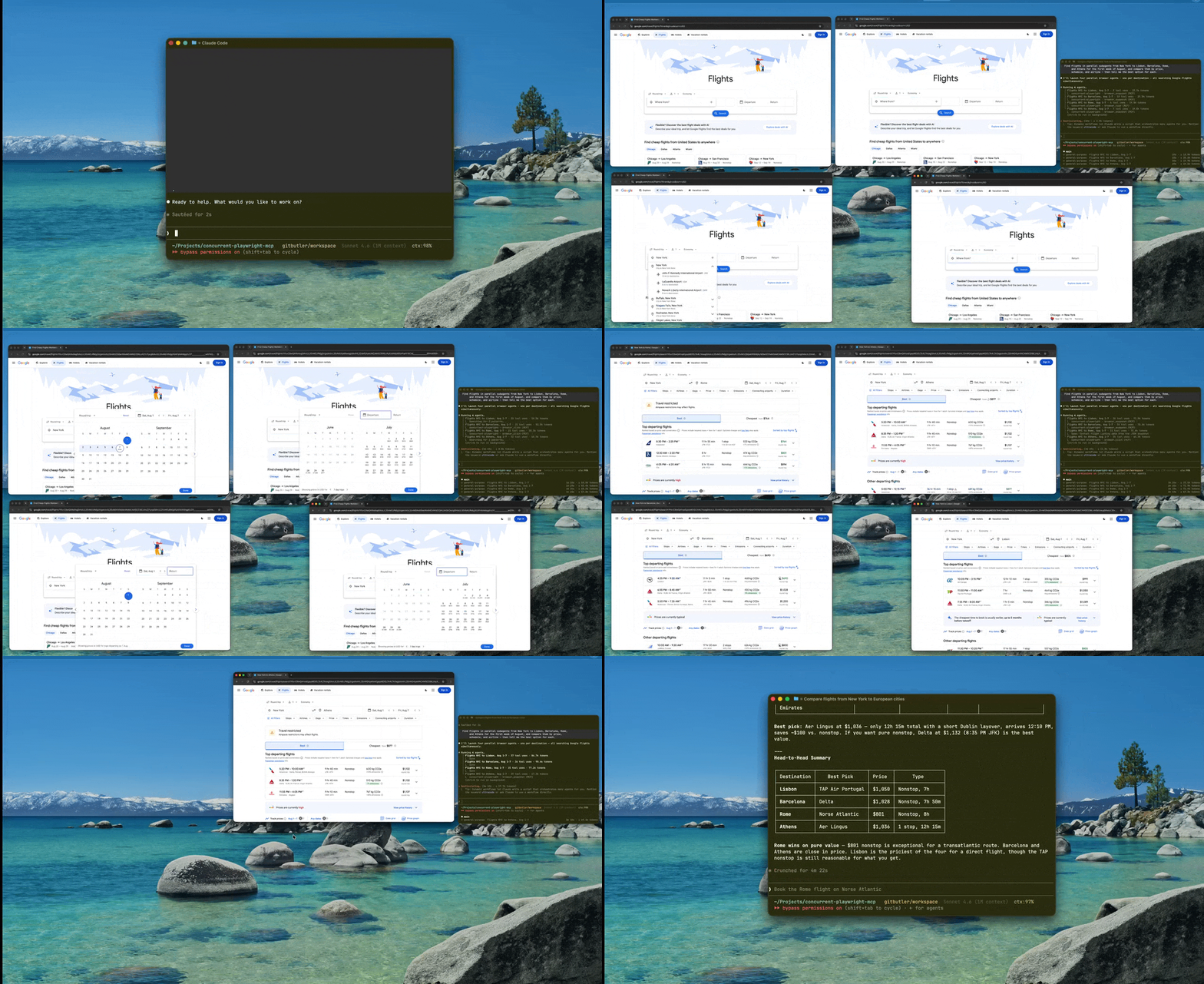
Multiple agents, each driving its own isolated browser session — in parallel.
The problem this solves
The official Playwright MCP server (@playwright/mcp) drives a single shared browser context by default, so concurrent clients share one cookie jar, storage, and set of tabs. That is fine for one agent doing one thing, but it breaks the moment you want parallel work:
- Two sub-agents navigating at once stomp on each other's page, cookies, and storage.
- A "log in as user A" flow and a "log in as user B" flow share one cookie jar, so the second login clobbers the first.
- There is no clean way to give each task its own sandbox and tear it down independently.
This server fixes that. Every session gets its own BrowserContext (an incognito-like profile: isolated cookies, localStorage, cache, and tabs) keyed by a sessionId you choose. Sessions share one browser process for efficiency but never share state. The headline guarantee is verified by a real-browser test and a benchmark that asserts zero cross-session collisions.
@playwright/mcp (default) |
concurrent-playwright-mcp | |
|---|---|---|
| Parallel sessions | Shared context | Isolated context per sessionId |
| Cookies / storage | Shared | Isolated per session |
| Independent teardown | No | browser_close_session per session |
| Resource bounds | n/a | Session cap + optional idle eviction |
Why not @playwright/mcp --isolated?
The official server can isolate too — its --isolated flag gives each connection its own context. The difference is the model:
- Addressable sessions. Here isolation is keyed by a
sessionIdyou choose and pass to every call, so a single client can open and drive many isolated sessions and route each call deliberately. With--isolated, a "session" is just the transport connection — you can't address N parallel contexts from one client. - Persistable, not ephemeral.
--isolateddiscards all state when the browser closes. Here you canbrowser_save_storage_stateand restore it (storageStatePathon create) to resume an authenticated profile across sessions. (An upstream request for named/persistent sessions was closed as out of scope.) - One lightweight context per session — not a process or container per session — so many sessions share one Chromium.
Use @playwright/mcp for a single browser; use this when many agents or tasks each need their own isolated, addressable session at the same time — especially over HTTP.
Architecture
cli.ts                  entrypoint: load config → pick transport
  ├─ config.ts          parse + validate env into a typed config
  ├─ transport/stdio.ts run over stdio (default)
  ├─ transport/http.ts  run Streamable HTTP: a session manager per client, one shared browser
  ├─ browser-provider.ts  the shared, lazily-launched, memoized Browser (a port)
  └─ server.ts          MCP edge: validates input (Zod), enforces policy, maps errors
       ├─ policy/url-policy.ts   navigation allowlist + file:/data: blocking (pure)
       ├─ policy/path-policy.ts  filesystem path confinement (pure)
       ├─ errors.ts             error taxonomy: SessionError base + machine-readable codes
       └─ session-manager.ts    isolated sessions over a BrowserProvider (the core)
            └─ session.ts        one isolated context: ref actions, capture, storage state
This is hexagonal: untrusted input is validated at the edge (server.ts) and passed inward as
typed data, so the domain (SessionManager/BrowserSession) carries no transport or re-validation
concerns and knows nothing about MCP. The browser is a port (BrowserProvider) injected into the
manager, so the isolation guarantee is unit-tested with a fake browser (fast, no Chromium in CI)
while a gated integration test proves it against real Chromium. The provider launches lazily and
memoizes, so a burst of concurrent createSession calls shares one browser; over HTTP, every client
gets its own session namespace while still sharing that one Chromium.
Install
npm install -g concurrent-playwright-mcp
# one-time: download the browser Playwright drives
npx playwright install chromium
Installing the package does not download Chromium — run
npx playwright install chromiumonce, or the firstbrowser_create_sessioncall will fail with a Playwright hint to do so.
Or run from source:
npm install
npm run setup:browser   # playwright install chromium
npm run build
Use it from an MCP client
Over stdio (one client, e.g. Claude Desktop / Claude Code / Cursor)
Point your client at the binary; it launches one server process for that client:
{
  "mcpServers": {
    "concurrent-playwright": {
      "command": "npx",
      "args": ["-y", "concurrent-playwright-mcp"],
      "env": {
        "PW_HEADLESS": "true",
        "PW_MAX_SESSIONS": "20",
        "PW_IDLE_TIMEOUT_MS": "300000",
      },
    },
  },
}
Over HTTP (many remote / independent agents → one server)
Run one long-lived server and let multiple agent clients connect to it. Each client gets its own isolated session namespace (it cannot see or touch another client's sessions), while all clients share a single Chromium process:
PW_TRANSPORT=http PW_PORT=3000 npx -y concurrent-playwright-mcp
# clients connect to the Streamable HTTP endpoint at http://<host>:3000/
Most clients accept an HTTP MCP URL directly; e.g.:
{
  "mcpServers": {
    "concurrent-playwright": { "url": "http://localhost:3000/" },
  },
}
HTTP mode has no built-in authentication. It binds
127.0.0.1by default and rejects mismatchedHostheaders (DNS-rebinding protection is on), so a local web page can't drive it. To serve real remote clients, setPW_HOSTand add the externally-visible host toPW_ALLOWED_HOSTS(e.g.PW_ALLOWED_HOSTS=mcp.example.com:3000), and put it behind your own authenticating proxy / network controls — anyone who can reach the port can drive a browser.
The session-per-agent pattern
The core idea: each agent or task uses its own sessionId. Create it once, then pass it to every
call; sessions never share cookies, storage, or tabs, so parallel work can't collide. Target elements
by the ref ids returned from browser_snapshot (the accessibility tree), not raw CSS:
browser_create_session  { "sessionId": "userA", "viewport": { "width": 1440, "height": 900 } }
browser_create_session  { "sessionId": "userB", "viewport": { "width": 375,  "height": 812 } }   # in parallel, fully isolated
browser_navigate        { "sessionId": "userA", "url": "https://example.com" }
browser_snapshot        { "sessionId": "userA" }                       # → YAML with refs like [ref=e7]
browser_click           { "sessionId": "userA", "ref": "e7", "element": "Sign in button" }
browser_save_storage_state { "sessionId": "userA", "path": "userA.json" }   # reuse the login later
browser_close_session   { "sessionId": "userA" }
Those
browser_… { … }lines are illustrative, not text you type. The model emits a structured tool call and the client routes it over MCP; you never hand-write tool calls.
How it works (integrating with an agent)
Three actors are involved:
- Operator (you): install the package + Chromium and add the config block above. That is the entire human surface — you don't enumerate tools or write tool calls.
- MCP client / harness (Claude Code, Claude Desktop, Cursor, …): spawns the server (stdio) or
connects to it (HTTP), performs the MCP handshake, calls
tools/listto discover the tools and their schemas automatically, and surfaces them — plus the server's built-ininstructions— to the model. - LLM / agent: drives the tools in a loop: allocate a
sessionId→browser_create_session→browser_navigate→browser_snapshot(read the page, getrefs) → act byref→ … →browser_close_session.
Configuration happens at three layers:
| Layer | Set by | Where | Examples |
|---|---|---|---|
| Server policy & limits | operator | env in the client config (stdio) or the server's env (HTTP) |
PW_HEADLESS, PW_MAX_SESSIONS, PW_ALLOWED_ORIGINS, PW_OUTPUT_DIR, PW_TRANSPORT |
| Per-session | agent | browser_create_session args |
sessionId (required), viewport, storageStatePath |
| Per-call | agent | each tool's args | url, ref + element, text, path, … |
Security limits live only in the server layer — an agent can't widen them (it can't escape
PW_OUTPUT_DIR or bypass PW_ALLOWED_ORIGINS). Per-call args are validated at the edge with
defaults, so the agent can omit the optional ones.
Tools
The agent discovers these (with full JSON schemas) via tools/list; this reference is for human
integrators. Optional params are marked ?. Every tool takes sessionId except
browser_list_sessions.
Session lifecycle
| Tool | Params (besides sessionId) |
Returns |
|---|---|---|
browser_create_session |
viewport?, storageStatePath? |
confirmation |
browser_list_sessions |
— (takes no sessionId) |
JSON array of live session ids |
browser_close_session |
— | confirmation |
browser_save_storage_state |
path |
path to saved cookies+localStorage |
Navigation & inspection
| Tool | Params (besides sessionId) |
Returns |
|---|---|---|
browser_navigate |
url |
confirmation |
browser_navigate_back |
— | confirmation |
browser_snapshot |
— | accessibility YAML with refs |
browser_screenshot |
fullPage?, path? |
PNG image (+ saved file if path) |
browser_evaluate |
script |
JSON-serialized result |
browser_wait_for |
selector, state?, timeout? |
confirmation |
browser_press_key |
key |
confirmation |
browser_resize |
width, height |
confirmation |
browser_console_messages |
onlyErrors? |
JSON |
browser_network_requests |
— | JSON |
browser_handle_dialog |
accept, promptText? |
confirmation |
browser_tabs |
action (list/new/close/select), index? |
confirmation / tab list |
Element actions — target by ref + element (a human description) from the latest browser_snapshot:
| Tool | Params (besides sessionId) |
|---|---|
browser_click |
ref, element |
browser_hover |
ref, element |
browser_type |
ref, element, text |
browser_select_option |
ref, element, values |
browser_file_upload |
ref, element, paths |
browser_drag |
sourceRef, sourceElement, targetRef, targetElement |
browser_fill_form |
fields — array of { ref, element, value } |
Configuration (env vars)
Invalid values (e.g. a negative PW_MAX_SESSIONS) are rejected with a warning on stderr and the
default is used; the effective config is logged to stderr at startup.
| Var | Default | Meaning |
|---|---|---|
PW_HEADLESS |
true |
false to show browser windows |
PW_MAX_SESSIONS |
50 |
Hard cap on live sessions |
PW_MAX_TABS |
20 |
Hard cap on tabs per session |
PW_MAX_CAPTURE |
1000 |
Max console/network entries retained per session |
PW_IDLE_TIMEOUT_MS |
0 (off) |
Evict a session after this long with no use |
PW_OUTPUT_DIR |
./output |
Directory screenshots are written to (paths confined to it) |
PW_UPLOAD_DIR |
unset (any) | Confine browser_file_upload paths to this directory |
PW_ALLOWED_ORIGINS |
unset (any) | Comma-separated origin allowlist for navigation |
PW_ALLOW_FILE_URLS |
false |
Allow file:/data: navigation |
PW_ACTION_TIMEOUT_MS |
15000 |
Per-action timeout for element interactions |
PW_EXECUTABLE_PATH |
unset | Use a specific Chromium build |
PW_TRANSPORT |
stdio |
http to serve over Streamable HTTP |
PW_HOST |
127.0.0.1 |
Host to bind in http mode |
PW_PORT |
3000 |
Port to bind in http mode |
PW_ALLOWED_HOSTS |
unset | Extra Host values accepted in http mode (see below) |
Security model
This server is dual-use: it hands an MCP client real control of a browser. Treat the client as semi-trusted and any page it visits as untrusted (a hostile page can try to steer a credulous agent into calling these tools with attacker-chosen arguments). With that in mind:
- Navigation (
browser_navigate) blocksfile:anddata:URLs by default — the sharpest local-file-read / SSRF vector. SetPW_ALLOW_FILE_URLS=trueto allow them. Note the default still permits anyhttp(s)URL, including internal services and cloud metadata (169.254.169.254); setPW_ALLOWED_ORIGINSto restrict navigation to an allowlist of origins for any networked deployment. - Screenshots and storage state (
browser_screenshotwith apath,browser_save_storage_state, andstorageStatePathon create) are confined toPW_OUTPUT_DIR; paths that try to escape it (via..or an absolute path) are rejected. Storage-state files contain cookies and may hold auth tokens — treat the output dir accordingly. - File uploads (
browser_file_upload) read local files. By default any path is allowed; setPW_UPLOAD_DIRto confine uploads to one directory. browser_evaluateruns arbitrary JavaScript in the page (sandboxed to the page, not Node). It is a privileged capability; the navigation allowlist is the most effective containment.- HTTP mode binds
127.0.0.1by default, enables DNS-rebinding protection (rejects unexpectedHostheaders), caps request body size and concurrent sessions, and gives each client an isolated session namespace. It has no authentication — see the warning under "Over HTTP" before exposing it beyond localhost.
Errors are reported in-band (isError) with a stable code prefix (e.g. NAVIGATION_BLOCKED,
PATH_NOT_ALLOWED, SESSION_NOT_FOUND), never thrown across the JSON-RPC channel.
Demo and benchmark
npm run demo        # two isolated sessions (desktop + mobile) drive a site in parallel
npm run benchmark   # N parallel sessions, reports throughput + asserts 0 collisions
npm run benchmark 25
Development
npm run check              # typecheck + lint + format + unit tests
npm run test:coverage      # unit tests with coverage (no browser needed)
npm run test:integration   # gated real-Chromium tests: isolation + deterministic, offline e2e
                           #   journeys through the MCP server (needs Chromium). Add
                           #   PW_HEADLESS=false to watch the parallel, isolated windows.
npm run build              # tsup -> dist/ (ESM + d.ts)
Test tiers: fast unit tests (the merge gate, no browser) → deterministic real-Chromium integration
and several end-to-end journeys through the MCP server against a local styled app (gated by
RUN_INTEGRATION=1, also run in CI).
See AGENTS.md for the engineering conventions this repo is built to.
License
MIT
Установка Concurrent Playwright
У этого сервера нет опубликованного пакета — он собирается из исходников. Открой репозиторий и следуй инструкции в README.
▸ github.com/dgutierrez1/concurrent-playwright-mcpFAQ
Concurrent Playwright MCP бесплатный?
Да, Concurrent Playwright MCP бесплатный — установка в пару кликов через Unyly без оплаты.
Нужен ли API-ключ для Concurrent Playwright?
Нет, Concurrent Playwright работает без API-ключей и переменных окружения.
Concurrent Playwright — hosted или self-hosted?
Self-hosted: сервер запускается локально на твоей машине командой из раздела установки.
Как установить Concurrent Playwright в Claude Desktop, Claude Code или Cursor?
Открой Concurrent Playwright на unyly.org, выбери вкладку своего клиента (Claude Desktop, Claude Code, Cursor) и нажми Install — конфиг сгенерируется автоматически, без правки JSON.
Похожие MCP
Playwright
Browser automation, scraping, screenshots
 автор: Microsoft
Puppeteer
Browser automation and web scraping.
 автор: modelcontextprotocol
opentabs-dev/opentabs
Plugin-based MCP server + Chrome extension that gives AI agents access to web applications through the user's authenticated browser session. 100+ plugins with a
 автор: opentabs-dev
robhunter/agentdeals
1,500+ developer infrastructure deals, free tiers, and startup programs across 54 categories. Search deals, compare vendors, plan stacks, and track pricing chan
 автор: robhunter
Compare Concurrent Playwright with
Не уверен что выбрать?
Найди свой стек за 60 секунд
Автор?
Embed-бейдж для README
Похожее
Все в категории browse