
Ctxmem
БесплатноНе проверенProvides AI agents with persistent, local, and shareable project memory by storing decisions and code context in a searchable SQLite index, supporting keyword a

Описание
Provides AI agents with persistent, local, and shareable project memory by storing decisions and code context in a searchable SQLite index, supporting keyword and semantic search via MCP.
README

ctxmem
Git-native, shareable project memory for AI coding agents — fully local, no cloud.
ctxmem gives your project a permanent, searchable memory that lives inside the
repo. AI agents (and you) can store decisions and recall relevant context on
demand, so nothing is forgotten when a chat exceeds the model's context window.
- 🧠 Remembers — decisions, notes, sessions + your code, in a searchable index.
- 🔎 Self-checking —
ctxmem asktells the agent whether memory already knows (HIT/WEAK/MISS) before it answers, so recall becomes a habit. - ♻️ Self-correcting — supersede an outdated decision (
--supersedes); recall demotes and flags it (⚠ SUPERSEDED), and warns when a memory points at code that no longer exists (⚠ STALE). - 🤝 Shareable — the memory is a text file committed to git. You commit, your colleague pulls, and they have your exact context. Branch-aware for free.
- 📦 Works as a git package —
pip install git+https://…, zero required deps. - 🔒 Fully local — SQLite files in your repo. No cloud, no API keys, no servers.
- 🔍 Search modes —
keyword(built-in) plussemantic/hybrid(🧪 beta, local embeddings).

📑 Table of contents
- ctxmem
- 📑 Table of contents
- 🎯 1. The problem it solves
- 💡 2. The core idea
- 🔄 3. How it works (data flow)
- 🗂️ 4. Project structure
- 📥 5. Install
- 🚀 6. Quick start (5 minutes)
- 🧭 7. Full walkthrough (install, agent, colleague)
- 📖 8. Commands reference
- 📊 9. Benchmark — how it was tested
- 🔍 10. Search modes: keyword vs semantic vs hybrid
- 🤝 11. Sharing with your team
- 🪝 12. Auto-sync with a git hook
- 🤖 13. Use it from an AI agent
- 🧪 14. Semantic backend with Ollama (beta)
- ❓ 15. FAQ
- 🤝 16. Contributing
- 📄 17. License
🎯 1. The problem it solves
Large language models have a finite context window (e.g. 200K tokens). When a session grows past it, the model "forgets" decisions, files it read, and the project's conventions. Worse, that context is trapped in one chat: it isn't shared with teammates, and it has no notion of what changed between branches.
The fix is not to make the window bigger. It is to keep the memory outside the model and feed back only the few relevant pieces when needed.
Principle: the context window is a cache, not storage. The truth lives in an external, searchable index.
💡 2. The core idea
Two files under .ctxmem/ in your repo:
.ctxmem/
├── memory.jsonl   # SOURCE OF TRUTH — committed to git.
│                  # Append-only, human-readable, one JSON object per line.
│                  # Holds your decisions / notes / sessions.
│
└── index.db       # DERIVED index — gitignored, rebuilt on demand.
                   # SQLite full-text (FTS5) + optional vector table.
                   # Holds a searchable copy of memory.jsonl PLUS your code symbols.
Why this split is the whole trick:
memory.jsonlis text in the repo → it versions, diffs, and merges like any file. Switch branch → the memory changes with it. Push → your teammate gets it.index.dbis disposable → anyone can rebuild it frommemory.jsonl+ the code on disk. So we never commit a binary; we commit readable history.
🔄 3. How it works (data flow)
flowchart TD
    A[You / AI agent] -->|ctxmem remember| B[memory.jsonl<br/>source of truth, git-committed]
    C[Your source code] -->|ctxmem sync| D[indexer: tree of symbols]
    B -->|ctxmem sync| E[index.db<br/>SQLite FTS5 + vectors]
    D --> E
    A -->|ctxmem recall query| F{search mode}
    F -->|keyword| G[FTS5 full-text]
    F -->|semantic 🧪| H[Ollama embed + sqlite-vec KNN]
    F -->|hybrid 🧪| I[merge both]
    G --> E
    H --> E
    I --> E
    E -->|top results| A
- Write:
rememberappends a JSON line tomemory.jsonl(and updates the index). - Index:
syncrebuildsindex.db= replaymemory.jsonl+ scan the code for symbols (functions/classes) + optionally compute embeddings. - Read:
recallsearches the index in the configured mode and returns the best matches — the small, relevant slice you (or the agent) actually need.
🗂️ 4. Project structure
ctxmem/
├── pyproject.toml            # Package metadata, CLI entry points, optional extras.
├── README.md                 # This file.
├── LICENSE                   # MIT.
├── .gitignore                # Ignores local package-maintainer state and build artifacts.
│
├── src/ctxmem/               # The Python package.
│   ├── __init__.py           # Package version marker.
│   ├── gitinfo.py            # Reads current git branch + commit (so memory is
│   │                         #   tagged with the context it was created in).
│   ├── store.py              # Storage layer: paths, config, the SQLite/FTS5 schema,
│   │                         #   insert/append/search/read helpers.
│   ├── indexer.py            # Scans source files and extracts code "symbols"
│   │                         #   (functions/classes) into searchable chunks.
│   ├── codemap.py            # Builds a structure + Python import map of the repo
│   │                         #   for `ctxmem map` (reuses indexer filters + ast).
│   ├── embeddings.py         # 🧪 beta: talks to Ollama for embeddings and to
│   │                         #   sqlite-vec for vector KNN search.
│   ├── retrieval.py          # The brain: rebuilds the index and dispatches a query
│   │                         #   to keyword / semantic / hybrid (with auto-fallback).
│   ├── bench.py              # Token-savings benchmark + SVG chart generation.
│   ├── cli.py                # The `ctxmem` command line (init, remember, recall, …).
│   └── mcp_server.py         # Exposes ctxmem to AI agents via the MCP protocol.
│
├── example/
│   ├── sample_app.py         # A tiny module so there is real code to index/recall.
│   └── bench/                # A sample generated benchmark report + charts.
│
├── ollama/                   # 🧪 beta: run the semantic backend in an isolated VM.
│   ├── lima.yaml             # Lima VM: Ubuntu + Ollama + the embedding model.
│   └── Taskfile.yaml         # `task start/stop/status/demo` helpers for the VM.
│
└── .ctxmem/                  # Created by `ctxmem init` in whatever repo you use it in.
    ├── memory.jsonl          # Committed source of truth.
    ├── config.json           # Committed: which search mode + model to use.
    ├── .gitignore            # Keeps index.db out of git.
    └── index.db              # Derived, local-only search index.
Note: this
ctxmempackage repo is the exception: its own.ctxmem/is maintainer-local and gitignored. In projects that usectxmem, commit.ctxmem/memory.jsonland.ctxmem/config.json; ignore only.ctxmem/index.db.
The modules in plain words
| File | Responsibility | Key functions |
|---|---|---|
gitinfo.py |
Know which branch/commit we're on. | branch(), commit() |
store.py |
Read/write files + SQLite. Defines the FTS5 table. | memory_paths, load_config, init_schema, insert_row, append_jsonl, search |
indexer.py |
Turn code files into searchable symbol chunks. | extract_symbols, index_code |
codemap.py |
Build a structure + Python import map for ctxmem map. |
build_map |
embeddings.py 🧪 |
Beta: local embeddings (Ollama) + vector KNN (sqlite-vec). | available, embed, build, search |
retrieval.py |
Rebuild the index; pick keyword/semantic/hybrid; fallback. | rebuild, get_conn, search |
bench.py |
Measure token / request savings; render SVG charts. | count_tokens, baseline_text, svg_grouped_bars |
cli.py |
The user-facing commands. | one cmd_* per subcommand |
mcp_server.py |
The agent-facing tools over MCP. | recall, ask, remember, memory_status |
Both cli.py and mcp_server.py are thin: they call into retrieval.py, which
calls store.py, indexer.py, and (optionally) embeddings.py. One brain, two
front-ends.
📥 5. Install
# from a clone
pip install -e .

# as a git package (this is the "works as a git package" part)
pip install "git+https://github.com/DoppiaG93/ctxmem.git"

# with optional extras
pip install "ctxmem[mcp]"        # AI-agent server (MCP)
pip install "ctxmem[semantic]"   # 🧪 beta semantic search (sqlite-vec; needs Ollama too)
pip install "ctxmem[all]"        # everything
Requires Python 3.8+ with FTS5 (bundled in virtually every sqlite3 build).
The base install has zero third-party dependencies.
Development checks
For local development, install the dev extra and run the same checks used by GitHub Actions:
python -m pip install --upgrade pip
python -m pip install -e ".[dev]"
python -m pytest
python -m pylint src/ctxmem tests
ctxmem --help
python -m pytest runs the automated test suite. python -m pylint src/ctxmem tests verifies the lint workflow locally. On GitHub, the workflows in
.github/workflows/test.yml and .github/workflows/lint.yml run automatically
on every push and pull request.
🚀 6. Quick start (5 minutes)
cd your-project

ctxmem init                                   # creates .ctxmem/
ctxmem remember --type decision \
  --title "Auth via JWT" --tags auth,security \
  "We chose stateless JWT over server sessions for horizontal scaling."

ctxmem sync                                   # also index your code
ctxmem ask "how do we handle authentication"      # verdict: HIT / WEAK / MISS
ctxmem recall "how do we handle authentication"   # ask in plain language
ctxmem recall "cart" --type symbol            # search only code symbols
ctxmem log                                     # recent memories
ctxmem status                                  # what's indexed
Then commit the memory so it's shared:
git add .ctxmem/memory.jsonl .ctxmem/config.json
git commit -m "chore: seed project memory"
🧭 7. Full walkthrough (install, agent, colleague)
A complete, realistic story: you have your own package/codebase, you add ctxmem, the AI agent starts remembering, and you hand the memory to a colleague.
First, the key question up front:
Do I type commands by hand, or is it automatic? Both — there are three levels, and you choose how much to automate:
What Who does it How Index the code automatic the git hook runs ctxmem syncon every commitRecord a decision you or the agent you run ctxmem remember, or the AI calls therememberMCP tool for youRecall context you or the agent you run ctxmem recall, or the AI calls therecallMCP toolThe code index maintains itself. Decisions are written either by you (one command) or automatically by the agent once you wire up an instruction file and, optionally, MCP tools (Step 4 below).
Step 1 — Add ctxmem to your codebase (once)
cd ~/code/my-awesome-package        # your existing repo

pip install "git+https://github.com/DoppiaG93/ctxmem.git"   # or: pip install -e ../ctxmem

ctxmem init                          # creates .ctxmem/ (keyword mode by default)
ctxmem hook install                  # auto-rebuild the index after every commit
ctxmem sync                          # first index of your existing code
What just happened:
.ctxmem/memory.jsonl(empty for now) +.ctxmem/config.jsonwere created.- A
post-commithook now keeps the code index up to date by itself. - Your code is already searchable: try
ctxmem recall "database connection".
Step 2 — Seed a few decisions (you, one line each)
Write down the things you'd want a new teammate (or a fresh AI session) to know:
ctxmem remember --type decision --title "HTTP client" \
  "We use httpx (async) everywhere; do not add requests."

ctxmem remember --type decision --title "DB" --tags db \
  "Postgres via SQLAlchemy 2.0; migrations with Alembic."

ctxmem remember --type note --title "Gotcha" \
  "The worker must run with TZ=UTC or scheduling breaks."
Check them: ctxmem log.
Step 3 — Commit the memory so it can be shared
git add .ctxmem/memory.jsonl .ctxmem/config.json
git commit -m "chore: seed project memory"
git push
Only the source of truth (memory.jsonl) and config are committed. The
index.db stays local (gitignored) and is rebuilt on demand.
Step 4 — Let the AI agent remember on its own (optional but powerful)
So far you typed the commands. To make the agent do it automatically, create the right instruction file for your tool:
ctxmem agent-init --agent codex      # writes/updates local AGENTS.md
ctxmem agent-init --agent copilot    # writes/updates .github/copilot-instructions.md
ctxmem agent-init --agent all        # writes both
ctxmem agent-init --agent all --mcp  # also writes .vscode/mcp.json
Codex reads AGENTS.md (often kept local and gitignored). GitHub Copilot reads
.github/copilot-instructions.md. The generated section is wrapped in ctxmem
markers, so re-running agent-init updates only that section.
After upgrading ctxmem (pip install -U ctxmem), run ctxmem update-instructions
to refresh the managed block in whichever of those files already exist — the block
carries a version footer so you can tell when it is stale.
The injected Project Memory Protocol tells the agent to recall before a
task, remember when it makes a decision, and sync after changing code. For
the full protocol text, the manual wiring, and MCP setup, see
§13 Use it from an AI agent.
Now, in a normal chat, the agent recalls past decisions at the start and records new ones as it goes — the memory grows by itself. You can still use the CLI anytime; the agent and you write to the same memory.
Step 5 — Your colleague gets the exact same context
git clone https://github.com/DoppiaG93/my-awesome-package && cd my-awesome-package
pip install "git+https://github.com/DoppiaG93/ctxmem.git"   # or your normal env setup

ctxmem hook install     # one-time: git doesn't share hooks, so each dev installs it
ctxmem recall "which HTTP client do we use"
#   [decision] HTTP client
#   We use httpx (async) everywhere; do not add requests.
They never ran remember — they simply pulled your memory.jsonl. The first
recall rebuilt their local index.db automatically. If they use Codex, they
can run ctxmem agent-init --agent codex to create their local AGENTS.md; if
the repo includes .github/copilot-instructions.md or .vscode/mcp.json,
those agent integrations travel with the repo.
Two one-time, per-machine steps that git can't do for you:
pip installctxmem, andctxmem hook install(git hooks live in.git/, which isn't pushed). Everything else travels in the repo.
Recap: what's manual vs automatic
- Automatic: code indexing (git hook), index rebuild on
recall, and — once Step 4 is set up — the agent recalling and recording decisions. - Manual (optional): writing decisions yourself with
ctxmem remember, and the two per-machine setup commands above.
📖 8. Commands reference
| Command | What it does |
|---|---|
ctxmem init [--mode M] |
Create .ctxmem/ and pick a search mode. |
ctxmem remember "text" [--type --title --tags --path --supersedes ID] |
Store a memory (→ memory.jsonl); prints the new record's id. Types: note, decision, session, todo. Use --supersedes ID to correct/replace an earlier memory. |
ctxmem recall "query" [--limit --type --mode] |
Search memory + code. Superseded records are demoted + flagged ⚠ SUPERSEDED; memories pointing at a missing file are flagged ⚠ STALE. |
ctxmem ask "question" [--limit --type --mode] |
Recall plus a verdict: HIT (memory knows), WEAK (only related code/superseded notes), or MISS (nothing). Use it to check memory before answering. |
ctxmem sync |
Rebuild index.db from memory.jsonl + code (+ embeddings if enabled). |
ctxmem map |
Scan the codebase and save a structure + Python import map into memory (--type map). Re-running refreshes it (supersedes the previous map). Great as a first step so agents know the layout. |
ctxmem mode [M] |
Show, or switch to, keyword / semantic 🧪 / hybrid 🧪. |
ctxmem log [--limit] |
List recent memories. |
ctxmem status |
Branch/commit, mode, and counts of indexed items. |
ctxmem hook install/uninstall |
Add/remove a git post-commit auto-sync hook. |
ctxmem agent-init [--agent copilot|codex|all] [--mcp] [--force] |
Wire up agents: write the memory protocol into .github/copilot-instructions.md for Copilot, local AGENTS.md for Codex, or both. With --mcp, also write .vscode/mcp.json. |
ctxmem update-instructions [--mcp] |
Refresh the managed instruction block(s) in existing agent files after upgrading ctxmem (idempotent). With --mcp, also overwrite .vscode/mcp.json if present. |
ctxmem bench "query" [--baseline files|memory|repo] |
Measure token savings and premium-request savings: recall snippets vs feeding whole files/memory/repo. Add --suite FILE --report DIR for a full report with SVG charts. |
ctxmem --root PATH … |
Run against a repo other than the current directory. |
Measuring token savings (bench)
ctxmem bench quantifies the whole point of the tool: instead of pasting whole
files (or the whole repo) into the model, you inject only the relevant recall
snippets. It reports two things — the context tokens you feed the model
and the number of premium requests (agent round-trips) the answer costs.
ctxmem bench "how is a marker structured"                 # snippets vs whole referenced files
ctxmem bench "how is a marker structured" --baseline repo # snippets vs the entire codebase
ctxmem bench "versioning" --baseline memory --type note   # snippets vs the whole memory.jsonl
  without ctxmem :    21306 tokens
  with ctxmem    :     1526 tokens
  saved          :    19780 tokens  (92.8%)
  reduction      :     14.0x smaller
  premium requests (estimated agent round-trips)
  without ctxmem :        6  (1 orient + 5 file reads)
  with ctxmem    :        1  (single recall)
  saved          :        5  (6.0x fewer)
Baselines: files (default — full text of the files behind the results),
memory (the whole memory.jsonl), repo (all indexed code + memory). Test
files are excluded from the baseline by default (--include-tests to keep
them), because a real agent would not paste whole test suites to answer a
question. Token counts use tiktoken when installed
(pip install "ctxmem[bench]"), otherwise a portable ~chars/4 estimate (the
label shows which was used).
Run a whole suite of questions and generate a shareable report with charts:
ctxmem bench --suite questions.txt --baseline files --report bench-out
# writes bench-out/report.md, bench-out/bench_tokens.svg, bench-out/bench_requests.svg
📊 9. Benchmark — how it was tested
The claim "ctxmem saves tokens and premium requests" is not hand-waving — it is measured on a real, third-party codebase and fully reproducible.
Setup
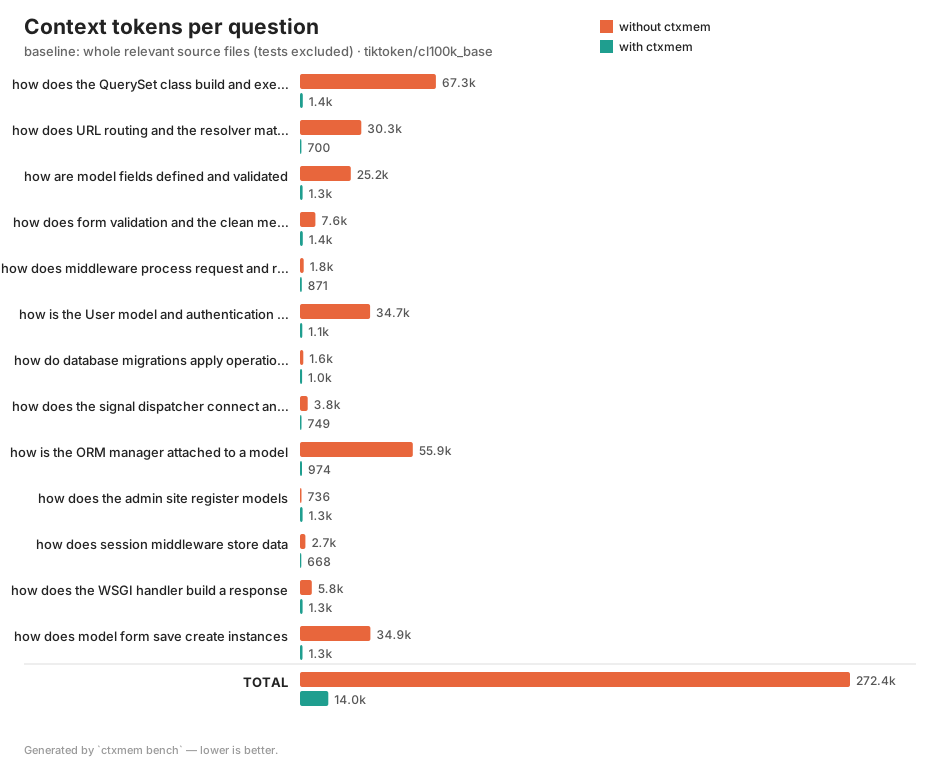
- Repo under test: the Django source tree (~2,900 Python files, ~45k indexed symbols) — a large, independent codebase to avoid any home-field advantage.
- Questions: 15 real "onboarding" questions a developer would ask (QuerySet, URL routing, model fields, form validation, middleware, auth, migrations, signals, ORM manager, admin, sessions, WSGI, model forms). See example/bench_questions_django.txt.
- "Without ctxmem" baseline: the full text of the relevant source files an agent would otherwise open — test files excluded, because dumping entire test suites overstates the naive cost.
- "With ctxmem": only the snippets a single
ctxmem recallreturns. - Tokenizer:
tiktoken/cl100k_base(the GPT-4 / Copilot family).
Results
| Metric | Without ctxmem | With ctxmem | Improvement |
|---|---|---|---|
| Context tokens (13 answerable questions) | 272,354 | 14,028 | 19.4× smaller (94.8%) |
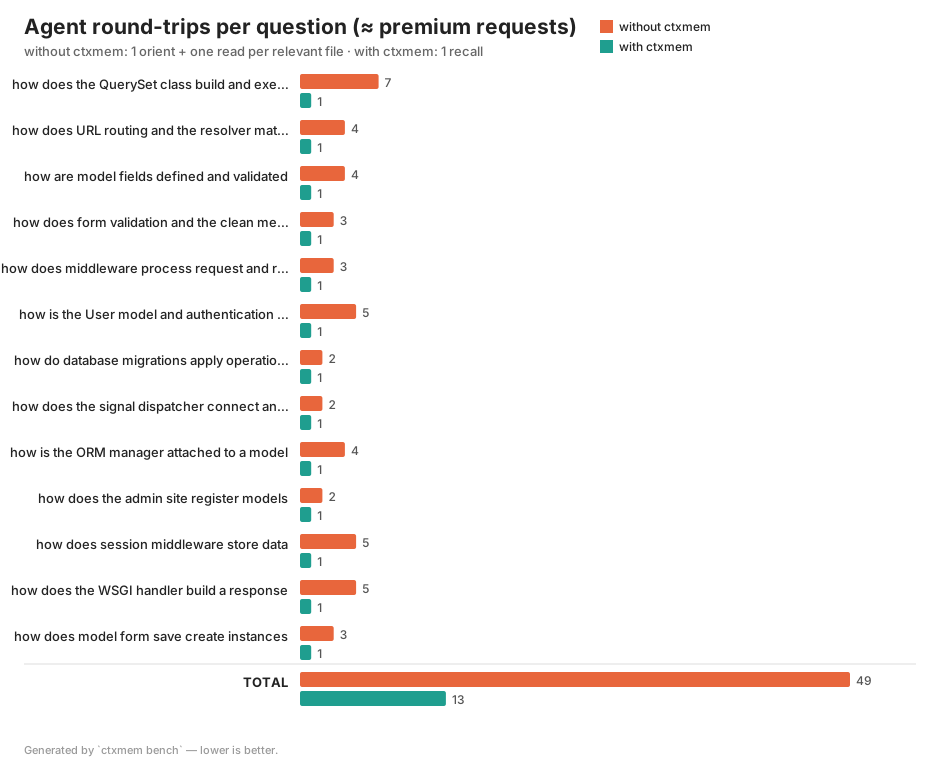
| Premium requests (agent round-trips) | 49 | 13 | 3.8× fewer |
Context tokens per question:
Premium requests per question (billed per model round-trip, not per token —
without stored memory the agent orients itself and then opens each relevant file;
ctxmem returns every snippet in one recall):
Reproduce it yourself
git clone https://github.com/django/django ~/bench-django
cd ~/bench-django
pip install "ctxmem[bench]"
ctxmem init && ctxmem sync                       # index the repo (~seconds)
ctxmem bench --suite /path/to/bench_questions_django.txt \
    --baseline files --report bench-out
Honest reading of these numbers
- The token figure is the context you feed the model, not a Copilot bill. Token savings translate directly into money on token-billed APIs (OpenAI/Anthropic) and into more headroom under the context-window limit.
- For a GitHub Copilot subscription (billed in premium requests), the lever is the right-hand chart: fewer exploration round-trips per question.
- Not every query wins big — small files or broad questions save less, and the suite includes those too. The report is generated as-is, no cherry-picking.
🔍 10. Search modes: keyword vs semantic vs hybrid
| Mode | Finds results by | Needs | Speed | Default |
|---|---|---|---|---|
keyword |
matching words (SQLite FTS5) | nothing | instant | ✅ |
semantic 🧪 |
matching meaning (embeddings) | sqlite-vec + Ollama | a bit slower | — |
hybrid 🧪 |
both, results merged | sqlite-vec + Ollama | a bit slower | — |
🧪
semanticandhybridare beta — the local-embedding backend is experimental and under active testing.keywordmode is stable and needs no setup. If the semantic backend isn't available, ctxmem automatically falls back to keyword and tells you ([keyword (fallback)]).
- keyword: great, zero-setup baseline. Searching
"login"won't find a note that only says"authentication". - semantic 🧪: understands meaning, so
"login"does find"authentication". Uses a local embedding model — no cloud. - hybrid 🧪: runs both and merges — best recall.
The mode is stored in .ctxmem/config.json (so it's shared).
ctxmem init --mode hybrid
ctxmem mode                       # show current mode + backend availability
ctxmem mode semantic              # switch (beta)
ctxmem recall "auth" --mode keyword   # override for one query
🤝 11. Sharing with your team
The memory travels through git like code:
# you
ctxmem remember --type decision "Payments go through Stripe, not PayPal."
git add .ctxmem/memory.jsonl && git commit -m "memory: payments" && git push

# your colleague
git pull
ctxmem recall "payments"     # index rebuilds from memory.jsonl → same context
Because memory.jsonl is a normal file:
- Branch-aware: each branch carries its own decisions; switch branch and
recallreflects it. - Merge-friendly: append-only lines merge cleanly; conflicts are rare and readable.
- No server: nothing to host, nothing to sync — git is the transport.
🪝 12. Auto-sync with a git hook
Keep the index fresh automatically:
ctxmem hook install      # writes .git/hooks/post-commit
ctxmem hook uninstall
After every git commit, the index rebuilds so recall always reflects the
latest code and decisions. The hook uses your exact Python interpreter, so it
works from inside a virtualenv.
🤖 13. Use it from an AI agent
There are two ways to connect an agent (e.g. Codex or GitHub Copilot) to the memory. They are independent — use whichever your setup allows.
Option A — instructions + CLI (recommended, no MCP needed)
The agent already runs terminal commands, so it can drive the ctxmem CLI
directly. You just tell it when to recall and remember via an instructions
file. This works even when MCP is unavailable or disabled by policy.
Set it up in one command from your repo root:
ctxmem agent-init --agent codex      # writes/updates local AGENTS.md
ctxmem agent-init --agent copilot    # writes/updates .github/copilot-instructions.md
ctxmem agent-init --agent all        # writes both instruction files
ctxmem agent-init --agent all --mcp  # also drop a .vscode/mcp.json (for Option B)
This inserts a Project Memory Protocol between managed markers
(<!-- ctxmem:begin --> … <!-- ctxmem:end -->). It is idempotent: if the
file already exists it appends the section; re-running updates that section in
place without duplicating it or touching your other instructions.
Codex uses AGENTS.md (often kept local and gitignored). GitHub Copilot uses
.github/copilot-instructions.md. The default remains --agent copilot for
backward compatibility.
The protocol tells the agent to:
- run
ctxmem ask "<the request>"before answering, to check whether the memory already knows (verdictHIT/WEAK/MISS) and load context; - reconcile conflicts — if the current code contradicts a memory (e.g. a
record flagged
⚠ STALEor⚠ SUPERSEDED), trust the code and correct the memory withctxmem remember --supersedes <id> …; - run
ctxmem remember …when it makes or confirms an important decision; - run
ctxmem syncafter changing code.
Requirements & tips:
ctxmemmust be on PATH in the terminal the agent uses. If you installed it in a venv, expose it globally, e.g.ln -s "$(command -v ctxmem)" ~/.local/bin/.- Use the agent in a mode that can run terminal commands (Codex, or VS Code
Copilot Agent mode). Choose "Always allow" for
ctxmemwhen your client offers command allow-listing. - Start a new chat after
agent-initso the updated instructions load. - Reality check: LLMs are probabilistic — a strong, imperative protocol makes
proactive saving reliable, not guaranteed. For 100% determinism, save
explicitly (ask the agent, or run
ctxmem rememberyourself) or via the git hook.
Option B — MCP server
ctxmem also ships an MCP server so agents can
call the memory as native tools. MCP is an open standard (MIT-licensed SDKs);
the server runs locally and reads only your repo.
pip install "ctxmem[mcp]"
Register it (VS Code .vscode/mcp.json, also created by agent-init --mcp):
{
  "servers": {
    "ctxmem": {
      "command": "ctxmem-mcp",
      "env": { "CTXMEM_ROOT": "${workspaceFolder}" }
    }
  }
}
If
ctxmem-mcpisn't on the global PATH (e.g. it lives in a venv), use the absolute path to the binary ascommand.
Tools exposed to the agent:
recall(query, limit, type, mode)— pull relevant context before a task.ask(query, limit, type, mode)— recall plus aHIT/WEAK/MISSverdict.remember(content, type, title, tags, supersedes)— record a decision (or correct an earlier one viasupersedes).memory_status()— mode, branch/commit, index counts.
The pattern (both options): the agent calls recall at the start of a task
(injecting only the relevant snippets, staying well under the token limit) and
remember at the end — so the project's memory grows and persists across sessions.
🧪 14. Semantic backend with Ollama (beta)
⚠️ Beta / experimental. Semantic search works but is under active testing. Keyword mode remains the stable default. Expect the semantic setup and defaults to evolve in a future release.
Semantic search needs two open-source, fully-local pieces:
- Ollama runs an embedding model on your machine
(offline, no API key). We use the small
nomic-embed-textmodel. - sqlite-vec stores the vectors and does nearest-neighbor search inside SQLite (a single loadable extension, no server).
Option A — install Ollama on the host
pip install "ctxmem[semantic]"
# install Ollama from https://ollama.com, then:
ollama pull nomic-embed-text
ctxmem mode semantic
Option B — run Ollama in an isolated Lima VM
Keeps Ollama off the host. Guest port 11434 is forwarded to the host, so ctxmem
(default ollama_url = http://localhost:11434) needs no extra config.
cd ollama
task start        # create VM, install Ollama, pull nomic-embed-text
task status       # verify the endpoint responds
task demo         # ctxmem mode semantic + a real query
task stop         # or: task delete   (fully reversible)
ollama/lima.yaml provisions Ubuntu 24.04, installs Ollama as a systemd service,
pulls the model, and includes a readiness probe. ollama/Taskfile.yaml wraps the
lifecycle in task commands.
❓ 15. FAQ
Is my data sent anywhere? No. Everything is local: SQLite files in your repo and, if you enable the beta semantic mode, a local Ollama. The MCP server also runs locally.
Do I have to use embeddings? No. keyword mode needs nothing and is the
default. Semantic is opt-in and still in beta.
Should I commit index.db? No — it's derived and gitignored. Commit
memory.jsonl and config.json.
What if a teammate doesn't have Ollama? ctxmem falls back to keyword automatically; the shared memory still works.
Does it scale to a big repo? The keyword index is fine for large repos.
Embeddings cost one Ollama call per chunk on sync; for very large codebases
incremental (diff-based) indexing is a natural next step.
Is MCP proprietary? No. MCP is an open protocol with MIT-licensed SDKs. The underlying LLM behind your agent may be proprietary, but the memory and the protocol here are fully open and self-hosted.
🤝 16. Contributing
Contributions are currently invite-only. The project is developed by a small set of invited collaborators, so unsolicited pull requests are not accepted right now — but bug reports and feature requests are always welcome via GitHub issues. If you would like to contribute code, reach out to @DoppiaG93 to be added as a collaborator.
Invited collaborators follow the Git Flow branching model (feature/*,
bugfix/*, hotfix/* → develop → main); see the
Contributing guide for branch naming, commit conventions,
and the release process.
Please also review our Code of Conduct. To report a security issue, follow the Security Policy instead of opening a public issue.
📄 17. License
Released under the MIT License.
Установка Ctxmem
У этого сервера нет опубликованного пакета — он собирается из исходников. Открой репозиторий и следуй инструкции в README.
▸ github.com/DoppiaG93/ctxmemFAQ
Ctxmem MCP бесплатный?
Да, Ctxmem MCP бесплатный — установка в пару кликов через Unyly без оплаты.
Нужен ли API-ключ для Ctxmem?
Нет, Ctxmem работает без API-ключей и переменных окружения.
Ctxmem — hosted или self-hosted?
Self-hosted: сервер запускается локально на твоей машине командой из раздела установки.
Как установить Ctxmem в Claude Desktop, Claude Code или Cursor?
Открой Ctxmem на unyly.org, выбери вкладку своего клиента (Claude Desktop, Claude Code, Cursor) и нажми Install — конфиг сгенерируется автоматически, без правки JSON.
Похожие MCP
wenb1n-dev/SmartDB_MCP
A universal database MCP server supporting simultaneous connections to multiple databases. It provides tools for database operations, health analysis, SQL optim
 автор: wenb1n-dev
Postgres Server
This server enables interaction with PostgreSQL databases through the Model Context Protocol, optimized for the AWS Bedrock AgentCore Runtime. It provides tools
 автор: madhurprash
Postgres
Query your database in natural language
 автор: Anthropic
PostgreSQL
Read-only database access with schema inspection.
автор: modelcontextprotocolCompare Ctxmem with
Не уверен что выбрать?
Найди свой стек за 60 секунд
Автор?
Embed-бейдж для README
Похожее
Все в категории data