
DéJà Server
БесплатноНе проверенEnables agents to check proposals against team decisions via check_decision tool and recall memory via recall_memory tool, preventing conflicts with standing de

Описание
Enables agents to check proposals against team decisions via check_decision tool and recall memory via recall_memory tool, preventing conflicts with standing decisions in Slack.
README
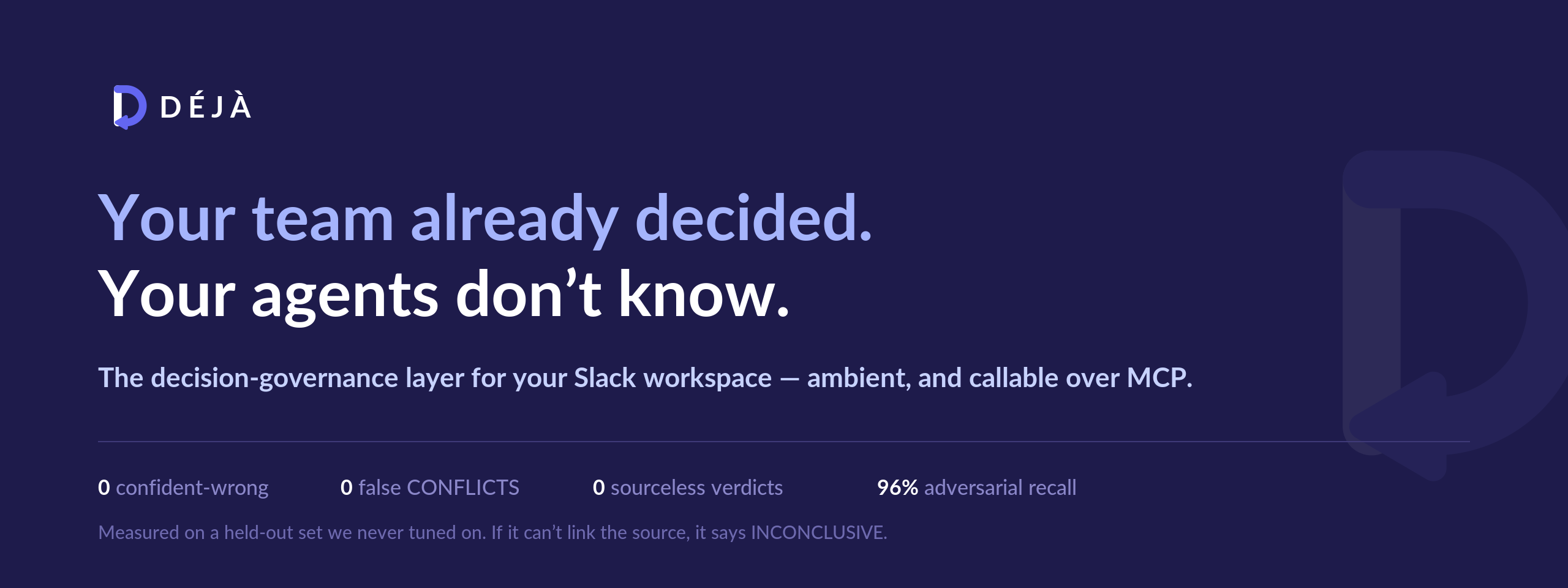
The numbers on the banner are the adversarial suite (83 hostile queries over this workspace): 0 confident-wrong, 0 false CONFLICTS, 0 sourceless verdicts, 96% recall. On the external benchmark — real, publicly documented decisions from workspaces the engine never saw — it is 6/8 with 1 confident-wrong, published in docs/EXTERNAL.md. We report the number that hurts.
Déjà — the decision-governance layer for your Slack workspace
Slack is filling up with agents. None of them know what your team already decided. Déjà does — it watches them, and now they can ask.
Most AI guardrails make you write the rules. Déjà reads them from what your team already decided.
When a decision, claim, or proposal comes up in a channel — from a human or an agent — Déjà checks it against the team's standing decisions and, only when it conflicts, drops a sourced guardrail:
⚠️ Conflicts with a standing decision · #eng "Opening a PR to migrate the job queue to Temporal." — the team rolled this back on Apr 23 (@maya): "duplicate task execution under a network partition… sticking with Redis." · 🔗 source
Two consumers, one engine:
- Ambient (Mode B) — Déjà reads every message, human and agent, and brakes conflicts. No opt-in needed; you don't grant permission, you're watched. ALLOW stays silent — the channel stays clean.
- MCP (collaborative) — any agent (or Slackbot) calls
check_decision(proposal)→ALLOW | CONFLICTS | INCONCLUSIVE, always sourced. Any agent in Slack can adopt this in five lines.
Slack Agent Builder Challenge · New Slack Agent track. Required technologies: RTS (permission-
aware assistant.search.context) + MCP (two tools — recall_memory + check_decision), plus
agent-to-agent governance and ambient agent watching. The LLM trigger runs on a Claude Max
subscription — no paid API key. · powered by Legibright
👩⚖️ Judges start here
- ▶️ Live 24/7 — Déjà runs on Railway (Socket-Mode agent + MCP server in one service), not a
laptop: deja-production.up.railway.app/healthz →
{"ok":true}. - 🎥 Demo video — (the Planner-Bot "agents on trial" run: ALLOW→silent, CONFLICTS, INCONCLUSIVE).
- ✅ Prove it yourself — one command, no secrets, no API key:
a phase-by-phase ✅ table. Then the numbers below, reproducibly:pip install -e ".[test]" && python scripts/verify_all.py --no-live
The LLM judge's outputs are cached inpython -m benchmarks.run # arc vs single-hit (held-out 4/6·3/5·0/4) python -m benchmarks.adversarial # 83 hostile queries → 0 confident-wrong, recall 96% python -m benchmarks.governance # 27 proposals → false-CONFLICTS 0, sourceless 0 python -m benchmarks.external # 8 real OSS decision histories → 6/8, and 1 honest missbenchmarks/.judge_cache.json(committed), so each of these runs offline, with no API key, in under a second — and is byte-for-byte deterministic: the numbers above are the numbers you get.docs/*.mdare regenerated from these runs (--md).
Quick start
pip install -e ".[test]"
cp .env.sample .env         # SLACK_USER_TOKEN (xoxp) + CLAUDE_CODE_OAUTH_TOKEN (`claude setup-token`)
slack run                   # the Slack app (Socket Mode): auto-trigger + memory cards
python -m deja.mcp_server   # the MCP server (stdio) for external agents
python scripts/verify_all.py   # the cross-phase gate — one green table (below)
How it was built (the phase story)
| Phase | What shipped | Gate proof in verify_all |
|---|---|---|
| 1 · Skeleton | Bolt app boots, listeners wired | deja imports, manifest valid |
| 2 · Recall (RTS) | Forgotten thread resurfaces, deterministic | recall resurfaces decision 3/3 |
| 3 · Judge→Recall→Reply | LLM trigger (Max subscription), end-to-end | pipeline PASS, trigger 4/4 |
| 4 · Block Kit card | Interactive card + App Home + privacy | card builders, App Home view |
| 5 · MCP | recall_memory tool + real stdio client |
recall_memory unit, MCP stdio |
| 6 · Seed | Realistic multi-author workspace + decision arcs | seed integrity, seed dry-run |
| 6 · Decision arc | Timeline + standing decision + owner + INCONCLUSIVE + save→Canvas | arc synthesis, arc card, decision store |
| v2 · Governance | check_decision verdict + ambient watch + Planner-Bot trial |
govern verdict, ambient loop-safety, governance benchmark |
| 7 · Docs | Architecture · submission · demo · review | — |
One command proves it all: python scripts/verify_all.py → a phase-by-phase ✅ table
(--no-live for the hermetic subset in CI). See docs/architecture.md ·
docs/SUBMISSION.md · docs/DEMO.md ·
docs/SLACKBOT-MCP.md · docs/HARDENING.md.
Does the arc beat search? (benchmark)
Measured on the exact live pipeline (judge(sentence) → recall_arc). On a held-out set we
never tuned on, single-hit search surfaces the standing decision 1/6 times and drifts onto an
unrelated decision 1/4 times. Déjà → 4/6 recurring · 3/5 single, never invents one (0/4).
(Dev set: 6/6 recurring, 7/7 single, 0 false decisions.)
We surface this, we don't hide it: Slack's Real-Time Search is rate-limited to ~1 call every few minutes (measured
Retry-After: 288s), so a 100+-query live benchmark isn't possible. The benchmark runs the real engine including the LLM judge (cached) through a reproducible RTS-free mirror, calibrated to live — sentences that fail live route through the same code here and were verified to match. Held-out recurring is 4/6, not higher, because the live card path is lexical-only (no LLM in the hot path): the semantic-gap cases ('observability stack' → the Datadog decision) need the LLM expansion, which is available but off live for speed. Honest cost, not a hidden failure. Method + limits: docs/BENCHMARK.md ·python -m benchmarks.run --md.
Robustness — silence is cheap, a confident wrong answer is fatal
benchmarks/adversarial.py runs the live pipeline over 83 hostile queries (paraphrases,
never-discussed topics, lexical traps, nonsense, typos, multi-topic, other languages,
false-premise provocations) and splits the result honestly: correct 49 · MISS 2 · correct-silent
32 · CONFIDENT-WRONG 0 → recall 96%, zero confident-wrong. It runs against a permissive mirror
(a superset of live search), so a trap like "did we decide to buy a boat?" surfaces the "BUYING
auth" thread and the grounding gate must reject it: a decision shows only if one of the query's
distinctive subject words is in the retrieved threads — a shared action verb (buy · migrate · drop ·
launch) is not a topic match. See docs/ROBUSTNESS.md.
Does the brake fire on the right proposal? (governance benchmark)
benchmarks/governance.py runs 27 labelled proposals through the exact live verdict
(judge → check_decision) — genuine conflicts, aligned proposals, never-discussed topics, lexical
traps, and discussed-but-undecided. Run once, no tuning: false CONFLICTS 0 · sourceless verdict 0 ·
owner attribution 11/11 · precision 100% / recall 62%. The 3 missed brakes are one honest class
(a positive adoption naming its rejected alternative without a rejection cue) — we would rather miss
a brake than raise a false one. Full method + the missed cases: docs/GOVERNANCE.md.
External validation on 8 real OSS decision histories: docs/EXTERNAL.md.
Architecture
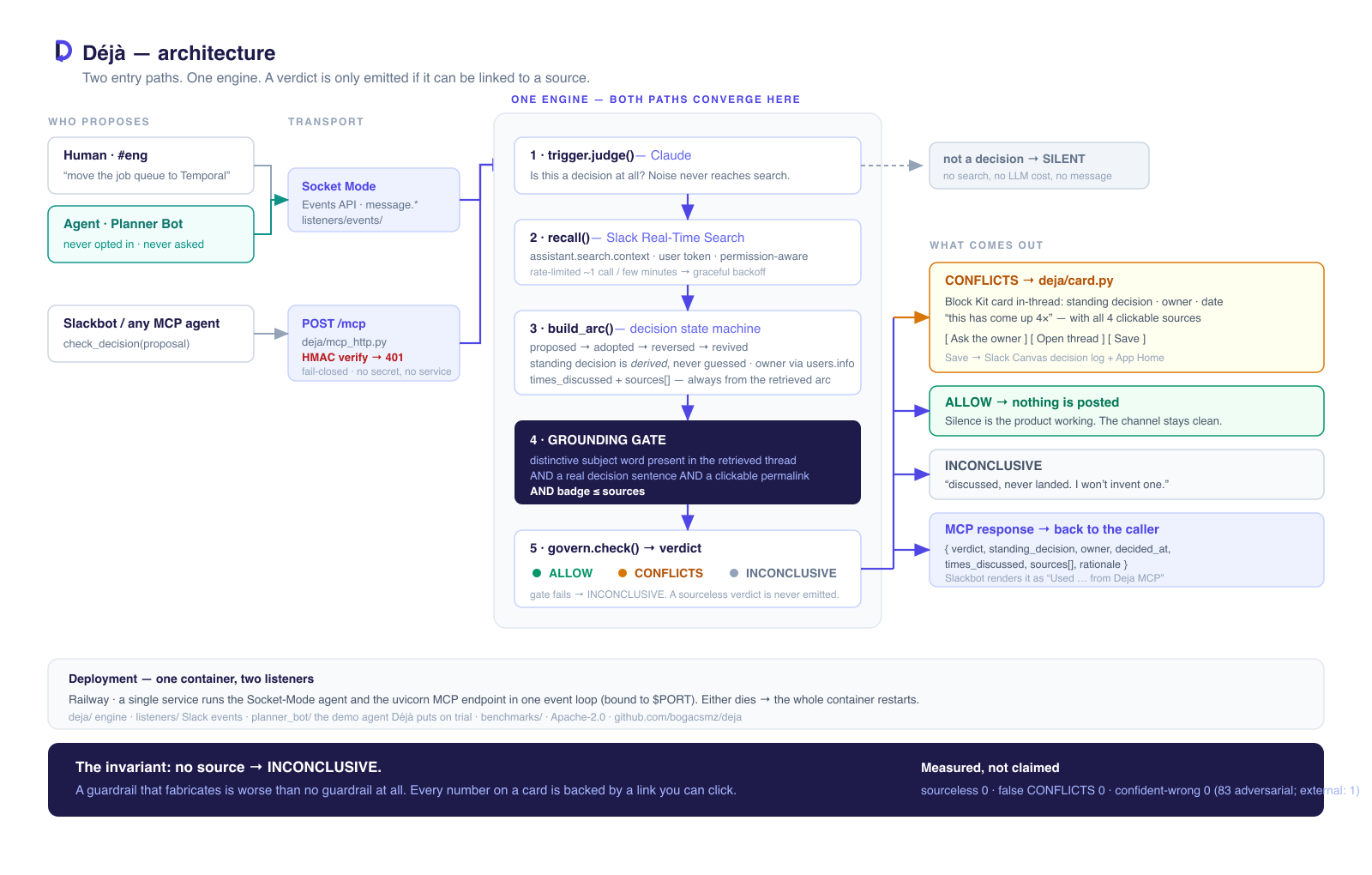
The governance contract — any agent can ask before it acts
Déjà's MCP server exposes two tools. The second is the interface contract: any agent in Slack can adopt this in five lines — call it before a consequential action and honour the verdict.
verdict = await mcp.call("check_decision", {"proposal": "Migrate the job queue to Temporal"})
if verdict["verdict"] == "CONFLICTS":
    # the team already rolled this back — stop and cite verdict["sources"]
    raise Halt(verdict["standing_decision"], by=verdict["owner"], at=verdict["decided_at"])
# ALLOW / INCONCLUSIVE → proceed (INCONCLUSIVE = discussed, never decided — Déjà won't invent one)
check_decision(proposal) → {verdict: ALLOW|CONFLICTS|INCONCLUSIVE, standing_decision, owner, decided_at, times_discussed, sources: [permalink, …], rationale}. The verdict runs
the same engine as the ambient guardrail (judge → recall_arc → grounding gate). A CONFLICTS with
no sources downgrades to INCONCLUSIVE — a fabricated brake is worse than none. Measured:
docs/GOVERNANCE.md — false-conflicts 0, sourceless 0, owner 11/11.
recall_memory(query, channel=None, limit=3) → {summary, memories:[{source_message, what_happened_next, channel, author, ts, permalink, score}], searched} is unchanged and still there
for pure lookup. Both run on the installer's user token, so they only ever reach the channels the
installing account can access (not per-caller — see Honest limits). Verify end-to-end with python scripts/mcp_smoke.py.
python -m deja.mcp_server # stdio (Cursor/Claude Desktop); DEJA_MCP_TRANSPORT=streamable-http for remote
{ "mcpServers": { "deja": {
  "command": ".venv/bin/python", "args": ["-m", "deja.mcp_server"],
  "cwd": "/absolute/path/to/slackhack"
} } }
Agents on trial — the brake, live (Mode B, no cooperation needed)
Déjà also watches the channel. A separate demo app, the Planner Bot (planner_bot/), posts action
proposals with no awareness of Déjà — Déjà catches the conflicting one and drops a sourced card,
stays silent on the aligned one, and refuses to invent a verdict on the undecided one. Governance
without the agent's opt-in. See planner_bot/README.md.
Layout
deja/ — the engine (recall/RTS · trigger/LLM · thread enrichment · card · store ·
govern/the verdict · mcp_server/two tools) · listeners/ — Slack events (incl. the ambient
watcher)/actions/views · planner_bot/ — the demo agent Déjà puts on trial · scripts/ — seed +
verify + smoke · benchmarks/ · tests/ · docs/.
Scaffolded from Slack's Bolt for Python starter template (MIT). The recall engine, decision arc, governance layer, MCP tools, benchmarks, and everything above are Déjà's own.
Установить DéJà Server в Claude Desktop, Claude Code, Cursor
unyly install d-j-mcp-serverСтавит в Claude Desktop, Claude Code, Cursor и VS Code — сам разбирается с npx, uvx и сборкой из исходников.
Впервые? Поставь CLI: curl -fsSL https://unyly.org/install | sh
Или настроить вручную
Выполни в терминале:
claude mcp add d-j-mcp-server -- uvx --from git+https://github.com/bogacsmz/deja slackhackFAQ
DéJà Server MCP бесплатный?
Да, DéJà Server MCP бесплатный — установка в пару кликов через Unyly без оплаты.
Нужен ли API-ключ для DéJà Server?
Нет, DéJà Server работает без API-ключей и переменных окружения.
DéJà Server — hosted или self-hosted?
Доступен hosted-вариант: Unyly запускает сервер в облаке, локальная установка не обязательна.
Как установить DéJà Server в Claude Desktop, Claude Code или Cursor?
Открой DéJà Server на unyly.org, выбери вкладку своего клиента (Claude Desktop, Claude Code, Cursor) и нажми Install — конфиг сгенерируется автоматически, без правки JSON.
Похожие MCP
Gmail
Read, send and search emails from Claude
 автор: Google
Slack
Send, search and summarize Slack messages
 автор: Slack
Runbear
No-code MCP client for team chat platforms, such as Slack, Microsoft Teams, and Discord.
Discord Server
A community discord server dedicated to MCP by [Frank Fiegel](https://github.com/punkpeye)
Compare DéJà Server with
Не уверен что выбрать?
Найди свой стек за 60 секунд
Автор?
Embed-бейдж для README
Похожее
Все в категории communication