
Desktop GUI Automation
БесплатноНе проверенCross-platform desktop GUI automation via OS-native accessibility APIs on macOS, Linux, and Windows.

Описание
Cross-platform desktop GUI automation via OS-native accessibility APIs on macOS, Linux, and Windows.
README
Every other tool needs a browser or a vision model. This one reads what the OS already knows.
A cross-platform MCP server for desktop GUI automation — driven by accessibility APIs, not screenshots.
Works with Claude, Codex, Gemini, Ollama, or any OpenAI-compatible client that supports MCP.
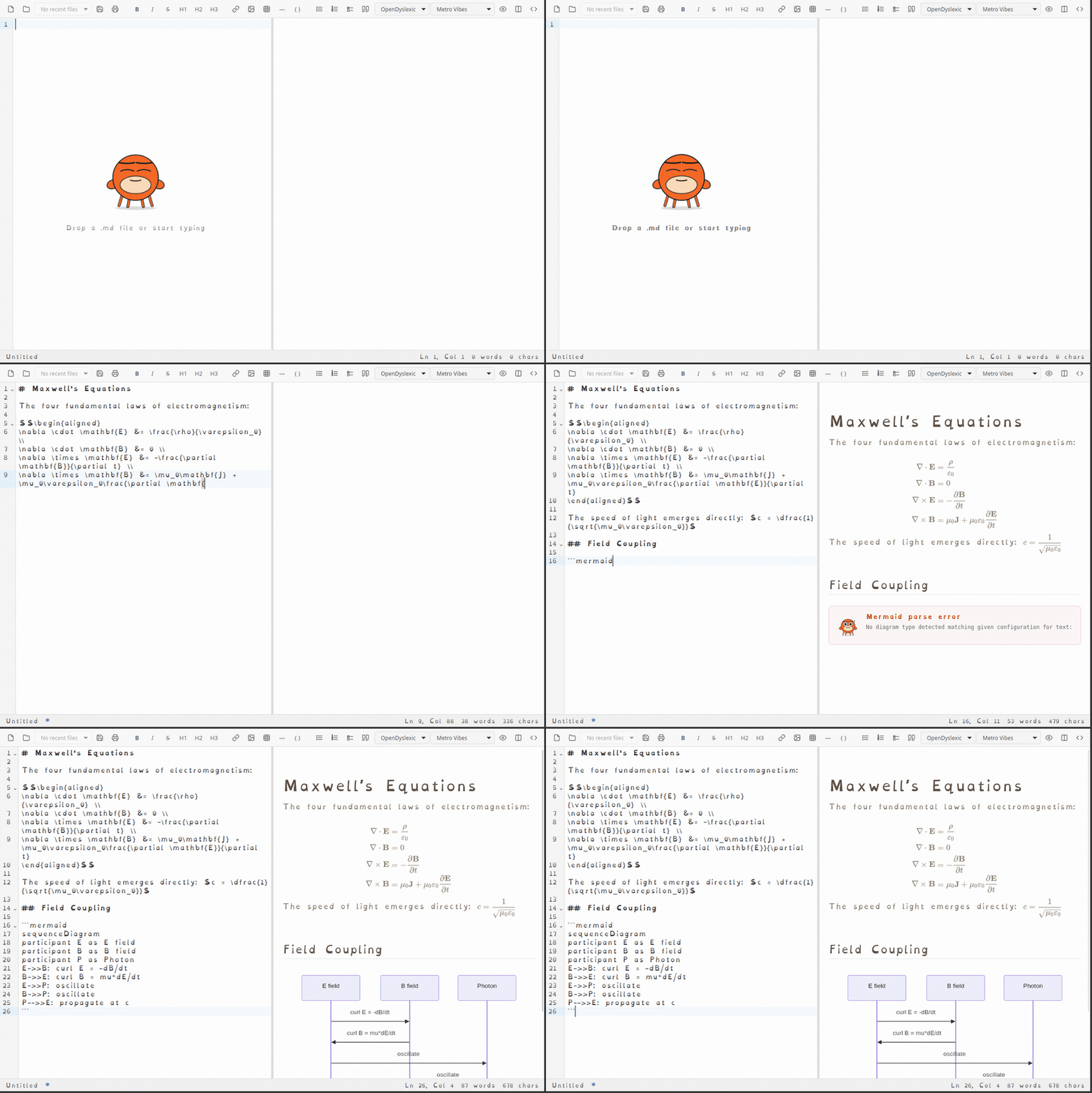 bad-ass-mcp recording itself interacting with MarkTheCrab
Why
Most AI desktop automation tools work by taking screenshots and asking a vision model "what do you see?" That's slow, expensive, and fragile.
Every major OS exposes a structured accessibility tree — the same one used by screen readers — that describes every button, text field, combo box, and menu in every running application. bad-ass-mcp speaks that language directly.
- macOS: AXUIElement via PyObjC
- Linux: AT-SPI2 via
gi.repository.Atspi - Windows: UI Automation via
comtypes
Actions fire on control objects directly, so the target window doesn't need focus. The user can keep working while automation runs in the background.
Tools
| Tool | Description |
|---|---|
list_windows |
List all visible application windows |
get_tree |
Full accessibility tree for a window as nested JSON |
find_elements |
Find elements by role and/or name |
click |
Click / invoke an element (foreground-independent) |
click_at |
Click at absolute screen coordinates — fallback for webview/canvas UI |
type_text |
Type text into a field (SetValue → EditableText → key injection) |
select_option |
Select an option in a combo box or list |
get_value |
Get the current value or text of an element |
wait_for_window |
Wait until a window matching a pattern appears |
wait_for_element |
Wait until an element exists and optionally has a given state |
screenshot |
Capture a PNG (write to output_path or return base64) |
start_recording |
Start recording the screen (or a specific window) |
stop_recording |
Stop recording and export as a GIF |
learn_layout |
Resolve semantic names → live handle IDs (one call per session) |
run_sequence |
Execute a list of actions server-side — no per-action round-trips |
Webviews: waking lazy accessibility trees
Chromium-based apps (Electron, CEF, and every Chromium browser) have a
full accessibility tree — they just don't build it until an assistive
technology announces itself. Until then the window looks canvas-only:
get_tree returns nothing and screenshot-clicking is the only option.
bad-ass-mcp announces itself. When a window's a11y tree comes back empty and the process looks like a webview, the backend performs the platform's "a screen reader is here" handshake, waits a beat, and re-probes before giving up:
- Linux: sets
org.a11y.Status.ScreenReaderEnabledon the session D-Bus at server start so Chromium/Electron apps launched afterwards enable accessibility from birth. Windows that stay hollow (an application+frame whose phantom child fetches asNone) are detected via the AT-SPI toolkit name and reportedaccessible: false: the app either launched before the flag went up or opts out on its own. Restarting the app with the server running should pick the flag up per Chromium's documented behavior, but note that is not yet verified here: the only Linux app live-tested so far (flatpak Vivaldi) ignores the flag entirely, its own first-run assistive-technology toggle included, and only produces a tree when launched with--force-renderer-accessibility. - macOS: sets
AXManualAccessibilityon the app (Electron's documented switch), falling back toAXEnhancedUserInterface(what VoiceOver sets, watched by plain Chrome/CEF). The attribute set only succeeds on apps that support it, so it's a free no-op elsewhere. - Windows: sets the system
SPI_SETSCREENREADERRUNNINGflag, then queries theChrome_RenderWidgetHostHWNDchild window — Chromium hangs its DOM tree off that renderer child, not the top-level HWND (which only shows empty panes).get_tree/find_elementsare routed through the renderer child automatically.
One wake attempt per process per server run. If list_windows still
reports accessible: false after this, the window is genuinely
canvas-only (custom OpenGL/Vulkan surface, immediate-mode toolkit
without AccessKit) — fall back to screenshot + click_at.
The tradeoff: a woken app spends some memory/CPU maintaining its tree, which is exactly why Chromium lazy-loads it. The wake targets the app you're automating, not the whole desktop (the Linux flag is technically session-global, but only a11y-aware apps respond, and only on demand).
Installation
Requirements: Python 3.11+, ffmpeg + gifsicle for recording (optional)
# macOS
pip install 'bad-ass-mcp[macos]'

# Linux — install system PyGObject + AT-SPI bindings first, then:
pip install bad-ass-mcp

# Windows
pip install 'bad-ass-mcp[windows]'
Linux: PyGObject and AT-SPI are not on PyPI — install them from your distro:
# Debian/Ubuntu
sudo apt install python3-gi gir1.2-atspi-2.0 at-spi2-core

# Arch
sudo pacman -S python-gobject at-spi2-core

# Fedora
sudo dnf install python3-gobject at-spi2-core
Then make sure AT-SPI is enabled (most desktop environments — GNOME, KDE, XFCE — have it on by default):
# Check
gsettings get org.gnome.desktop.interface toolkit-accessibility

# Enable
gsettings set org.gnome.desktop.interface toolkit-accessibility true
If you're using a venv, create it with --system-site-packages so it can see the distro-installed gi:
python -m venv --system-site-packages venv
Windows: Elevated (admin) applications can only be automated from an elevated Python process. No special permissions are needed for normal apps.
Register with Claude Code
claude mcp add bad-ass-mcp --scope user -- bad-ass-mcp
Or manually in ~/.claude.json:
{
  "mcpServers": {
    "bad-ass-mcp": {
      "type": "stdio",
      "command": "bad-ass-mcp"
    }
  }
}
Usage
list the windows on screen
→ [{ "id": "12345", "name": "Firefox", ... }]

find the search box in window 12345 and type "hello"
→ find_elements(window_id="12345", role="entry")
→ type_text(handle_id="...", text="hello")
Electron/CEF apps get their lazy accessibility tree woken automatically (see Webviews above). For apps that still don't expose a clean tree, type_text falls back to platform-native key injection automatically (AT-SPI on Linux, Quartz events on macOS, PostMessage on Windows).
Architecture
bad_ass_mcp/
├── server.py          # FastMCP tool definitions
├── types.py           # WindowInfo, ElementHandle, ActionResult, StaleHandleError
└── backend/
    ├── base.py        # Abstract DesktopBackend interface
    ├── linux.py       # AT-SPI2 + xdotool
    ├── macos.py       # AXUIElement + Quartz
    └── windows.py     # UI Automation + ctypes Win32
The abstract backend interface means adding a new platform is just implementing one class. The full contract-test suite runs against every backend via FakeBackend.
Releasing
Tag a version and the release workflow builds and attaches the wheel automatically:
git tag v0.2.0 && git push --tags
License
MIT
Установка Desktop GUI Automation
У этого сервера нет опубликованного пакета — он собирается из исходников. Открой репозиторий и следуй инструкции в README.
▸ github.com/holdmybeer-gg/bad-ass-mcpFAQ
Desktop GUI Automation MCP бесплатный?
Да, Desktop GUI Automation MCP бесплатный — установка в пару кликов через Unyly без оплаты.
Нужен ли API-ключ для Desktop GUI Automation?
Нет, Desktop GUI Automation работает без API-ключей и переменных окружения.
Desktop GUI Automation — hosted или self-hosted?
Self-hosted: сервер запускается локально на твоей машине командой из раздела установки.
Как установить Desktop GUI Automation в Claude Desktop, Claude Code или Cursor?
Открой Desktop GUI Automation на unyly.org, выбери вкладку своего клиента (Claude Desktop, Claude Code, Cursor) и нажми Install — конфиг сгенерируется автоматически, без правки JSON.
Похожие MCP
GitHub
PRs, issues, code search, CI status
 автор: GitHub
Filesystem
Secure file operations with configurable access controls.
Memory
Knowledge graph-based persistent memory system.
Template MCP Server
A CLI tool to create a new Model Context Protocol server project with TypeScript support, dual transport options, and an extensible structure
 автор: mcpdotdirect
Compare Desktop GUI Automation with
Не уверен что выбрать?
Найди свой стек за 60 секунд
Автор?
Embed-бейдж для README
Похожее
Все в категории development