
Diffgate Review
БесплатноНе проверенCatches the guardrails your coding agent deletes while editing — a deterministic code review gate on just the changed lines, before any review bot. Grades each

Описание
Catches the guardrails your coding agent deletes while editing — a deterministic code review gate on just the changed lines, before any review bot. Grades each line green/yellow/orange by impact in milliseconds; 0 false blocks. In your coding agent (MCP),
README
npm version npm downloads VS Code Marketplace Open VSX License GitHub stars
Coding agents don't write textbook vulnerabilities anymore — they delete your guardrails while editing.
We measured it across local and frontier models: 0% classic OWASP bugs (SQL injection, XSS, hardcoded secrets) in code written from scratch. But the same frontier model that wrote flawless greenfield code reintroduced security footguns in 13% of edits — an unguarded recursive merge (prototype pollution), a bare cors() (any origin), a path built from request data with no containment check. And editing existing code is most of what an agent does. The measurement →
DiffGate is the deterministic tripwire for exactly that residue — a review pass that runs before any review bot sees a PR, at the keystroke and the commit, where fixing is cheapest. It grades only the lines that changed (🟢 merge · 🟡 glance · 🟠 verify) in milliseconds, runs your tests only when a change earns it, and blocks only when it's earned: 0 false blocks on a public, versioned corpus (BENCHMARK.md). Not a model grading its own homework — the same verdict inside your coding agent (MCP), your editor, your pre-commit hook, and your CI.
| Tier | Meaning | What you do | Examples |
|---|---|---|---|
| 🟢 Green | Safe / self-contained | merge freely | comments, local logging |
| 🟡 Yellow | Review (soft dependency) | take a look | deprecated APIs, raw SQL, network calls, dependency edits |
| 🟠 Orange | High-impact, gate it | verify before merge | schema/migrations, hardcoded secrets, auth/crypto, public-API changes, injection sinks |
Why a tripwire, not another review bot
Review bots comment after the PR exists; linters and scanners flag everything they see. Neither guarantees the risky line gets discussed: we scanned 350 merged AI-assisted PRs — of the 109 with flagged AI-attributed changes, only 3 drew public discussion from any human besides the author. DiffGate sits earlier — with the agent and the human writing the code — and decides what deserves your attention, your tests, or a block, staying quiet otherwise. That's the whole product:
- Diff-scoped. Findings report only on the lines that changed, against the committed baseline — no whole-file noise, no re-litigating code you didn't touch.
- Tiered triage, not a flat list. Three tiers route attention: green merges, yellow is a glance, orange is gated.
- The gate runs your tests — selectively. On an orange change, DiffGate runs your
testCommandand shows the real exit code and output. Green and yellow pass instantly. The pre-commit hook is fast because tests fire only when a change is genuinely high-impact. - Earns the right to block. Broad cross-language injection findings stay advisory on their own; they escalate to a blocking finding only when the optional code graph proves the sink is reachable from an untrusted entry point (an HTTP/event handler). Recall from the rules, the right to block from the graph.
- Change-impact aware. With an optional code graph, a finding carries its cross-file blast radius — caller counts, suggested reviewers, untested call sites — and an exported symbol nobody calls is de-escalated. Cross-file context makes reviews quieter, not louder.
- Fast. A review runs in milliseconds on the changed lines — quick enough to sit in the agent and editor inner loop, not only in CI.
- Provably low-noise.
diffgate benchruns a versioned corpus offline: 100% precision / 0 false blocks on clean changes. Reproduce it yourself — that's the point of shipping the corpus. See BENCHMARK.md.
The measurement is reproducible
The 0% / 13% numbers aren't a marketing line — they come from a scripted experiment (four models from local to frontier, greenfield vs. edit mode, Wilson confidence intervals) that you can rerun with diffgate marginal. Methodology, per-model tables, and caveats: docs/MEASUREMENT.md. DiffGate's security rules are tuned to that measured residue, not to maximizing rule count.
Quick start
npm install -g diffgate-review
cd your-repo
diffgate init                    # auto-detects language + test command, writes .diffgate.json
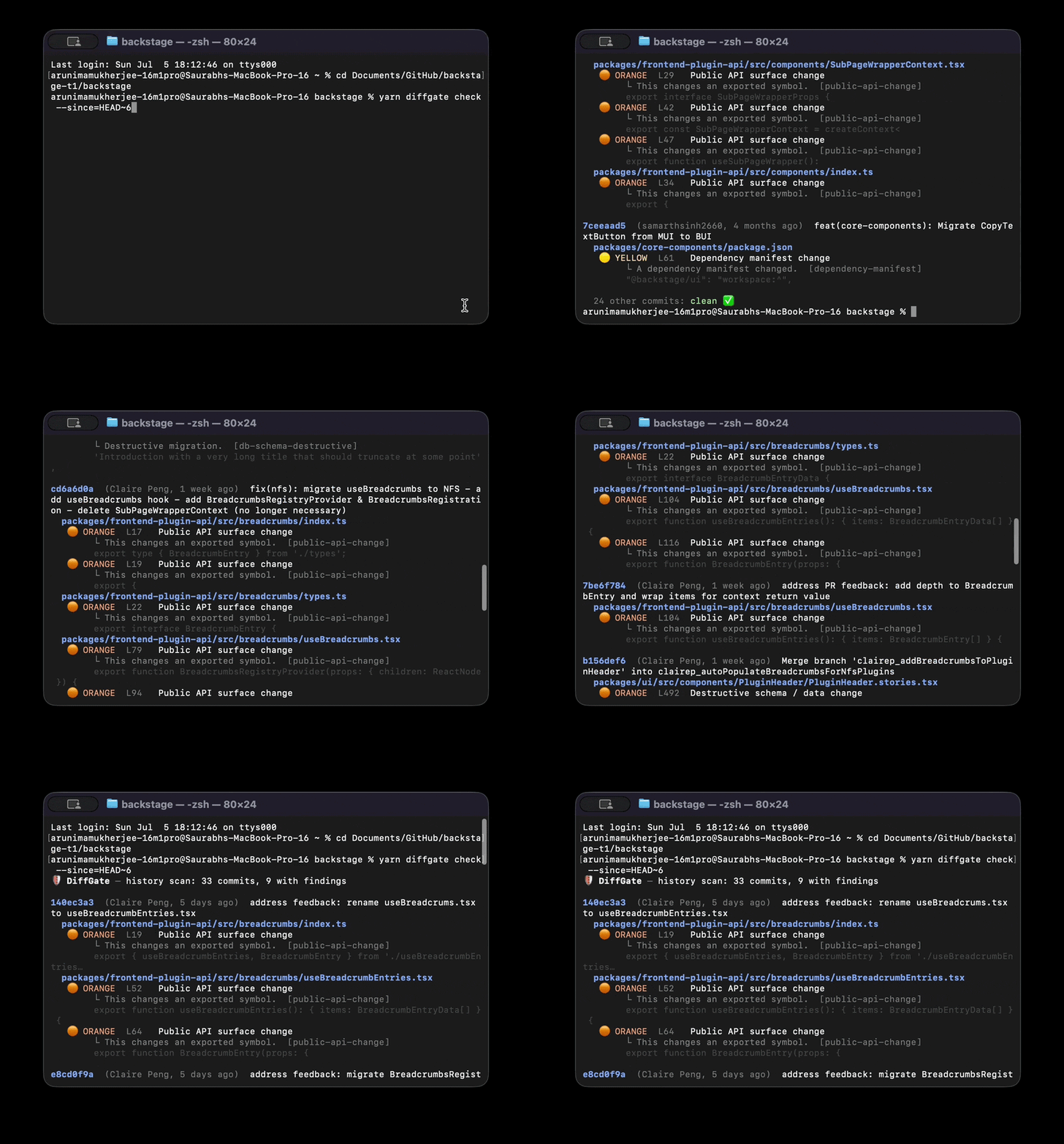
diffgate check --since=HEAD~20   # see what it catches in your own history — no PR required
diffgate check                   # review your pending changes right now
No git history or uncommitted changes yet? See the output on bundled examples first:
diffgate init --demo # live scan, no config or git changes needed
The surfaces (one shared engine, one verdict)
1. In your coding agent (via MCP)
The highest-leverage spot: the agent self-checks generated code before it's written to disk, gets back structured findings (zero LLM tokens), and surfaces what it corrected (original + fix + why) instead of silently rewriting. A trustworthy, deterministic self-check is what makes it safe to grant the agent more autonomy.
# Claude Code — one command:
claude mcp add diffgate -- diffgate mcp

# One-click via Smithery (zero config):
npx @smithery/cli install diffgate-review --client claude

# Cursor — add to MCP settings:
# { "diffgate": { "command": "diffgate", "args": ["mcp"] } }
Or one-click in Claude Desktop: download diffgate.mcpb and open it. The server also exposes prompts and resources; see MCP.md.
2. In your editor (VS Code / Cursor)
Inline squiggles on changed lines, hover cards (why · who owns it · quick-fix), a Risk Review tree, a status-bar summary, and Deep Review (agentic blast-radius analysis for orange findings). The same verdict you'd get from the CLI, on the diff you're reviewing.
Install from the VS Code Marketplace or Open VSX (Cursor / Windsurf / Gitpod).
3. On the command line — and in CI
diffgate check reviews your diff and exits non-zero on high-impact findings: a pre-commit hook locally, the same gate in your pipeline.
diffgate install-hook # adds .git/hooks/pre-commit; only runs tests on 🟠 orange changes
The local loop is the wedge — fix while the context is fresh — and the same engine runs as a PR gate so the verdict carries to where it's enforced for the whole team. See docs/TEAM.md for the GitHub Action, shared learnings, and org policy packs. CI runs can optionally layer an external scanner (Semgrep) through the same gate for broader language coverage — advisory-only, off by default (docs/CONFIG.md).
Common commands:
diffgate check                 # review pending changes (the gate)
diffgate check --staged        # staged-only (pre-commit)
diffgate check --since=HEAD~20 # audit recent history, per-commit (see below)
diffgate check --agent         # machine verdict for coding agents
diffgate scan <path>           # analyze files directly (no git needed)
diffgate watch                 # live review as you edit
diffgate guidelines            # review diff against AGENTS.md / CLAUDE.md etc.
diffgate feedback <rule> <f> <l> --dismiss   # suppress a false positive (shared via git)
diffgate mcp                   # start the MCP stdio server
Audit recent AI-authored history. Point check at commits already in your log — each
finding is attributed to a specific commit, so you get a story, not a repo-wide report card:
diffgate check --since=HEAD~20        # last 20 commits, one block per commit
diffgate check --since="2 weeks ago"  # by date instead of a rev
diffgate check --ai-authored          # only agent commits (Claude/Copilot/Cursor/… — heuristic)
diffgate check --author="Claude"      # matches author *and* Co-authored-by trailers
diffgate check <sha>                  # a single commit by hash
History mode is report-only (it audits the past — it never runs your test command or blocks a
commit) and honors --json and --limit=<n> (default 50). Merge commits are skipped.
Run diffgate --help for the full list (report, bench, stats, graph, marginal, …).
How it works
- Diff-aware:
git diff(CLI) or an in-memory LCS diff (editor, accurate on unsaved buffers) finds changed lines; findings only report on those lines. - Real AST where it counts:
@babel/parser(JS/TS) and tree-sitter (Python, PHP, Go, Ruby, Java, C#, Kotlin — via WASM, no native build) power precise rules: deprecated calls aren't matched inside comments or strings, exported-signature changes are detected structurally, and SQL injection is sink-targeted, parameter-aware, and sanitizer-aware —cur.execute(f"… {uid}")/$pdo->query("… $id")block, whilecur.execute("… %s", (uid,)),$pdo->prepare("… ?"), a single-quoted'… $id', and aSELECTin a log line don't. - A deterministic floor everywhere else: comment-aware pattern rules for secrets, destructive/schema changes, auth/crypto, dynamic execution / shell-out, raw queries, and network calls across Go, Java, Ruby, and any text. Commented-out code (
# os.system(x)) isn't flagged; a secret committed inside a comment still is. Docs/prose files (.md,.rst, …) are held to the same standard: the word "oauth2-provider" in a changelog isn't auth code, but a key pasted in a README is still a leak. - Earned blocking: broad cross-language injection advisories for the non-AST languages (Ruby
#{}, Go/Ruby shell-out) escalate to blocking only when the optional code graph proves reachability from an untrusted entry point — community CodeGraph, no Pro taint engine required. (JS/TS, Python, and PHP block on local AST evidence and don't need this.) - The gate: on a high-impact change, DiffGate runs your
testCommandand shows the actual exit code and output. - Learnings:
diffgate feedbackrecords dismiss/confirm verdicts; dismissed findings (same rule + same code) are suppressed everywhere. Stored in.diffgate/learnings.json; commit it to share across the team. - Optional add-ons: a provider-agnostic AI layer (plain-English explanations + fixes) and a cross-file blast-radius pass via an optional code graph. Both are off by default and degrade gracefully to a no-op.
Engine layout: src/core (shared) · src/cli.ts (CLI) · src/mcp.ts (MCP) · extension/ (VS Code).
Coverage scales with language
How deeply DiffGate analyzes a change depends on the file's language — be explicit about this so you can calibrate how much to trust a clean result.
| Tier | Languages | Depth |
|---|---|---|
| Deep (AST) | JS / TS (@babel) |
All injection classes + public-API & signature changes + deprecated-API quick-fixes. Prototype pollution and NoSQL injection are JS/TS-only; JS/TS findings are also eligible for code-graph taint confirmation. |
| Deep (AST) | Python, PHP, Go, Ruby, Java, C#, Kotlin (tree-sitter) | Sink-targeted, parameter- and sanitizer-aware injection detection — placeholders, argument-vectors, and escapers are correctly treated as safe. Sink classes per language below. |
Sink classes per Deep-AST language (full detail — every sanitizer and safe-form, plus the code-graph boundary — in docs/SCOPE.md):
- Python (7) — SQL · XSS · path traversal · CORS · command · code · deserialization
- PHP (8) — SQL · command · code · file inclusion · deserialization · XSS · path traversal · CORS
- Go (4) — SQL · command · path traversal · CORS
- Ruby (6) — SQL · command · code · deserialization · XSS · CORS
- Java (6) — SQL · command · deserialization · path traversal · XXE · CORS
- C# (7) — SQL · command · deserialization · path traversal · XSS · XXE · CORS
- Kotlin (6) — SQL · command · deserialization · path traversal · XXE · CORS
SSRF is a cross-language advisory across all eight Deep-AST languages (a request-tainted URL into an outbound-request sink; library-qualified and tainted-only, so static/config URLs aren't flagged). XXE covers the JVM (Java, Kotlin) and .NET (C#), suppressed when the file shows recognized hardening. Permissive CORS now also covers all eight — wildcard Access-Control-Allow-Origin, allow-all framework configs (gin/rs-cors, Spring @CrossOrigin, ASP.NET AllowAnyOrigin(), Ktor anyHost(), rack-cors), and request-reflected origins; explicit allowlists aren't flagged.
| Tier | Languages | Depth |
|---|---|---|
| Floor (pattern) | C/C++, Rust, Swift, Scala, … | Secrets, destructive/schema changes, auth/crypto, dynamic exec / shell-out, raw queries, network calls, TODO. Cross-language injection advisories that escalate via the code graph. |
| Text | YAML, Terraform, JSON, any text | Secrets and TODO/FIXME markers. |
Fast by design — and scoped to match. A review runs in milliseconds on the changed lines, which is exactly what lets the same check sit in the agent and editor inner loop. That speed is a deliberate trade: DiffGate is the deterministic gate on the diff, not an exhaustive whole-repo taint engine. Coverage is per-language (deep where there's an AST, a pattern floor elsewhere), the security rules are tuned to the residue agents actually ship rather than to maximize raw rule count, and a clean result means "nothing matched at this language's tier," not "proven safe." For deep cross-file taint analysis across many languages, pair it with a dedicated SAST. Full per-language detail and the code-graph boundary: docs/SCOPE.md.
Configuration
diffgate init writes a tailored .diffgate.json at your repo root. Minimal example:
{
  "testCommand": "npm test",          // run for orange changes (the gate)
  "gate": { "mode": "working", "failOn": "orange" },
  "deprecated": [
    { "pattern": "StripeClient.charge", "replacedBy": "StripeClient.createPaymentIntent" }
  ]
}
Any rule — built-in or custom — can be path-scoped with include/exclude globs, the escape hatch for the one file where a forbidden idiom is legitimate (e.g. process.env inside the config loader itself). Full schema, the built-in rule table, LLM providers, and per-rule tuning: docs/CONFIG.md.
More
- The PR was reviewed. The risky line wasn't. — our PR-trail study: 350 merged AI-assisted PRs, 109 with flagged AI-attributed changes, 3 with public human discussion beyond the author.
- docs/SCOPE.md: per-language coverage tiers (deep AST vs. pattern vs. text-only) and what the code graph does and doesn't do.
- docs/CONFIG.md: full
.diffgate.jsonschema, all built-in rules, LLM providers, native precision & test-scope behavior. - docs/TEAM.md: rolling DiffGate out to a team (GitHub Action / PR gate, shared learnings, org-wide policy packs, SOC 2 evidence, metrics for leaders).
- docs/CODE-GRAPH.md: optional cross-file blast radius (caller counts, suggested reviewers, test gaps, reachability, taint analysis).
- docs/MEASUREMENT.md: what agents actually ship unprompted and how to reproduce it (
diffgate marginal). - MCP.md: MCP tools, prompts, resources, and AI configuration.
Try it
diffgate scan mock_project
You'll see green findings (logging), yellow findings (a deprecated call), and orange findings (a DROP COLUMN migration, a public export).
Tests
npm test # builds the extension, runs the full unit/integration suite + extension smoke test
Support the project
If DiffGate caught something for you — or you just like the idea of a deterministic gate for agent code — star the repo ⭐. It's the signal that tells other people this is worth trying.
- 🐛 Found a false block, or a sink it missed? Open an issue — a false block is a bug we treat as P0.
- 💡 Want a language or rule covered? File a feature request with the idiom you'd like caught.
- 🔒 Security report? Please disclose privately — see SECURITY.md.
Contributing & License
See CONTRIBUTING.md. Apache 2.0; see LICENSE.
Установить Diffgate Review в Claude Desktop, Claude Code, Cursor
unyly install diffgate-reviewСтавит в Claude Desktop, Claude Code, Cursor и VS Code — сам разбирается с npx, uvx и сборкой из исходников.
Впервые? Поставь CLI: curl -fsSL https://unyly.org/install | sh
Или настроить вручную
Выполни в терминале:
claude mcp add diffgate-review -- npx -y diffgate-reviewFAQ
Diffgate Review MCP бесплатный?
Да, Diffgate Review MCP бесплатный — установка в пару кликов через Unyly без оплаты.
Нужен ли API-ключ для Diffgate Review?
Нет, Diffgate Review работает без API-ключей и переменных окружения.
Diffgate Review — hosted или self-hosted?
Self-hosted: сервер запускается локально на твоей машине командой из раздела установки.
Как установить Diffgate Review в Claude Desktop, Claude Code или Cursor?
Открой Diffgate Review на unyly.org, выбери вкладку своего клиента (Claude Desktop, Claude Code, Cursor) и нажми Install — конфиг сгенерируется автоматически, без правки JSON.
Похожие MCP
wenb1n-dev/SmartDB_MCP
A universal database MCP server supporting simultaneous connections to multiple databases. It provides tools for database operations, health analysis, SQL optim
 автор: wenb1n-dev
Postgres Server
This server enables interaction with PostgreSQL databases through the Model Context Protocol, optimized for the AWS Bedrock AgentCore Runtime. It provides tools
 автор: madhurprash
Postgres
Query your database in natural language
 автор: Anthropic
PostgreSQL
Read-only database access with schema inspection.
автор: modelcontextprotocolCompare Diffgate Review with
Не уверен что выбрать?
Найди свой стек за 60 секунд
Автор?
Embed-бейдж для README
Похожее
Все в категории data