
Ecfr Cartography
БесплатноНе проверенAn MCP server that turns the US Code of Federal Regulations into an agent-navigable citation graph, enabling traversal of regulatory references and detection of

Описание
An MCP server that turns the US Code of Federal Regulations into an agent-navigable citation graph, enabling traversal of regulatory references and detection of stale citations via structured tools.
README
An MCP server that turns the US Code of Federal Regulations into an agent-navigable citation graph — so agents can traverse the regulatory graph instead of skimming PDFs. Point Claude at 45 CFR part 170 and ask "which section is the hub? which citations are stale?"; you get structured, edge-by-edge answers grounded in the live eCFR API instead of best-effort text search.
Under the hood: a small pure-Python citation extractor (regex + reference graph), a FastMCP server that wires six tools over stdio, and a D3 visualizer for the README hero. All three share the same graph code so the picture can't drift from what the model sees.
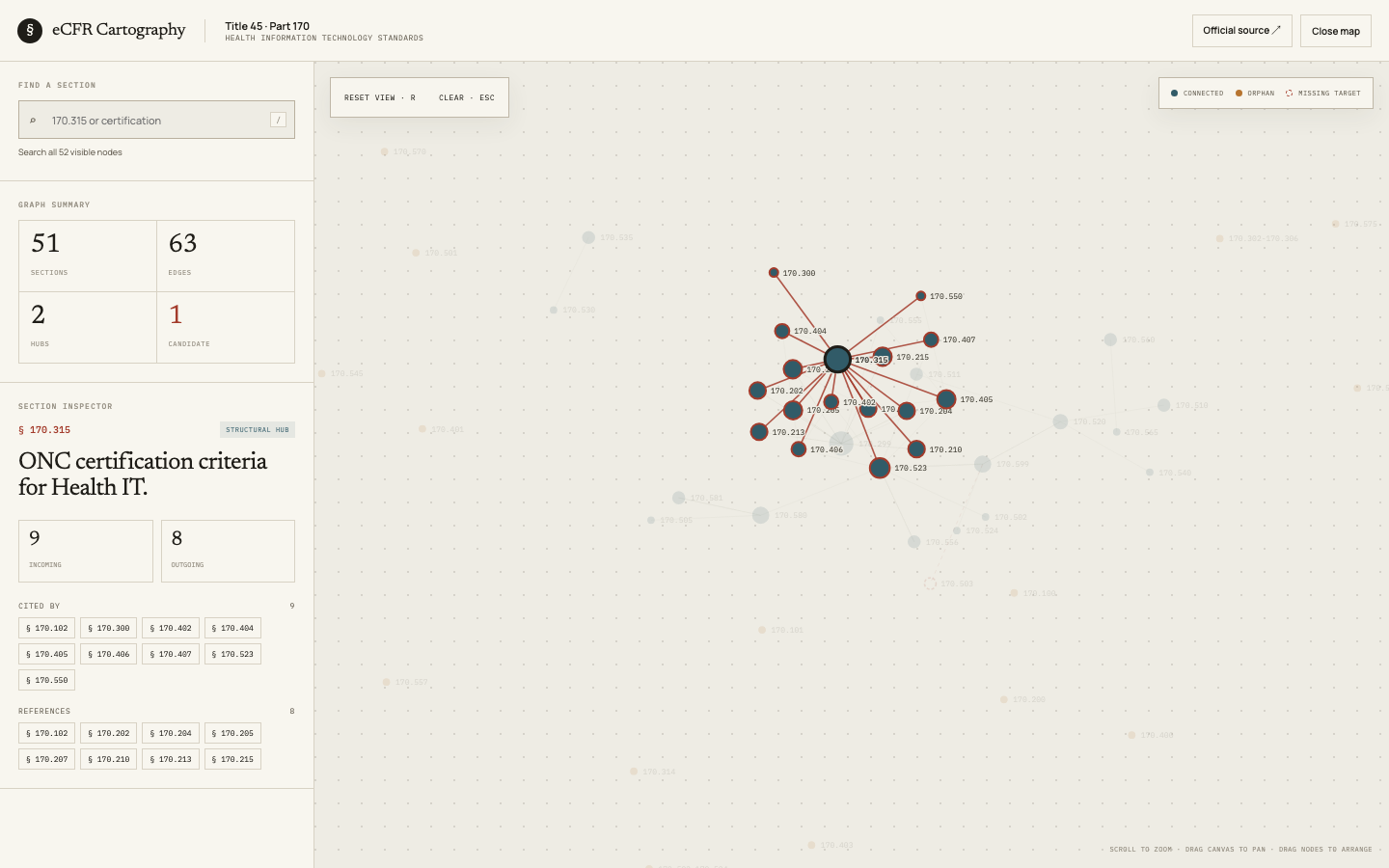
45 CFR part 170 in the Cartography investigation workspace. Node size scales with in-degree; the federal-blue cluster centers on the twin hubs § 170.315 and § 170.299; orphans (definitions, one-off subparts) sit ochre on the periphery; and the red dashed ghost is § 170.503 — a citation target § 170.599 still points at, even though § 170.503 was removed in the 2020 ONC final rule.
Tools
| Tool | What it does | When to reach for it |
|---|---|---|
search_regulations(query, per_page) |
Full-text search across all 50 CFR titles. | Discover which title/part governs a topic. |
get_part_structure(title, part) |
Ordered list of every section + its heading. | Get a table of contents cheaply. |
get_section_text(title, part, section, date?) |
Full section text + every citation extracted from it. | Read one section and see where it points. |
map_part_references(title, part) |
Flagship. Builds the intra-part citation graph — nodes, edges, top-10 hubs, orphans, external refs, statutory authorities. | Ask "which section anchors this part?" or "what other parts does this part depend on?" |
find_stale_references(title, part) |
Same-part citations whose target section doesn't exist in the fetched part. | Surface likely-broken cross-references for a compliance-review workflow. |
get_section_history(title, part, section) |
Every amendment version recorded for a section. | Point-in-time questions ("what did this look like before 2020?"). |
Every tool returns a JSON string. Errors come back as {"error": "..."} rather
than exceptions, so an LLM caller never sees a raw traceback.
Install
Requires Python 3.11+.
git clone https://github.com/apraba05/ecfr-cartography-mcp
cd ecfr-cartography-mcp
python -m venv .venv && source .venv/bin/activate
pip install -r requirements.txt
Run the offline test suite:
pytest -q               # 18 tests, all pure — no network
pytest -m integration -q  # 5 tests, hits the live eCFR API
Confirm the server registers all six tools:
python server.py --list
# search_regulations
# get_section_text
# get_part_structure
# map_part_references
# find_stale_references
# get_section_history
Wire it up to Claude Desktop / Claude Code
Add this to your MCP client's config
(~/Library/Application Support/Claude/claude_desktop_config.json on macOS, or
.claude/mcp.json for Claude Code):
{
  "mcpServers": {
    "ecfr-cartography": {
      "command": "python",
      "args": ["/absolute/path/to/ecfr-cartography-mcp/server.py"]
    }
  }
}
Restart the client. The six tools show up under the ecfr-cartography server.
Three-minute demo (45 CFR part 170 — ONC health-IT certification)
Copy-paste these into a Claude conversation with the server connected. The narrative shows an agent walking the graph rather than word-searching PDFs.
1. Discover the part with search.
Tool:
search_regulationsArgs:query="electronic health records certification API",per_page=5
Every result surfaces its title + part. Expect 45 CFR 170 (ONC Health IT Certification) at the top for this query.
2. Map the entire part in one call.
Tool:
map_part_referencesArgs:title="45",part="170"
Returns ~51 sections and ~63 intra-part edges. The top_referenced list
identifies § 170.315 (Certification criteria) and § 170.299 (Incorporation
by reference) as the twin hubs — each with in-degree 9. Roughly a third of the
sections are orphans (definitions, purpose statements, one-off subparts).
3. Ask the model to spot broken cross-references.
Tool:
find_stale_referencesArgs:title="45",part="170"
Returns one candidate: § 170.599 → § 170.503. Section 170.599 ("Incorporation by reference") says "IBR approved for § 170.503" — but 170.503 isn't in the current part.
4. Prove it with the versioner (the point-in-time story).
Tool:
get_section_historyArgs:title="45",part="170",section="170.503"
Response: three versions, the last one on 2020-06-30 with
"removed": true. The ISO/IEC standard incorporated by reference in § 170.599
is anchored to a section that was retired six years ago. That's a real
regulatory-graph defect surfaced without a human reading the whole part.
5. Optional flourish — recover the removed text.
Tool:
get_section_textArgs:title="45",part="170",section="170.503",date="2020-05-01"
Fetches the part as it stood before the removal so the model can quote the old language back to you.
Honest limitations
- Recall isn't perfect. Citation extraction is regex-based. It handles the
common forms exhaustively —
§ 170.404,§§ 170.401 through 170.404,45 CFR 164.512,42 CFR part 2,part 171 of this title,42 U.S.C. 300jj-11,42 U.S.C. §§ 1301 et seq.— but obscure phrasings ("the regulation at Title 45, Section 170.315") will slip through. A statistical extractor would push recall higher at the cost of the "reproducible, offline unit-testable" property that made regex the right call for a portfolio piece. find_stale_referencesreturns candidates, not conclusions. A dangling target may be a reserved section, an intentional cross-title cite, or a paragraph-level reference the extractor misread. The tool response says so explicitly. Always verify against the source before acting.- Large parts pull a lot of XML. 40 CFR part 60 is ~13 MB of XML and yields
1,800+ sections and 5,600+ edges.
map_part_referenceshandles it, but the D3 visualizer starts to strain — the tool is happier on chunks the size of 45 CFR 170. - In-memory caching only. The httpx client caches within one server process. There's no on-disk cache; a restart re-fetches.
- Titles-list resolution is authoritative for dates. The versioner is
point-in-time. If you don't pass a
date, we use the title'sup_to_date_as_of— which may lag reality by a business day or two.
Next steps
- Statute → regulation authorization graph. The
statutory_refsfield already collects USC citations. Cross-link them against uscode.house.gov to build the "which statute authorizes this rule?" graph — the reverse of what agencies publish. - State administrative codes. Same shape, different sources — Cornell's LII
and per-state SoS APIs. A
search_state_regulationstool + amap_state_part_referencestool would drop straight in beside these six. - Diff two point-in-time snapshots.
get_section_historyalready exposes version dates; adiff_section(section, date_a, date_b)tool would surface what changed between rulemakings. - Federal Register cross-linking. Each amendment date maps back to a
Federal Register notice; adding a
get_amendment_noticetool would connect the graph to the rulemaking record.
Files
server.py       FastMCP server — six tools over stdio
citations.py    Pure citation extractor + ReferenceGraph (no HTTP)
visualize.py    CLI: python visualize.py 45 170 → graph.html
tests/
  test_citations.py     18 offline tests
  test_integration.py    5 live-API smoke tests
MIT licensed. Contributions welcome.
Установка Ecfr Cartography
У этого сервера нет опубликованного пакета — он собирается из исходников. Открой репозиторий и следуй инструкции в README.
▸ github.com/apraba05/ecfr-cartography-mcpFAQ
Ecfr Cartography MCP бесплатный?
Да, Ecfr Cartography MCP бесплатный — установка в пару кликов через Unyly без оплаты.
Нужен ли API-ключ для Ecfr Cartography?
Нет, Ecfr Cartography работает без API-ключей и переменных окружения.
Ecfr Cartography — hosted или self-hosted?
Доступен hosted-вариант: Unyly запускает сервер в облаке, локальная установка не обязательна.
Как установить Ecfr Cartography в Claude Desktop, Claude Code или Cursor?
Открой Ecfr Cartography на unyly.org, выбери вкладку своего клиента (Claude Desktop, Claude Code, Cursor) и нажми Install — конфиг сгенерируется автоматически, без правки JSON.
Похожие MCP
GitHub
PRs, issues, code search, CI status
 автор: GitHub
Filesystem
Secure file operations with configurable access controls.
Memory
Knowledge graph-based persistent memory system.
Template MCP Server
A CLI tool to create a new Model Context Protocol server project with TypeScript support, dual transport options, and an extensible structure
 автор: mcpdotdirect
Compare Ecfr Cartography with
Не уверен что выбрать?
Найди свой стек за 60 секунд
Автор?
Embed-бейдж для README
Похожее
Все в категории development