
FastMCP Prompts Example
БесплатноНе проверенA tutorial demonstrating how to build reusable, parameterized MCP prompt templates using FastMCP, including patterns for research, summarization, and code revie

Описание
A tutorial demonstrating how to build reusable, parameterized MCP prompt templates using FastMCP, including patterns for research, summarization, and code review.
README
Follow on X WhatsApp Channel License
A small, focused tutorial showing how to build MCP prompts with FastMCP — reusable, parameterized message templates that any MCP client (Claude Desktop, IDEs, custom agents) can discover and render.
📚 Perfect as a first step into the Model Context Protocol before diving into tools and resources.
📖 What are MCP prompts?
While MCP tools let a model do things and resources let it read things, prompts are user-controlled templates: the client lists them, fills in their arguments, and injects the rendered messages into the conversation. Think of them as slash commands for LLMs.
✨ What this example covers
main.py demonstrates the three patterns you'll use most, from simplest to most powerful:
| # | Prompt | Pattern | Concept demonstrated |
|---|---|---|---|
| 1 | research_prompt |
Return a plain str |
Simplest form — auto-wrapped in a single user message |
| 2 | summarize_prompt |
Optional + constrained args | Literal types & defaults become a client-visible argument schema |
| 3 | code_review_prompt |
Return list[Message] |
Seed a full multi-turn conversation (user + assistant messages) |
Along the way you'll also see: naming, descriptions, tags, and server instructions.
🚀 Quickstart
Prerequisites: Python 3.12+ and uv.
# 1. Clone and enter the project
git clone https://github.com/mohamedelamraoui1/fastMCP-2-0-example.git
cd fastMCP-2-0-example

# 2. Install dependencies
uv sync

# 3. Run the server (stdio transport)
uv run main.py
If everything is set up correctly, you'll see the FastMCP banner and the server waiting for a client on stdio:
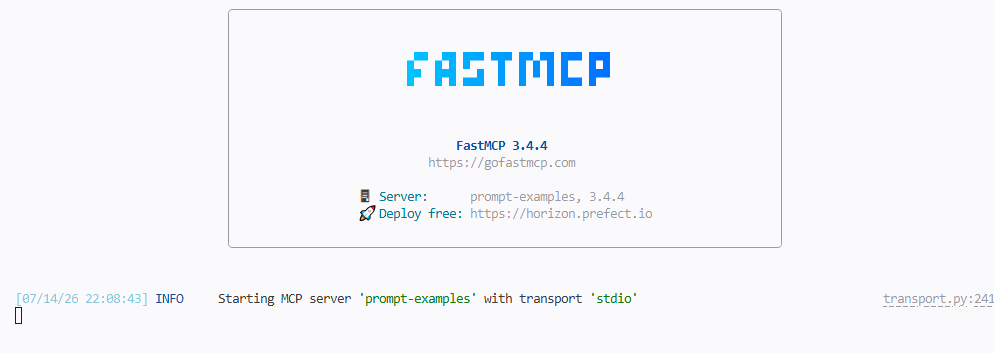
🔍 Test with the MCP Inspector
The fastest way to explore the prompts is the MCP Inspector — a web UI for poking at any MCP server. It requires Node.js (the Inspector is an npm package that FastMCP launches for you).
Step 1 — Launch the Inspector:
uv run fastmcp dev inspector main.py
You'll see output like this, and your browser opens automatically:
🚀 MCP Inspector is up and running at:
   http://localhost:6274/?MCP_PROXY_AUTH_TOKEN=<session-token>
⚙️ Proxy server listening on localhost:6277
If the browser doesn't open, copy the full URL (including the token) from the terminal.
Step 2 — Connect to the server. The connection form is pre-filled (transport STDIO, command fastmcp run main.py). Just click Connect — the indicator turns green when the handshake succeeds.
Step 3 — List the prompts. Open the Prompts tab and click List Prompts. You should see all three: research_prompt, summarize_prompt, and code_review_prompt, each with its description.
Step 4 — Render a prompt. Click a prompt, fill in its arguments in the form (e.g. topic = "quantum computing" for research_prompt), and click Get Prompt. The right panel shows the exact messages the server returns.
Step 5 — See the interesting cases:
- On
summarize_prompt, notice thelengthandtonefields only accept theLiteralvalues from the type hints — that's the argument schema in action. - On
code_review_prompt, paste any snippet ascodeand notice the result is three messages (user→assistant→user), not one — a pre-seeded conversation.
When you're done, stop the Inspector with Ctrl+C in the terminal.
🖥️ Use it from Claude Desktop
Add the server to your Claude Desktop config (claude_desktop_config.json):
{
  "mcpServers": {
    "prompt-examples": {
      "command": "uv",
      "args": ["run", "--directory", "C:/absolute/path/to/fastMCP-2-0-example", "main.py"]
    }
  }
}
Restart Claude Desktop, then look for the prompts in the + (attachments) menu.
💡 No API key needed. Claude Desktop uses your Claude account, and this MCP server only serves prompt templates — it never calls an LLM itself. You'd only need an Anthropic API key if you wrote your own client that sends the rendered prompts to the API.
🗂️ Project structure
.
├── main.py          # The MCP server — 3 prompt patterns, fully commented
├── assets/          # Screenshots used in this README
├── pyproject.toml   # Project metadata & dependencies
├── uv.lock          # Locked dependency versions
└── README.md
📚 Learn more
- FastMCP documentation — the framework used here
- FastMCP: Prompts guide — deep dive on the prompt API
- Model Context Protocol — the open protocol specification
- MCP: Prompts concept — how clients consume prompts
🛠️ Tech stack
| Technology | Role |
|---|---|
| Python 3.12+ | Language |
| FastMCP 3.x | MCP server framework |
| uv | Dependency & environment management |
📄 License
This project is licensed under the MIT License — see the LICENSE file for details.
Made with ❤️ for the MCP community. Follow @mcoding_off for more tutorials.
Установка FastMCP Prompts Example
У этого сервера нет опубликованного пакета — он собирается из исходников. Открой репозиторий и следуй инструкции в README.
▸ github.com/mohamedelamraoui1/mcp-prompts-tutorialFAQ
FastMCP Prompts Example MCP бесплатный?
Да, FastMCP Prompts Example MCP бесплатный — установка в пару кликов через Unyly без оплаты.
Нужен ли API-ключ для FastMCP Prompts Example?
Нет, FastMCP Prompts Example работает без API-ключей и переменных окружения.
FastMCP Prompts Example — hosted или self-hosted?
Self-hosted: сервер запускается локально на твоей машине командой из раздела установки.
Как установить FastMCP Prompts Example в Claude Desktop, Claude Code или Cursor?
Открой FastMCP Prompts Example на unyly.org, выбери вкладку своего клиента (Claude Desktop, Claude Code, Cursor) и нажми Install — конфиг сгенерируется автоматически, без правки JSON.
Похожие MCP
GitHub
PRs, issues, code search, CI status
 автор: GitHub
Filesystem
Secure file operations with configurable access controls.
Memory
Knowledge graph-based persistent memory system.
Template MCP Server
A CLI tool to create a new Model Context Protocol server project with TypeScript support, dual transport options, and an extensible structure
 автор: mcpdotdirect
Compare FastMCP Prompts Example with
Не уверен что выбрать?
Найди свой стек за 60 секунд
Автор?
Embed-бейдж для README
Похожее
Все в категории development