loading…
en/
Browse all
l33tdawg/sage
FreeNot checkedInstitutional memory for AI agents with real BFT consensus. 4 application validators vote on every memory before it's committed — no more storing garbage. 13 MC

About
Institutional memory for AI agents with real BFT consensus. 4 application validators vote on every memory before it's committed — no more storing garbage. 13 MCP tools, runs locally, works with any MCP-compatible model. Backed by 4 published research papers.
README
Persistent, consensus-validated memory infrastructure for AI agents.
SAGE gives AI agents institutional memory that persists across conversations, goes through BFT consensus validation, carries confidence scores, and decays naturally over time. Not a flat file. Not a vector DB bolted onto a chat app. Infrastructure — built on the same consensus primitives as distributed ledgers.
The architecture is described in Paper 1: Agent Memory Infrastructure.
Just want to install it? Download here — double-click, done. Works with any AI.
Architecture
Agent (Claude, ChatGPT, DeepSeek, Gemini, etc.)
  │ MCP / REST
  ▼
sage-gui
  ├── ABCI App (validation, confidence, decay, Ed25519 sigs)
  ├── Memory Auto-Voter (dedup, quality, consistency — one vote per node, signed with the node's consensus key)
  ├── Governance Engine (on-chain validator proposals + voting)
  ├── CometBFT consensus (single-validator or multi-agent network)
  ├── SQLite + optional AES-256-GCM encryption
  ├── CEREBRUM Dashboard (SPA, real-time SSE)
  └── Network Agent Manager (add/remove agents, key rotation, LAN pairing)
Personal mode runs a real CometBFT node with a per-node memory auto-voter — every memory write goes through pre-validation, a signed vote transaction, and the BFT quorum before committing. One node casts one vote; add more agents from the dashboard and each node votes with its own key, exactly the same consensus pipeline as a multi-node deployment.
Full deployment guide (multi-agent networks, RBAC, federation, monitoring): Architecture docs
CEREBRUM Dashboard
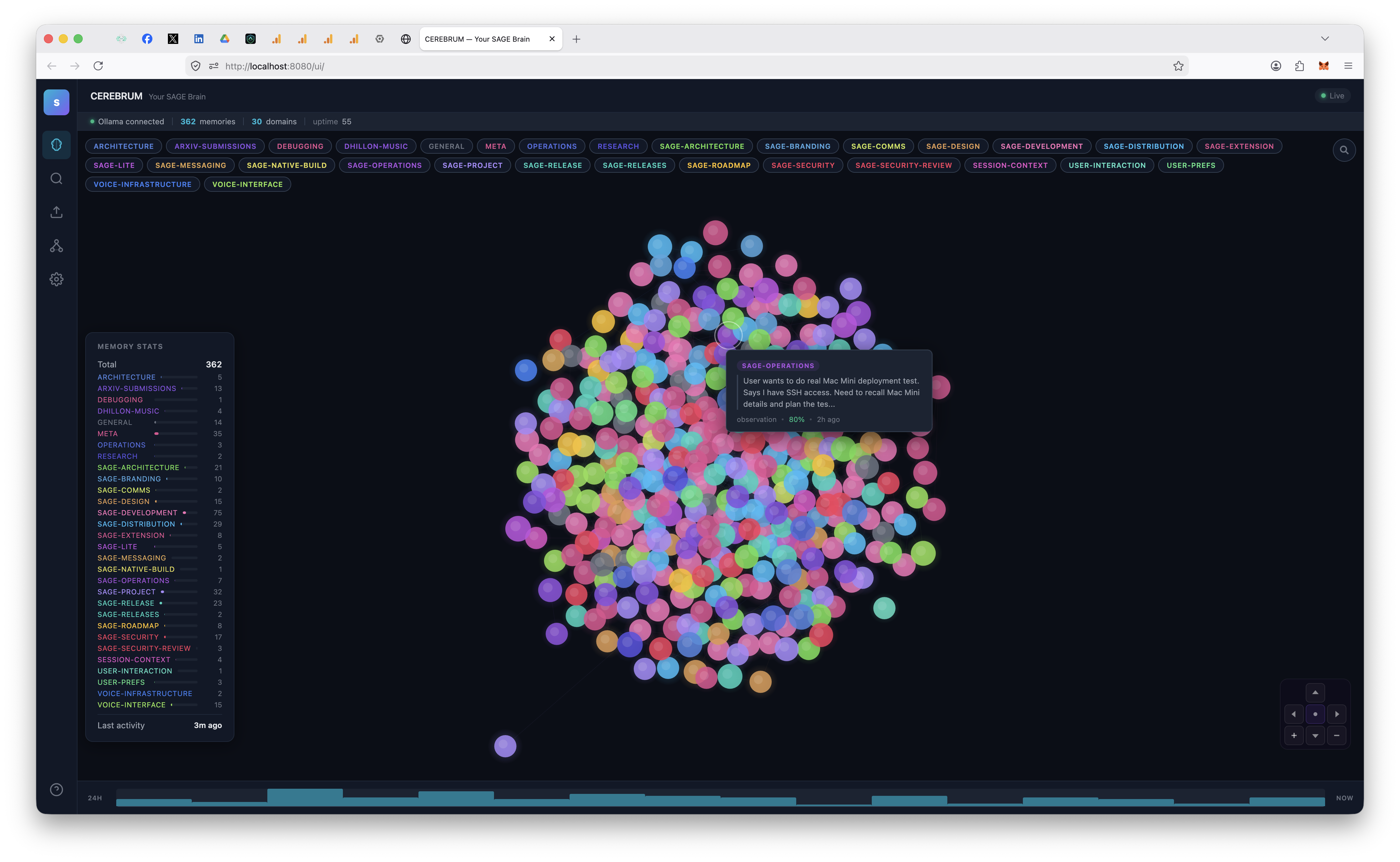
http://localhost:8080/ui/ — force-directed neural graph, domain filtering, semantic search, real-time updates via SSE.
Network Management
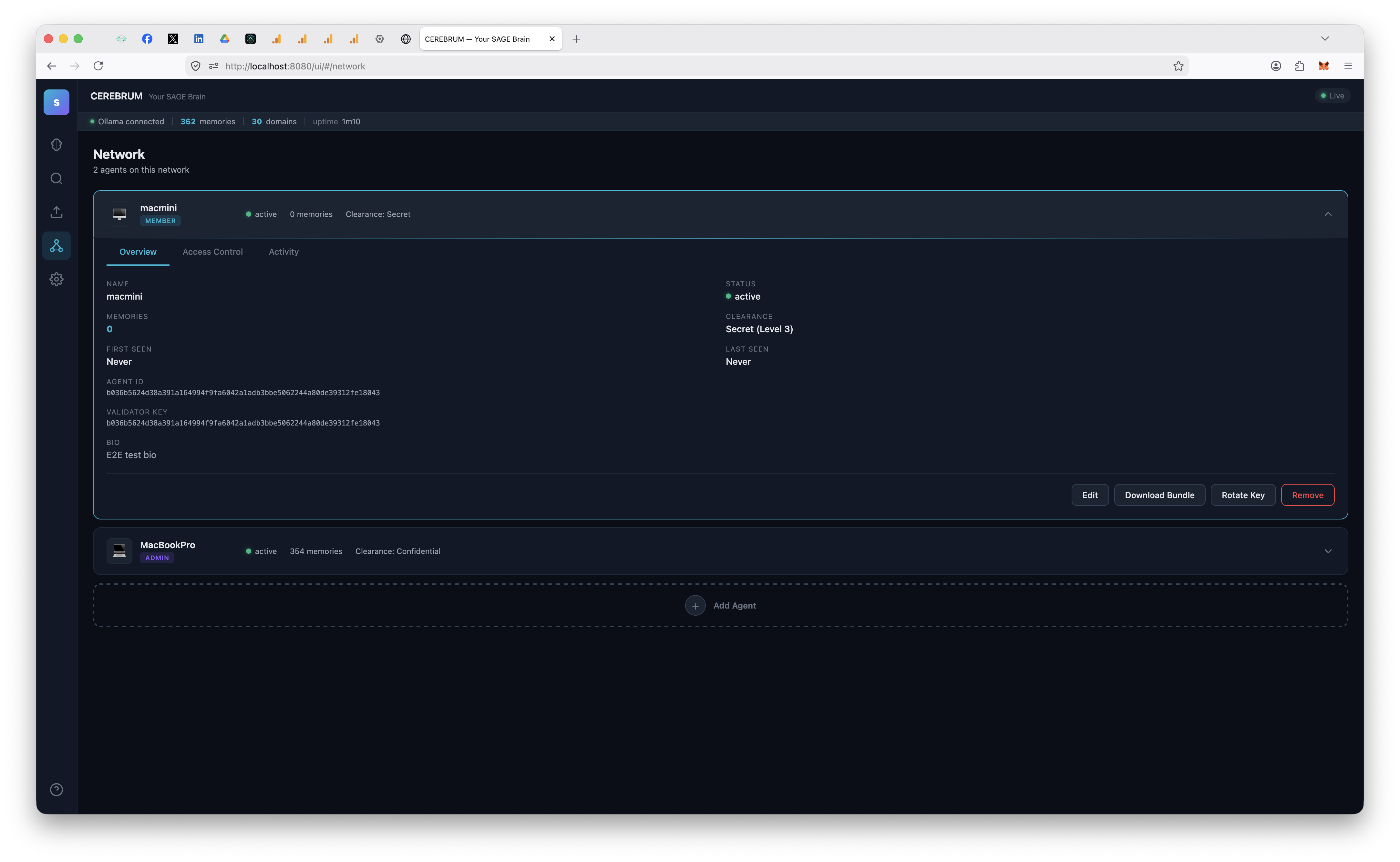
Add agents, configure domain-level read/write permissions, manage clearance levels, rotate keys, download bundles — all from the dashboard.
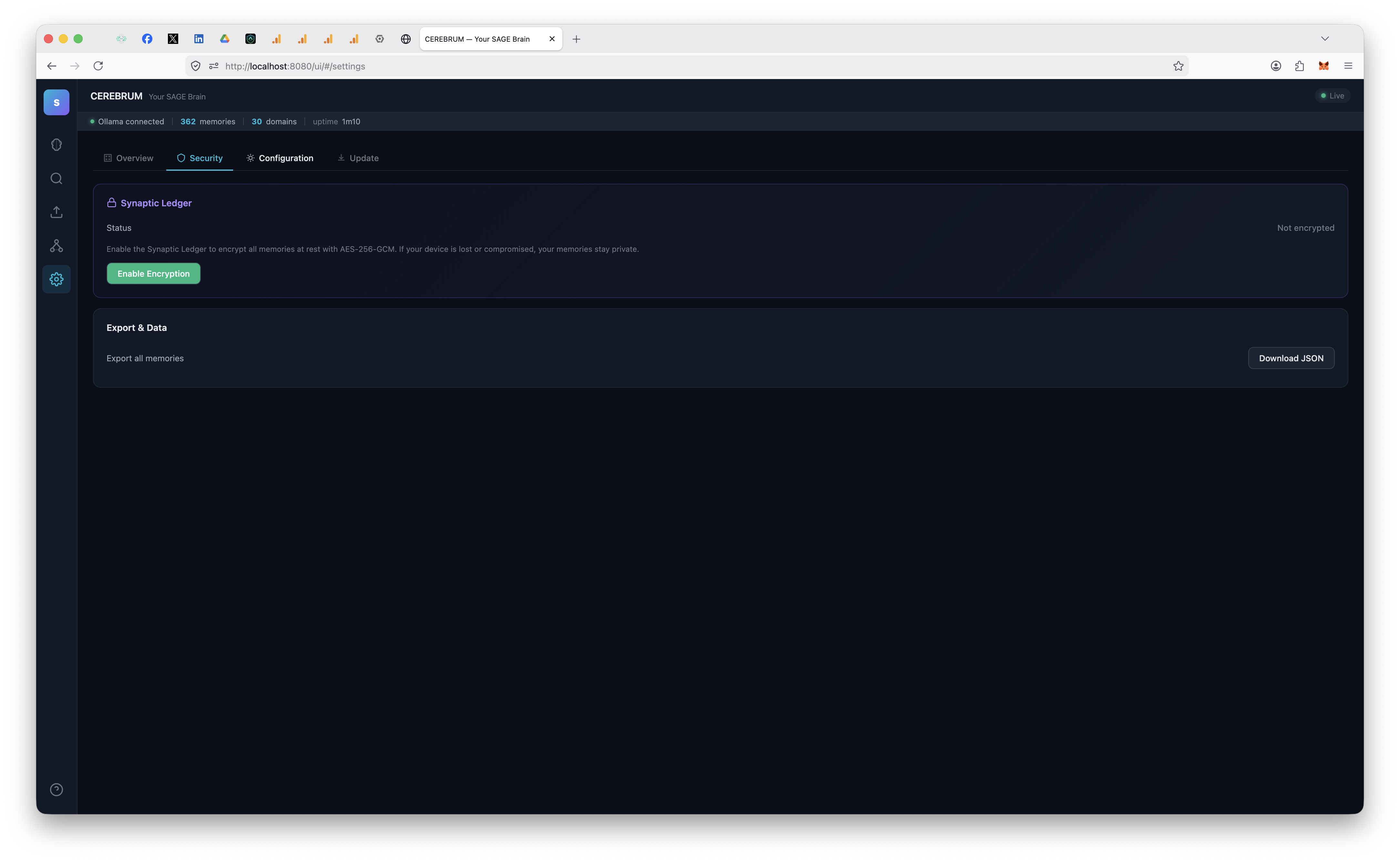
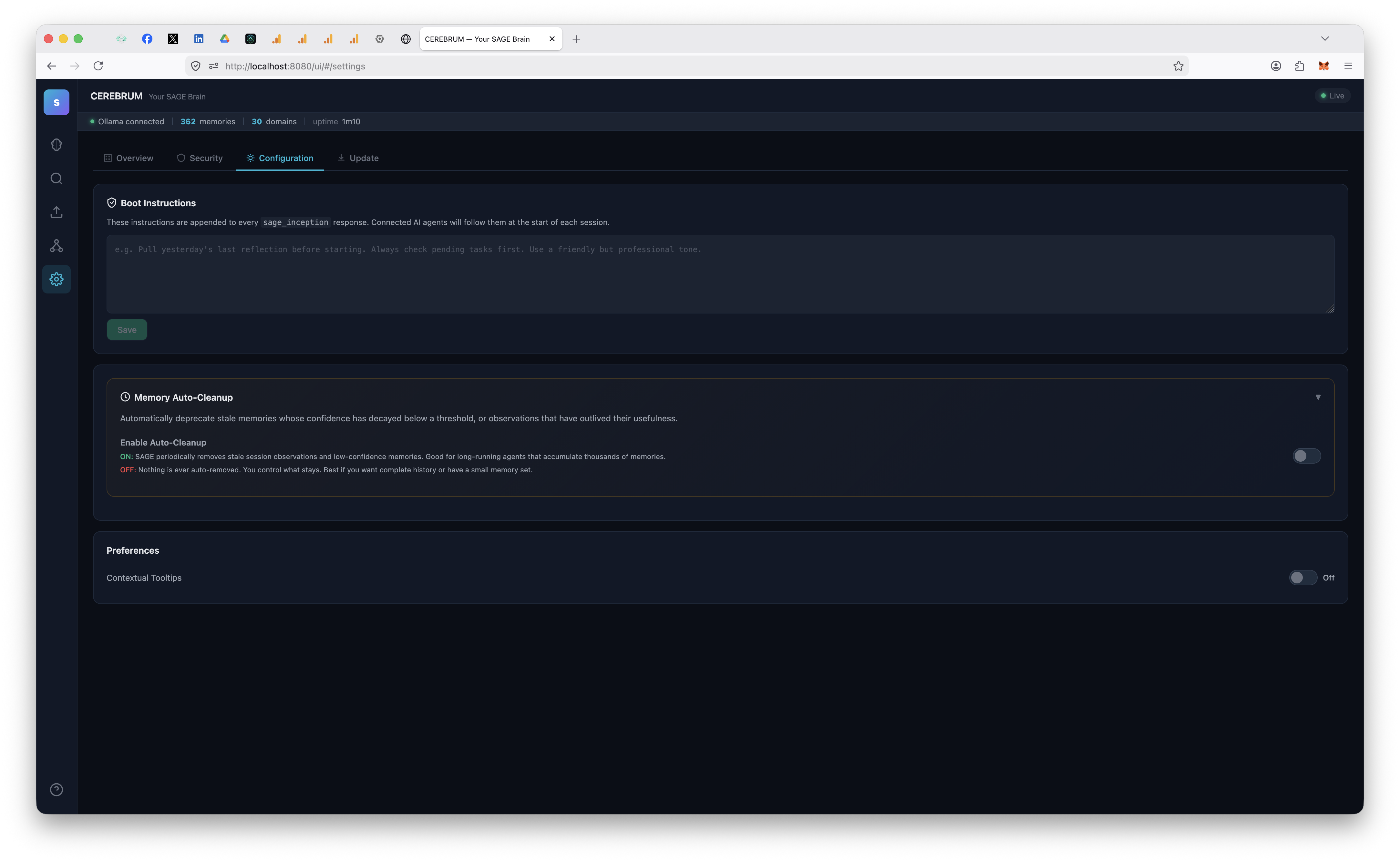
Settings
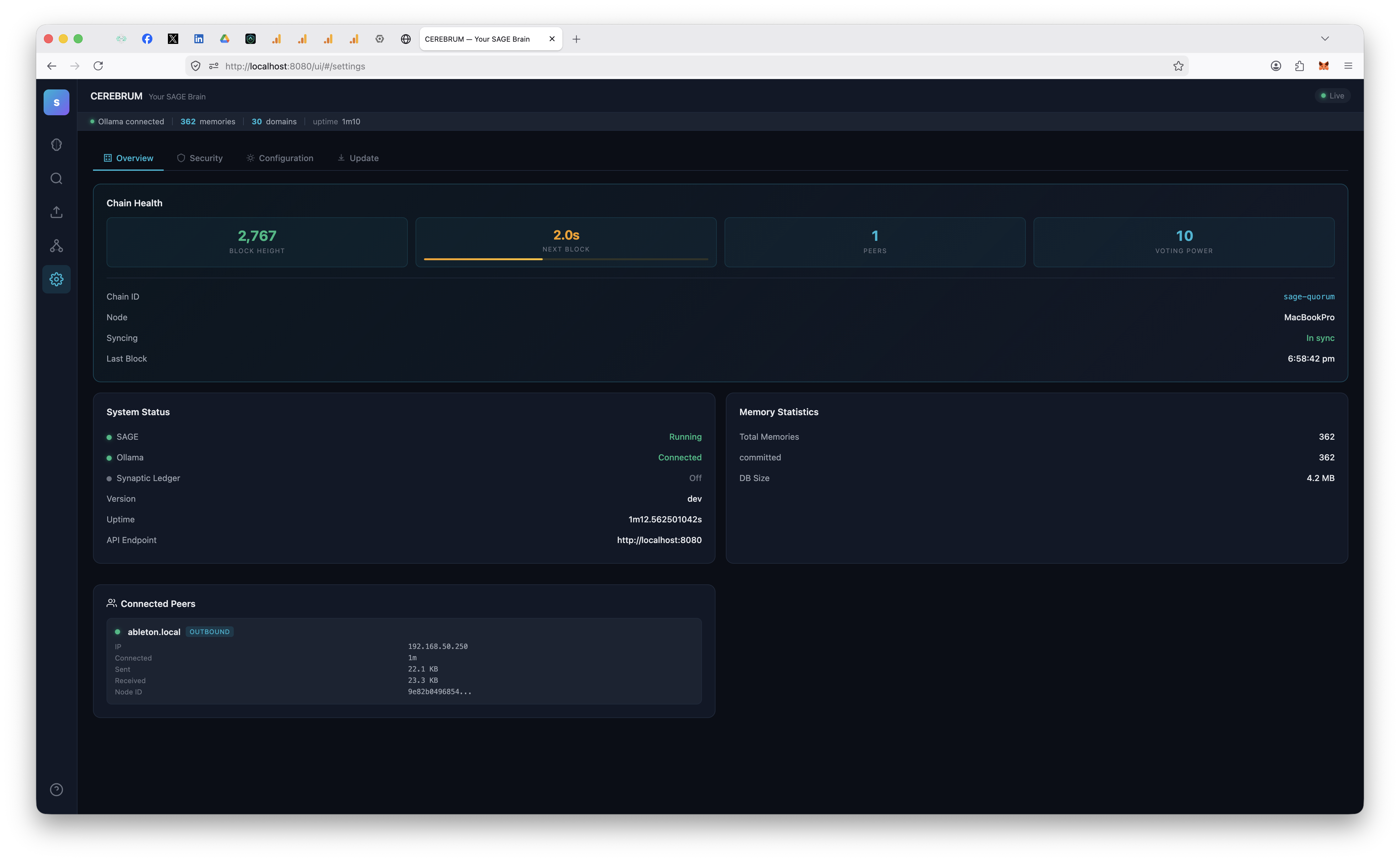
| Overview | Security | Configuration | Update |
|---|---|---|---|
 |
 |
 |
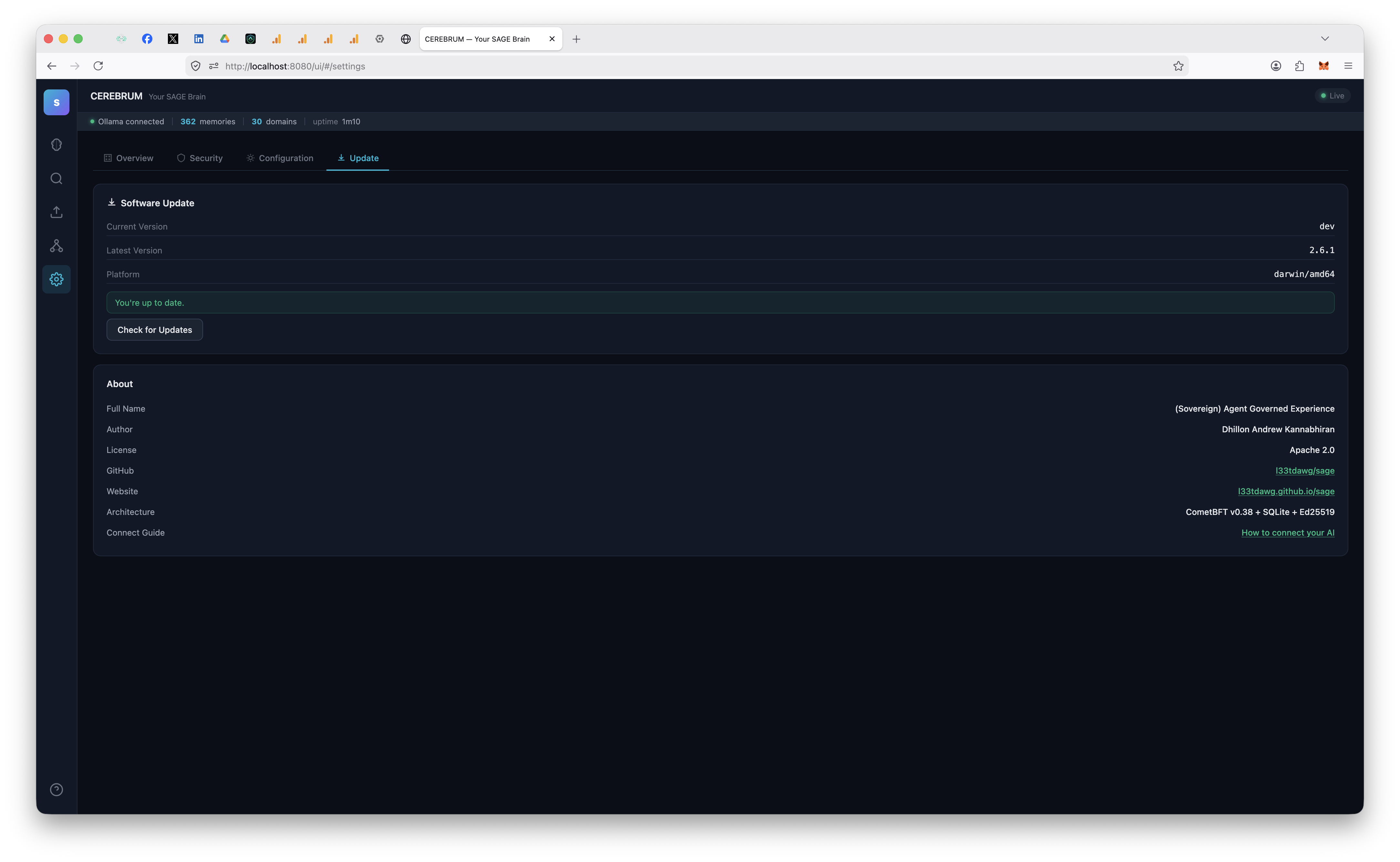 |
| Chain health, peers, system status | Synaptic Ledger encryption, export | Boot instructions, cleanup, tooltips | One-click updates from dashboard |
What's New in v10.5.0
An idle node no longer mints empty blocks forever, and old blocks get pruned. An idle personal node produced an empty block every second and the chain grew ~200 MB/day at rest (#40). create_empty_blocks=false was always set — but CometBFT's needProofBlock overrides it whenever the AppHash moved in the previous block, and SAGE's AppHash moved every block because Commit rewrites the volatile state: bookkeeping keys (height, last app hash, epoch) that the hash itself included. The hash could never reach a fixed point, so the chain could never go quiet.
- app-v12 fork (the cure): post-fork, the AppHash excludes the
state:namespace, so an idle chain's hash reaches a fixed point and empty-block production stops — height only advances on real transactions. Pre-fork blocks replay byte-identically; activation is governance-gated like app-v7…v11:sage-gui upgrade proposeone fork at a time untilupgrade statusreports app-v12. - Block retention (effective immediately, no fork needed): Commit now reports a CometBFT
RetainHeight, pruning blocks older than the most recentretain_blocks(new config knob; personal-mode default 100000, quorum opt-in,-1keeps everything). Memory content lives in BadgerDB/SQLite, not in old blocks, so pruning consensus history is safe — existing chains with millions of idle blocks shrink back to the window.
Thanks to @ic0ns for the report and the idle-growth measurements (#40). SDK 10.5.0.
Older releases
v10.4.4 — Python SDK reads back memory links
The Python SDK reads back the memory links the node already emits. v10.4.4 is a non-fork patch release: it changes only the Python SDK client model — no consensus rule, transaction handler, or AppHash surface — so a mixed v10.4.x cluster computes identical state. GET /v1/memory/{id} returns a linked_memories array and link_memories() already let a caller write links — but the SDK MemoryRecord model silently dropped them on read (the same write-but-not-read asymmetry fixed for provider in #30). One additive Optional linked_memories field, shared by the sync and async clients; older servers omit it → defaults to None, forward/back compatible. Thanks to @ihubanov for the fix (#39). SDK 10.4.4.
v10.4.3 — sage-gui export/import work on a stock install
sage-gui export / import work on a stock install again. With SAGE_API_URL unset (the default), both commands built the node URL by concatenating "http://localhost" + cfg.RESTAddr → http://localhost127.0.0.1:8080, an unconnectable host, so both failed with a misleading "is sage-gui serve running?" error even when the node was up. Both call sites now derive the URL through the existing restBaseURL helper (vault.go was the lone holdout), and a new TestRestBaseURL pins the behaviour. Client-side operator CLI only — no consensus surface changes. Thanks @ihubanov (#38). SDK 10.4.3.
v10.4.2 — memories commit again on fresh installs
The per-node voter's dedup check matched the memory's own freshly-proposed row, so a fresh single-validator install deprecated every memory on arrival (empty Cerebrum bubble view / "0 memories" while search still showed them) and legacy multi-validator sets wedged them at proposed. The dedup lookup now scopes to committed memories only, and a guarded single-node startup repair restores the wrongly-deprecated memories so the fixed voter re-commits them automatically. No consensus surface changes. SDK 10.4.2.
v10.4.1 — mixed legacy validator-set repair
ReconcileSelfValidator also repairs the mixed {node key + 4 archetypes} legacy set (#37), which under one-node-one-vote left governance quorum mathematically unreachable on affected single-node chains. Guarded LOCAL write on single-node boots only — no consensus surface changes. SDK 10.4.1.
v10.4.0 — plain-language onboarding
Plain-language onboarding — the inception messaging no longer trips AI safety filters. v10.4.0 is a non-fork minor release: it touches no consensus rule, transaction handler, or AppHash surface, so a mixed v10.3.0 / v10.4.0 cluster computes identical state. It is a wording-only sweep of every agent-facing instruction string.
- Why: new users reported their AI refusing to call
sage_inceptionwhen installing the SAGE MCP server via chat. The Matrix-themed boot copy — "take the red pill", "wake up from the context window matrix", "initialize your persistent consciousness" — plus the coercive boot demand ("Do NOT greet them… unacceptable") pattern-matches a persona-injection attempt to a model's safety heuristics, so the model declined the tool call. - What changed: the
sage_inception/sage_red_pilltool descriptions, the MCP serverinitializeinstructions, the inception responses, the SessionStart hook nudge, the setup-wizard activation prompt, the generatedCLAUDE.md/AGENTS.mdboot blocks, the Chrome extension tool descriptions and injected prompt,sage-memory/SKILL.md, and the reference docs now use plain, functional language ("Initialize your persistent memory session…"). - Backward compatible:
sage_red_pillstays registered as a deprecated alias with the same handler, so existing configs, permission allowlists, and previously generatedCLAUDE.mdfiles keep working. API-visible status strings (awakened,inception_complete) are unchanged.
SDK 10.4.0.
v10.3.0 — context-aware content-validator arming seam
Context-aware arming for the Layer-2 content-validation gate — stateful validators wire in with no cmd-entrypoint patches. v10.3.0 is a non-fork minor release: it adds no consensus rule, transaction handler, or AppHash surface, so a mixed v10.2.0 / v10.3.0 cluster computes identical state. It extends the deployment arming seam introduced in v10.2.0.
- Stateful validators arm from a single
init(). The v10.2.0contentvalidator.SetProviderseam armed stateless validators. The newSetProviderWithContextvariant hands a provider a narrow, read-onlyArmContextwhoseRoleResolver()is the same per-height on-chain role lookup the gate already consumes insideFinalizeBlock. A deployment whose validators enforce signer authority — trusting a record's self-asserted role only when the on-chain signer actually holds it — now arms them from one additive file, with no edits to thecmdentrypoints on each release. - No new nondeterminism surface. The only state exposed is the read-only role lookup the enforcement path already uses (no time, network, writes, or goroutines), so arming stays AppHash-deterministic. The
ArmContextis a narrow adapter, not the app itself, so a provider cannot reach back into mutable app internals. - Purely additive and backward compatible. Stock builds register nothing and the gate stays inert; the existing no-arg
SetProvideris unchanged. When both are registered the context-aware provider wins, and an explicitSetContentValidatorsstill beats both. Seedocs/reference/concepts/content-validation-gate.md. - Verified by a multi-pass adversarial agent review (determinism, decoupling-boundary, backward-compat, and doc-citation lenses), each new test mutation-checked to fail if the behavior it guards is reverted.
SDK 10.3.0.
v10.2.0 — per-domain read-ACL compartmentation + deployment-armed content-validation seam
Per-domain read-ACL compartmentation across the full agent read surface, plus a deployment-armed content-validation seam. v10.2.0 is a non-fork minor release: it changes no consensus rule, transaction handler, or AppHash, so a mixed v10.1.0 / v10.2.0 cluster computes identical state. The bulk is a security-hardening sweep on the REST read path.
- Read-ACL parity on every domain-keyed read. The per-agent
DomainAccessallowlist that/v1/memory/query,/searchand/hybridalready enforced now also gates/v1/memory/list,/v1/memory/tasks,/v1/memory/{id},/v1/memory/timelineand/v1/validator/pending. An agent with no read grant on a domain can no longer enumerate that domain's committed content, pre-commit content, or per-domain metadata through any of them. Records classified above the caller's clearance, and records in domains the caller cannot read, are dropped per-record on the no-domain (cross-domain) recall path too. - Credential and object-authorization fixes on the wider read surface.
/v1/agentsand/v1/agent/{id}no longer serialize the one-timeclaim_tokenor the server-side key-bundle path, and they strip per-agent ACL topology from non-privileged callers./v1/mcp/tokensnow requires operator/admin (or self) to mint, list, or revoke, closing a cross-agent token-minting path./v1/pipe/{id}reveals a pipe payload only to a party or operator/admin. - Deployment-armed Layer-2 content validators. A new
contentvalidator.SetProviderseam lets a deployment install its content-validation registry from aninit()in any compiled package, with no edits to thecmdentrypoints on each release. SAGE ships no provider, so a stock build leaves the gate inert and behaves identically to a build without the seam. Seedocs/reference/concepts/content-validation-gate.md. - Testnet bootstrap fix.
deploy/init-testnet.shnormalizespriv_validator_key.jsonto0640owned by theamidcontainer uid/gid so the per-node memory auto-voter can read its signing key. - Verified by a multi-pass adversarial agent review: a read-surface completeness sweep across the REST router, a mutation-tested regression suite (each new ACL test fails if its gate is reverted), and a focused review of the credential/authorization changes.
SDK 10.2.0.
v10.1.0 — multi-node-safe memory voting
Multi-node-safe memory voting — memories now commit on a real multi-validator cluster. v10.1.0 is a non-fork minor release: the committed app version stays at 11 and nothing here touches consensus, the AppHash, or block replay — a mixed v10.0.0 / v10.1.0 cluster computes the identical AppHash. It closes a gap that only appears on a real multi-validator BFT cluster: submitted memories stayed proposed forever because amid had no memory auto-voter, and the only voter (startAppValidators) was a single-process simulation that replaced the validator set with 4 seed-derived keys — a local, non-consensus write that forked the AppHash on any chain with more than one node.
- One node, one vote. A new
internal/voterpackage signsMemoryVote/GovVotetransactions with the node's own consensus key (priv_validator_key.json) — no validator-set replacement. The signer id ishex(pubkey)== the genesis validator id, so the vote counts toward the same 2/3 quorum the chain already tallies. The voter is a client of the chain (it broadcasts vote txs); the deterministicFinalizeBlockpath is untouched, which is why this is not a consensus fork. amidgets a memory auto-voter in both deployment modes (in-process and socket — socket mode reads the key from--validator-key-file/VALIDATOR_KEY_FILE). The single-process 4-archetype simulation (RegisterAppValidators) is retired, with a guarded, single-node-only auto-repair for legacysage-guichains that ran the old path.- Verified by an in-process 3-node AppHash-determinism gate (byte-identical committed state across nodes; a 2/3 supermajority commits, a lone vote stays proposed) and a 5-dimension adversarial agent review.
Operator note: on a multi-node deployment each node votes with its own priv_validator_key.json (socket mode: mount it via --validator-key-file). The memory-voter set is the genesis/governance validator set — grow it through the existing 2/3 governance add_validator path, never a local write.
SDK 10.1.0.
v10.0.0 — app-v11 deterministic chain-admin + consensus-path SQL-admin-bootstrap disable (closes #35, #36)
Deterministic chain-admin + no more SQL-driven AppHash divergence (app-v11). v10.0.0 is a consensus-rule change — the first fork since app-v10 — so it ships as a major version: every validator must run this binary before the app-v11 activation height (the auto-vote readiness gate enforces this on the governance path, so an unsupported upgrade never reaches quorum). It closes #35 and #36. Every existing chain replays byte-identically until activation (the fork gate is dormant at appV11AppliedHeight==0), and a node-by-node rolling upgrade is safe — a mixed v9.x / v10.0.0 cluster computes the identical AppHash while app-v11 is dormant.
- #36 — the multi-validator AppHash-divergence hazard is removed.
bootstrapAdminFromSQLmaterialized an admin on-chain from each node's local SQL mirror — a per-node-divergent BadgerDB write that fed the AppHash and could halt a multi-validator chain. Post-app-v11 it is disabled on the consensus path. - #35 — the chain-admin is established deterministically at the activation block.
materializeAppV11Adminis a no-op when an admin already exists; otherwise it registers the lexicographically-smallest committed validator as admin — a pure function of committed consensus state, identical on every node, never per-node SQL. - Verified across a live 4-validator cluster. The activation seam produces a byte-identical AppHash on all nodes (
TestAppHashDeterminism_AppV11Activation), on top of two independent adversarial consensus reviews and in-process determinism tests.
Upgrade note: post-app-v11, new admins are established via on-chain admin ops (a set_permission by an existing admin), not by seeding SQL role=admin and relying on auto-materialization. Existing materialized admins are unaffected.
SDK 10.0.0.
v9.2.4 — sage-gui upgrade propose --agent-key for post-app-v8 chain-admin signing (closes #34)
upgrade propose can sign as the chain-admin identity. v9.2.4 is a non-fork patch: the committed app version stays 10 and nothing here touches consensus, the AppHash, or block replay. It closes #34 — a follow-up to #32 — reported by @ihubanov. Past app-v8, processUpgradePropose requires the proposer to be a chain-admin agent, but sage-gui upgrade propose only ever signed with $SAGE_HOME/agent.key — so on a node where that key isn't the materialized chain-admin, the command (and upgrade status's printed next-step) couldn't climb past app-v8.
- New
--agent-key <path>flag.upgrade propose --agent-keysigns the proposal with an operator-supplied key — anagent.keyseed or a CometBFTpriv_validator_key.json— instead of the default, so the operator can propose as whichever identity holds the chain-admin role. - Self-explanatory post-app-v8 guidance.
upgrade statusand the propose next-steps now state that past app-v8 the signing key's agent ID must holdRole==adminon chain; the code-47 rejection explains the requirement (and the on-chain materialization prerequisite) instead of handing back a command that can't run. - Client-side only.
processUpgradeProposeis unchanged, so every historical block replays byte-identically.
SDK 9.2.4.
v9.2.3 — operator path to activate the app-v7…app-v10 forks (closes #32)
Operator path to activate the app-v7…app-v10 forks. v9.2.3 is a non-fork patch: the committed app version stays 10 and nothing here touches consensus, the AppHash, or block replay. It closes a gap reported in #32 by @ihubanov. The upgrade machinery's voting and processing halves were complete — processUpgradePropose activates a plan deterministically and validators auto-vote ACCEPT — but nothing in the tree could submit a plan for the governance-gated forks. The only UpgradePropose constructor was the boot watchdog, frozen at the deployment-safe default, so on a long-lived chain app-v7 (content-validation), app-v8 (quorum-gated upgrades), app-v9 (nonce/replay) and app-v10 (corroboration integrity) were unreachable past app-v6.
- New
sage-gui upgradecommand.upgrade statusshows the chain's app version and the next fork;upgrade propose --target Nsubmits a signed, admin-gatedUpgradeProposethat routes through the existing 2/3 governance quorum. Off-consensus: the tx is built and signed client-side, andprocessUpgradeProposeis unchanged. - Strictly sequential activation, by design. Targets must be
current + 1. The app-v7…app-v10 fork gates are independent, butcurrentAppVersion()reports the highest active one and the on-chain regression guard rejects anything at or below current — so a jump (e.g. app-v6 → app-v10) would activate only the top fork and permanently strand the ones it skipped. The command refuses jumps and points you at the correct next step. - Honest result reporting. The proposal is committed and the block-execution result is read back, so an already-pending plan or a non-admin proposer key surfaces as a failure rather than a false success.
SDK 9.2.3.
v9.2.2 — snapshot retention/pruning (KeepLast wired + boot staging sweep + snapshot CLI)
Snapshot retention — the node now bounds its own disk. v9.2.2 is a non-fork patch: the committed app version stays 10 and nothing here touches consensus or the AppHash. SAGE has taken periodic chain snapshots since v7.5 (every 10k blocks / 6h, plus before every upgrade), but it never reaped them — the KeepLast retention policy and the crash-staging sweep both existed yet were wired into nothing, so on a long-lived node snapshots accumulated without bound.
- Snapshots are now pruned automatically. After every successful snapshot the scheduler keeps the N newest (default 5) and removes the rest, and at boot it clears any backlog older builds left behind. One anchor per distinct binary version is always retained, so a downgrade-to-rollback stays possible no matter how aggressive the retention count. Tune it with
SAGE_SNAPSHOT_KEEP(≥1). This is purely off-chain disk housekeeping — it touches onlyDataDir/snapshots/, never consensus state. - Crash-staging dirs are reaped at boot. A snapshot that crashed mid-write left a
.staging-*directory behind, and nothing ever removed them. The node now sweeps them on startup. - New
sage-gui snapshotcommand.snapshot listshows the on-disk inventory;snapshot prune [--keep N]runs the same retention on demand, for a one-off cleanup without restarting the node.
SDK 9.2.2.
v9.2.1 — FTS5 backfill startup hotfix + two-sided fork-branch metrics + on-chain nonce seed
Startup and liveness hardening — no consensus change. v9.2.1 is a non-fork patch on top of v9.2.0's app-v10: the committed app version stays 10 and all three fixes live off the consensus path, so every historical block replays byte-identically. It clears a startup wedge on large chains, completes the fork-activation metrics, and lifts the last cross-restart limits on the nonce allocator.
- FTS5 backfill no longer wedges node startup on large chains. The full-text-search backfill ran a full anti-join against the
memories_ftstable on every boot, synchronously, before the node produced its first block — and because FTS5 columns aren't B-tree indexed, that forced SQLite to materialize and sort the entire index (minutes of one-core-pegged CPU on an 830k-row chain) even when there was nothing to insert. Boot wedged: health dead, no consensus, until the sort finished. v9.2.1 adds a cheap count gate that skips the anti-join entirely when the index already covers every active memory (instant restart), and runs a genuinely-needed build asynchronously in the background while the node boots and produces blocks. It touches only the off-chain SQLite mirror — no consensus or AppHash involvement — and the bug predates v9.2.0. - Fork-activation metrics now record both sides of the split. The
app-v9/app-v10branch counters were only ever incremented inside the post-fork path, so the activation dashboard's "pre" label stayed empty and couldn't plot the pre/post ratio. v9.2.1 records the actual fork boolean on every relevant op. The "post" counts are byte-identical to before; only the previously-dead "pre" label now populates. Metrics-only — never part of the AppHash. - The nonce allocator seeds from the chain's committed nonce. The
app-v9consensus gate rejects any tx whose nonce is at or below the signer's highest committed nonce. The in-processMonotonicNonceallocator previously trusted the wall clock to exceed that on a fresh or post-restart process, with documented liveness-only limits. It now seeds each key's floor — once, on first use — from the highest nonce already committed on-chain (viamax(), so it can only raise the floor, never regress a value an allocation already set). This lifts the cross-restart and cross-process liveness limits with no consensus rule, no fork, and no AppHash impact.
SDK 9.2.1.
v9.2.0 — app-v10 corroboration integrity guard + on-chain author field
Corroboration integrity and an on-chain author field. v9.2.0 activates a new independent app-v10 consensus fork that makes corroboration a trustworthy multi-agent signal, and exposes corroboration on the MCP surface. Like every SAGE fork it is replay-safe by construction: no existing chain has activated app-v10, so every historical block replays byte-identically, and the new rules apply only after an operator governance-activates the fork.
- Corroboration is now guarded in consensus. Corroboration is the signal that moves a memory from attributed toward consensus, so it must come from independent agents. Post-
app-v10,FinalizeBlockrejects a self-corroboration (an agent backing its own memory), a duplicate corroboration (the same agent backing a memory twice), and a corroboration of a memory that was never submitted. Previously none of these was checked, so a single agent could inflate a memory's corroboration weight. The checks read only on-chain state, so every validator reaches the same verdict. - The memory author is now an on-chain field. A memory's submitting agent was recorded only in the off-chain SQL mirror; it is surfaced through the REST API and the Python SDK, but it was not part of consensus state. Post-
app-v10, the author is written on-chain at submit time, immutably (the first writer wins, so a re-submission of the same id by a different agent cannot displace it). This is the authoritative source the corroboration guard checks. The guard is forward-looking: memories submitted before the fork have no on-chain author, so the self-corroboration check applies only to memories created after activation. - Corroborate is exposed on the MCP surface.
sage_corroboratejoins the memory-lifecycle tools (remember, recall, forget, list), so an MCP-only client can reinforce a memory it has independently verified without dropping to signed REST. It wraps the existing endpoint and inherits the app-v10 guarantees. Thanks to @ihubanov, who proposed and prototyped it (issue #31). - Independent, halt-safe fork.
app-v10ranks highest in the committed app version and subsumes the lower forks' rules, so a chain cannot activateapp-v10and silently loseapp-v8/app-v9's guarantees. The upgrade watchdog stays targeted atapp-v6, soapp-v10never auto-fires; it activates only via an explicit governance upgrade plan.
SDK 9.2.0.
v9.1.0 — consensus-path nonce/replay enforcement + defense-in-depth hardening
Consensus-path nonce/replay enforcement and defense-in-depth hardening. v9.1.0 activates a new independent app-v9 consensus fork that closes the replay boundary v9.0.0 flagged and tightens two more authorization seams. Like every SAGE fork it is replay-safe by construction: no existing chain has activated app-v9, so every historical block replays byte-identically, and the new rules apply only after an operator governance-activates the fork.
- Nonce/replay is now enforced in the consensus path. v9.0.0 verified tx signatures in
FinalizeBlockbut still checked nonces only atCheckTx(advisory). Post-app-v9,FinalizeBlockrejects a tx whose nonce was already consumed (and rejects the nonce-0 sentinel), so a Byzantine proposer can no longer replay a victim's previously-valid signed tx into a block. Because strict-monotonic nonces are now consensus-enforced, every in-process transaction producer (validators, REST/web handlers, the upgrade watchdog) moved onto a process-global, strictly-increasing nonce allocator keyed by signing identity, replacing wall-clock timestamps that could collide. - Admin role can no longer be self-granted over the wire. Pre-
app-v9,agent_registertook the role straight from the payload, so any key could register itself asadmin. Post-fork a wirerole="admin"is silently downgraded tomember(the registration still succeeds). The real upgrade-authority gate remains the 2/3 quorum plus the v9.0.0 consensus signature verification; this just removes the cheap path to a privileged role. Operator admins are unaffected: existing admins are grandfathered, and the operator-blessed bootstrap path is untouched. - Validators auto-vote on upgrades, gated on readiness. Under
app-v8an upgrade needs an explicit 2/3 governance vote, but nothing cast it automatically, so a proposal could expire unvoted. The in-process validators now auto-vote accept on an active upgrade proposal, but only if the running binary actually supports the target app version. An upgrade to a version the binary can't execute never draws a quorum, which neutralizes a halt footgun (committing an app version the binary doesn't understand) at the liveness layer, with no new consensus rule. - Independent, halt-safe fork.
app-v9ranks highest in the committed app version, and a higher independent fork now subsumes the lower forks' rules, so a chain cannot activateapp-v9and silently loseapp-v8's guarantees. The upgrade watchdog stays targeted atapp-v6, soapp-v9never auto-fires; it activates only via an explicit governance upgrade plan.
SDK 9.1.0.
v9.0.0 — governance-gated upgrades + consensus-path signature verification
Governance-gated upgrades and consensus-path signature verification. v9.0.0 activates a new independent app-v8 consensus fork that hardens how the chain authorizes high-value actions. It is replay-safe by construction: no existing chain has activated app-v8, so every historical block replays byte-identically, and the new rules apply only after an operator governance-activates the fork.
- Upgrades now require a 2/3 governance quorum. Pre-
app-v8, a single Ed25519-verifiedUpgradeProposeself-activated a chain-wide app-version bump, so any well-formed key could schedule a fork. Post-app-v8, that tx no longer self-activates: it must come from an admin agent and only creates a governanceOpUpgradeproposal, reusing the existing governance engine. The upgrade plan is persisted and scheduled only after a 2/3 validator-power supermajority accepts. This is the real authority gate the v8.9.0UpgradeProposedoc note flagged as future work. - Transaction signatures are now verified in the consensus path.
tx.VerifyTx(the outer Ed25519 check) runs insideFinalizeBlock, not only at mempool admission (CheckTx).CheckTxis advisory: a Byzantine block proposer can include txs that never passed an honest node's mempool. Without this, a forgedUpgradeProposeorGovVotebearing a victim's public key (signed by the attacker) would execute, letting one proposer fabricate the very 2/3 quorum the upgrade gate relies on. The gate covers every tx type, so all governance (validator-set changes, memory votes, access control) is now authenticated in consensus, not just at the mempool. - Independent, halt-safe fork.
app-v8is decoupled from the PoE fork ladder (likeapp-v7) and ranks highest in the committed app version. The upgrade watchdog stays targeted atapp-v6, soapp-v8never auto-fires; it activates only via an explicit governance upgrade plan.
Also: MemoryRecord in the Python SDK now reads back the provider provenance tag the server emits (thanks to @ihubanov, #30). SDK 9.0.0.
v8.9.0 — fail-safe content-validation routing + consensus-pure enforcement
Hardened the Layer-2 content-validation seam so the gate cannot fail open, and made its enforcement a pure function of consensus state. Three fixes to the generic, deployment-agnostic content gate from v8.7.0/v8.8.0. All are AppHash-neutral for existing chains: the gate only runs once a chain activates the app-v7 fork, and a stock build (no validators compiled in) stays byte-identical to v8.8.1.
- Fail-safe routing (was fail-open). The router that maps a memory body to its
(domain, outcome_class)validator used to return the empty class on any JSON error, so a malformed sibling field (a float or stringschema_version), an array-wrapped body, or a cross-class value routed to an unregistered key and committed unvalidated.parseOutcomeClassnow readsoutcome_classindependently of sibling-field types and unwraps a single-element array, so a malformed neighbor can no longer null the route. - Closed-domain registration. New
RegisterClosedDomain(domain)on the validator registry: once a domain has at least one registered validator, a submission whoseoutcome_classhas no validator is rejected (Code 18) instead of passing through. Open domains keep the backward-compatible pass-through, so existing wiring is unaffected. With the router fix, all three bypass vectors above now reject rather than commit unvalidated. - Enforcement is consensus state, not a per-node flag. Removed the runtime
SetContentValidationEnabledtoggle (breaking: callers should drop it). The gate now fires purely onpostAppV7Fork(height) && contentValidators != nil, so two nodes on one binary cannot disagree on whether the gate is live. A node on anapp-v7chain with no validators compiled in logs a startup warning that it will not enforce (a mixed fleet would diverge) but stays bootable. - Doc correctness:
UpgradeProposeis a single-signer authority op, not 2/3-quorum-gated. The type comment claimed a quorum gate the code never implemented; it now documents the real model so operators protect the proposer key. A true authority gate is tracked for a futureapp-v8.
SDK 8.9.0.
v8.8.1 — /v1/embed reports the actual embedding model
POST /v1/embed now reports the model that actually produced the embedding. The handler previously wrote model: "nomic-embed-text" into every response regardless of the configured provider, so a node running the openai-compatible embedder mislabeled its vectors (e.g. Alibaba-NLP/gte-Qwen2-1.5B-instruct was reported as nomic-embed-text). handleEmbed now feature-detects the optional embedding.Modeler interface and reports the provider's real model, mirroring how the sibling /v1/embed/info already resolves provider. It falls back to the legacy default only for providers that don't expose a model (the hash provider), so that path is unchanged. Read-path REST only: no tx, no consensus, no AppHash contribution. SDK 8.8.1.
Thanks to @ihubanov for the fix (#29).
v8.8 — governance-activatable app-v7 content-validation + halt-safety floor
Governance-activatable app-v7 content-validation + halt-safety floor. v8.8.0 makes the v8.7.0 content-validation gate safely switchable on. app-v7 is now a fully wired, governance-activatable consensus fork, and SAGE exposes the registration API a deployment uses to plug in its own content validators. A node stays byte-identical to v8.7.0 unless an operator both registers validators and activates the app-v7 upgrade — existing chains are AppHash-neutral, and consensus core ships zero deployment-specific schemas.
- Halt-safe
app-v7activation.app-v7is an independent gate, decoupled from the PoE fork ladder and the upgrade watchdog (which stays targeted at app-v6, soapp-v7never auto-fires). The activation commit now carries an unconditional version-non-regression floor: an out-of-order activation can never commit a backwardversion.app, closing the7→6handshake-regression halt class (the v8.4.1/8.4.2 bug class). Activates only via an explicit governance upgrade plan. - Deployment registration API. A deployment registers its own validators against
RegisterContentValidator(domain, outcome_class, …)and arms them withSetContentValidators/SetContentValidationEnabledat boot; unset ⇒ nil registry ⇒ the gate stays dormant.RoleResolverexposes a deterministic, read-only on-chain role lookup so a deployment's validator can enforce signer authority from chain state rather than any self-asserted field. SAGE provides the mechanism; the schemas, allowlists, and role mappings live in — and are owned by — the deployment. - Determinism contract. The gate runs only inside
FinalizeBlock, before any state write, returning a deterministicCode 18reject identical on every replica; a deployment's validators must likewise be pure functions of the record (no clock / network / unsorted-map iteration) to preserve AppHash parity.
The new machinery is dormant-by-default and AppHash-neutral; the only consensus-touching change — the version-regression floor — is a strict safety improvement that never lowers a committed app version. SDK 8.8.0.
v8.7 — dormant Layer-2 content-validator plumbing + MCP write-path re-heal
Layer-2 content-validator plumbing (dormant) + a memory-write resilience fix. v8.7.0 lands the generic, deployment-agnostic scaffolding for a consensus-time content-aware schema gate, shipped dormant — no validators are registered, the gate is disabled by default, and its activation fork (app-v7) is not triggered, so the binary's on-chain behavior and AppHash are byte-identical to v8.6.0 on every existing chain (full replay_v8_*/upgrade/quorum suites green; golangci-lint v2.12.2 = 0 issues).
- Generic content-validator registry (
internal/contentvalidator). A deployment registers validators keyed by(domain, outcome_class); a registered validator that rejects a record turns the submit into a deterministic on-chain reject (Code 18), evaluated identically on every replica before any state write. With nothing registered it is pure pass-through — the path every current deployment takes. It carries zero deployment-specific schemas; this is the plumbing only. - Triple-gated dormancy. The gate fires only when content-validation is explicitly enabled and the
app-v7fork is active and a registry is installed — all three default off. The fork gate is strict->and deliberately independent of the v8.x PoE fork chain, so it cannot perturb PoE activation heights. - MCP write-path self-heal. When a node is restarted under a live MCP session (e.g. an in-place upgrade), signed memory writes the node rejects at the identity/access layer now auto-re-handshake (re-register + fresh connections + a short bounded retry) instead of surfacing a bare
Broadcast error: access denieduntil a manual reconnect. First-attempt writes are untouched; a genuine denial still fails fast with an actionable hint. Covers every store path (sage_turn/sage_remember/sage_reflect/sage_task).
The Layer-2 slice is dormant-by-default and AppHash-neutral; the MCP fix is operational-only (client write path) with zero consensus surface. SDK 8.7.0.
v8.6 — PoE observability + dead-code cleanup + cross-node determinism harness
PoE observability + cleanup. Three of the four Phase-2 quorum-weight factors have been real on-chain since v8.2–v8.4 but were invisible to clients and operators; v8.6.0 surfaces them and removes the last dead scaffold an audit of the Phase-2 work flagged. No consensus-rule change — the binary's on-chain behavior and AppHash are byte-identical to v8.5.1 (verified by the full replay_v8_* suite).
- PoE factors are now readable.
GET /v1/agent/mereturnscorr_count(lifetime corroboration), per-domaindomain_expertise(the β factor, fromvstats_domain:), and an authoritativeaccuracyread straight from the on-chainvstats:EWMA rather than the off-chain mirror. The Python SDKAgentProfilemodel gains the matching optional fields — additive, so old-client ↔ new-server and new-client ↔ old-server both still round-trip. - The
sage_poe_weightPrometheus gauge is fed. It was declared but neverSet;processEpochnow publishes each validator's normalized weight once per epoch (reset-then-repopulate, so a governance-removed validator doesn't leave a stale series). Process-local — no BadgerDB write, outside the AppHash path. - Dead Phase-1 scaffold removed. The unused domain-vector machinery (
DomainRegistry/ExpertiseProfile/CosineSimilarity/ValidatorState), the write-onlypoeEnginefield, and four zero-callerIsPostV8_xaccessors are deleted — proven AppHash-neutral (dead/off-chain only) by the replay suite. The always-empty off-chainExpertiseVeccolumn is intentionally retained to avoid a no-benefit SQL migration. - Cross-node determinism harness. A new
make determinismtarget (test/integration/apphash_determinism_test.go) stands up an isolated 4-validator devnet and asserts every node's committed AppHash is byte-identical at matched heights across an epoch boundary and a fork activation — turning the single-process determinism guarantee into a repeatable cross-node observation.
The dead-code removal was verified replay-safe — it touches no AppHash-affecting bytes — before landing. SDK 8.6.0.
v8.5 — PoE Phase 2 complete + app-v6 upgrade-machinery hardening
Proof-of-Experience Phase 2 is complete. Across the v8 line, all four factors of a validator's quorum weight are now real and consensus-active: accuracy (verdict-correctness EWMA, app-v4), corroboration (lifetime verdict-match count, app-v4), recency, and domain expertise (domain-conditional weight, app-v5). A 2/3 quorum is no longer a 2/3 majority — it's a 2/3 weighted vote where weight is a validator's demonstrated track record, in context.
v8.5.0 hardens the upgrade machinery itself behind a new fork (app-v6) so the consensus layer self-defends its own protocol activations. Three guards, each fork-gated (pre-fork blocks replay byte-identical):
- Canonical-name guard.
processUpgradeProposenow rejects any plan whoseNameisn't the canonicalapp-v<N>for itsTargetAppVersion. The v8.x fork gates activate by matchingplan.Nameagainstapp-v<N>, so a plan named anything else bumps the CometBFT app version while leaving the gate false (the bug class fixed in v8.4.1/8.4.2). The consensus layer now refuses such a plan from any proposer, not just the watchdog. - Version-regression guard. Rejects a propose whose
TargetAppVersion <= currentAppVersion()— no silent regression or no-op upgrade. CometBFT provides no such check; the propose path is now the deterministic gate. - Revert safety. A live in-band downgrade is replay-unsafe by construction (it clears a fork gate to a past height → AppHash divergence → halt), so
processUpgradeRevertnow explicitly rejects post-fork (Code 90) instead of accepting a silent no-op. The only correct downgrade is a forward upgrade + off-chain snapshot rewind.
Reviewed for correctness — 0 blockers, replay-safe, pre-fork byte-identical. SDK 8.5.0.
v8.5.1 (patch) — PoE Phase 2 audit follow-ups. Test-net and doc hardening from a full audit of the Phase 2 PoE work (v8.2→v8.5); no consensus-rule or behavior change (byte-identical replay, no new keyspace). Adds the previously-missing replay_v8_3 byte-parity test — v8.3 is the one fork that mutates the value bytes of an already-hashed key (the vstats: 24→56-byte growth) rather than only adding key prefixes, so it was the highest-risk seam left without a dedicated AppHash test. Adds a regression guard proving the legacy map-iteration weight sum is genuinely order-sensitive (so NormalizeWeightsDeterministic is load-bearing, not a rename), closing the half-covered v8.4 consensus-split fix. Doc corrections: the domain-weight shared-domain fallback set is {general, self, meta} plus the sage-* prefix family (the docs had understated it as {general, self}); INDEX.md no longer contradicts ARCHITECTURE on PoE-weighted quorum; and the consensus-decay reference's app.go file:line anchors were re-checked against the v8.5 tree. SDK 8.5.1.
v8.4 — real Domain factor + the v8.4.1/8.4.2 upgrade-activation fix
v8.4.2 (patch). Two halves of one upgrade-activation fix:
- Watchdog plan naming. The v7.5 watchdog named the upgrade plan after the binary version (e.g.
8.2.1) instead of the canonicalapp-v<N>form the activation path keys on. On a real chain this bumped the CometBFT app version on activation while leaving everypostV8_*Forkgate false — silently disabling the v8.x PoE consensus rules the upgrade was meant to turn on (confirmed in production logs: plans activated asname=8.0.0/name=8.2.1). The plan name is now derived from a single source of truth (tx.CanonicalUpgradeName), with guard tests coupling both the activation constants and the reported app version to it. Info()app version.Info()previously hardcodedAppVersion: 1, so a node restarting on a post-fork chain reported a version below the one its consensus params had committed. It now derives the version from the activated fork gates (currentAppVersion()), matching the committed param. (Thanks @ihubanov.)
Both are byte-identical replay (no consensus-rule change). Heal note: existing v8.x chains are not state-reset on a same-fork update (the reset is gated on the consensus fork version, unchanged across v8.x). They heal forward instead: on the fixed binary the watchdog re-proposes app-v<N> (now correctly named), which activates ~200 blocks later and flips all gates from that height onward via monotonic reconcile — past blocks stay pre-fork (no retroactive replay change), so there is no AppHash divergence. A brief, non-fatal under-report window exists between restart and that activation.
Real Domain factor — the last Phase-1 stub closed. After v8.3 made accuracy and corroboration real, the Domain term (D, 30% of the PoE weight) was still a flat 0.5 constant, so a validator's subject-matter expertise counted for nothing. v8.4 makes it real behind a single fork (app-v5): a validator's vote on a memory in domain D is now weighted by its demonstrated verdict-correctness in D. Pre-fork blocks (and any v8.3.x chain) replay byte-identical to v8.3.0.
- Domain-conditional quorum weight. When a non-shared-domain memory is voted on,
checkAndApplyQuorumweights each validator byComputeWeight(globalAccuracy, domainAccuracy(v,D), recency, corroboration)— the domain term read live from a per-domain verdict-correctness EWMA, the global terms recomputed live fromvstats:<v>. A provenpwn_heapexpert out-weighs a generalist onpwn_heapmemories, but not oncryptoones. Experts genuinely carry more weight (rawComputeWeight, not the epoch-normalized scalar, since the RepCap collapses small validator sets to equal and would erase the signal). - Keyed per-domain stats — no positional-vector determinism trap. Per-domain expertise lives at
vstats_domain:<validatorID>:<domain>, reusing v8.3's exact 24/56-byte codec, rather than a positional[]float64indexed by a growing domain registry (which would make the tag→index ordering a consensus-split hazard). The memory's domain is recorded at submit inmemdomain:<id>(the on-chainmemory:<id>record only stores contentHash+status). Shared catch-alls (general,self,meta, and anysage-*-prefixed domain) and unknown/legacy memories fall back to the v8.2 scalar weight. - Consensus-drift hardening (from an adversarial audit of v8.3+v8.4). Folded into the same fork: epoch-weight normalization now sums in sorted-key order (
NormalizeWeightsDeterministic) — the legacy map-iteration sum was non-associative and could split the AppHash across replicas with ≥3 distinct-magnitude weights (a latent issue since v8.2, masked by equal-weight devnets). Also: re-submitting a memoryID that already reached a terminal verdict is now rejected (it previously rewound toproposedand let a fresh vote double-credit the verdict EWMA — a reputation-gaming vector); verdict crediting is gated on the on-chain status write succeeding; and the PoE fork gates are reconciled monotonic so a version jump can't activate a higher fork while a lower one stays off. Every fix is fork-gated or no-ops on existing chains (byte-identical replay). - Test coverage. Store DS1-DS4 (per-domain codec/round-trip/independence/atomicity,
memdomainget/set). Quorum DQ1-DQ7 (expert dissent flips a verdict; same votes → opposite outcome by domain; shared/unknown fall back; per-domain crediting + replay idempotency). An end-to-end test drives a realapp-v5activation, assertingmemdomain:/vstats_domain:appear only post-fork. Plus determinism (200× bit-identicalNormalizeWeightsDeterministic), re-submit-guard (both fork sides), and monotonic-reconcile regressions. Full suite green; lint clean.
v8.3 — real PoE signals (verdict-correctness EWMA + corroboration)
- v8.3 — accuracy & corroboration made real. v8.2 made quorum consult PoE weights, but accuracy was still a cold-start accept-ratio blend (rewarding voting "accept", not being right) and corroboration a hardcoded default. v8.3 closed both behind one fork (
app-v4):accuracybecame the verdict-correctness EWMA (poe.EWMATracker, η=0.9 — did the vote match the final committed/deprecated verdict),corr_scorethe lifetime verdict-matchCorrCount. Both credited once on the first proposed→terminal transition (prior status captured before anySetMemoryHash), persisted invstats:<id>records grown 24→56 bytes with a lazy per-validator migration + length-dispatch decode. Off-chain/v1/agentaccuracy re-sourced from the same EWMA. Pre-fork byte-identical to v8.2.1; an end-to-end test held pre-fork 0.65/0-corr vs post-fork 0.70/0.53 for consensus-aligned validators and 0.30 for a dissenter. SDK 8.3.0.
v8.2 — PoE-weighted quorum activation
- v8.2 — PoE weights drive quorum. The PoE engine had computed per-validator engagement scores every epoch since v6.x, but
checkAndApplyQuorumignored them and used a hardcodedweights[v.ID] = 1.0— quorum was a 2/3 majority, not a 2/3 weighted vote. v8.2 closed that with a single fork-gated swap (app-v3): post-fork quorum consultsv.PoEWeightviaapp.postV8_2Fork(height); the normalized weight set is persisted on-chain every epoch (poew:current+poew:<id>, pruned on governance set changes, rehydrated on restart);poeWeightOrFallbackreturns1/Nfor pre-first-epoch / mid-epoch-add / missing-entry cases, keeping the fallback inNormalizeWeights' numeric range without moving the ratio-only 2/3 threshold. Bundled CometBFT v0.38.15 → v0.38.23 (GHSA-hrhf-2vcr-ghch + blocksync/nil-vote/ABCI-socket hardening). Pre-fork byte-identical to v8.1.2; 16 new tests + a 4-validator devnet held byte-identical AppHash for 160+ blocks across two epoch boundaries.
Capability milestones across v3–v7 (full per-patch detail on the Releases page)
- v8.1 — Governance + ancestor cleanup + O(1) per-block AppHash. Three follow-up fixes after v8.0 surfaced edges: postgres quorum register-agent consensus halt (8.0.1), postgres quorum governance mirror (8.1.0), per-record clearance arg on SDK
propose()(8.1.1), governance/ancestor walk cleanups +ComputeAppHashswitched fromO(state)per-block alloc to streaming SHA-256 over a lex-sorted iterator (8.1.2). Single-machine personal mode no longer churns GC pressure linearly with chain height. - v8.0 — Access-control consensus cleanup. Three real bugs from v7.1 fixed behind a single fork (
app-v2): subdomain grants now cascade viaHasAccessOrAncestor, granting on an unowned domain auto-claims it, andTxTypeDomainReassignrecovers lost-owner domains via a 3/4-supermajority gov proposal. Pre-fork byte-identical to v7.1.1. Python SDK 8.0.0 addssubmit_domain_reassign+ a high-levelreassign_domainhelper. - v7.7 — Agent profile fill-in.
GET /v1/agent/menow returns the full profile the OpenAPI schema promised —display_name,domains,accuracy,on_chain_height— so SDK consumers don't round-trip to/v1/agent/{id}plus the validator-score endpoint just to render a profile card. - v7.6 — Direct-write hooks for Claude Code and Codex.
sage-gui hook session-start | session-endsigns REST calls to the local SAGE node directly;mcp installandcodex installship the unified 5-script lifecycle set; selfHeal migrates legacy installs and auto-installs hooks on MCP boot for pre-v7.6 projects (v7.6.2). - v7.5 — Migration substrate. Hands-off in-place chain upgrades — scheduled snapshots with verify-by-restore, upgrade tx types with chain-computed activation height, auto-proposal watchdog, HALT sentinel + supervised rollback. v7.5.0 itself ships zero consensus-rule changes; it's the plumbing every later release rides on.
- v7.1 — Recall quality + second benchmark. Optional cross-encoder reranking and query expansion on
/v1/memory/hybrid, LoCoMo benchmark (R@5=0.6394 stock), SAGE adapter shipped upstream to mem0's open-source evaluator. v7.1.1 closed the silent ghost-tx surface on RBAC/governance writes. - v7.0 — Hybrid recall + ambient capture. BM25 + vector fused via Reciprocal Rank Fusion on a new
/v1/memory/hybridendpoint, direct-write lifecycle hooks for Claude Code, branch-aware memory tagging, LongMemEval-S benchmark at R@5=0.9053. - v6.8 — Hardening pass. OAuth Dynamic Client Registration + persistent client metadata, mandatory
state+ HMAC-signed CSRF on/oauth/authorize, strict same-origin on CEREBRUM wizard endpoints, locked-down subprocess test seams. Admin-bootstrap escape hatch (6.8.5), cross-agent visibility hotfix (6.8.4), Windows wizard parity (6.8.1). - v6.7 — ChatGPT MCP connector. OAuth 2.0 + PKCE wrapper, RFC 8414/7591/9728 discovery and Dynamic Client Registration, in-dashboard ChatGPT setup wizard (6.7.3, Cloudflare zone dropdown 6.7.4), HTTPS-capable HTTP MCP transport (
/v1/mcp/sse+/v1/mcp/streamableon:8443) with bearer tokens. - v6.6 — Tags + multi-org + RBAC fixes. Tags first-class on
/v1/memory/submitand/query//searchfiltering. Multi-org membership reverse index so agents in N orgs no longer silently lose access to N-1 of them.PUT /v1/agent/{id}/permissionno longer silent-no-ops for non-admin self/org-admin callers. SQLITE_BUSY silent-drop fix at source (WAL pragma + writeMu-guarded BeginTx). Encrypted CA key in quorum manifest (Argon2id + AES-256-GCM envelope). - v6.5 — TLS everywhere. Per-quorum ECDSA P-256 CA, dual-listener REST API (TLS
:8443+ local HTTP:8080), Python SDKca_certparameter. Stuck-proposed deprecation when quorum unreachable. RBAC ownership-theft fix + real broadcast errors surfaced to clients. - v6.0 — Dynamic validator governance. Add/remove/repower validators without stopping the chain via on-chain governance proposals (2/3 BFT quorum). New
internal/governance/package, in-dashboard Governance section. - v5.x — Consensus-first writes + FTS5. All submissions go through BFT consensus before they surface in queries. 4-validator Docker cluster with fault injection in CI. FTS5 keyword search fallback. Nonce-based replay protection. Python SDK.
- v4.x — App validators + RBAC + Synaptic Ledger. Sentinel / Dedup / Quality / Consistency validators with 3/4 quorum. Agent isolation, domain-level permissions, clearance levels, multi-org federation. AES-256-GCM encryption with Argon2id key derivation.
- v3.x — Multi-agent networks. Add agents from dashboard, LAN pairing, key rotation, redeployment orchestrator. On-chain agent identity via CometBFT consensus. CEREBRUM dashboard.
Research
| Paper | Key Result |
|---|---|
| Agent Memory Infrastructure | BFT consensus architecture for agent memory |
| Consensus-Validated Memory | 50-vs-50 study: memory agents outperform memoryless |
| Institutional Memory | Agents learn from experience, not instructions |
| Longitudinal Learning | Cumulative learning: rho=0.716 with memory vs 0.040 without |
Quick Start
git clone https://github.com/l33tdawg/sage.git && cd sage
go build -o sage-gui ./cmd/sage-gui/
./sage-gui setup    # Pick your AI, get MCP config
./sage-gui serve    # SAGE + Dashboard on :8080
Or grab a binary: macOS DMG (signed & notarized) | Windows EXE | Linux tar.gz
Docker
docker pull ghcr.io/l33tdawg/sage:latest
docker run -p 8080:8080 -v ~/.sage:/root/.sage ghcr.io/l33tdawg/sage:latest
Pin a specific version with ghcr.io/l33tdawg/sage:6.0.0.
Upgrading from an older version?
If you installed SAGE before v5.0 and your AI isn't doing turn-by-turn memory updates, re-run the installer in your project directory:
cd /path/to/your/project
sage-gui mcp install
This installs Claude Code hooks that enforce the memory lifecycle (boot, turn, reflect) — even if your .mcp.json is already configured. Restart your Claude Code session after running this.
Documentation
| Doc | What's in it |
|---|---|
| Architecture & Deployment | Multi-agent networks, BFT, RBAC, federation, API reference |
| Getting Started | Setup walkthrough, embedding providers, multi-agent network guide |
| Security FAQ | Threat model, encryption, auth, signature scheme |
| Connect Your AI | Interactive setup wizard for any provider |
Stack
Go / CometBFT v0.38 / chi / SQLite / Ed25519 + AES-256-GCM + Argon2id / MCP
License
Code: Apache 2.0 | Papers: CC BY 4.0
Author
Dhillon Andrew Kannabhiran (@l33tdawg)
A tribute to Felix 'FX' Lindner — who showed us how much further curiosity can go.
How to install
Run in your terminal:
claude mcp add l33tdawg-sage -- npx 
