
Local Llm
БесплатноНе проверенEnables coding agents like Claude Code and Codex to offload boilerplate generation, summarization, and other bounded text tasks to local or cheap cloud LLMs, ke

Описание
Enables coding agents like Claude Code and Codex to offload boilerplate generation, summarization, and other bounded text tasks to local or cheap cloud LLMs, keeping the frontier agent in charge of judgment and code edits.
README






English · 繁體中文
I gave Claude Code an intern. It works for free and lives on my laptop.
❝ Senior model decides. Local model types. ❞
Why I built this
One afternoon I watched Claude Code reach for a frontier model — the good one, the one my credit card feels — to generate an __init__.py. Then a pytest skeleton. Then a throwaway first draft of a function I was about to rewrite anyway.
That's when it clicked: I was paying senior-engineer rates for a senior engineer's typing. The thinking — reading my repo, planning the change, reviewing the diff, deciding what's safe to ship — that's what the expensive model is for. The boilerplate is not.
So I did the lazy thing. I already had LM Studio running on my Mac, doing nothing between prompts. Why not let the cheap model on my own machine handle the grunt work, and keep the frontier brain for the calls that actually matter?
One snag: my Mac has 24GB of RAM, and local models cheerfully ate all of it until the whole session froze. So the first thing I built wasn't the clever delegation — it was a dumb RAM valve that refuses a local call when memory runs low. Everything else grew around that.
That's all local-llm-mcp is: a small MCP server that hands your coding agent an intern. The intern only ever returns text — it can't read your repo, edit a file, or run a command — and the senior model reviews everything before a single line changes.
The whole idea in one line: senior model decides, local model types.
Try it in three commands
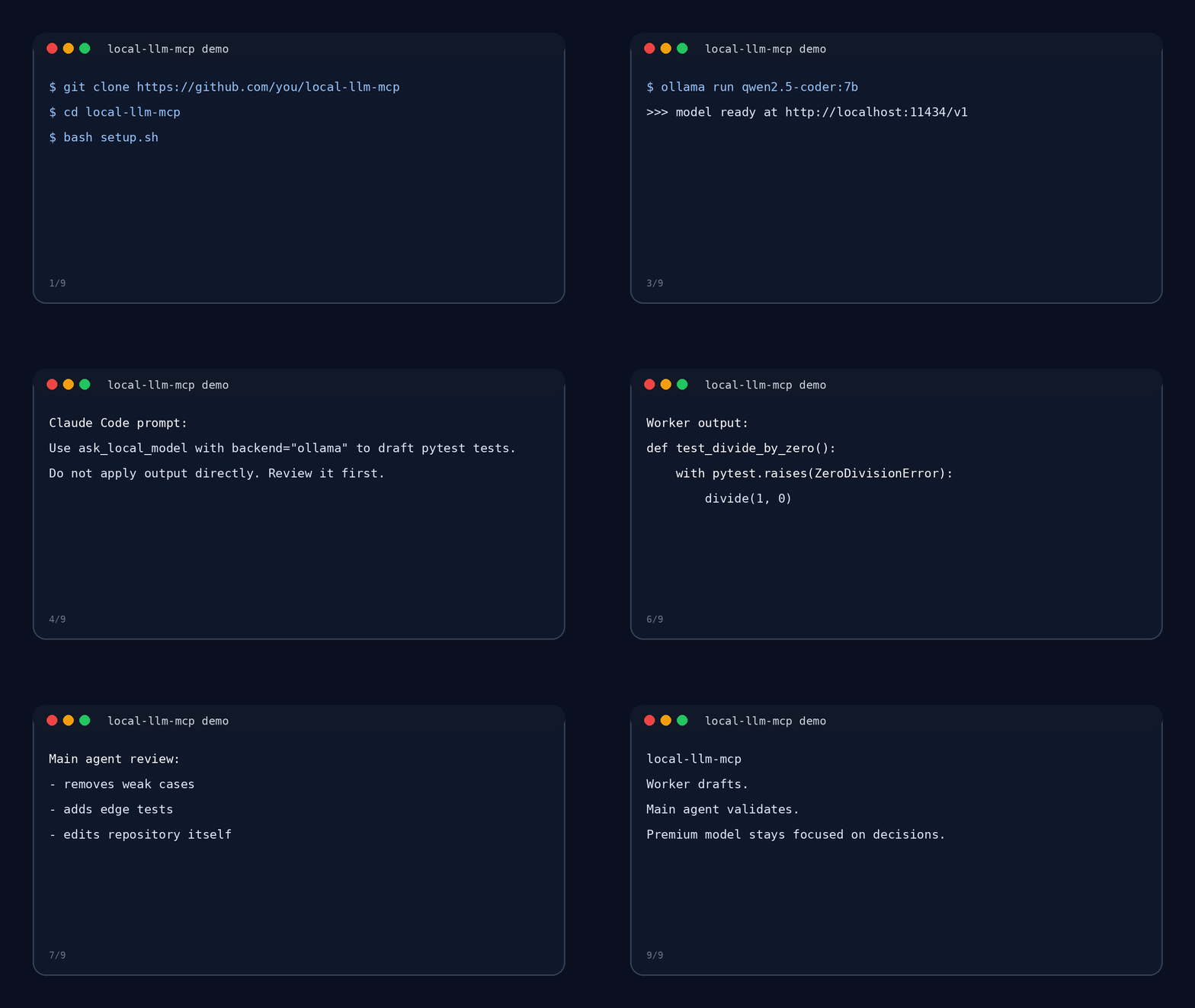
git clone https://github.com/HenryLinyy/local-llm-mcp
cd local-llm-mcp
bash setup.sh        # venv + registers with Claude Code & Codex + smoke test
Then open a fresh Claude Code or Codex session. No API keys needed — local backends work out of the box. setup.sh even picks a RAM threshold based on your machine.
The mental model
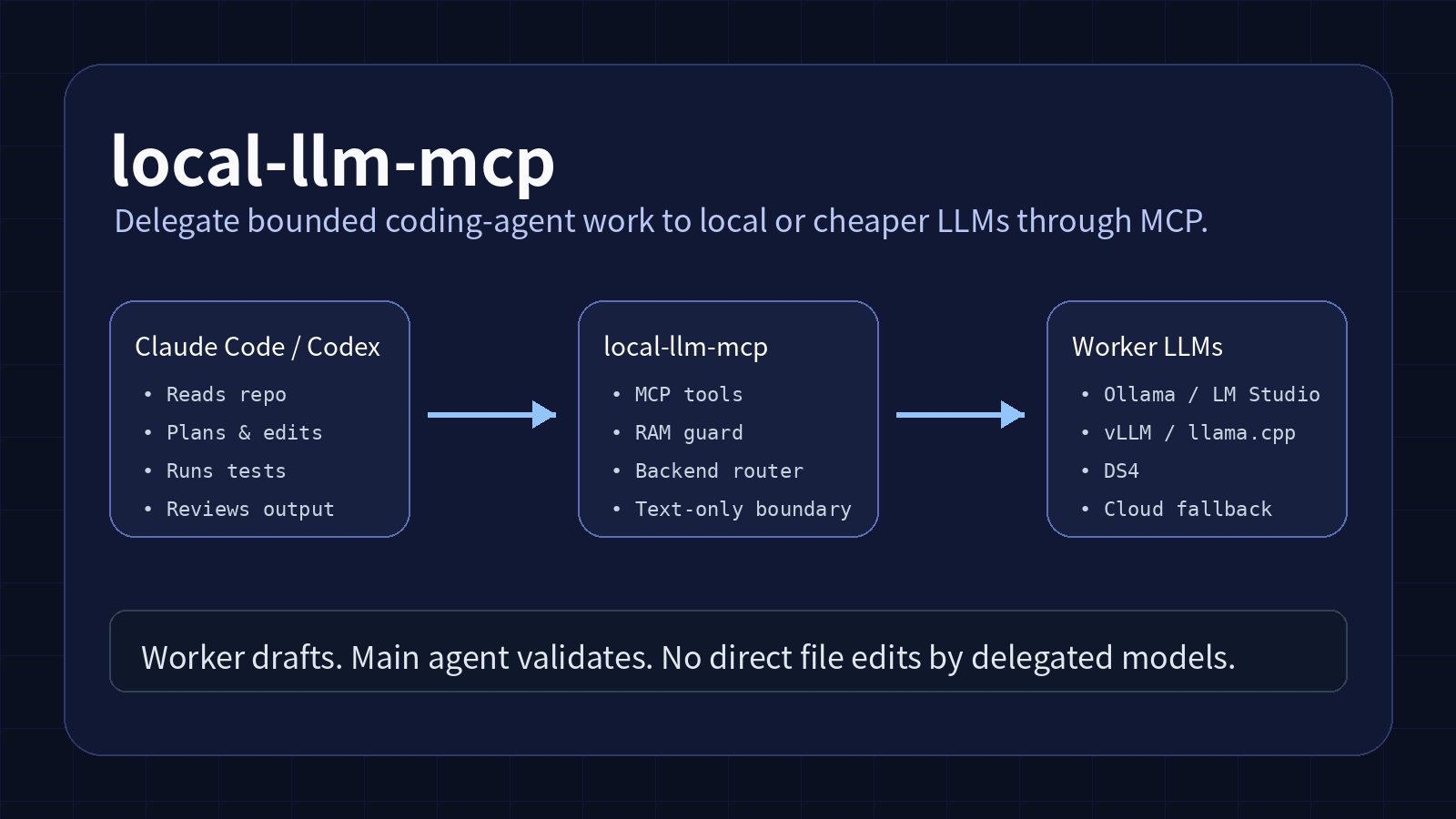
Claude Code / Codex   the senior — reads the repo, plans, edits, runs tests, reviews
local-llm-mcp         hands one bounded task to the intern over MCP
Ollama / LM Studio    the intern — drafts boilerplate, tests, docs, summaries, for $0
A local 7B model costs $0 per token. My frontier agent does not. The rest is arithmetic — and I'll get to the arithmetic honestly below.
The intern can't touch your repo. That's not a missing feature; it's the point. I never have to trust the cheap model with anything that matters — worst case, it hands back a bad draft and the senior throws it out.
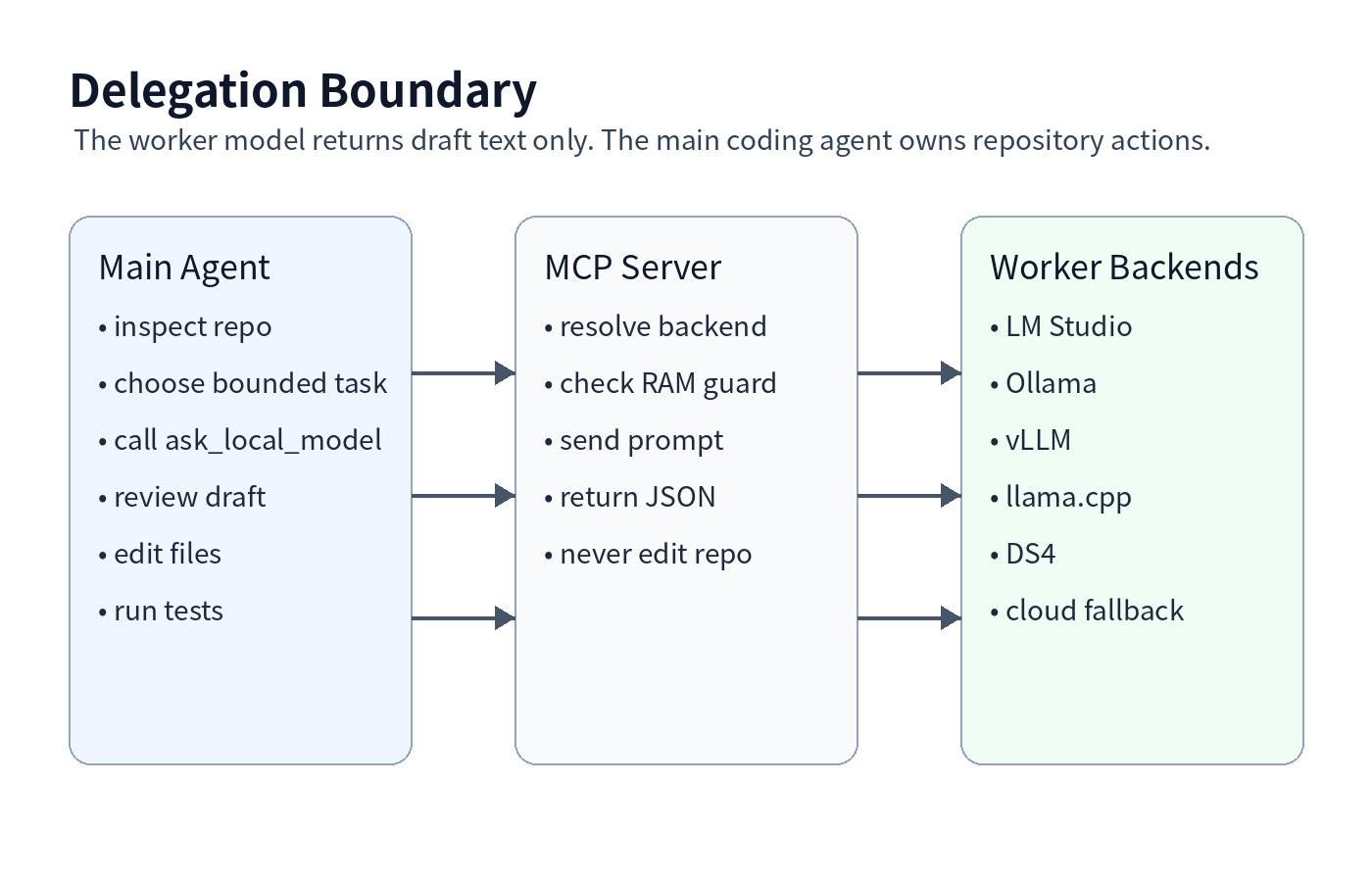
What I hand the intern / what stays on my desk
| ✅ Hand to the intern | 🚫 Keep with the senior |
|---|---|
| README & docstring first drafts | Final architecture decisions |
| Boilerplate, config, glue code | Security & correctness sign-off |
pytest / unittest scaffolds |
Anything that edits the repo |
| Long-file summaries | Running shell commands |
| Repetitive format conversions | Applying a patch unreviewed |
| "Sketch 3 alternative approaches" | Any judgment call |
My rule of thumb: if a wrong answer is cheap to catch, delegate it. If it's expensive to catch, don't.
How I actually use it
There's no API to learn. I just tell the senior to delegate, in plain English:
Use ask_local_model with backend="ollama" to draft a pytest suite for this module.
Don't apply it — review it first, then edit the repo yourself.
Call local_status. If a local model is up, use it for boilerplate.
Otherwise fall back to backend="deepseek".
More of my go-to prompts are in examples/claude-code-prompts.md.
Bring any intern you like
Local backends need nothing but a running server. Cloud backends are optional — they read their key from an env var or keys.json, never from source.
| Backend | Type | Protocol | Default URL | Default model | Key |
|---|---|---|---|---|---|
lmstudio |
local | OpenAI | http://localhost:1234/v1 |
qwen/qwen3-coder-next |
— |
ollama |
local | OpenAI | http://localhost:11434/v1 |
qwen2.5-coder:7b |
— |
vllm |
local | OpenAI | http://localhost:8001/v1 |
auto | — |
llamacpp |
local | OpenAI | http://localhost:8080/v1 |
auto | — |
ds4 |
local | OpenAI | http://127.0.0.1:8000/v1 |
auto | — |
deepseek |
cloud | OpenAI | https://api.deepseek.com/v1 |
deepseek-v4-flash |
DEEPSEEK_API_KEY |
openrouter |
cloud | OpenAI | https://openrouter.ai/api/v1 |
anthropic/claude-sonnet-4 |
OPENROUTER_API_KEY |
groq |
cloud | OpenAI | https://api.groq.com/openai/v1 |
openai/gpt-oss-120b |
GROQ_API_KEY |
cerebras |
cloud | OpenAI | https://api.cerebras.ai/v1 |
gpt-oss-120b |
CEREBRAS_API_KEY |
agnes |
cloud | OpenAI | https://apihub.agnes-ai.com/v1 |
agnes-2.0-flash |
AGNES_API_KEY |
minimax |
cloud | Anthropic | https://api.minimaxi.com/anthropic |
MiniMax-M3 |
MINIMAX_API_KEY |
Every URL and default model is env-overridable. Running something exotic? Add a custom backend — no Python required.
The tools it exposes
| Tool | Purpose |
|---|---|
ask_local_model |
Send a prompt to a backend, get back text + usage metadata. |
list_backends |
Show configured backends, URLs, protocols, key status. |
local_status |
Memory, guard state, backend reachability, config paths. |
list_local_models / list_models |
List model IDs from backends that expose GET /models. |
set_backend |
Add, update, or remove a custom backend live. |
refresh_backends |
Reload custom_backends.json without restarting. |
set_guard |
Change the RAM / exclusivity guards live. |
set_system_prefix |
Pin a system prefix for prompt-cache-friendly cloud calls. |
The intern is on a short leash
I learned this the hard way, so you don't have to. Two guards:
- RAM valve — local calls are refused when free memory drops below
LOCAL_LLM_MIN_FREE_GB. This is the feature that exists because I froze my own machine one too many times. - Exclusive backend — when a heavy local server (
ds4by default) is up, other local backends stand down instead of fighting over memory.
Tune them live, no restart: set_guard(min_free_gb=8), set_guard(exclusive_backend="none").
And secrets never enter git — keys.json, config.json, and custom_backends.json are all gitignored; keys load from env vars or a chmod 600 file. Cloud backends skip the RAM guard, but they send your prompts to a third party and may cost money — read SECURITY.md before pointing one at proprietary code.
So how much does it save?
Here's where most READMEs lie to you with a big number. I'm not going to.
The honest answer is it depends entirely on your workload, so instead of inventing a percentage I shipped a harness to measure your own:
python scripts/benchmark.py --backend ollama --model qwen2.5-coder:7b --out results.jsonl
Compare premium-only vs. delegated mode with BENCHMARK.md and the runbook. Trust your numbers — not mine, and definitely not a number a README made up to get you to star it.
Custom backends — any OpenAI- or Anthropic-compatible endpoint
Add it straight from the tool:
set_backend(name="my_qwen", base_url="http://localhost:9000/v1", default_model="qwen3-coder", local=1, protocol="openai")
…or drop it in custom_backends.json and call refresh_backends. See examples/custom_backends.openrouter.json.
Manual install — if you'd rather not run setup.sh
python3 -m venv .venv
.venv/bin/python -m pip install -e .

# Claude Code
claude mcp add local-llm -s user -e LOCAL_LLM_MIN_FREE_GB=16 -- "$PWD/.venv/bin/python" "$PWD/server.py"

# Codex
codex mcp add local-llm --env LOCAL_LLM_MIN_FREE_GB=16 -- "$PWD/.venv/bin/python" "$PWD/server.py"
Tests
python -m unittest discover -s tests -v
python scripts/smoke_test.py
CI runs both on Python 3.10, 3.11, and 3.12.
FAQ
Does the intern touch my files? Never. It returns text; every edit goes through the senior (your main agent).
Do I need a beefy GPU? No. 7B coder models run on modest hardware, and the RAM valve keeps you from OOMing. No local model handy? Point the intern at a cheap cloud backend.
Is this a fusion model or an autonomous agent? Neither. It's a delegation layer — a tool your existing agent calls.
Why not just switch my agent to a cheap model entirely? Because I want the frontier model's judgment and the cheap model's typing. This keeps both.
Windows / Linux? The server is cross-platform (the RAM guard reads vm_stat on macOS, /proc/meminfo on Linux). The shell helpers are macOS/zsh-flavored.
My other experiments in this space
- qwable — a local multi-model gateway and agent runtime for Codex & Claude Code on Apple Silicon.
- Conclava — a council of local LLMs with task-aware routing and multi-model deliberation.
Contributing
Issues and PRs welcome — see CONTRIBUTING.md. If this saved you some tokens, a ⭐ tells me it was worth open-sourcing.
License
MIT — see LICENSE. Built by someone who got tired of paying frontier prices for import os.
Установка Local Llm
У этого сервера нет опубликованного пакета — он собирается из исходников. Открой репозиторий и следуй инструкции в README.
▸ github.com/HenryLinyy/local-llm-mcpFAQ
Local Llm MCP бесплатный?
Да, Local Llm MCP бесплатный — установка в пару кликов через Unyly без оплаты.
Нужен ли API-ключ для Local Llm?
Нет, Local Llm работает без API-ключей и переменных окружения.
Local Llm — hosted или self-hosted?
Self-hosted: сервер запускается локально на твоей машине командой из раздела установки.
Как установить Local Llm в Claude Desktop, Claude Code или Cursor?
Открой Local Llm на unyly.org, выбери вкладку своего клиента (Claude Desktop, Claude Code, Cursor) и нажми Install — конфиг сгенерируется автоматически, без правки JSON.
Похожие MCP
GitHub
PRs, issues, code search, CI status
 автор: GitHub
Filesystem
Secure file operations with configurable access controls.
Memory
Knowledge graph-based persistent memory system.
Template MCP Server
A CLI tool to create a new Model Context Protocol server project with TypeScript support, dual transport options, and an extensible structure
 автор: mcpdotdirect
Compare Local Llm with
Не уверен что выбрать?
Найди свой стек за 60 секунд
Автор?
Embed-бейдж для README
Похожее
Все в категории development