
Locum
БесплатноНе проверенDelegate Grok Bot coding work to your own local Claude Code / Codex CLIs via a custom MCP connector

Описание
Delegate Grok Bot coding work to your own local Claude Code / Codex CLIs via a custom MCP connector
README
A locum is a qualified professional who temporarily does someone else's job.
Grok Bot is a good chatbot and an expensive coder. Locum lets it hand real coding work to the Claude Code and Codex CLIs already logged in on your machine, instead of burning its own usage grinding through your repo itself.
Grok Bot lives in xAI's cloud, so it can't see localhost. It reaches Locum over a tunnel, as a custom MCP connector — a documented Grok feature, not a hack.
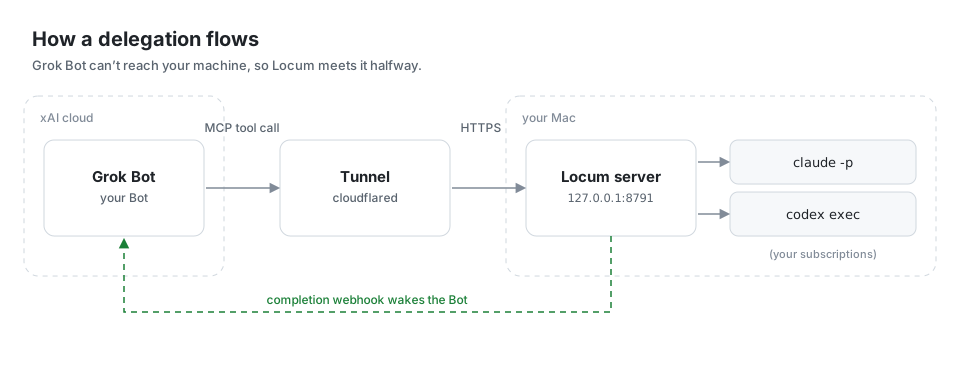
Not affiliated with xAI, Anysphere, OpenAI, or Anthropic.
The rules
This only works because it's your machine, your subscriptions, your work. Anthropic's legal page says Pro/Max plans assume ordinary individual use, and forbids routing other people's requests through your plan's credentials.
| ✅ | You, your machine, your subscription, your own work |
| ❌ | Letting other people's requests hit your subscription |
| ⚠️ | Sharing this code so others run it on their own setup — fine, as long as the rules below hold |
Four invariants. They never come out:
- Never touch credential files, keychains, or OAuth tokens.
- Never call
api.anthropic.com/api.openai.comdirectly. - Only spawn the official
claude/codexbinaries, logged in by you. - Single operator: one token, one list of allowed folders.
Anything that breaks one of these is the wrong feature.
Setup
You need claude and codex already signed in, plus uv.
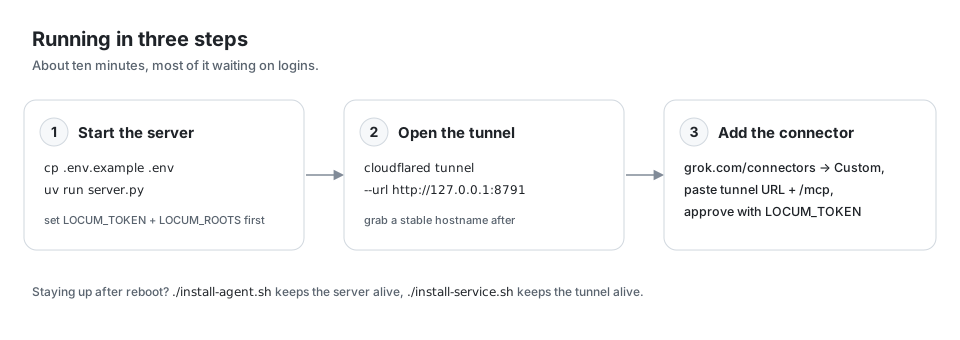
1. Start the server.
cp .env.example .env   # set LOCUM_TOKEN and LOCUM_ROOTS
set -a && source .env && set +a
uv run server.py
2. Open the tunnel.
brew install cloudflared
cloudflared tunnel --url http://127.0.0.1:8791
Quick tunnels get a new URL on every restart, and Grok stores the URL — fine for a first try, annoying forever. For a stable hostname (needs a domain on your Cloudflare account):
cloudflared tunnel login
./setup-tunnel.sh locum.example.com
cloudflared tunnel run locum
3. Add the connector. In Grok: Connectors → New Connector → Custom, with your tunnel URL plus /mcp.
Grok only speaks OAuth 2.1 for custom connectors, so Locum ships its own tiny authorization server — nothing to register anywhere. It usually self-configures; if Grok shows a manual form instead:
| Field | Value |
|---|---|
| Client ID | anything, e.g. locum |
| Client Secret | leave empty |
| Authorization Endpoint | https://<tunnel>/authorize |
| Token Endpoint | https://<tunnel>/token |
| Scopes | mcp |
| Token Auth Method | none (PKCE only) |
You'll get a consent screen showing where you're redirecting (check it says grok.com) and asking for a passphrase — that's your LOCUM_TOKEN. This gate matters: /authorize sits on a public tunnel, and without it anyone with the URL could mint a token and run commands on your machine.
Staying up after a reboot
Two scripts, two jobs:
sudo ./install-service.sh   # keeps the tunnel up (don't use `cloudflared service install` — it writes a broken plist)
./install-agent.sh          # keeps the server up; no sudo, it must run as you
Two macOS gotchas that fail confusingly:
- If the checkout is under Documents/Desktop/Downloads, give Full Disk Access to
uv. Launchd agents don't inherit your terminal's permissions. - Run
claude setup-tokenand save it asCLAUDE_CODE_OAUTH_TOKENin.env. Without it, delegation fails with "OAuth session expired" even though the server starts fine.
Make the Bot actually use it
A connector only makes the tools available. If you don't tell the Bot to prefer them, it keeps doing the work itself and you save nothing.
Bot description (this is the one that matters). New Bot → Edit Profile → Description, and paste something like:
You have the `locum` connector, which delegates work to the operator's own
machine.

Any task touching a real repository (multi-file edits, refactors, debugging,
running tests, reading a codebase) must go to delegate_to_claude rather than
being done yourself.

Call status first: it shows the allowed roots, which CLIs are present, and
whether a slot is free.

delegate_to_claude returns a job_id immediately. Poll check_job about every 30s
and report recent_activity so progress is visible. Never re-delegate a job that
is still queued or running. For follow-ups on the same work use resume_claude
with the session_id, never a fresh delegation (resume_codex for Codex jobs).

cwd must be an absolute path inside an allowed root.
Skill (nice to have). SKILL.md teaches good delegation prompts. Ask a Bot to save it as a skill called delegate-to-locum, then enable it under Settings → Plugins → Yours.
How a job runs
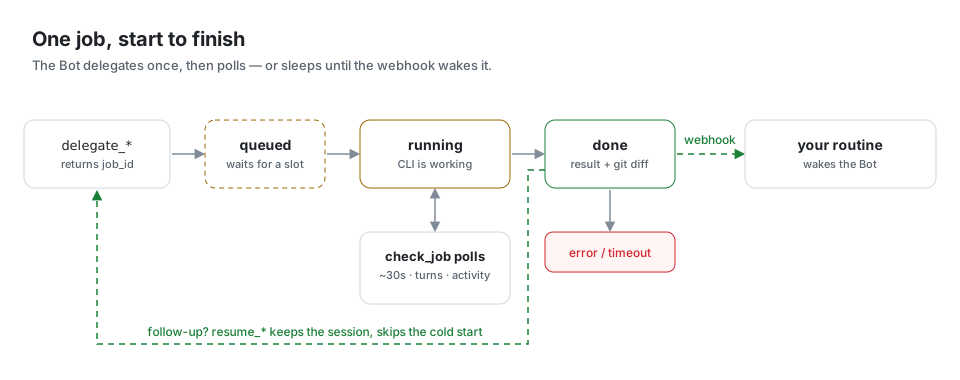
Everything is async — a coding task takes far longer than an MCP call can wait. delegate_* hands back a job_id immediately; the job sits in queued until a slot frees, then runs. The Bot checks check_job every ~30s for status, turns, and recent activity — or skips polling entirely: set LOCUM_COMPLETION_WEBHOOK and Locum pings your routine once when the job finishes. Follow-ups go through resume_claude / resume_codex with the old session_id, never a fresh delegation.
Tools
| Tool | Purpose |
|---|---|
delegate_to_claude(prompt, cwd, model?, effort?) |
Start a Claude Code job. Returns job_id immediately. |
resume_claude(session_id, prompt, cwd?, model?, effort?) |
Continue a session. Reuses the prompt cache — always prefer for follow-ups. |
delegate_to_codex(prompt, cwd, model?, effort?) |
Same contract, via Codex CLI. |
resume_codex(session_id, prompt, cwd?, model?, effort?) |
Continue a Codex session. Fails loudly if Codex reports back a different thread. |
check_job(job_id) |
Poll. Returns status, queue position, turns, activity, result — plus git_changes when cwd is a repo. |
list_jobs(limit?, status?) |
Recent jobs, newest first. Confirms work really ran, recovers a lost job_id, finds a session_id to resume. |
cancel_job(job_id) |
Kill a runaway job. |
status() |
Roots, CLIs on PATH, running/queued counts, free slots, budget use. Call before delegating. |
effort is one vocabulary across both CLIs (low / medium / high / max; Codex maps max onto high). model passes straight through. Both cost real quota, so raise them on purpose, not by habit.
Dashboard
https://your-host/dashboard shows every session — prompt, model, transcript, tokens, cost — with running jobs streaming live. Sign in with LOCUM_TOKEN; there is no second secret. History and session IDs survive restarts; transcripts don't.
It's a control surface too: filter the list by status, copy a session id for resume_*, or cancel a queued or running job from its detail pane (with a confirm — there's no undo).
The server also narrates jobs on stdout. Under launchd: tail -f ~/Library/Logs/locum/server.out.log | grep -v 'INFO:'. Set LOCUM_NARRATE=0 for quiet, and truncate the log now and then — it doesn't rotate.
Safety
Delegated jobs run autonomously (LOCUM_AUTONOMY=bypass): nobody is at the keyboard, so an approval prompt wouldn't pause the job, it would hang it until timeout. That means the agent can run anything as you — LOCUM_ROOTS only controls where the job starts.
What protects you, in order: your LOCUM_TOKEN, narrow LOCUM_ROOTS, and running this only for yourself. LOCUM_AUTONOMY=ask restores prompting, but Grok Bot can't answer prompts, so jobs will hang.
None of that limits spend, so there are caps: LOCUM_MAX_COST_USD and LOCUM_MAX_JOBS_PER_DAY, each measured over the trailing 24h and each disabled when unset. Tripping one refuses new delegations with a clear error, and status shows use so far. Cost only counts reported spend (Codex reports none), so set the job cap too if Codex matters to you.
Tests
python3 test_oauth.py                                      # auth flow, 13 checks
uv run --with fastmcp --with uvicorn python3 test_jobs.py # jobs, 125 checks
Neither needs claude installed.
Troubleshooting
Start here: uv run server.py --doctor checks the common stuff (token, roots, CLIs, port, journal) and exits nonzero with FAIL lines.
Everything 404s, even /health. Port collision — something else owns the port. (The Grok Bot desktop app squats on [::1]:8787, which is why the default is 8791.) Check:
lsof -nPw -iTCP:<port> -sTCP:LISTEN
curl -s http://127.0.0.1:<port>/health   # locum answers {"ok": true}
Jobs fail with "OAuth session expired". First run claude -p "reply with OK" yourself — if that fails, just claude /login. If it works standalone but not through Locum, the server was started inside a Claude Code session; restart it from a normal terminal.
Cloudflare 403, error 1010. Cloudflare blocks Python's default User-Agent. Anything calling the tunnel from Python needs headers={"User-Agent": "something/1.0"}. MCP clients are unaffected.
Honest limits
- Cuts Grok Bot usage, doesn't zero it. The win is ~50 Bot steps becoming one delegation plus a few polls.
- Your machine has to be awake with the tunnel up.
- Cold starts re-pay ~18k tokens of setup. Resume instead.
Project
- How it works, the architecture writeup
- CONTRIBUTING.md, development setup and the four invariants
- SECURITY.md, threat model and how to report a vulnerability
- CHANGELOG.md
Licensed under Apache 2.0.
Установка Locum
У этого сервера нет опубликованного пакета — он собирается из исходников. Открой репозиторий и следуй инструкции в README.
▸ github.com/HarjjotSinghh/locumFAQ
Locum MCP бесплатный?
Да, Locum MCP бесплатный — установка в пару кликов через Unyly без оплаты.
Нужен ли API-ключ для Locum?
Нет, Locum работает без API-ключей и переменных окружения.
Locum — hosted или self-hosted?
Self-hosted: сервер запускается локально на твоей машине командой из раздела установки.
Как установить Locum в Claude Desktop, Claude Code или Cursor?
Открой Locum на unyly.org, выбери вкладку своего клиента (Claude Desktop, Claude Code, Cursor) и нажми Install — конфиг сгенерируется автоматически, без правки JSON.
Похожие MCP
GitHub
PRs, issues, code search, CI status
 автор: GitHub
Filesystem
Secure file operations with configurable access controls.
Memory
Knowledge graph-based persistent memory system.
Template MCP Server
A CLI tool to create a new Model Context Protocol server project with TypeScript support, dual transport options, and an extensible structure
 автор: mcpdotdirect
Amap Maps Mcp Server
MCP server for using the AMap Maps API
 автор: duxiaohui
Supabase
Database, auth and storage
 автор: Supabase
Everything
Reference / test server with prompts, resources, and tools.
Git
Tools to read, search, and manipulate Git repositories.
Sequential Thinking
Dynamic and reflective problem-solving through thought sequences.
Time
Time and timezone conversion capabilities.
Compare Locum with
Не уверен что выбрать?
Найди свой стек за 60 секунд
Автор?
Embed-бейдж для README
Похожее
Все в категории development