
Mant
БесплатноНе проверенLocal-first TUI, structured CLI, and MCP server for manuals and Markdown

Описание
Local-first TUI, structured CLI, and MCP server for manuals and Markdown
README
CI codecov OpenSSF Scorecard crates.io License: Apache-2.0
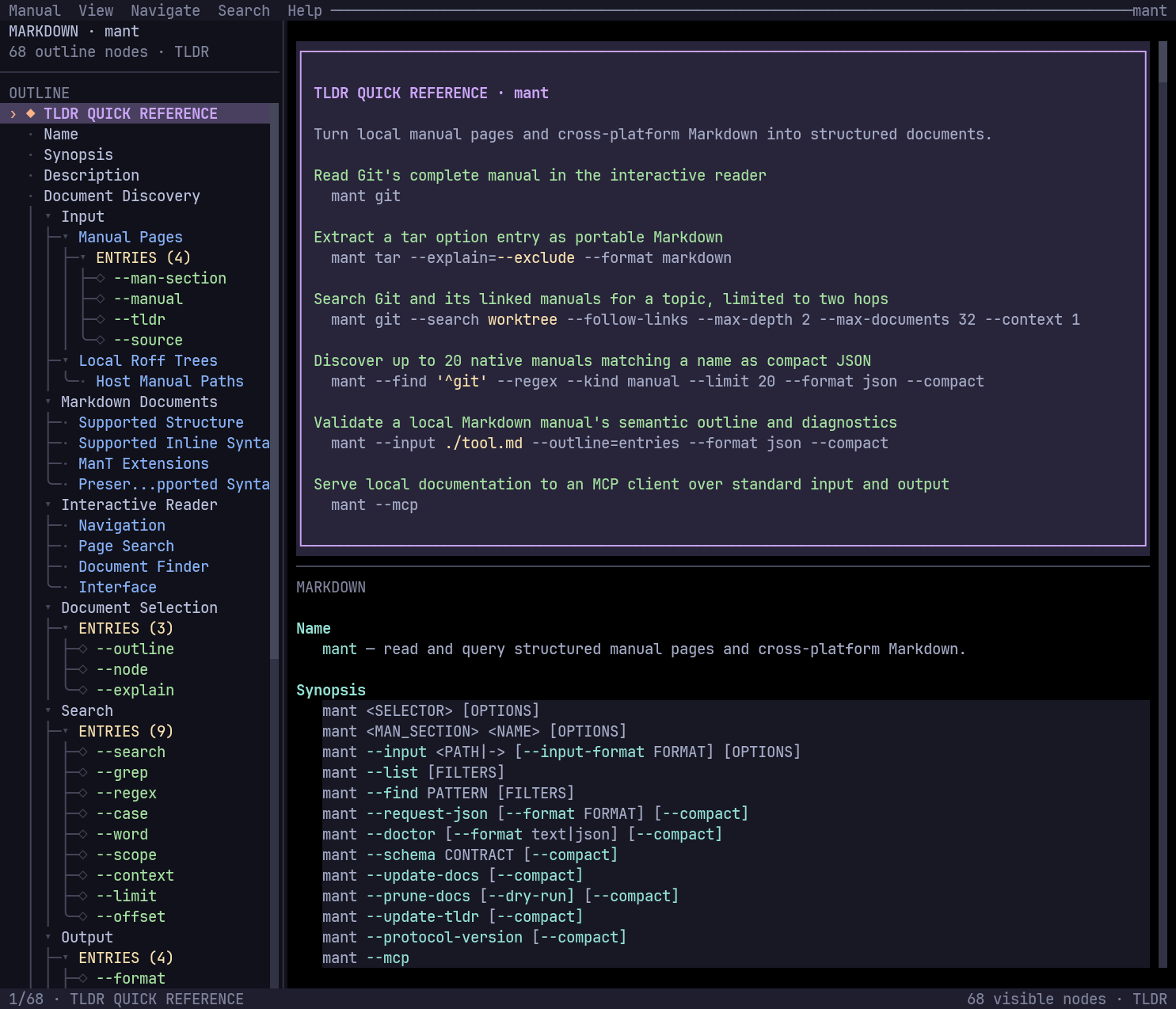
ManT is a local-first documentation reader and query engine. It turns native man/mdoc pages and Markdown libraries into one navigable catalog for people, scripts, and agents.
One native mant executable provides a full-screen TUI, deterministic
Markdown/text/JSON output, generated schemas, and a read-only MCP server. Every
interface consumes the same typed document model. Bundled libmandoc gives
Linux with glibc, macOS, and Windows the same manual-page parser without
requiring a system man or mandoc executable at runtime.
Install
Install or update the latest release.
Unix (Linux with glibc, or macOS)
curl --proto '=https' --tlsv1.2 -LsSf https://raw.githubusercontent.com/BryanHeBY/ManT/main/scripts/install.sh | sh
Windows (PowerShell)
irm https://raw.githubusercontent.com/BryanHeBY/ManT/main/scripts/install.ps1 | iex
All options, uninstallation, and alternative methods are in the installation guide.
Agent prompt
Read https://raw.githubusercontent.com/BryanHeBY/ManT/main/docs/installation.md
and install or update the latest ManT release for this system. Use its
recommended user-scoped method, verify the installation, and report any PATH
change still needed.
One binary, one model, three interfaces
| Interface | Entry point | Designed for |
|---|---|---|
| Interactive TUI | mant NAME in a terminal, or --ui |
Hierarchical reading, document discovery, typed links, history, search, mouse input, and tldr quick references |
| Structured CLI | Projection options, --format, or redirection |
Outlines, excerpts, semantic explanations, location-aware search, and stable Markdown/text/JSON |
| Read-only MCP | mant --mcp |
Local discovery and focused document retrieval for agents over stdio |
A complete query automatically opens the reader only when both standard input and output are terminals. Redirection remains useful and predictable:
mant git > git.md
mant git | less
Use --ui to require the reader or --format markdown to require output,
independent of terminal detection.
Why ManT
- Navigate a documentation library, not just one page. A single catalog covers personal Markdown, installed sources, and native manual sections; typed links and bounded back/forward history connect them.
- Address structure directly. Sections, options, commands, variables, and
environment variables are semantic nodes, so
--excludecan be retrieved without searching or copying the complete page. - Get the same interpretation everywhere. The TUI, CLI renderers, search, generated schemas, and MCP tools consume one normalized Rust document model.
- Keep automation predictable. Outlines and excerpts use explicit selectors; search results include reusable nodes and generated-Markdown coordinates.
- Stay local-first. Ordinary reading and querying need no network service, and the bundled parser avoids a runtime dependency on host manual tools.
- Treat Markdown as documentation, not a second-class fallback. It receives the same hierarchy, links, semantic entries, search, output, and agent access as native manuals.
Interactive reader
mant git
mant --input README.md
mant tar --ui
The Outline sidebar mirrors nested document sections and reveals normalized options, commands, variables, and environment variables on demand. Selecting a node places its target at the top of the content pane; after scrolling settles, the outline follows the first visible document node.
j/kor arrow keys move through visible nodes.h/lcollapse and expand branches.d/uor page keys scroll the document.Ctrl+Oopens a live finder for registered Markdown and native manuals.Alt+Left/Alt+Rightmove backward and forward through document jumps.Ctrl+For/opens confirmed full-page search.nandShift+Nselect the next and previous matches.F10opens the menu,?opens help, andqquits.
The mouse can select and fold outline nodes, follow underlined in-page, cross-document, and web/email links, scroll both panes, drag scrollbars, and resize the Outline sidebar. Markdown links stay inside their registered source; man and mdoc references select an exact manual section.
Human-facing help, diagnostics, and tldr output use terminal-aware
colour. --color auto|always|never controls the shared policy; automatic mode
honours terminal capabilities, NO_COLOR, and TERM=dumb. Structured formats
and redirected automatic output never gain presentation escape sequences.
Structured discovery and queries
Discover installed Markdown and native manuals without opening each document:
mant --list
mant --find process
mant --find '^git' --regex --kind manual --format json
--list exposes one tree rooted at documents/, sources/<source>/, and
manual/<section>/. --find emits stable tab-separated canonical paths by
default, making it suitable for filtering and shell pipelines. Literal
discovery ranks exact paths or leaf names first, then component suffixes,
prefixes, and other substring matches; stable path order breaks ties. A query
containing / also matches the complete canonical path.
When both standard streams are terminals, text from --list and --find
opens in a built-in less-like pager only if it exceeds the terminal height.
Use the mouse or the usual less navigation and / search bindings;
--no-pager forces direct text. Redirected output and --format json always
remain plain, deterministic standard output.
Start with an outline and retrieve only the section or option that matters:
mant gcc --outline
mant git --tldr
mant gcc --node 4.2 --format markdown
mant tar --node acls --format json
mant tar --explain=--exclude
Heading paths are one-based. Path 0 and selector tldr are reserved for an
available quick reference. --tldr selects that node across embedded Markdown
and cached tldr candidates, and permits a quick reference even when no full
document exists. On a color terminal, tldr and text projections such as
outline, node, explanation, and search use semantic styles; pipes, NO_COLOR,
and TERM=dumb receive plain text.
--color always|never overrides detection, while an explicit --format
continues to select Markdown, text, or JSON.
Search returns a complete outline trail to the nearest reusable node together
with exact generated-Markdown coordinates. Text output presents the same
ancestor chain used by --explain:
mant tar --search=--acls --context 1
mant gcc --search 'worktree|branch' --regex --case smart
mant git --search worktree --follow-links
mant --document git --document git-lfs --explain=--work-tree
--document is repeatable and defines an ordered set of initial registered documents. --follow-links expands that set breadth-first through typed manual and same-source Markdown links; --max-depth and --max-documents bound the traversal. Search pagination is global across the stable document order, while explanations remain grouped by exact document address. Cycles and duplicate paths query a document once, missing links remain visible in JSON, and the typed frontier distinguishes links excluded by depth from links excluded by the document budget.
With --ui, the first initial document opens normally and confirmed text search spans the resolved set. Selecting a match in another document uses the existing back/forward history. The document finder remains global rather than being restricted to the query set.
Partial document queries default to text; Markdown and JSON remain explicit
alternatives. Full output supports Markdown, text, and JSON. Native roff manuals
additionally support --format man, which emits manual-only plain text without
tldr content:
mant git --format markdown
mant --input README.md --format text
mant git --format json --compact
Discover machine contracts from the installed binary rather than copying request shapes from documentation:
mant --doctor
mant --doctor --format json --compact
mant --schema request
mant --schema all --compact
mant --protocol-version
mant --version
mant --doctor performs an offline, read-only check of the effective data
paths, registered documents, installed sources, bundled libmandoc, native
manual index, optional Git requirement, and tldr caches. It suggests the
existing explicit maintenance commands without running them. Warnings keep a
successful status; a broken promised capability returns status 1.
The structured protocol and Schema reference documents every versioned request and response projection, coordinate rule, and compact MCP tool. The separate IR reference describes the richer in-process model from which those structured and textual presentations are projected.
Build a local documentation library
mant --list presents one logical tree regardless of where a document came
from:
documents/                  personal Markdown
sources/<source>/           installed Markdown collections
manual/<section>/           native man and mdoc pages
Exact catalog paths are unambiguous. Short selectors use root documents first;
configured sources then sort around native manuals at priority 0. Positive
sources win, manuals win a zero tie, and negative sources act as fallbacks.
Unique component suffixes make a deep path such as languages/en/tool
convenient without hiding collisions.
Native manuals
ManT indexes raw, gzip, and zstd pages from traditional man<section>/
directories and flat roots containing files such as widget.1. Project-local
collections can use MANT_MANPATH as a complete override:
mkdir -p ./project-man/man1
cp ./widget.1 ./project-man/man1/widget.1
MANT_MANPATH="$PWD/project-man" mant widget --manual
The same index works on Linux with glibc, macOS, and Windows. On Unix it reads
the host's man-path configuration (man-db, mandoc, or macOS man.conf) before
using conservative fallbacks; macOS also follows its active Xcode or Command
Line Tools tree. Windows can use %APPDATA%\ManT\man.conf with manpath DIRECTORY lines. Logical queries
accept mant 1 git, mant 'git(1)', mant git --man-section 1, and the
canonical path mant manual/1/git. A dotted selector such as git.1 remains
an exact logical document name; ManT never guesses whether its suffix is a
manual section. Manual aliases and parser I/O remain bounded to their indexed
collection; the complete lookup and .so policy is documented in the
mant manual.
Markdown collections
Personal .md and .markdown files below ManT's documents/ directory keep
their extension-free relative hierarchy. Configured Git repositories and
direct archive URLs are installed in the sibling managed sources/ directory,
without mixing their files into the personal tree:
[team]
repo = "https://github.com/example/cli-docs.git"
branch = "main"
path = "manuals"
priority = 10
Run mant --update-docs to install or update configured sources and
mant --prune-docs --dry-run before explicitly removing orphaned source data.
Windows selectors try an exact documented executable name before following
PATHEXT, so packages can retain canonical names such as tool.exe.md while
mant tool remains convenient. The document-source guide
defines platform paths, archive configuration, selection, precedence, and
transactional update behavior.
Personal documents/ may use leaf-file symlinks to regular files, including
targets outside that tree; broken links and directory symlinks are ignored.
Installed source caches never follow links, and source acquisition rejects
selected Git or archive links so packages remain portable across platforms.
Markdown headings, prose, code, links, lists, tables, and selected semantic definition lists enter the same model as native manuals. Unsupported syntax remains visible with a diagnostic instead of being silently discarded. The bundled mant-markdown(7) and mant-roff(7) manuals define the exact input contracts; every bundled manual is also a self-hosted ManT document.
One-off input and quick references
Physical files are deliberately separate from logical catalog selectors:
mant --input README.md
mant --input /usr/share/man/man1/git.1.gz --outline
cat guide.md | mant --input - --input-format markdown
cat widget.1 | mant --input - --input-format roff
When compatible local tldr data exists, a combined query that selects a native
section 1 or 8 family page places its quick reference before the full
document as reserved node 0. This includes unqualified queries and exact
section selectors such as mant 1 tar. Other native categories do not acquire
an unrelated command quick reference. --manual deliberately excludes quick
references. mant git --tldr selects only the quick reference; an unambiguous
section qualifier such as mant 1 tar --tldr is accepted for command families
1 and 8, but it does not become part of the tldr topic. For --tldr, a Markdown
candidate participates only when it actually embeds a quick reference: personal
documents win, positive source priorities precede the cached tldr baseline at
0, and zero or negative sources follow it. --source NAME restricts this
lookup to the selected Markdown source. A cached tldr entry does not make a
missing ordinary document query succeed: ManT reports the failed lookup and
suggests the explicit mant NAME --tldr command instead. ManT reads
installed-client caches or its private cache, which mant --update-tldr can
update. Markdown authors may also embed a document-owned quick reference using
the format described in the mant manual.
MCP
Run the same executable as a read-only MCP server:
mant --mcp
Configure the client command as mant with arguments ["--mcp"]. Five
read-only tools—mant_find, mant_outline, mant_read, mant_explain, and
mant_search—return bounded plain text or CommonMark instead of the complete
document AST. Start with mant_find; its canonical document IDs remove
ambiguity from later calls. Each call reads the files currently visible in
documents/, configured installed sources, and native manual paths. MCP has no
update, network, or mutation tool and does not promise a session snapshot
across calls. Detailed lowering diagnostics remain available through ordinary
CLI JSON queries.
mant_explain and mant_search accept several initial document IDs and can
optionally follow typed links as a bounded breadth-first scope. Native CLI
queries and interactive cross-document search use the same scope model.
Architecture
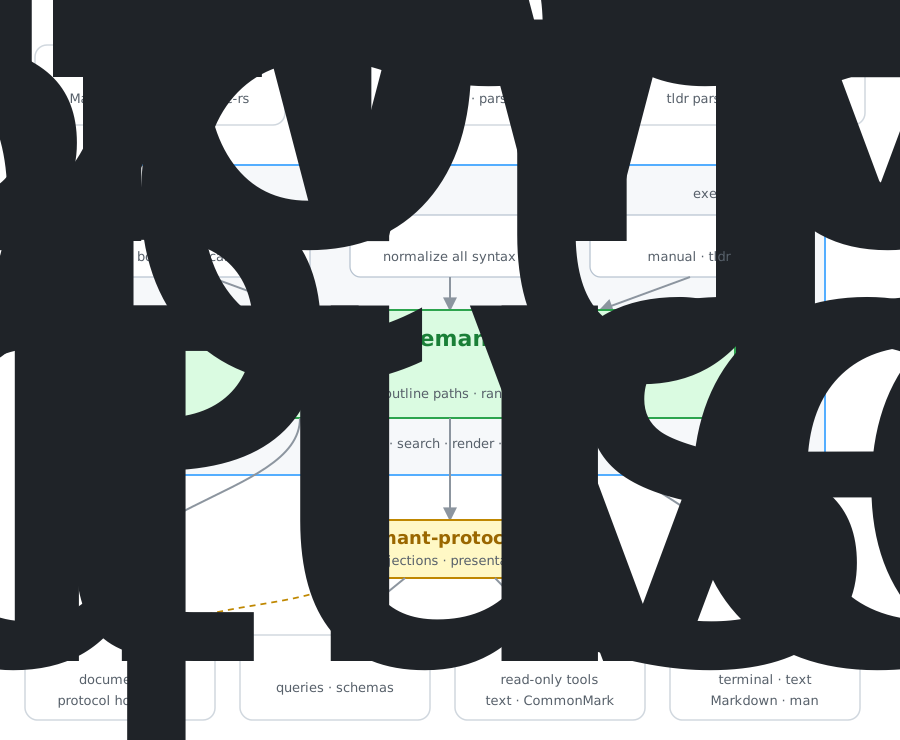
mant-ir is the semantic center nested inside the mant-engine execution
layer. Interactive use passes its in-memory ResolvedContent directly to
mant-ui, and human renderers operate on the same model. Structured host and
process interactions share the mant-protocol contract layer. Catalog
callbacks, CLI JSON, request JSON, and MCP therefore use the same logical
identities and projections, while each boundary chooses its appropriate
representation: versioned JSON for processes and compact text for MCP. Git and
archive updates are an optional native CLI capability
layered on mant-sources, not part of document reads or MCP.
Documentation
- Installation methods and platform requirements
- mant(1) command manual
- Document source configuration and updates
- mant-protocol(5) structured integration contract
- mant-ir(7) normalized document model
- mant-markdown(7) supported Markdown
- mant-roff(7) native manual compatibility
- Native engine and crate boundaries
- Development guide and repository map
- Maintainer release procedure
License
ManT-authored work is licensed under the Apache License 2.0. Rust dependencies, bundled parser sources, cached tldr-pages content, real-world test fixtures, and screenshot fonts retain their upstream terms; upstream tldr pages are CC BY 4.0 and are attributed at render time. See the third-party notice map. Native releases include a CycloneDX SBOM and signed GitHub provenance/SBOM attestations. Please report vulnerabilities through the private process in the security policy.
Установка Mant
У этого сервера нет опубликованного пакета — он собирается из исходников. Открой репозиторий и следуй инструкции в README.
▸ github.com/BryanHeBY/ManTFAQ
Mant MCP бесплатный?
Да, Mant MCP бесплатный — установка в пару кликов через Unyly без оплаты.
Нужен ли API-ключ для Mant?
Нет, Mant работает без API-ключей и переменных окружения.
Mant — hosted или self-hosted?
Self-hosted: сервер запускается локально на твоей машине командой из раздела установки.
Как установить Mant в Claude Desktop, Claude Code или Cursor?
Открой Mant на unyly.org, выбери вкладку своего клиента (Claude Desktop, Claude Code, Cursor) и нажми Install — конфиг сгенерируется автоматически, без правки JSON.
Похожие MCP
GitHub
PRs, issues, code search, CI status
 автор: GitHub
Filesystem
Secure file operations with configurable access controls.
Memory
Knowledge graph-based persistent memory system.
Template MCP Server
A CLI tool to create a new Model Context Protocol server project with TypeScript support, dual transport options, and an extensible structure
 автор: mcpdotdirect
Amap Maps Mcp Server
MCP server for using the AMap Maps API
 автор: duxiaohui
Supabase
Database, auth and storage
 автор: Supabase
Everything
Reference / test server with prompts, resources, and tools.
Git
Tools to read, search, and manipulate Git repositories.
Sequential Thinking
Dynamic and reflective problem-solving through thought sequences.
Time
Time and timezone conversion capabilities.
Compare Mant with
Не уверен что выбрать?
Найди свой стек за 60 секунд
Автор?
Embed-бейдж для README
Похожее
Все в категории development