
Local Relay
БесплатноНе проверенA persistent local MCP relay that caches tool discovery, keeps upstream servers warm, and allows agents to hot-add or refresh MCP servers through management too

Описание
A persistent local MCP relay that caches tool discovery, keeps upstream servers warm, and allows agents to hot-add or refresh MCP servers through management tools.
README
npm version
npm downloads
GitHub stars
GitHub forks
CI
License: MIT

Persistent local MCP relay for developer machines.
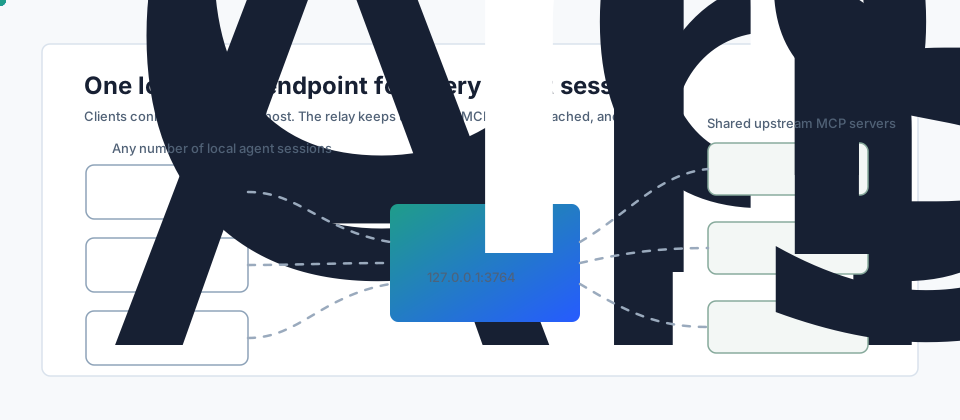
mcp-local-relay runs once on localhost, keeps upstream MCP servers warm, caches tool discovery, exposes health/status, and lets agents hot-add or refresh upstream MCP servers through MCP tools. Point Codex, Claude Code, Antigravity, Cursor, and desktop apps at one fast local MCP endpoint instead of duplicating the same MCP connections in every session.
Status: v0.1 — public initial release. Streamable HTTP upstreams, cached tool discovery, hot-swap MCP onboarding tools, PostHog CLI-mode preset, macOS LaunchAgent helpers, JSON health/status endpoints, and a SwiftUI status bar app source package are implemented. Start with docs/ARCHITECTURE.md and docs/STATUS-BAR.md.
Why
Raw MCP clients often do eager startup discovery. Remote or large MCP servers can slow launch, fail on auth, or inject huge tool schemas into context. If you run several agent sessions, each one tends to start its own copy of the same MCP connections.
A persistent local relay gives you:
- fast localhost startup
- one shared MCP instance for many Codex, Claude Code, Antigravity, Cursor, or desktop sessions
- cached
tools/list - low-context provider presets, starting with PostHog CLI mode
- LaunchAgent lifecycle and logs on macOS
/healthzand/status- hot-swap onboarding via MCP management tools
How it works
- One local MCP endpoint — clients connect once to
127.0.0.1. - Persistent upstreams — remote MCP servers stay warm outside the client process.
- Cached discovery —
tools/listis served from a local cache while refreshes happen in the background. - Hot-swap onboarding — agents use
relay_*MCP tools to add, validate, refresh, enable, or disable upstream servers. - Observable runtime — LaunchAgent logs plus
/healthzand/statusmake failures inspectable.
Install
pnpm add -g mcp-local-relay
mcp-local-relayctl init
mcp-local-relayctl install
mcp-local-relayctl start
Update later with:
mcp-local-relayctl upgrade
The LaunchAgent points at the installed global CLI path, so upgrading the package and restarting the agent moves every client session to the latest relay without changing client MCP config. If your global install uses a specific package manager, pass --package-manager pnpm, npm, yarn, or bun.
To let the LaunchAgent-backed relay keep itself on the latest published npm
version, opt in from ~/.config/mcp-local-relay/config.json:
{
  "updates": {
    "autoUpgrade": true,
    "checkIntervalMs": 86400000,
    "packageManager": "pnpm"
  },
  "servers": []
}
When enabled, the relay checks npm on updates.checkIntervalMs, runs the same
package-manager command as mcp-local-relayctl upgrade if a newer version
exists, and restarts the LaunchAgent. Use mcp-local-relayctl update-check to
trigger a manual check through the running relay.
For development from a checkout:
pnpm install
pnpm build
node bin/mcp-local-relay.mjs serve --config examples/config.posthog.json
Client Config
Point every client at the relay once:
{
  "mcpServers": {
    "mcp-local-relay": {
      "type": "http",
      "url": "http://127.0.0.1:3764/mcp"
    }
  }
}
After that, Codex, Claude Code, Antigravity, Cursor, and other Streamable HTTP MCP clients can share the same local endpoint:
http://127.0.0.1:3764/mcp
Use the relay's MCP tools or CLI to add or update upstream servers without editing every client config again.
Add MCP Servers
An upstream server config looks like this:
{
  "id": "posthog",
  "name": "PostHog",
  "category": "Product analytics",
  "mode": "posthog-cli",
  "remote": {
    "type": "streamable_http",
    "url": "https://mcp.posthog.com/mcp"
  },
  "envFile": "~/.config/mcp-local-relay/posthog.env",
  "cache": {
    "toolsTtlMs": 900000,
    "autoRefreshMs": 900000
  }
}
cache.autoRefreshMs keeps enabled upstream MCP servers warm and refreshes
their tool lists in the background. It defaults to toolsTtlMs; set it to 0
to disable automatic refresh for a server.
Warm Add From An Agent
Ask any agent connected to the relay to call relay_add_server with the server config:
{
  "id": "docs",
  "name": "Docs",
  "category": "Documentation",
  "remote": {
    "type": "streamable_http",
    "url": "https://your-docs-mcp.example.com/mcp"
  },
  "cache": {
    "toolsTtlMs": 900000
  }
}
relay_add_server validates the upstream MCP, opens the connection, caches tools/list, persists the config, and emits notifications/tools/list_changed so clients that support it can see the new tools without restarting.
Warm Add From The CLI
Use one of the example server files, or create your own:
mcp-local-relayctl add --file examples/server.posthog.json --warm
mcp-local-relayctl add --file examples/server.docs.json --warm
--warm sends the config to the running local relay. Without --warm, the CLI edits the config file offline:
mcp-local-relayctl add --file examples/server.search.json
mcp-local-relayctl restart
More examples live in examples/.
Hot-Swap Tools
The relay exposes management tools:
relay_list_serversrelay_add_serverrelay_update_serverrelay_remove_serverrelay_enable_serverrelay_disable_serverrelay_refresh_toolsrelay_get_statusrelay_get_client_configrelay_validate_server
When a server is added, updated, removed, enabled, disabled, or refreshed, the relay emits notifications/tools/list_changed. Clients that honor the notification can see new tools without a session restart.
PostHog Preset
Use mode: "posthog-cli" to request PostHog's slim CLI MCP surface. Store the API token in an env file:
mkdir -p ~/.config/mcp-local-relay
umask 077
printf 'POSTHOG_MCP_API_TOKEN=phx_...\n' > ~/.config/mcp-local-relay/posthog.env
The token is read at runtime and is not written into client config or LaunchAgent plists.
LaunchAgent vs stdio
Stdio MCP is simple, but each client process pays startup, auth, and discovery costs. A LaunchAgent relay persists outside the client, keeps logs, warms caches, and can be inspected independently.
Status
mcp-local-relayctl status
mcp-local-relayctl update-check
mcp-local-relayctl logs
curl http://127.0.0.1:3764/status
The optional macOS menu bar app shows the same local relay state:
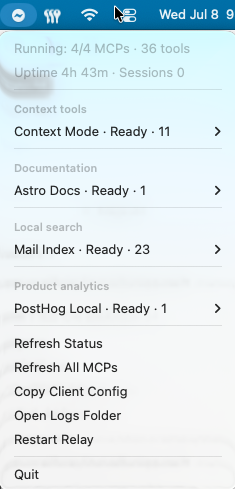
The optional macOS status bar app lives in
macos/McpLocalRelayStatusBar. It is a small SwiftUI MenuBarExtra app
that reads the local admin API, shows relay/server status, refreshes upstream
tool caches, restarts the LaunchAgent-backed relay, opens the logs folder, and
copies client config without reading env files.
cd macos/McpLocalRelayStatusBar
swift run
To install it as a login item from a checkout:
pnpm install:status-bar
That builds the app into ~/Applications/Mcp Local Relay Status Bar.app,
registers ~/Library/LaunchAgents/com.unsoldgroup.mcp-local-relay-status-bar.plist,
and opens it immediately. Remove it with:
pnpm uninstall:status-bar
The local admin API used by the app is:
GET /statusGET /client-configPOST /servers/:id/refreshPOST /restart
Documentation
- docs/ARCHITECTURE.md — relay shape, tool naming, and hot-swap flow.
- docs/STATUS-BAR.md — design notes for the optional macOS menu bar monitor.
- docs/assets/social-preview.png — 1280x640 repository social preview image for GitHub settings.
- SECURITY.md — private disclosure and secret-handling posture.
- SUPPORT.md — what to include in bug reports.
About
Built by Unsold Group — a group of innovative travel brands leveraging AI to improve customer experience and operations.
This project came out of production work on Expedition Insure, Unsold Group's travel insurance platform for polar, expedition, and adventure travel. Expedition Insure uses agent workflows, MCP tools, local context systems, and operational automations every day; mcp-local-relay packages one of the infrastructure patterns that made those workflows faster and more reliable.
If you are building with AI agents in a real operational environment, follow:
- unsold.group — innovative travel brands using AI to deliver better customer experiences.
- expedition.insure — expedition and adventure travel insurance for polar, remote, and hard-to-place trips.
Feedback & contact
There is no telemetry. We only know what users report.
- Discussions — questions, ideas, and integration notes.
- Issues — bugs and feature requests.
- Security/privacy issues → SECURITY.md.
- More from the builders → unsold.group.
License
Установка Local Relay
У этого сервера нет опубликованного пакета — он собирается из исходников. Открой репозиторий и следуй инструкции в README.
▸ github.com/unsoldgroup/mcp-local-relayFAQ
Local Relay MCP бесплатный?
Да, Local Relay MCP бесплатный — установка в пару кликов через Unyly без оплаты.
Нужен ли API-ключ для Local Relay?
Нет, Local Relay работает без API-ключей и переменных окружения.
Local Relay — hosted или self-hosted?
Self-hosted: сервер запускается локально на твоей машине командой из раздела установки.
Как установить Local Relay в Claude Desktop, Claude Code или Cursor?
Открой Local Relay на unyly.org, выбери вкладку своего клиента (Claude Desktop, Claude Code, Cursor) и нажми Install — конфиг сгенерируется автоматически, без правки JSON.
Похожие MCP
GitHub
PRs, issues, code search, CI status
 автор: GitHub
Filesystem
Secure file operations with configurable access controls.
Memory
Knowledge graph-based persistent memory system.
Template MCP Server
A CLI tool to create a new Model Context Protocol server project with TypeScript support, dual transport options, and an extensible structure
 автор: mcpdotdirect
Compare Local Relay with
Не уверен что выбрать?
Найди свой стек за 60 секунд
Автор?
Embed-бейдж для README
Похожее
Все в категории development