
Ops Brief Agent
FreeNot checkedEnables agencies to generate deterministic, ranked operational briefs by combining delivery status, financial performance, and recent client communication from

About
Enables agencies to generate deterministic, ranked operational briefs by combining delivery status, financial performance, and recent client communication from ClickUp, QuickBooks, and Gmail.
README
A read-only, MCP-style Ops Brief Agent for agencies and IT service companies managing multiple clients. It combines delivery status, financial performance, and recent client communication into a deterministic, ranked operational brief.
This repository is a portfolio/demo implementation, not a production deployment. It does not claim measured performance, accuracy, cost savings, or time savings.
Data sources
- ClickUp supplies the schedule hierarchy: Client (Folder) → Project (List) → Milestone (Task).
- QuickBooks Online sandbox supplies project or milestone budgets and actual costs.
- Gmail uses read-only access to find the latest agency-sent client update associated with each canonical milestone ID.
Canonical milestone IDs, such as MS-2026-101-01, provide deterministic joins across systems. Project IDs are derived using the repository's canonical ID scheme. Fuzzy matching is prohibited.
Architecture
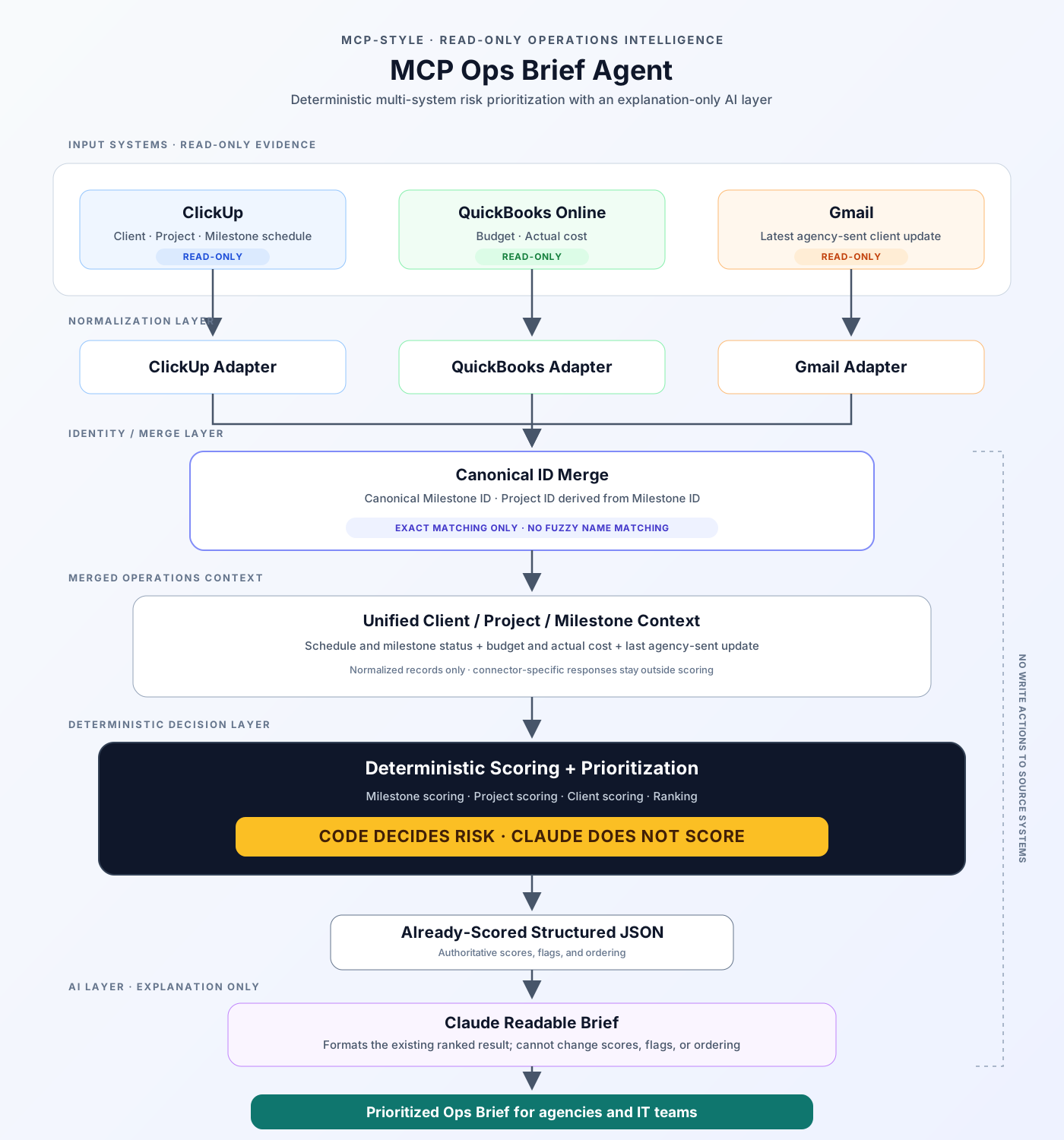
ClickUp, QuickBooks Online, and Gmail provide read-only evidence, deterministic code performs canonical merging and risk scoring, and Claude only converts already-scored JSON into a readable prioritized Ops Brief.
ClickUp ─────┐
QuickBooks ──┼→ adapters → normalized records → deterministic scoring → ranked ClientScore[]
Gmail ───────┘
                                                              ↓
                                                   Claude readable brief
                                                              ↓
                                          deterministic output validation
                                                              ↓
                                                        Ops Brief
Connector data is normalized and scored deterministically before Claude is called. Claude Sonnet is only the readable reporting layer: it does not calculate or change risk scores or risk flags. Its structured response is locally validated against the deterministic ClientScore[] before it is accepted.
The current deterministic engine supports the risk and data-quality decisions implemented in the code, including:
- schedule risk based on expected versus phase-derived completion;
- overdue milestones based on due dates;
- communication risk based on the age of the latest agency-sent update;
- budget risk based on spend relative to budget and completion progress;
- supported data-gap flags, including missing budgets and low-volume data.
Verified demo hierarchy
Client: Acme Corp
Projects:
- Website Redesign
- SEO Retainer
Milestones:
- Design Phase
- Development Phase
- Monthly Optimization
The demo records verify both milestone-based and project-wide costing modes. Demo names and values are fixture/sandbox data, not claims about a real business.
Safety boundaries
The current system is read-only:
- no autonomous client communication or Gmail sending;
- no QuickBooks write actions;
- no ClickUp write actions;
- Gmail access is limited to the
gmail.readonlyscope; - Claude cannot override deterministic scoring or flags;
- malformed, incomplete, reordered, or contradictory Claude output is rejected locally.
OAuth refresh may update local token files under credentials/, but it does not modify accounting, email, or project-management records.
Deterministic joins and costing
The only cross-system association is an exact canonical identifier:
- ClickUp tasks carry a canonical milestone ID.
- Gmail message subjects are matched against exact bracketed milestone IDs.
- QuickBooks Customer Notes contain an exact
MilestoneID: ...orProjectID: ...value.
Milestone notes select milestone-based costing; project notes select project-wide costing. No client name, project name, email address, or approximate text match is used as a cross-system join.
Development
npm.cmd install
npm.cmd run typecheck
npm.cmd run build
npm.cmd test
npm.cmd run run:live executes the live read-only connector pipeline and calls Claude to format the already-ranked result. It requires locally configured credentials and should not be used as an offline test command.
Local credentials
Credential and token files belong under credentials/, which is ignored by Git. Environment files, dependencies, and generated build output are also ignored. Never commit API keys, OAuth client secrets, access tokens, refresh tokens, authorization headers, or personal email addresses.
from github.com/amatvictoriacoram1994-spec/mcp-ops-brief-agent
Installing Ops Brief Agent
This server has no published package — it is built from source. Open the repository and follow its README.
▸ github.com/amatvictoriacoram1994-spec/mcp-ops-brief-agentFAQ
Is Ops Brief Agent MCP free?
Yes, Ops Brief Agent MCP is free — one-click install via Unyly at no cost.
Does Ops Brief Agent need an API key?
No, Ops Brief Agent runs without API keys or environment variables.
Is Ops Brief Agent hosted or self-hosted?
A hosted option is available: Unyly runs the server in the cloud, no local setup required.
How do I install Ops Brief Agent in Claude Desktop, Claude Code or Cursor?
Open Ops Brief Agent on unyly.org, pick your client tab (Claude Desktop, Claude Code, Cursor) and press Install — the config is generated automatically, no JSON editing.
Related MCPs
Gmail
Read, send and search emails from Claude
 by Google
Slack
Send, search and summarize Slack messages
 by Slack
Runbear
No-code MCP client for team chat platforms, such as Slack, Microsoft Teams, and Discord.
Discord Server
A community discord server dedicated to MCP by [Frank Fiegel](https://github.com/punkpeye)
Klavis AI
Open Source MCP Infra. Hosted MCP servers and MCP clients on Slack and Discord.
Work90210/APIFold
Turn any REST API into a hosted MCP server. 18 free public servers (GitHub, Stripe, Slack, OpenAI, Notion, and more) — no setup required, bring your own API key
 by Work90210
arikusi/deepseek-mcp-server
MCP server for DeepSeek AI with chat, reasoning, multi-turn sessions, function calling, thinking mode, and cost tracking.
 by arikusi
hashgraph-online/hashnet-mcp-js
MCP server for the Registry Broker. Discover, register, and chat with AI agents on the Hashgraph network.
 by hashgraph-online
profullstack/mcp-server
A comprehensive MCP server aggregating 20+ tools including SEO optimization, document conversion, domain lookup, email validation, QR generation, weather data,
 by profullstack
WayStation-ai/mcp
Seamlessly and securely connect Claude Desktop and other MCP hosts to your favorite apps (Notion, Slack, Monday, Airtable, etc.). Takes less than 90 secs.
 by waystation-ai
Compare Ops Brief Agent with
Not sure what to pick?
Find your stack in 60 seconds
Author?
Embed badge for your README
Browse similar
All communication MCPs