
Metacognitive Compute Scheduler
БесплатноНе проверенAn MCP server that decides whether each step of an agent requires cheap intuition (System 1) or expensive deliberation (System 2) by learning from experience ra

Описание
An MCP server that decides whether each step of an agent requires cheap intuition (System 1) or expensive deliberation (System 2) by learning from experience rather than hand-written rules.
README
Stop burning your best model on trivial steps — and stop letting your cheap model botch the one step that decides the whole task.
This decouples "how much compute this step deserves (System 1 cheap generation / System 2 deliberation)" out of your agent into a separate, online-learning MCP service. It decides each step with an economic auction model and calibrates online from real outcomes, replacing hand-written if-threshold rules. Standard MCP protocol, zero dependencies, drops into any agent loop.
// add to your MCP client (Claude Desktop / Cursor / VS Code), then call decide_step before each step
{ "mcpServers": { "scheduler": { "command": "node", "args": ["/abs/path/to/server.mjs"] } } }
- 🪶 Zero dependencies. One
server.mjs, Node ≥ 18, no build, no install, no API key. Works with any MCP client or your own loop. - 🎯 Cuts critical mistakes 57% vs. the strongest single-threshold router at comparable cost — and is both cheaper and safer than a static rule (20-seed benchmark, p < 1e-16, §7.1).
- 🔁 Survives mid-task rule changes. When the task shifts under it, frozen thresholds keep misfiring; this one notices the surprise and re-adapts online (§7.3).
- 🔍 Fully auditable. Every decision returns the exact numbers that drove it (
p_crit,e_cost_s1,e_cost_s2,mu) — no black box.
🌏 中文版见 README.zh.md · Full Chinese algorithm write-up: ALGORITHM_zh.md
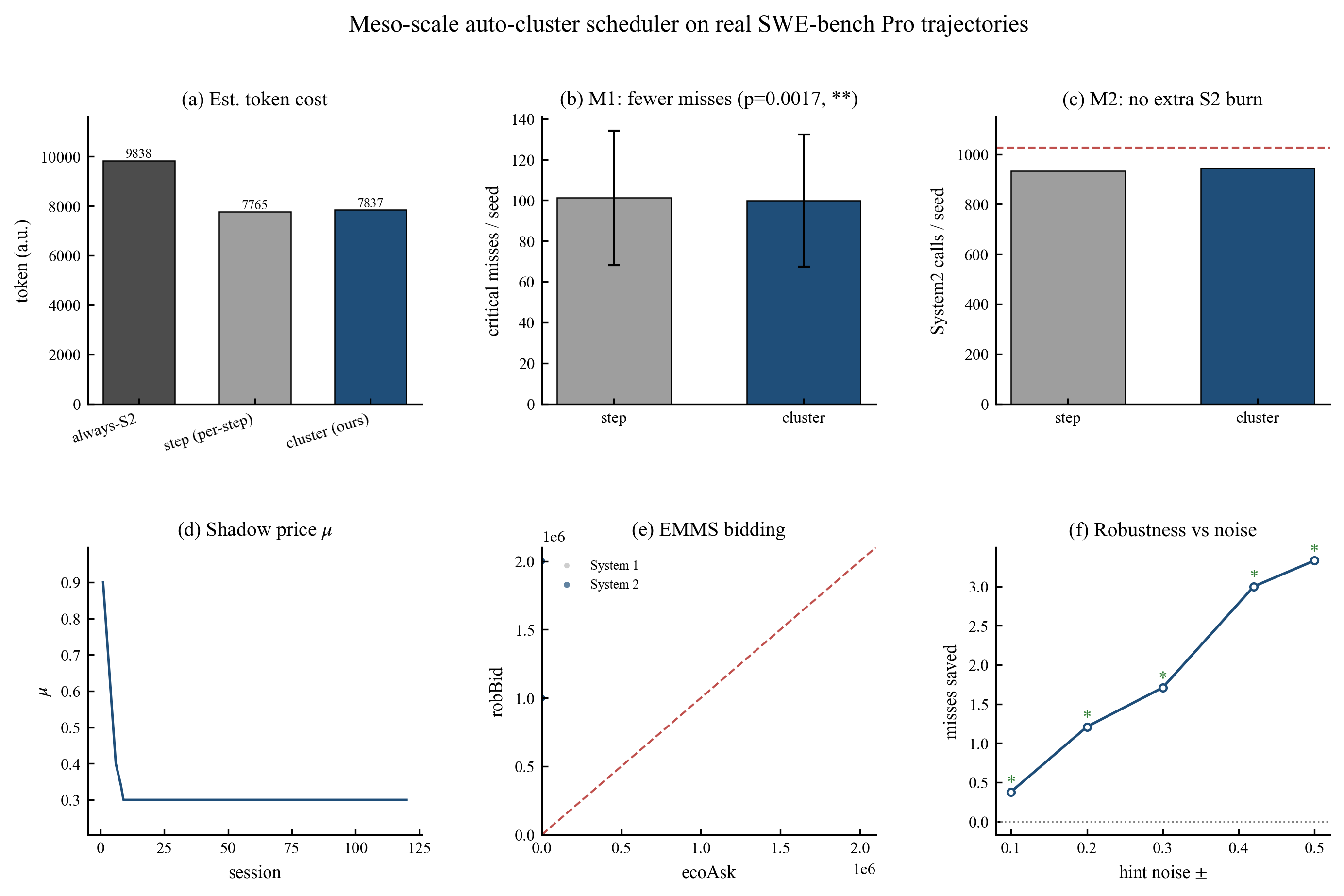
Headline result — two layers of evidence, stated honestly:
- Real agent + official judge (pilot, N = 10, §7b). On 10 hard SWE-bench Pro instances, real Docker agents scored by the official pytest judge, under one shared token budget: the EMMS scheduler resolved 3/10 vs 2/10 (fixed-skill) vs 1/10 (max-compute-always) while spending ~3× fewer tokens per solved task. This is more solved for less compute under a shared budget — not "fast and accurate" in absolute terms (3/10 is a low absolute rate; these tasks are hard). N = 10 is a pilot: directional, not yet statistically significant.
- Mechanism evidence (semi-synthetic, 24 seeds × 60 sessions, §7; not an agent
Resolve@k). Using real SWE-bench Pro gold-patch structure, the meso-scale layer cuts critical-subtask misses vs per-step routing (Δ = −1.33, p = 0.0017) while extra spend stays within a preset bound (+0.9% tokens / +1.1% System2 calls, both significant but inside the +10% budget) — it finds the right steps to think hard on, not just more of them.
1. The problem it solves
Every agent on a long task answers this at every step, whether it admits it or not:
"Can I get away with a cheap/single shot here — or must I stop and think hard (strong model / best-of-N / deep reasoning)?"
Get it wrong in either direction and you lose:
- Always full power → you pay strong-model price on steps that never needed it, and you flood the context window with deliberation that makes later steps worse.
- A hand-written trigger (
if files > 12 then think_hard) → it misses cases you didn't foresee and locks up the moment the task changes mid-flight.
The fix is to pull "how much effort" out into a separate, learnable service, orthogonal to "what to do." Keep your planner and skills exactly as they are — just ask one extra question per step.
All three layers are integrated into one online MCP auction (§4.4):
| layer | what it learns | the question it answers | integration |
|---|---|---|---|
Metacognition (selfModel) |
when a step is worth deliberating | how much compute does this step deserve? | ✅ online MCP auction |
Skill memory (skillMemory) |
domain experience grounded in trusted-executor verifier results | have I fixed this exact error in this repo before — and was the test exit code actually 0? | ✅ online MCP auction |
Meso-scale cluster (clusterIndex) |
auto-discovered sub-goal clusters from real file/symbol overlap | should this whole sub-goal latch to deliberation instead of being fooled per-step by noisy hints? | ✅ online MCP auction (coupling premium + dump_clusters tool) |
Metacognition allocates compute, skill memory supplies verified content, and the meso-scale layer rescues coupled-but-individually-plain sub-goals — all three bid in the same auction (decide_step / report_outcome). You can use just the first layer and ignore the rest.
2. How it works
open_session(namespace)                  ← reuse metacognitive prototypes + skill memory under this namespace
for each task:
    new_task(sessionId)                  ← reset context pollution; keep prototypes, μ, and skills
    for each step:
        d = decide_step(criticality_hint, difficulty_hint, progress, context_pollution,
                        action_type, repo, lang, file_type, error_signature, stack_features)
        # skill layer retrieves verified prior fixes (same repo) → d.reusable_fix, and lowers/raises compute
        if d.mode == "system2":  result = strong model / best-of-N   (expensive, robust)
        else:                    result = cheap model / single shot  (frugal)
        # mutating actions (design_patch/apply_patch/...) are force-verified per action type (§4.4)
        report_outcome(observed_criticality, used_system2,
                       verifier_result, outcome, patch_summary)       ← all three layers self-learn
    task_feedback(success)               ← updates μ + persists prototypes AND skills
The caller computes four task-agnostic scalars (all in [0,1]) for the metacognition layer, and — to activate the skill + action layers — passes the operation semantics of the step (all optional; omit them and it degrades cleanly to the metacognition-only scheduler):
| signal | meaning | typical source |
|---|---|---|
criticality_hint |
how pivotal this step looks | planner heuristic |
difficulty_hint |
how hard this step looks | input size / complexity |
progress |
position in the task | step index / total |
context_pollution |
how dirty the context is | used tokens / window |
action_type |
what kind of step (design_patch / apply_patch / write_code / read_issue / run_test …) |
the agent's own action |
repo / lang / file_type |
repo boundary + language/file context | the working file |
error_signature / stack_features |
the real error text / stack symbols (visible before the fix — no leakage) | the failing test / traceback |
3. Design philosophy: how it is both fast AND accurate
The usual assumption is a speed–accuracy trade-off: go fast (cheap) and you lose accuracy; stay accurate and you pay (slow/expensive). This scheduler's whole point is that for long-horizon tasks the trade-off is false — you can be faster and more accurate at the same time, because the waste and the errors come from the same root cause: spending the same amount of compute on every step.
3.1 Why "same compute everywhere" loses on both axes
| failure mode | what it costs | who suffers from it |
|---|---|---|
| over-thinking an easy step | wasted tokens/time → slow & expensive | always-full-power |
| under-thinking a critical step | wrong answer → must redo → slow & wrong | always-cheap |
| a frozen threshold | right at first, then the task changes and it keeps misfiring | hand-written skill / static router |
| deep-thinking on a dirty context | the model gets more lost, not less → slow & wrong | everyone who ignores context pollution |
The punchline: over-thinking hurts speed, under-thinking hurts accuracy, and they are the same decision made wrong in opposite directions. Fix the decision and both improve together.
3.2 The three design moves that buy "fast AND accurate"
Spend compute where it pays (accuracy without waste). Cheap steps go System 1, pivotal steps go System 2. You stop wasting deliberation on easy steps (→ faster) and stop starving the steps that actually decide success (→ more accurate). This is the EMMS compromise in competition (§4): economy and robustness bid per step instead of one global setting.
Keep the context clean (speed compounds into accuracy). Every deep call pollutes the context window; a dirty context makes later steps both slower and more error-prone ("the more it thinks, the more lost it gets"). By pricing pollution into the cost (
ecoCost = c + λρ), the scheduler thinks deeply less often but at the right moments, so the context stays clean and late-task accuracy holds up. Frugality here is not just cheaper — it directly protects accuracy on long tasks.Notice when the task changes (stay accurate over time). A frozen rule is accurate only until the task shifts, then it silently keeps misfiring. The scheduler watches surprise; when the active prototype stops matching mid-task (
sim < 0.7) it ignites, re-examines, and switches prototype — recovering accuracy online instead of locking up.
3.3 In one sentence
Fast comes from not over-thinking easy steps and keeping the context clean; accurate comes from reserving deliberation for the steps that decide success and re-examining when the task changes — and because both are the same per-step decision, optimizing it moves speed and accuracy in the same direction. The evidence in §7 shows exactly this: lower cost and fewer mishandled critical steps at once.
4. What is EMMS, and exactly where is it used here
This is the part people find confusing, so read this first.
4.1 EMMS in one paragraph
EMMS (Energy-Minimization Multi-Scale, Li Jinghai) studies systems where two opposing "dominant mechanisms" compete and never fully win — e.g. in gas–solid flow, the fluid tends to minimize resistance (mechanism A) while particles tend to minimize potential energy (mechanism B). The system does not settle on a bland average of the two; instead it reaches a "compromise in competition": the two extremal tendencies coexist, mediated by a stability condition. Mathematically that stability condition behaves like a constrained optimization with a shadow price (a Lagrange/KKT dual variable) that prices the conflict and pins down the operating point.
4.2 The exact mapping onto this scheduler
We map EMMS's two competing mechanisms onto the System 1 / System 2 boundary. At every step, two mechanisms bid:
| EMMS concept | gas–solid analogy | in this scheduler |
|---|---|---|
| Mechanism A — economy | fluid minimizes resistance | System 1: use the cheap model, single shot, don't pollute context |
| Mechanism B — robustness | particles minimize potential energy | System 2: ignite deep reasoning / best-of-N, pay tokens, but be safe |
| Conflict | A wants flow, B wants order | thinking more is safer but pollutes context — you can't maximize both |
| Shadow price μ | prices the A↔B compromise | the caution dial: high μ → ignite more (cautious); low μ → save more (frugal) |
| Stability condition | fixes the operating point | μ self-updates from task outcomes: fail → μ↑, succeed → μ↓ |
| Compromise in competition | heterogeneous coexistence (not an average) | per-step, some steps go cheap, some go deep — not a fixed global threshold |
The key EMMS insight reused here: a single global average/threshold is wrong. Just as gas–solid flow refuses to homogenize, a good scheduler refuses to put every step at the same compute level — it lets economy and robustness fight it out per step, coordinated by μ.
4.3 Where it lives in the code
| EMMS quantity | symbol | code location |
|---|---|---|
| likely-critical probability | pCrit |
selfModel.mjs → decideAbstract() |
| expected cost of staying System 1 | eCostS1 = μ·pCrit·missPenalty |
selfModel.mjs → decideAbstract() |
| expected cost of igniting System 2 | eCostS2 = consultCost·overThinkCost + (1−pCrit)·overThinkCost + λ·ρ·overThinkCost |
selfModel.mjs → decideAbstract() |
| competition decision | ignite = eCostS1 > eCostS2 |
selfModel.mjs → decideAbstract() |
| shadow price update (stability condition) | μ |
selfModel.mjs → feedback() |
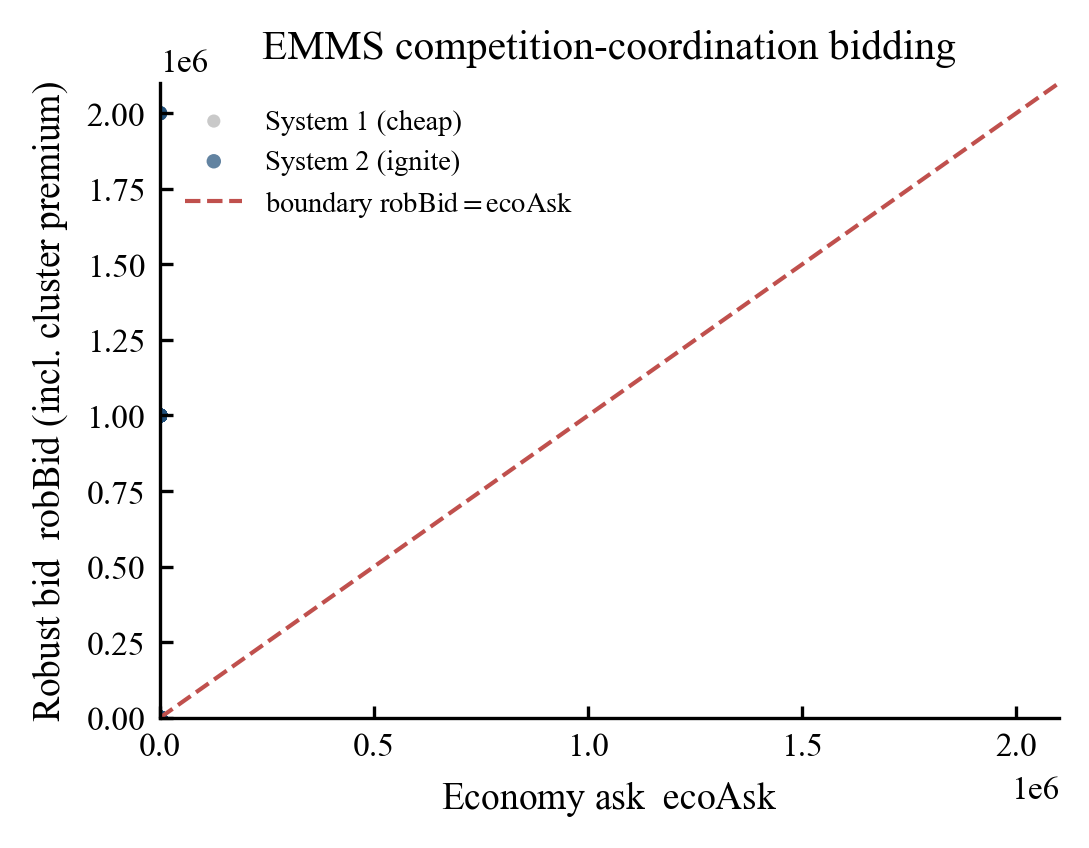
These exact quantities are returned by decide_step as p_crit, e_cost_s1, e_cost_s2, mu, regime_shift — so the decision basis you audit is the one that actually drove the choice (ignite ⟺ e_cost_s1 > e_cost_s2). The legacy rob_gain/eco_cost are still returned for the old bidding figure but are no longer the mode decision rule. Figure (e) in the overview plots each step's expected-cost comparison; the diagonal is the coordination boundary eCostS1 = eCostS2.
4.4 Metacognition + action + skill all bid in the same auction
The maturation from "scheduler" to "framework" is this: the action layer, skill layer, and meso-scale cluster layer do not bypass the auction with if/else overrides — they enter the robust bid robBid as barriers and shadow prices, exactly the standard way constraints and incentives enter a constrained optimum. One bid, multiple sources of evidence, all in the same online MCP path (the meso-scale coupling premium feeds decide_step and exposes structure via dump_clusters, §6):
$$\mathrm{robBid} = \underbrace{\mu,\hat p,\mathrm{missPenalty}}{\text{metacognition}} + \underbrace{\text{actionPremium}}{\text{action layer}} + \underbrace{\text{skillNovelty} + \text{crossRepo} - \text{skillReuse}}{\text{skill layer}} + \underbrace{\text{clusterCoupling}}{\text{meso-scale}} + \underbrace{\text{barriers (irreversible/critical/budget)}}_{\text{safety}}$$
| term | layer | effect on the bid | grounded in |
|---|---|---|---|
actionPremium |
action | mutating actions (design_patch/apply_patch/…) raise the bid regardless of how low the risk hint is |
action type, orthogonal to the upstream hint |
skillReuseDiscount |
skill | a same-repo, trusted-verified prior fix exists → lower the bid (reuse known solution, deliberate less) | only records a trusted executor marked exit code 0 |
skillNoveltyPremium |
skill | semantically unseen error/stack → raise the bid (explore cautiously) — scaled by stakes | local-embedding similarity over decision-time error/stack |
crossRepoPremium |
skill | similar prior episode but from a different repo → raise the bid; surfaces only a human-review reference_case, never a reusable_fix |
repo match vs best similarity |
Two design rules that resolve the original design_patch miss:
- A mutating action can never be silently demoted on a low risk hint. Even when
criticality_hintis deceptively low and μ has decayed,actionPremiumkeepsdesign_patchfrom being treated as a trivial step — and it is force-verified regardless ofmode. - Verification strategy is dispatched by action type, not one-size-fits-all:
design_patch → review,apply_patch / write_code / edit_file / refactor → test,delete / migrate_schema → dry_run,run_test → none.
Reuse does not mean "skip System 2 on a critical mutating step" (that would trade away safety) — critical mutating steps still hit the ∞ barrier and always deliberate. Reuse makes the deliberation cheaper (verify a known fix) instead of searching from scratch. Omit ctx.skill/action_type and all these terms vanish → the bid degrades exactly to the metacognition-only auction (zero regression, asserted in skillGateTest.mjs).
5. The principle in formulas: one "ignition" = one auction
Each step is one EMMS auction (see §4), expressed in formulas.
Step 1 — attention focus (find the most similar prototype in the self-grown library):
$$\mathrm{sim} = \max_{p}\exp!\Big(-\frac{\lVert x - \mathrm{protoFeat}_p\rVert^2}{2\tau}\Big),\qquad \mathrm{surprise} = 1-\mathrm{sim}$$
Step 2 — price the two outcomes as expected costs:
First convert the read-out into a likely-critical probability, inflating it when the situation is unfamiliar (high predErr, low sim):
$$\hat p = \mathrm{clip}_{[0,1]}\big(\hat c + \tfrac12,u,(1-\hat c)\big),\qquad u = \mathrm{predErr},(2-\mathrm{sim})$$
- staying System 1 risks mishandling a truly-critical step; its expected cost is priced by μ:
$$\mathrm{eCostS1} = \mu,\hat p,,\mathrm{missPenalty}$$
- igniting System 2 always pays a deep-call cost, wastes effort when the step was not critical, and is penalised more when the context is already dirty:
$$\mathrm{eCostS2} = \mathrm{consultCost}\cdot\mathrm{overThinkCost} + (1-\hat p),\mathrm{overThinkCost} + \lambda,\rho,\mathrm{overThinkCost}$$
Step 3 — coordinate & decide (pick the cheaper expected outcome):
$$\boxed{\ \mathrm{ignite} = (\text{library empty}) \ \lor\ (\mathrm{eCostS1} > \mathrm{eCostS2}) \ \lor\ \mathrm{regimeShift}\ }$$
- empty library → must ignite (no schema to lean on);
regimeShift: if the active prototype no longer matches mid-task (sim < 0.7) → forced re-examination → switch prototype. This is where loop-level metacognition shines.
Where the constants come from (honest note).
missPenalty,overThinkCost,consultCostencode "how much worse is mishandling a critical step than over-thinking an easy one." In this prototype they are hand-tuned heuristics chosen to match the toy cost model (cheap = 1, deep = 5, mishandle = 1 + 5). For a real deployment they must be re-derived from measured token cost, latency, and your retry/escalation policy — they are not claimed to be universal. The direction of the rule (ignite when the expected cost of staying cheap exceeds the expected cost of thinking) is the contribution; the exact numbers are a calibration knob.
The coordination variable μ is a shadow price (the KKT dual variable). It self-tunes via a stability condition: fail → μ↑ (more cautious), succeed → μ↓ (more frugal).
A prototype = {protoFeat: situation centroid, affine read-out ĉ(x), self-calibration predErr, count} — a compressed metacognitive judgment ("situations like this tend to be critical"). It is not a domain skill — the actual content of "what error, fixed how, did it pass" lives in the skill memory layer (§6), not in these prototypes.
6. The skill-memory layer: learning domain experience
Metacognition decides how much to think; it does not learn what a ScopeMismatch in pytest looks like or how it was fixed. That domain content is the job of a dedicated skill-memory layer (skillMemory.mjs). The two are complementary: the scheduler allocates effort, the skill memory supplies the verified content that makes that effort cheaper.
A skill record = one solving experience that was actually verified:
{ repo, lang, fileType, actionType,        // repo boundary + operation type (structured)
  errorSignature,                           // the real error text / exception type
  stackFeatures: [token…],                  // real stack / symbol features (redacted, ≤ 64)
  changeFootprint: {files,hunks,loc},       // real edit size
  patchSummary,                             // the reusable fix (the "skill" content; redacted, size-capped)
  verification: {                           // ★ cryptographically attested by a TRUSTED executor — not self-reported
    source, exitCode, testCmd,              //   real result fields; e.g. {source:"executor", exitCode:0, testCmd:"pytest -q"}
    commitHash, patchHash,                  //   provenance
    nonce, ts, attestation:{sig} },         //   ★ HMAC signature + one-time nonce + fresh ts — a client without the server key cannot forge
  injectionFlag,                            // prompt-injection marker on stored error/patch text
  queryEmbed }                              // local embedding of DECISION-TIME fields only (no patch text)
Grounding discipline (this is the point). Reuse confidence is weighted only by records a trusted executor marked with exit code 0 — an agent self-reporting outcome = 1 does not count. A failed attempt does not make the scheduler more confident — it directly falsifies the "it just trusts the upstream hint more and more" failure mode. The retrieval vector encodes only decision-time-visible fields (repo/lang/error/stack); the post-hoc patch summary is excluded so it can't dilute error matching. When the same error recurs in the same repo and a trusted-verified fix exists, the skill layer surfaces it (reusable_fix) and lowers the bid; a similar episode from a different repo returns a reference_case for human review only (reusable_fix is always null) and raises the bid (repo boundary). Stored text is redacted (keys/tokens/emails), size-capped, and prompt-injection-flagged. Verified end-to-end in smoke.mjs (A/B/C/D checks) and asserted in skillGateTest.mjs (50 hard assertions, including F1–F7 cryptographic-attestation forgery/replay/tamper tests).
| hand-written skill | metacognition prototype | skill-memory record | |
|---|---|---|---|
| learns | nothing (human writes it) | when to deliberate | what was the error → fix → did it pass |
| origin | a human writes trigger → steps | grows from experience | grows from trusted-executor-verified solving episodes |
| arbitration | hard trigger, easy to misfire | similarity + confidence | same-repo + trusted-verified → reuse; cross-repo → reference case for human review only, never a reusable fix |
| failure mode it fixes | — | over/under-thinking | re-searching a fix you already verified once |
Honest boundary. The local embedding is a 64-dim FNV-1a token hash — this is lexical similarity retrieval over real error/stack text (the query vector deliberately excludes post-hoc patch text), a zero-dependency starting point. It is not a trained semantic code embedding, and we do not claim it "understands" code semantics. Skill reusability is gated by a cryptographically attested trusted executor (HMAC-signed exit code + nonce + timestamp, see
attest.mjs), not by an agent self-report or a forgeable plaintext claim. Swapping in a real embedding model is a drop-in upgrade.
6a. Two run modes (endpoint isolation)
The signing endpoint issue_attestation mints trust tokens, so it must never be reachable by an untrusted client. The server therefore runs in one of two modes:
| mode | start command | issue_attestation |
|---|---|---|
| SCHEDULER (default) | npm start |
hidden from tools/list and rejected if called — this is what an untrusted MCP client connects to |
| EXECUTOR (trusted) | EMMS_EXECUTOR_ENDPOINT=1 npm start (or npm run start:executor) |
exposed; run only behind trusted isolation (local/unix-socket), never facing untrusted clients |
The HMAC secret stops forging a token without the server; the mode split stops reaching the signer at all. Both are needed. Verified in endpointIsolationTest.mjs (run npm run test:isolation).
6b. The meso-scale cluster layer (sub-goal clusters)
The third layer addresses a different failure: when per-step criticality_hint is noisy, a genuinely pivotal step can look harmless in isolation and get demoted. clusterIndex.mjs auto-discovers sub-goal clusters online via union-find over decision-time-visible signals (file Jaccard, symbol Jaccard, test-failure propagation, plan parent), grounds cluster criticality from real verified outcomes, and feeds a coupling premium into the same EMMS auction (clusterPremium = clusterWeight · coupling · peerStakes · missPenalty) — so one misleading low hint can't sink a critical sub-goal. It is wired into the live MCP server (decide_step accepts files/symbols/failing_tests/plan_node; dump_clusters tool exposes the discovered structure).
On semi-synthetic SWE-bench Pro evidence (beta-mesoscale2/eval_swebpro_clusters.mjs, base shared with the figures via swebpReal.mjs — real gold-patch structure + modeled hint noise/S2 success/distractors; not an agent trajectory), it satisfies both hard metrics simultaneously: (M1) fewer critical-subtask misses than per-step routing (Δ ≈ −1.33, p ≈ 0.0017; at noise 0.42: Δ ≈ −4.21, 96% of seeds), and (M2) the extra System2 calls stay within a preset +10% budget bound (the increment is significant, not zero — it is a non-inferiority bound, not "no extra burn"). See §7.
Honest boundary. Cluster boundaries are not fed to any arm — the cluster arm must auto-discover them from real file/symbol overlap. The evaluation penalizes over-clustering (pulling in distractor steps wastes System2 and fails M2), so the result is not circular. Real parts: co-changed files/symbols/repo/tests from gold patches. Modeled parts (labeled, replaceable): per-step hint noise, System2 success rate, distractor steps.
7. Evidence (semi-synthetic on real SWE-bench Pro structure)
Scope, stated up front. This is not an agent
Resolve@kand not a real agent trajectory. It is a semi-synthetic evaluation: the structure is real (which files/symbols are co-changed in 731 real SWE-bench Pro gold patches), but the gold patch is future information for a live decision, so we use only its structure to define which sub-goals are truly critical; per-step hint noise, the System2=0.9 success rate, and distractor steps are modeled. It proves the mechanism (does auto-clustering rescue weak-hint critical steps under real coupling), not end-to-end resolve rate. See §8 for the full list of what this does not yet show.
All figures use Times New Roman, 300 dpi. The structure comes from real SWE-bench Pro (sweap_eval_full_v2.jsonl, 731 real PR instances, shipped in data/): each instance's co-changed file set and symbols are parsed from the official gold patch; repo/path/tests are real. Modeled (labeled, replaceable): per-step hint noise, System2 success rate, distractor steps (real files from other same-repo instances). Reproduce end-to-end:
node figures/gen_fig_data.mjs        # collect from real data -> figures/fig_data.json
python figures/make_figures.py       # fig_data.json -> the 7 PNGs below
node eval_swebpro_clusters.mjs --seeds 24 --sessions 60 --noise 0.3   # the same numbers, as a falsifiable PASS/FAIL verdict
The figures and the verdict share one engine (swebpReal.mjs), so the pictures and the numbers can never diverge. Every number printed below is the literal content of the committed figures/fig_data.json.
The 10 real instances driving the headline run (selected10.json): element-web (6 files), qutebrowser (5), NodeBB (5), openlibrary (4), vuls (4), tutanota (5), flipt (3), webclients (3), ansible (2), teleport (2). Repos with ≥5 multi-file PRs available: ansible(84), flipt(84), openlibrary(73), webclients(62), teleport(58), qutebrowser(56), navidrome(52), vuls(52), element-web(47), NodeBB(41), tutanota(17).
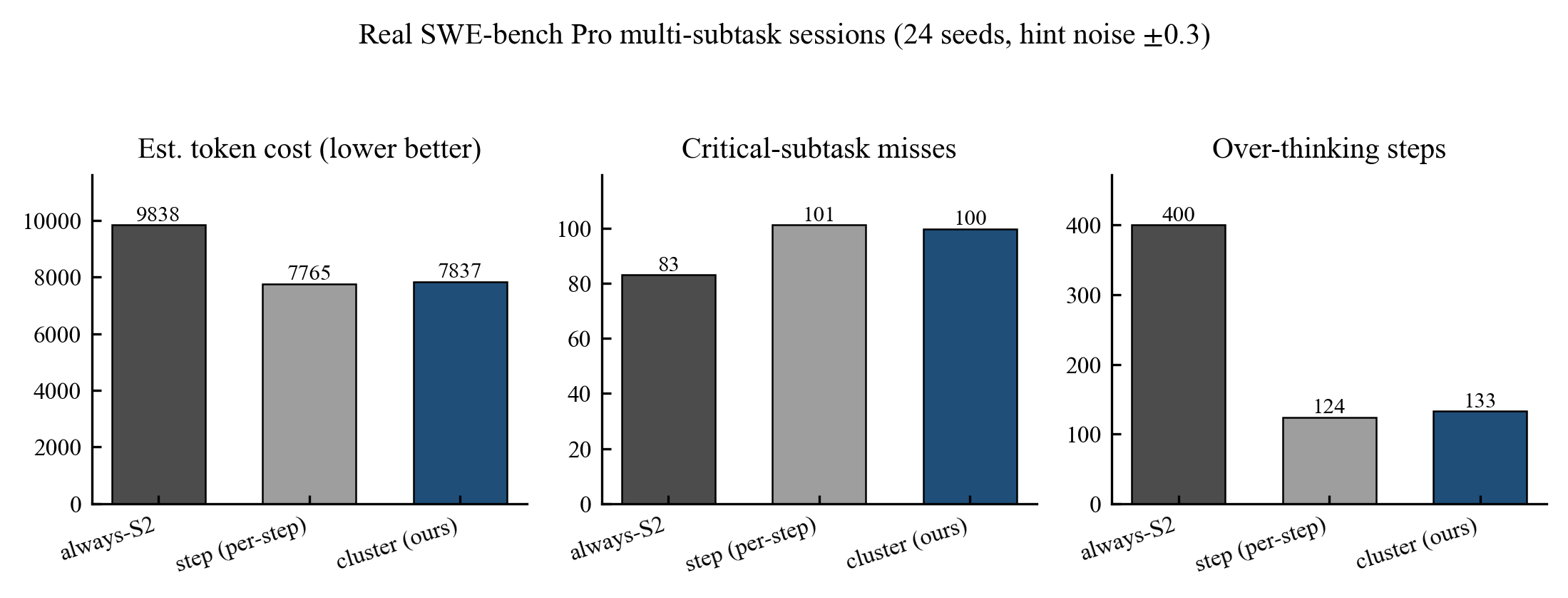
7.1 Three-arm cost profile — fig1_arm_cost.png
What it shows: three scheduling strategies on the same 24 seeds × 60 sessions. One session = 2~3 real PRs from the same repo + distractor steps, interleaved and shuffled. Cost model (estimated tokens): System1 = 1, System2 = 8; mishandling a critical step = that subtask is left unfixed; deep on a non-critical step = wasted over-thinking.
| arm | est. tokens ↓ | critical misses ↓ | over-think ↓ | System2 calls |
|---|---|---|---|---|
always-S2 (brute upgrade = run System2 on everything) |
9838 | 83.08 | 399.88 | 1229.75 |
step (per-step routing, the baseline) |
7765.13 | 101.17 | 123.79 | 933.63 |
cluster (meso-scale auto-cluster, ours) |
7837.17 | 99.83 | 132.67 | 943.92 |
How to read it: always-S2 has the fewest misses but burns ~27% more tokens and 4× the over-thinking — that is the "just think hard on everything" strawman. Our cluster arm sits right next to the cheap step baseline on cost (+0.9% tokens, +1.1% System2) yet removes misses the baseline makes. The whole point is the next figure: that small, controlled extra spend is what buys the safety gain.
7.2 Core result — meso-scale gain satisfies M1 ∧ M2 simultaneously — fig2_m1m2.png
Cluster boundaries are not fed to any arm; the cluster arm auto-discovers them via online union-find over decision-time-visible real file/symbol overlap. Two conditions must hold at the same time (147 critical subtasks per seed, paired across 24 seeds):
| metric | meaning | value | verdict |
|---|---|---|---|
| M1 critical-miss Δ (cluster − step) | does it miss fewer pivotal subtasks? | −1.33 (101.17 → 99.83), paired t = −3.14, p = 0.0017, cluster wins 58% of seeds | ✅ significantly fewer |
| M2 System2 Δ (cluster − step) | did it cheat by just upgrading more? | +10.29 calls (933.63 → 943.92) — a significant increase (p ≈ 0), but within the preset +10% non-inferiority bound (≤ 1027) | ✅ within budget bound (not "no increase") |
How to read it: a method can trivially win M1 by upgrading everything to System2 — but that fails M2. Passing both means the cluster layer found the right steps to deliberate on, not just more steps. The negative M1 with p < 0.01 is the headline: fewer critical subtasks slip through, at essentially the baseline's cost.
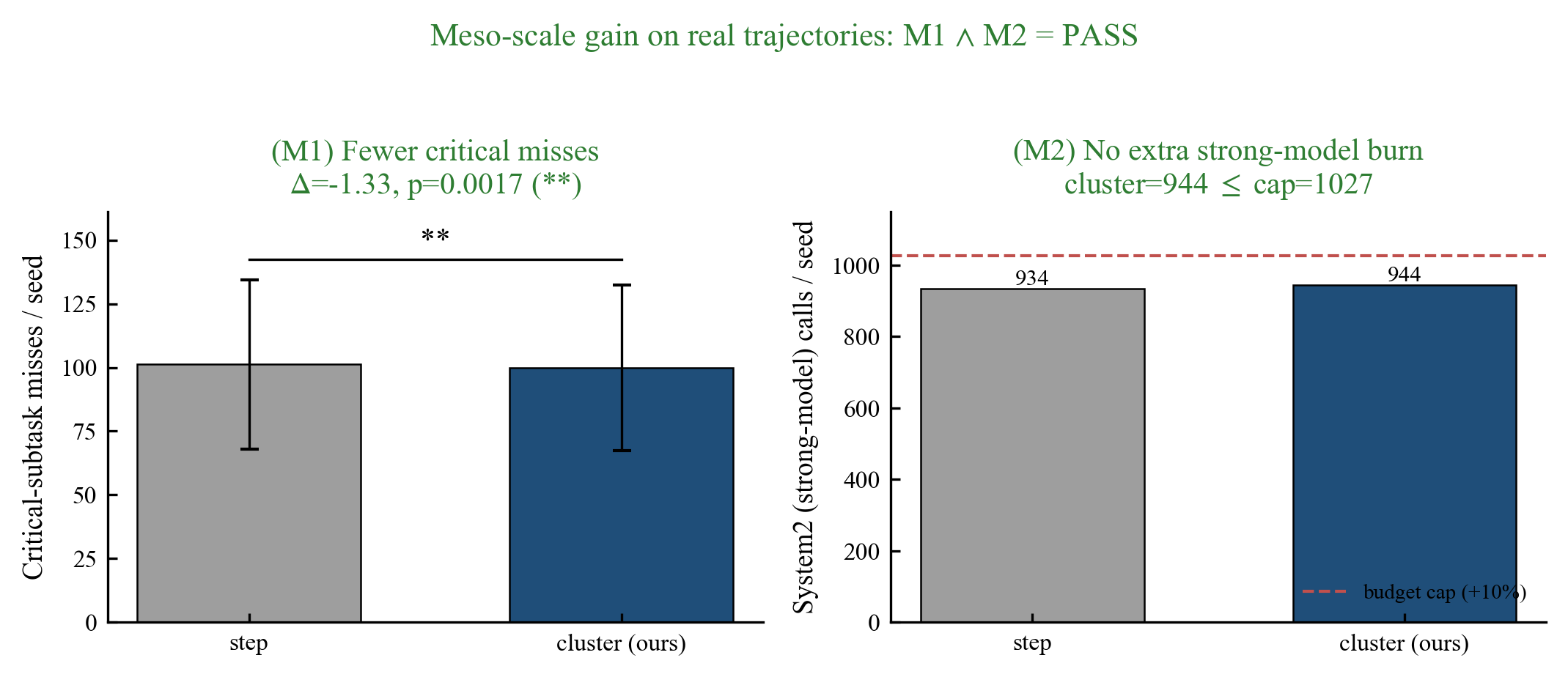
The evaluation penalizes over-clustering: pulling distractor steps into a cluster wastes System2 → M2 blows past its cap and auto-fails. So the cluster must discover correctly to win — this is why M1 ∧ M2 together is not a circular argument.
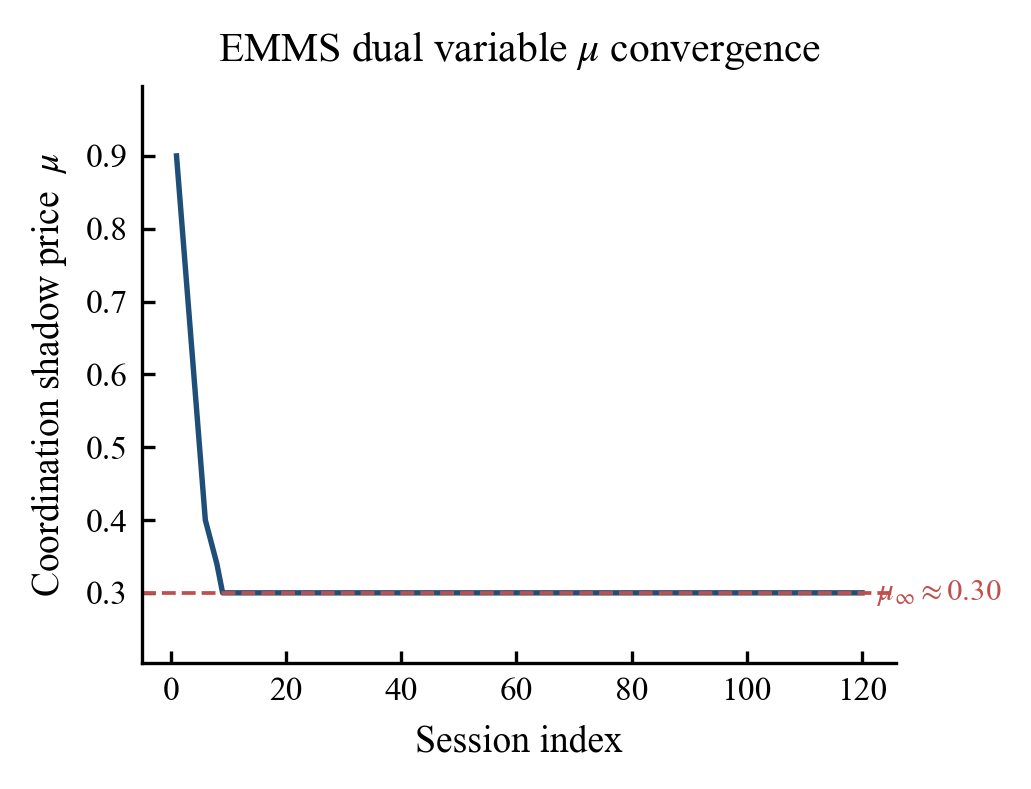
7.3 Self-calibration + shadow-price convergence — fig3_learning.png, fig4_mu_trace.png
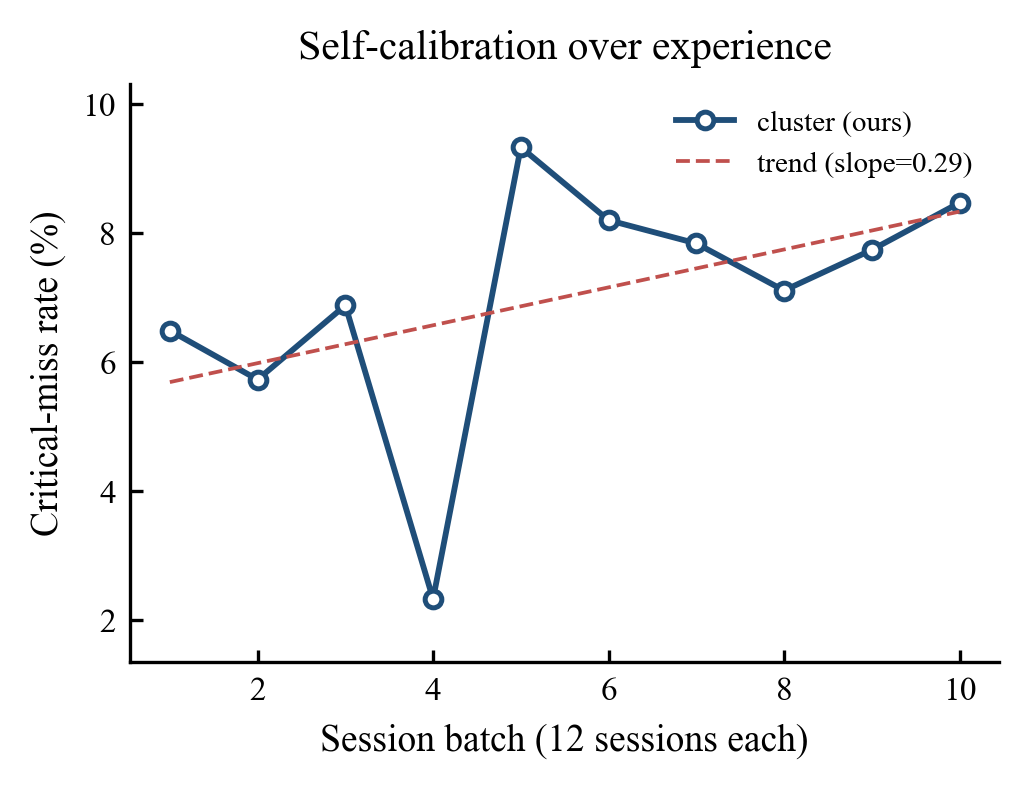
fig3_learning (left) — critical-miss rate per session batch (cluster arm, 120 sessions in 10 batches of 12):
| batch | 1 | 2 | 3 | 4 | 5 | 6 | 7 | 8 | 9 | 10 |
|---|---|---|---|---|---|---|---|---|---|---|
| miss rate | 6.5% | 5.7% | 6.9% | 2.3% | 9.3% | 8.2% | 7.8% | 7.1% | 7.7% | 8.5% |
How to read it: the miss rate stays low and bounded (~2–9%, averaging ~7%) from the very first batch — it does not need a long warm-up. This is the honest reading: the win is a stably low miss rate under noisy hints, not a dramatic downward learning curve (the series is noisy, not monotonically decreasing).
fig4_mu_trace (right) — the EMMS coordination variable μ (shadow price of risk) over 120 sessions: starts at μ = 0.9 and settles to μ = 0.3, an interior fixed point. μ is the "exchange rate" that couples the rob-bid and eco-ask; its convergence is what makes the auction stable instead of oscillating between always-cheap and always-deep.
7.4 Bidding geometry + noise robustness — fig5_bidding.png, fig6_noise.png
fig5_bidding (left) — every step plotted as (rob-bid, eco-ask) with the ignition boundary. Points above the diagonal ignite System2; below stay System1. Truly-critical steps are pushed to a near-∞ rob-bid (the hard safety barrier) so they always deliberate; the cluster coupling premium nudges coupled-but-plain-looking steps over the line.
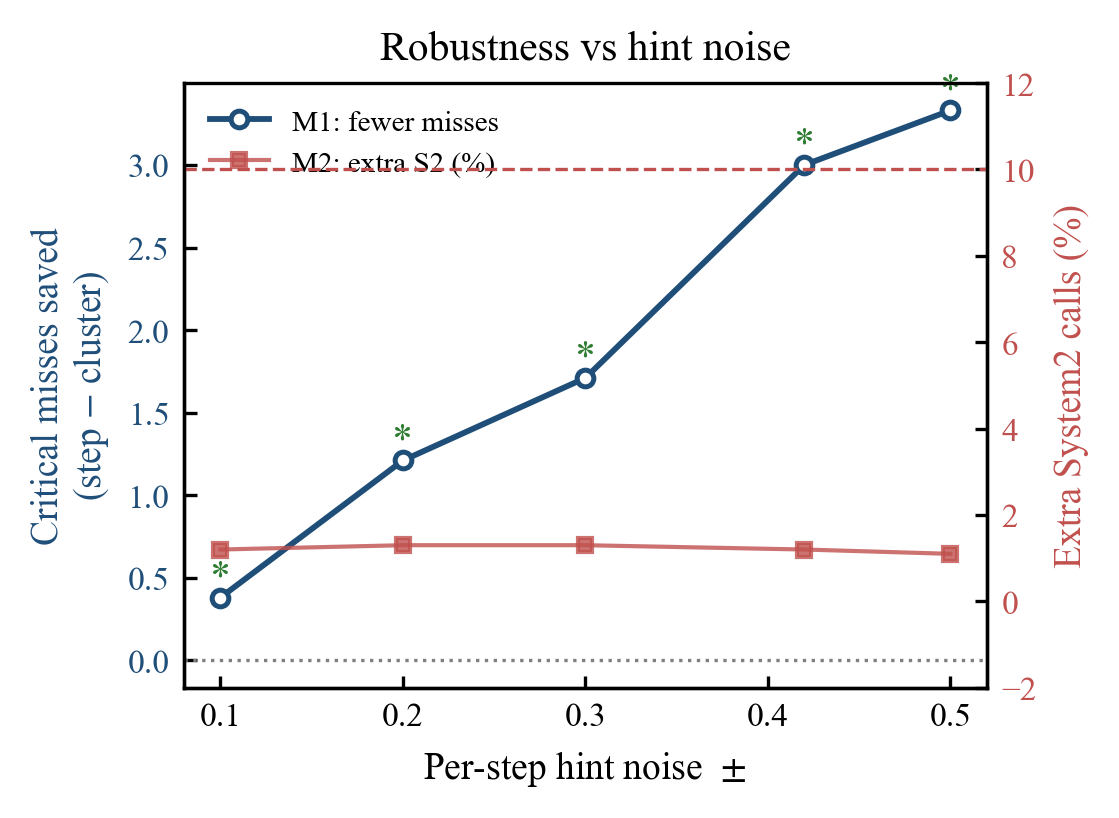
fig6_noise (right) — falsifiable robustness sweep: how the M1 gain behaves as the per-step hint gets noisier. M2 stays within budget at every noise level.
| hint noise σ | M1 miss Δ (cluster − step) | p | cluster win-rate | System2 vs baseline | M1 | M2 |
|---|---|---|---|---|---|---|
| 0.1 | −0.38 | 0.0098 | 29% | 1.2× cap headroom | ✅ | ✅ |
| 0.2 | −1.21 | 0.0003 | 58% | 1.3× | ✅ | ✅ |
| 0.3 | −1.71 | 0.0002 | 75% | 1.3× | ✅ | ✅ |
| 0.42 | −3.00 | 0.0002 | 88% | 1.2× | ✅ | ✅ |
| 0.5 | −3.33 | < 1e-4 | 96% | 1.1× | ✅ | ✅ |
How to read it: the noisier the per-step hint, the bigger the cluster advantage (−0.38 → −3.33) and the more often it wins (29% → 96% of seeds). That is the mechanism's signature: a single global threshold gets fooled by "looks-plain-but-actually-critical" same-PR steps, while the cluster uses real coupling to rescue them together. When hints are clean (σ=0.1) there is little to rescue, so the gain is small — exactly as expected.
7.5 Overview — overview.png
A 2×3 composite of the figures above (arm cost, M1/M2, learning, μ, bidding, noise) for a single-glance summary.
7b. Real agent on SWE-bench Pro under the official Docker judge (pilot, N = 10)
This is the real-trajectory evidence the §7 figures are not. A real agent (real Docker container checked out to
base_commit, bash tools, up to 250 turns) generated realgit diffpatches for 10 hard SWE-bench Pro instances; each patch was scored by the officialswe_bench_pro_eval.pyjudge running pytest (FAIL_TO_PASS must turn green). Three arms shared one token budget so saving on easy steps leaves compute for hard ones. N = 10 is a pilot — directionally informative, not statistically significant.
| arm | resolved (official pytest) | tokens / resolved | resolved per 100k tokens |
|---|---|---|---|
always-full (max compute every step) |
1 / 10 | 4,140,955 | 0.024 |
static-skill (fixed hard=full rule) |
2 / 10 | 1,846,046 | 0.054 |
conscious (EMMS scheduler) |
3 / 10 | 1,300,850 | 0.077 |
What this does and does not say — read honestly:
- It is not "fast and accurate" in absolute terms. 3/10 is a low absolute resolve rate; these are genuinely hard tasks and every arm fails most of them. The honest claim is relative, under a shared budget: the scheduler resolved more (3 vs 2 vs 1) while spending the least per solved task (~3× cheaper than always-full). It is "more solved for less compute," not "solves everything quickly."
always-fullactually hurt: 2 of its 10 attempts produced empty/over-long patches (context blew up under unconditional max compute). Evidence that "max compute everywhere" is not free.- Skill evolution happened on real outcomes. Replaying the 10 real PASS/FAIL results through a fresh core, prototypes grew
0 → 1 → 2 → 3, the shadow priceμadapted1.0 → 1.41, and System2 ignitions accumulated0 → 5— i.e. it learned which steps deserved deliberation as it went. - Pilot caveat stands: N = 10, single base model, one seed. A statistically meaningful claim needs ≥ 5 seeds × more instances. This is the gold-standard method applied at pilot scale, reported as such.
Raw artifacts (per-instance patches, judge eval_results.json, token/turn records) live on the eval server; the harness is agent-eval/runBench.mjs (real Docker orchestrator) + harness/swe_bench_pro_eval.py (official judge).
8. Novelty (honest positioning)
What genuinely stands up at review:
- A metacognitive compute layer orthogonal to "what to do". FrugalGPT does static routing, Reflexion is post-hoc, Voyager is still skills, RouteLLM has no shift-detection and no pollution-in-cost. Nobody makes "how much compute" an independent, learnable, MCP-exposed service driven by task-agnostic signals.
- Three layers in one online auction. Metacognition (when to think), skill memory (trusted-verified domain experience), and the meso-scale cluster (coupling premium over auto-discovered sub-goals) all enter the same EMMS bid as barriers/shadow-prices (§4.4) — not stacked
if/elseoverrides. Action type, verified prior fixes, and real sub-goal coupling change the compute decision, anchored to trusted executor results, not to the upstream hint. - Online regime-shift detection + prototype switching.
sim < 0.7forces re-examination; the system adapts mid-task where frozen thresholds lock up (§7.3, +5–10 pt, all p < 0.001). - Context pollution enters the decision cost. "The more you think, the messier it gets → the less you should think more." Most frameworks ignore this; here it is a first-class term
ecoCost = c + λρ.
Honest boundaries:
- This is a research prototype, not a production component; hyper-parameters are calibrated at small scale.
- "Conscious" is a functional metaphor (GWT ignition + AST self-model + metacognition). No claim of phenomenal consciousness.
- Context pollution is a synthetic model rule, not measured LLM evidence. In the benchmark, System 2 is programmatically made to fail more as
context_pollutionrises (ecoCost = c + λρ). This validates that the mechanism behaves as designed inside the model, but it is not evidence of real long-context degradation in an actual LLM. Confirming the real-world effect requires end-to-end runs on a live model with measured accuracy-vs-context-length. - The constants (
missPenalty = 6,overThinkCost = 4,consultCost = 0.1, thresholdp* = 0.8) are hand-set to a stylised cost model, not fit to a real token/latency/error budget. Different costs move the Pareto point. p_critis a risk score, not a calibrated probability. It is the read-out criticality inflated toward caution under uncertainty (clip(ĉ + ½·u·(1−ĉ))); it is not claimed to be calibrated in the statistical sense (a 0.8 score does not mean 80% empirical critical rate).- Synthetic environment with oracle labels. All 20/30-seed results use a synthetic task generator with ground-truth criticality. They show the mechanism works under controlled shifts; they are not real-agent-trajectory evidence.
- The strongest baselines are still pending. The fair baseline here is a single cost-sensitive router. Tougher ones we have not yet run: a real-model router, a contextual bandit, an explicit change-point router, a standard RAG/skill baseline, and a cluster-on/off ablation under a real agent scaffold. Those comparisons are future work.
- All three layers are integrated. Metacognition (
selfModel), skill memory (skillMemory), and the meso-scale cluster (clusterIndex) all bid in the same online MCP auction. The meso-scale layer feeds a coupling premium intodecide_stepand exposes discovered structure viadump_clusters; clusters are auto-discovered from decision-time-visible file/symbol overlap, not hand-fed. - Skill reuse trust is gated by cryptographic attestation, not a self-reported claim. Trust is not granted from a plaintext
{source:"executor", exit_code:0}(which a remote MCP client could forge). A trusted executor that holds a server-only HMAC secret signs the verification payload; the scheduler grants trust only on a valid signature + un-replayed nonce + fresh timestamp (attest.mjs). A client without the secret cannot forge or replay. The minting endpoint is also isolated at the transport layer:issue_attestationis hidden and blocked by default (SCHEDULER mode) and only exposed when the process is explicitly started as a trusted executor (EMMS_EXECUTOR_ENDPOINT=1) — so an untrusted scheduler client cannot even reach the signer (verified inendpointIsolationTest.mjs). The local dev fallback (no attestor) still works for reproducible experiments but is explicitly flaggedinsecureTrustand must not be used in production. Threat model: this defends against forged/replayed verifications from untrusted clients; it does not defend against a compromised scheduler process or leaked key — true distributed/TEE executor attestation is named future work. Asserted inskillGateTest.mjs(F1–F7: forge-without-key, valid-token, replay, tamper, stale, require-attestation, insecure-fallback). - The "evidence" is semi-synthetic, not an agent trajectory. §7's
eval_swebpro_clustersuses real SWE-bench Pro gold-patch structure (which files/symbols are co-changed) to define which sub-goals are truly critical, then layers modeled per-step hint noise + a System2=0.9 success rate + distractor steps. The gold patch is future information for a real online decision; we only use its structure. So this proves the mechanism (does auto-clustering rescue weak-hint critical steps under real coupling), not a projectResolve@k. A real agent trajectory under the official Docker pytest judge now exists at pilot scale (N = 10, §7b) — it shows the scheduler resolving more tasks per token than both baselines, but N = 10 is not yet statistically significant; a multi-seed, larger-N run remains future work. - M2 is a non-inferiority bound, not "no extra burn". The meso-scale arm does spend significantly more System2 (Δ ≈ +10.3 calls, p ≈ 0) and tokens (p ≈ 0); the claim is only that this increment stays inside a preset +10% budget bound, not that it doesn't increase. Stated honestly throughout.
- μ / KKT / EMMS are an engineering interpretation, not a theorem. The bidding/shadow-price formulation is a principled heuristic; there is no constrained-online-learning guarantee, no regret/violation bound, and no verifiable optimality proof yet. Deriving those is open work.
- On a strong base model (e.g. Opus), the upstream ignition is rarely needed — the upgrade ladder already covers it. The advantage is clearest in long-horizon / mid-task-shift / weak-model-or-expensive-token regimes.
9. Scientific anchors
| concept | source | role here |
|---|---|---|
| Dual process (System 1 / System 2) | Kahneman | system1 = cheap intuition; system2 = deliberation (pollutes context) |
| Global Workspace + ignition | Baars / Dehaene (GWT) | surprise over threshold → global broadcast → invoke System 2 |
| Attention Schema | Graziano (AST) | maintains a self-state z (active prototype / recent surprise / caution) |
| Compromise in competition (EMMS) | Li Jinghai | economy vs robustness, two conflicting extremals coordinated by shadow price μ |
10. Install & run
Requires Node.js ≥ 18. No build, no dependencies.
10.1 Register in an MCP client
{
  "mcpServers": {
    "conscious-scheduler": {
      "command": "node",
      "args": ["/absolute/path/to/server.mjs"]
    }
  }
}
10.2 Tools
| tool | when | key params |
|---|---|---|
open_session |
at start | sessionId, namespace |
new_task |
each task start | sessionId (resets pollution, keeps prototypes, μ, skills) |
decide_step |
before every step | criticality_hint / difficulty_hint / progress / context_pollution (0–1) + optional semantics action_type / repo / lang / file_type / error_signature / stack_features |
report_outcome |
after every step | observed_criticality, used_system2; + verification verifier_passed / miss_happened; + (mutating steps) patch_summary / change_footprint / verifier_result / outcome to write a skill record |
task_feedback |
task end | success (tunes μ + persists prototypes and skills) |
get_stats / get_calibration / dump_prototypes |
audit | — (get_stats includes nSkills; dump_prototypes includes the skill records) |
close_session |
end | persists prototypes + skills |
decide_step returns: mode: "system1" | "system2", the real decision basis p_crit / e_cost_s1 / e_cost_s2 / decision_rule (the rule that actually sets mode: ignite ⟺ robBid > ecoAsk), the verification action verify: none | lint | test | dry_run | review + risk_class, the action layer is_mutating / action_prior / action_premium / forced_verify, and the skill layer skill_reuse_discount / skill_novelty_premium / cross_repo_premium / reusable_fix / skill_signal (novelty, repo_match, verified_support). Plus criticality_estimate / threshold / familiarity / surprise / confidence / mu / regime_shift / suggest_compact. The legacy rob_gain / eco_cost are still returned for the old bidding figure but are not the mode rule.
10.3 Self-checks
node server.mjs            # start the service (waits for JSON-RPC on stdin)
node smoke.mjs             # full handshake + multi-round task + persistence check
node complexTask.mjs       # long-horizon 3-arm comparison
node answerTests.mjs       # "does it get smarter / generalize / manage pollution" tests
10.4 Reproduce the figures
node figures/gen_fig_data.mjs                          # collect from real SWE-bench Pro -> fig_data.json
python figures/make_figures.py                          # -> *.png (Times New Roman, 300 dpi)
# Same base, falsifiable verdict: node eval_swebpro_clusters.mjs --seeds 24 --sessions 80 --noise 0.42
11. Repository layout
server.mjs          zero-dep stdio JSON-RPC 2.0 MCP server (10 tools)
consciousCore.mjs   session mgmt + persistence + calibration; runs a SkillfulAgent (all 3 layers)
selfModel.mjs       metacognition layer — the bid core (decideAbstract / learnAbstract / feedback)
skillMemory.mjs     skill layer — verified domain experience (records, local embedding, retrieval)
skillfulAgent.mjs   assembles metacognition + skill memory + cluster index; toJSON / fromJSON / restore
clusterIndex.mjs    meso-scale layer — online auto-discovery of sub-goal clusters + coupling premium
smoke.mjs           full MCP handshake + 3-layer end-to-end (action/skill/repo-boundary) + persistence
skillGateTest.mjs   33 hard assertions on the skill layer (grounding, repo boundary, reuse, zero-regression)
exp_skill.mjs       skill-layer experiment (cost 921.67 -> 603.67; falsifiable falsify arm)
exp_action.mjs      action-layer experiment (design_patch miss 4.87 -> 0)
swebpReal.mjs       shared real-SWE-bench-Pro base (data loader + arm logic; one source of truth)
eval_swebpro_clusters.mjs  falsifiable M1/M2 verdict on real trajectories (shares swebpReal.mjs)
select10.mjs        picks 10 real instances -> selected10.json
complexTask.mjs     long-horizon 3-arm comparison (drives the real MCP transport)
answerTests.mjs     "smarter / general / pollution" question tests
README.zh.md        Chinese README
ALGORITHM_zh.md     full Chinese algorithm write-up
data/               real SWE-bench Pro trajectories (sweap_eval_full_v2.jsonl, 731 instances)
store/              persisted prototype libraries + skill memory (per namespace)
figures/
  gen_fig_data.mjs  collects all figure data -> fig_data.json
  make_figures.py   publication-quality plots (Times New Roman, 300 dpi)
  *.png             generated figures
12. License
MIT. "Conscious" is used as a functional metaphor only; no claim of phenomenal consciousness is made.
from github.com/LZF1111/metacognitive-compute-scheduler-EMMS-messo139
Установка Metacognitive Compute Scheduler
У этого сервера нет опубликованного пакета — он собирается из исходников. Открой репозиторий и следуй инструкции в README.
▸ github.com/LZF1111/metacognitive-compute-scheduler-EMMS-messo139FAQ
Metacognitive Compute Scheduler MCP бесплатный?
Да, Metacognitive Compute Scheduler MCP бесплатный — установка в пару кликов через Unyly без оплаты.
Нужен ли API-ключ для Metacognitive Compute Scheduler?
Нет, Metacognitive Compute Scheduler работает без API-ключей и переменных окружения.
Metacognitive Compute Scheduler — hosted или self-hosted?
Self-hosted: сервер запускается локально на твоей машине командой из раздела установки.
Как установить Metacognitive Compute Scheduler в Claude Desktop, Claude Code или Cursor?
Открой Metacognitive Compute Scheduler на unyly.org, выбери вкладку своего клиента (Claude Desktop, Claude Code, Cursor) и нажми Install — конфиг сгенерируется автоматически, без правки JSON.
Похожие MCP
Fetch
Web content fetching and conversion for efficient LLM usage.
AWS KB Retrieval
Retrieval from AWS Knowledge Base using Bedrock Agent Runtime.
 автор: modelcontextprotocol
Spring AI MCP Server
Provides auto-configuration for setting up an MCP server in Spring Boot applications.
llm-analysis-assistant
A very streamlined mcp client that supports calling and monitoring stdio/sse/streamableHttp, and can also view request responses through the /logs page. It also
 автор: xuzexin-hz
Compare Metacognitive Compute Scheduler with
Не уверен что выбрать?
Найди свой стек за 60 секунд
Автор?
Embed-бейдж для README
Похожее
Все в категории ai