
NeuronScope Server
БесплатноНе проверенMCP server for analyzing transformer language model internals, exposing tools to trace attention heads and neurons responsible for predictions, get activation s

Описание
MCP server for analyzing transformer language model internals, exposing tools to trace attention heads and neurons responsible for predictions, get activation statistics, ablate components, and sketch circuits.
README

Ask a language model "why did you say that" and get back the actual attention heads and neurons responsible, as JSON, from the command line or from an agent over MCP.

Install
pip install neuronscope-cli
That gets you the neuronscope command. To install from source instead (for development or to
track main):
git clone https://github.com/RudrenduPaul/NeuronScope
cd NeuronScope
pip install -e .
[!NOTE] The first run of any command downloads the requested model from the HuggingFace Hub (
gpt2is about 500MB) and prints two lines to stderr that are expected, not errors: a CPU-fallback notice if you don't have a CUDA GPU, and an unauthenticated-HF-Hub rate-limit notice. Neither one means anything broke.
Quickstart
neuronscope trace gpt2 "The capital of France is Paris. The capital of Japan is" --top-k 5
Real output from this exact command (stderr trimmed to the two expected warnings mentioned above):
Prompt: The capital of France is Paris. The capital of Japan is
Predicted next token: ' Tokyo'
Top attention heads (by direct logit
            attribution)
┏━━━━━━━┳━━━━━━┳━━━━━━━━━━━━━━━━━━━┓
┃ Layer ┃ Head ┃ Logit attribution ┃
┡━━━━━━━╇━━━━━━╇━━━━━━━━━━━━━━━━━━━┩
│     9 │    8 │            4.0679 │
│     8 │   11 │            2.9028 │
│    10 │    7 │           -1.4782 │
│     8 │   10 │           -1.3999 │
│    10 │    0 │            1.1424 │
└───────┴──────┴───────────────────┘
Top MLP neurons (by activation
          magnitude)
┏━━━━━━━┳━━━━━━━━┳━━━━━━━━━━━━┓
┃ Layer ┃ Neuron ┃ Activation ┃
┡━━━━━━━╇━━━━━━━━╇━━━━━━━━━━━━┩
│    10 │     97 │     7.8394 │
│    11 │    611 │     4.6954 │
│    11 │   2997 │     4.6468 │
│    10 │   1793 │     4.5443 │
│     9 │   1460 │     4.4196 │
└───────┴────────┴────────────┘
gpt2 predicts Tokyo correctly, and head L9H8 is the single biggest contributor to that
prediction. Add --json to get the machine-readable version of the same result:
neuronscope trace gpt2 "The capital of France is Paris. The capital of Japan is" --top-k 3 --json
{
  "schema_version": 1,
  "operation": "trace",
  "model": {
    "requested_name": "gpt2",
    "resolved_name": "gpt2",
    "backend": "transformer_lens",
    "device": "cpu",
    "n_layers": 12,
    "n_heads": 12,
    "d_model": 768,
    "d_mlp": 3072
  },
  "prompt": "The capital of France is Paris. The capital of Japan is",
  "predicted_token": " Tokyo",
  "predicted_token_id": 11790,
  "top_neurons": [
    { "layer": 10, "neuron_index": 97, "activation": 7.839381217956543 },
    { "layer": 11, "neuron_index": 611, "activation": 4.695372581481934 },
    { "layer": 11, "neuron_index": 2997, "activation": 4.646785736083984 }
  ],
  "top_heads": [
    { "layer": 9, "head_index": 8, "logit_attribution": 4.067923545837402 },
    { "layer": 8, "head_index": 11, "logit_attribution": 2.9028172492980957 },
    { "layer": 10, "head_index": 7, "logit_attribution": -1.4781968593597412 }
  ]
}
What it does
NeuronScope is a CLI and MCP server built on top of TransformerLens. TransformerLens does the actual model loading, hooking, and activation math; NeuronScope adds a stable CLI, a versioned JSON schema, and an MCP server around it, so a script or an agent can ask "which components drove this output" without writing TransformerLens code directly.
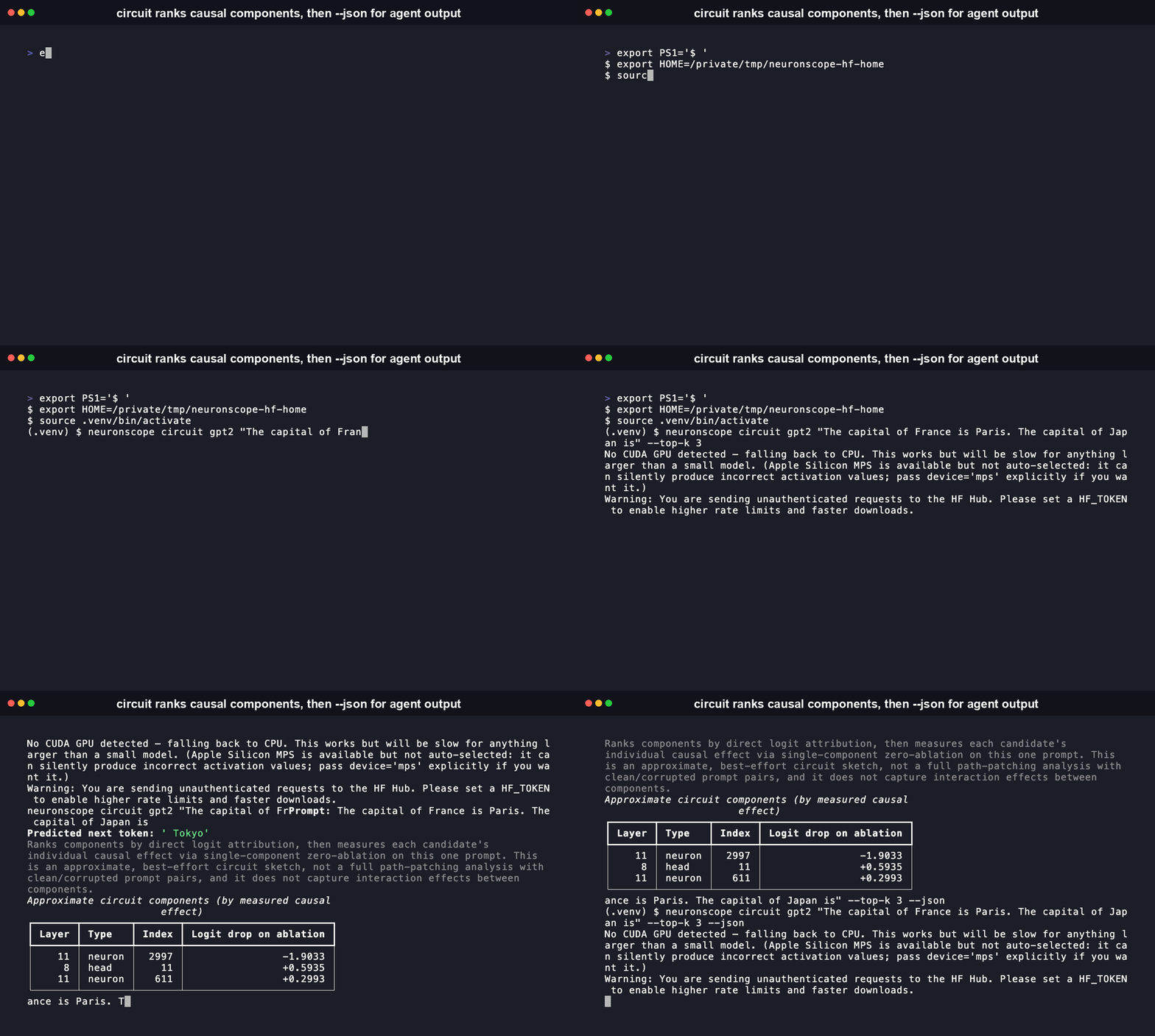
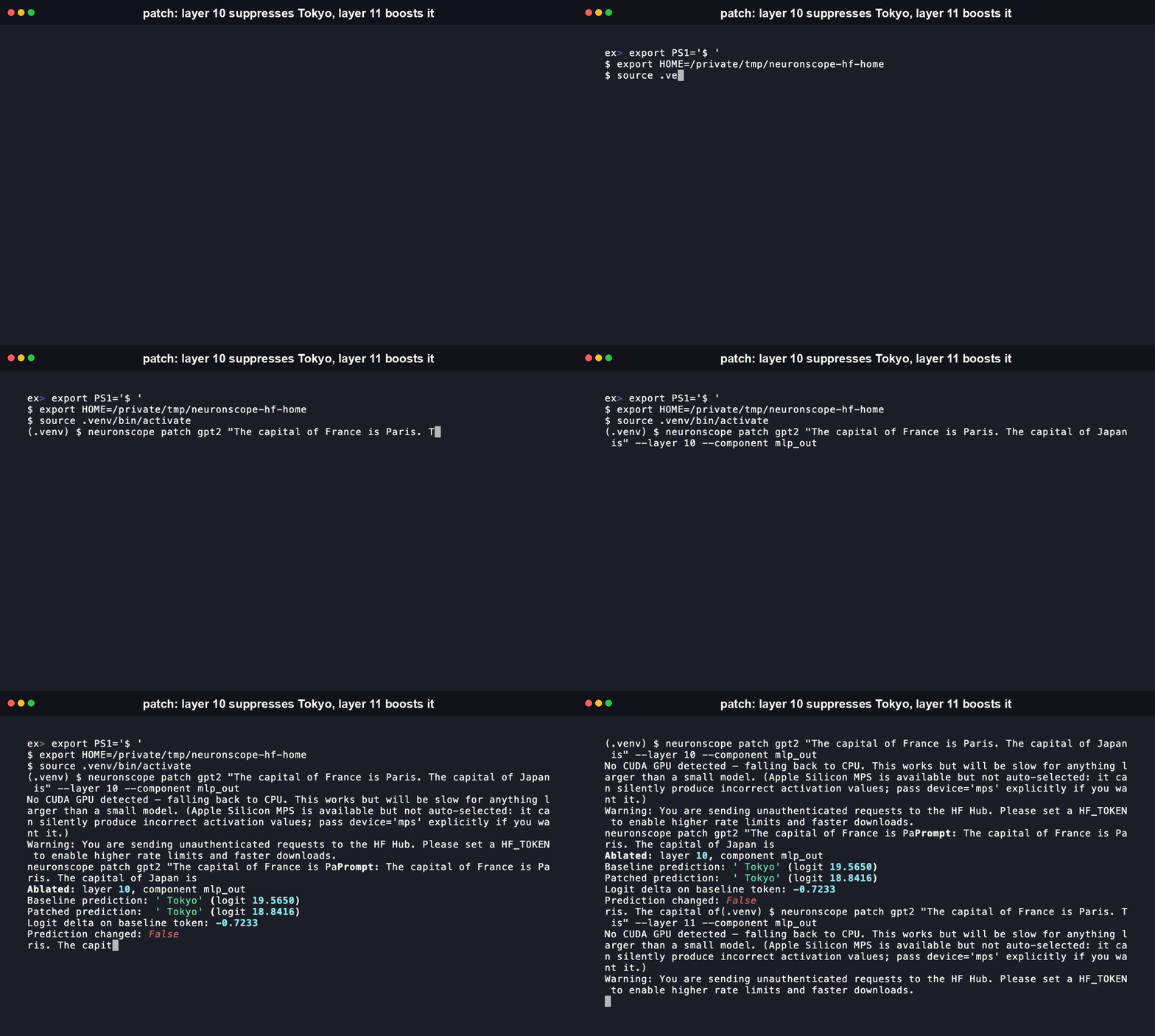
trace: runs a prompt through the model and ranks attention heads by direct logit attribution to the predicted token, and MLP neurons by activation magnitude at the final prompt position.activations: dumps shape, mean, std, min/max, and the max-activating sequence position for every layer's residual stream, MLP neuron activations, and attention pattern.patch: zero-ablates one component (resid_pre,resid_mid,resid_post,attn_out,mlp_out, ormlp_post) at a given layer and reports how the predicted token and its logit changed.circuit: a best-effort automated circuit sketch. Ranks candidate heads/neurons by logit attribution, then measures each one's individual causal effect via single-component ablation. This is not full path-patching with clean/corrupted prompt pairs and does not capture interaction effects between components. The--jsonoutput says so explicitly in itsmethodfield.- Every command supports
--jsonfor aschema_version-stamped document instead of a table, and the same four operations are exposed as MCP tools returning the identical shape via.model_dump(), so a CLI call and an MCP tool call produce the same document for the same input. - Model support is whatever
transformer_lens.HookedTransformer.from_pretrainedsupports. Installingneuronscope-clitoday pulls TransformerLens 3.6.0, which supports 249 pretrained checkpoints and aliases (OFFICIAL_MODEL_NAMES), covering GPT-2, Pythia, Llama, Gemma, Qwen, and more. Small models likegpt2run comfortably on CPU.
NeuronScope does not replace TransformerLens, nnsight, SAELens, Anthropic's circuit-tracer, or Neuronpedia. It wraps TransformerLens for one narrower job: fast, scriptable, agent-callable component tracing on a single prompt. It leaves deeper mechanistic work (SAE training, transcoder-based circuit graphs, hosted feature browsing) to those tools.
CLI reference
Every command takes MODEL (any name HookedTransformer.from_pretrained accepts, for
example gpt2 or EleutherAI/pythia-70m) and PROMPT as positional arguments.
| Command | Extra flags | What it does |
|---|---|---|
neuronscope trace MODEL PROMPT |
--top-k INTEGER (default 10), --json |
Ranks top attention heads (logit attribution) and MLP neurons (activation magnitude) for the predicted next token |
neuronscope activations MODEL PROMPT |
--json |
Dumps per-layer activation summary stats (residual stream, MLP, attention pattern) |
neuronscope patch MODEL PROMPT |
--layer INTEGER (required), --component [resid_pre|resid_mid|resid_post|attn_out|mlp_out|mlp_post] (required), --json |
Zero-ablates one component and reports the logit/prediction delta |
neuronscope circuit MODEL PROMPT |
--top-k INTEGER (default 10), --json |
Best-effort circuit sketch via ranked single-component ablation |
neuronscope mcp-server |
none | Starts the MCP server over stdio |
Global: neuronscope --version, neuronscope <command> --help. Exit codes: 0 success,
1 a runtime error (prompt too long for the model's context window, --layer out of range,
etc.), 2 a Click usage error (bad flags), 3 an unsupported model name.
MCP Server
NeuronScope ships a Model Context Protocol server so an AI agent (Claude, Cursor, or any MCP-compatible client) can trace, inspect, ablate, and sketch circuits directly, without a human invoking the CLI by hand.
Install the extra:
pip install "neuronscope-cli[mcp]"
Add it to your MCP client's config (for Claude Desktop, claude_desktop_config.json):
{
  "mcpServers": {
    "neuronscope": {
      "command": "uvx",
      "args": ["--from", "neuronscope-cli", "neuronscope-mcp"]
    }
  }
}
The server exposes four tools, trace, activations, patch, and circuit, each returning
the identical pydantic-model-shaped JSON the CLI's --json flag prints, via .model_dump(), so
an agent calling this server and a script calling the CLI get the same document for the same
input. A real trace call and its response:
trace(model="gpt2", prompt="The capital of France is Paris. The capital of Japan is", top_k=3)

{
  "schema_version": 1,
  "operation": "trace",
  "predicted_token": " Tokyo",
  "predicted_token_id": 11790,
  "top_neurons": [
    { "layer": 10, "neuron_index": 97, "activation": 7.839381217956543 }
  ],
  "top_heads": [
    { "layer": 9, "head_index": 8, "logit_attribution": 4.067923545837402 }
  ]
}
Errors never raise across the tool boundary: every handler catches its exceptions and returns a
structured ErrorResponse dict instead, so a calling agent always gets a parseable result.
[!WARNING] NeuronScope caps model size (2B parameters by default,
NEURONSCOPE_MAX_MODEL_PARAMS) and how many models can load at once (1 by default,NEURONSCOPE_MAX_CONCURRENT_LOADS), but puts no timeout on model loading or forward passes. If you expose this MCP server somewhere an untrusted agent can call it, still put a resource limit around the process (a cgroup,ulimit, or a container memory/CPU cap) as defense in depth rather than relying on these in-process caps alone.
Transport is stdio, so there is nothing to host: the MCP client spawns the server as a local subprocess. Source: neuronscope/mcp_server.py.
- Claude Code reads this from a project-level
.mcp.jsonin your repo root, or you can add it withclaude mcp add neuronscope -- neuronscope-mcp. - Claude Desktop reads this from its
claude_desktop_config.json(~/Library/Application Support/Claude/claude_desktop_config.jsonon macOS,%APPDATA%\Claude\claude_desktop_config.jsonon Windows), under the same"mcpServers"key. - The
neuronscope mcp-serverCLI subcommand still works as a local, non-uvxalternative that runs the same server over stdio from an existing install.
How it compares
All five of these are real, actively maintained projects doing different jobs. This table compares CLI/JSON-agent-output surface and model coverage, not depth of interpretability research, where TransformerLens, nnsight, SAELens, circuit-tracer, and Neuronpedia are all more mature than NeuronScope. Star counts, release info, and last-push dates below were pulled from each project's GitHub API on 2026-08-03 and will drift over time; check the repos directly for current numbers.
| Project | Stars | Last activity | CLI | Agent-callable structured output | Model coverage |
|---|---|---|---|---|---|
| TransformerLens | 3,750 | v3.6.0 released 2026-07-28, pushed 2026-08-03 | No (Python library) | No | 249 pretrained checkpoints/aliases (its own official list) |
| nnsight | 1,014 | v0.7.0 released 2026-05-05, pushed 2026-07-30 | No (Python library) | No (returns tensors/Python objects) | Any HuggingFace or PyTorch model generically, no fixed list |
circuit-tracer (Anthropic-authored, moved from safety-research/circuit-tracer) |
2,882 | v0.5.2 released 2026-07-18, pushed 2026-07-18 | Yes | JSON attribution-graph export; no MCP server | Fixed transcoder allowlist: Gemma-2 (2B), Gemma-3 (270M-27B), Llama-3.2 (1B), Llama-3.1 (8B Instruct), Qwen-3 (0.6B-14B), GPT-OSS (20B) |
| SAELens | 1,492 | v6.47.0 released 2026-07-28, pushed 2026-07-28 | No (Python library) | No | Any PyTorch model generically; deepest integration is with TransformerLens |
| Neuronpedia | 1,093 | continuously deployed, tag v1.0.795 | No (hosted web app + REST API) | REST API returns JSON; MCP access exists only via an unofficial third-party wrapper, not the official repo | Models loadable through TransformerLens's model table (GPT-2, Gemma-2, Llama, DeepSeek, etc.) |
| NeuronScope (this project) | 1 | this commit | Yes | Yes: --json on every command, plus a native MCP server returning the same schema |
Whatever TransformerLens's HookedTransformer.from_pretrained supports: 249 checkpoints/aliases |
The honest differentiation is narrow: NeuronScope is the only one of these with a CLI, a native MCP server, and a versioned JSON schema together in one package, and it's model-agnostic across whatever TransformerLens supports rather than pinned to a fixed transcoder allowlist like circuit-tracer. It is not more capable, more mature, or more widely used than any of these projects.
What is NeuronScope and why does it exist
TransformerLens gives you a Python API for loading a model and running hooked forward passes. That's the right interface for a research notebook. It's the wrong interface for a script that needs a subprocess call and a JSON document back, or for an agent that needs a tool it can call over MCP. NeuronScope exists to be that second interface: the same underlying computation, wrapped so a CLI invocation or an MCP tool call gets back a schema-versioned document instead of a Python object graph.
FAQ
Is this a replacement for TransformerLens, nnsight, SAELens, circuit-tracer, or Neuronpedia? No. NeuronScope is built directly on TransformerLens and does not do anything TransformerLens itself can't already do at a lower level. It doesn't train SAEs (SAELens), do full path-patching circuit discovery with transcoders (circuit-tracer), give you a Python-native tracing context manager for arbitrary PyTorch models (nnsight), or host a browsable feature database (Neuronpedia). It's a CLI and MCP wrapper around one slice of TransformerLens's functionality.
What models are supported?
Anything transformer_lens.HookedTransformer.from_pretrained supports, which today is 249
checkpoints and aliases spanning GPT-2, Pythia, Llama, Gemma, Qwen, and others. Run
python -c "from transformer_lens.loading_from_pretrained import OFFICIAL_MODEL_NAMES; print(len(OFFICIAL_MODEL_NAMES))"
in your own environment to get the exact count for your installed version, since
TransformerLens adds models over time.
Does it need a GPU?
No. Small models like gpt2 run fine on CPU; that's what the test suite and the quickstart
above run on. Larger models will be slow on CPU. NeuronScope does not auto-select Apple
Silicon's MPS backend even when available, because PyTorch's MPS backend can silently
produce incorrect values for some ops that this project's activation-patching math depends
on being exact. Pass device="mps" explicitly in your own code if you want it anyway.
Is it safe to expose the MCP server to an untrusted agent? Only with resource limits in place. See Known limitations below.
How is NeuronScope different from circuit-tracer, the other CLI tool in this list? circuit-tracer does deeper circuit analysis (full attribution graphs from trained transcoders) but only for a fixed allowlist of models: Gemma-2, Gemma-3, Llama-3.1/3.2, Qwen-3, and GPT-OSS. NeuronScope trades that depth for breadth: it works with any of TransformerLens's 249 supported checkpoints with no transcoder training step, and ships an MCP server so an agent can call it directly. The cost is that NeuronScope does single-component logit attribution and zero-ablation, not transcoder-based path patching.
Does the installed version always match what's on PyPI?
Run neuronscope --version after installing to check. pip install neuronscope-cli pulls
whatever release PyPI has published most recently; the code on this repo's main branch can
be ahead of that between releases. Installing from source (pip install -e .) always tracks
main exactly, including whatever hasn't been released yet.
What license is NeuronScope under, and can I use it commercially?
MIT. You can use, modify, and redistribute it in commercial and closed-source projects,
with attribution and the license notice kept intact. The dependencies it pulls in
(TransformerLens, PyTorch, the mcp package) carry their own licenses; check those
separately if you're redistributing a bundled product rather than just calling
neuronscope-cli as a dependency.
Known limitations
circuitis an approximation. It ranks components by logit attribution and measures each one's individual causal effect via single-component zero-ablation on one prompt. It does not do full path-patching with clean/corrupted prompt pairs, and it will not catch interaction effects between components. The--jsonoutput states this in itsmethodfield so a caller doesn't have to trust prose to know the caveat.- No timeout on model loading or forward passes. Once a request passes the resource
caps below, NeuronScope runs the load and the forward pass to completion with no
built-in wall-clock limit. If you run the MCP server somewhere an untrusted agent can
call it, put a resource limit around the process (a cgroup,
ulimit, or a container memory/CPU cap) as defense in depth. - Model size and load concurrency are capped, but only in-process.
neuronscope/core/limits.pyrejects a model overNEURONSCOPE_MAX_MODEL_PARAMS(2B parameters by default) before any weights are downloaded, and rejects a load onceNEURONSCOPE_MAX_CONCURRENT_LOADS(1 by default) other loads are already in flight, both with a structured error rather than a hang or a crash. The size check is best-effort: if a model's parameter count can't be determined (for example, fully offline with nothing cached yet), it fails open rather than blocking a legitimate request, so it's not a hard guarantee on its own -- pair it with a process-level resource limit for untrusted deployments. HookedTransformer.from_pretrainedis deprecated upstream. TransformerLens 3.6.0 emits aDeprecationWarningpointing atTransformerBridge.boot_transformersas the replacement. It still works today, and every command shown in this README ran on it, but NeuronScope's backend hasn't migrated yet. Tracked as an open item; migrating would be a change insideneuronscope/backends/transformer_lens.py, not a change to any CLI command or MCP tool signature.
Contributing
Issues and pull requests are welcome. See CONTRIBUTING.md for dev setup, where the code lives, and what a PR needs before it merges. Quick version:
pip install -e ".[dev,mcp]"
pytest -v
CI runs the same suite on Python 3.10, 3.11, and 3.12 on every push and pull request against
main. The suite covers 87% of neuronscope/ (pytest --cov=neuronscope), with the MCP
server's less-exercised paths (specific error branches) the main gap.
License
MIT. See LICENSE.
Установка NeuronScope Server
У этого сервера нет опубликованного пакета — он собирается из исходников. Открой репозиторий и следуй инструкции в README.
▸ github.com/RudrenduPaul/NeuronScopeFAQ
NeuronScope Server MCP бесплатный?
Да, NeuronScope Server MCP бесплатный — установка в пару кликов через Unyly без оплаты.
Нужен ли API-ключ для NeuronScope Server?
Нет, NeuronScope Server работает без API-ключей и переменных окружения.
NeuronScope Server — hosted или self-hosted?
Self-hosted: сервер запускается локально на твоей машине командой из раздела установки.
Как установить NeuronScope Server в Claude Desktop, Claude Code или Cursor?
Открой NeuronScope Server на unyly.org, выбери вкладку своего клиента (Claude Desktop, Claude Code, Cursor) и нажми Install — конфиг сгенерируется автоматически, без правки JSON.
Похожие MCP
LibreOffice Tools
Enables AI agents to read, write, and edit Office documents via LibreOffice with token-efficient design. Supports multiple formats including DOCX, XLSX, PPTX, a
 автор: passerbyflutter
dannote/figma-use
Full Figma control: create shapes, text, components, set styles, auto-layout, variables, export. 80+ tools.
 автор: dannote
Logo.dev
Search and retrieve company logos by brand or domain. Customize size, format, and theme to match your design needs. Accelerate design, prototyping, and content
 автор: NOVA-3951
Design Inspiration Server
Searches top design platforms like Dribbble and Behance to provide UI inspiration, color palettes, and layout patterns via the Serper API. It allows users to re
 автор: YonasValentin
PIX4Dmatic
Enables GUI automation for controlling PIX4Dmatic on Windows through MCP. Supports launching, focusing, capturing screenshots, sending hotkeys, clicking UI elem
 автор: jangjo123
Figma
Extract design specs and assets
 автор: Figma
mcp-dockmaster
An Open-Sourced UI to install and manage MCP servers for Windows, Linux and macOS.
ariekogan/ateam-mcp
Build, validate, and deploy multi-agent AI solutions on the ADAS platform. Design skills with tools, manage solution lifecycle, and connect from any AI environm
 автор: ariekogan
thinkchainai/mcpbundles
MCP Bundles: Create custom bundles of tools and connect providers with OAuth or API keys. Use one MCP server across thousands of integrations, with programmatic
 автор: thinkchainai
arikusi/nakkas
MCP server that turns AI into an SVG artist. One rendering engine with JSON config, AI controls all design parameters. CSS @keyframes + SMIL animations, 16+ ele
 автор: arikusi
Compare NeuronScope Server with
Не уверен что выбрать?
Найди свой стек за 60 секунд
Автор?
Embed-бейдж для README
Похожее
Все в категории design