
nwiizo/tfmcp
БесплатноНе проверен🦀 🏠 - A Terraform MCP server allowing AI assistants to manage and operate Terraform environments, enabling reading configurations, analyzing plans, applying c

Описание
🦀 🏠 - A Terraform MCP server allowing AI assistants to manage and operate Terraform environments, enabling reading configurations, analyzing plans, applying configurations, and managing Terraform state.
README
⚠️ This project includes production-ready security features but is still under active development. While the security system provides robust protection, please review all operations carefully in production environments. ⚠️
tfmcp is a command-line tool that helps you interact with Terraform via the Model Context Protocol (MCP). It allows LLMs to manage and operate your Terraform environments, including:
🎮 Demo
See tfmcp in action with Claude Desktop:
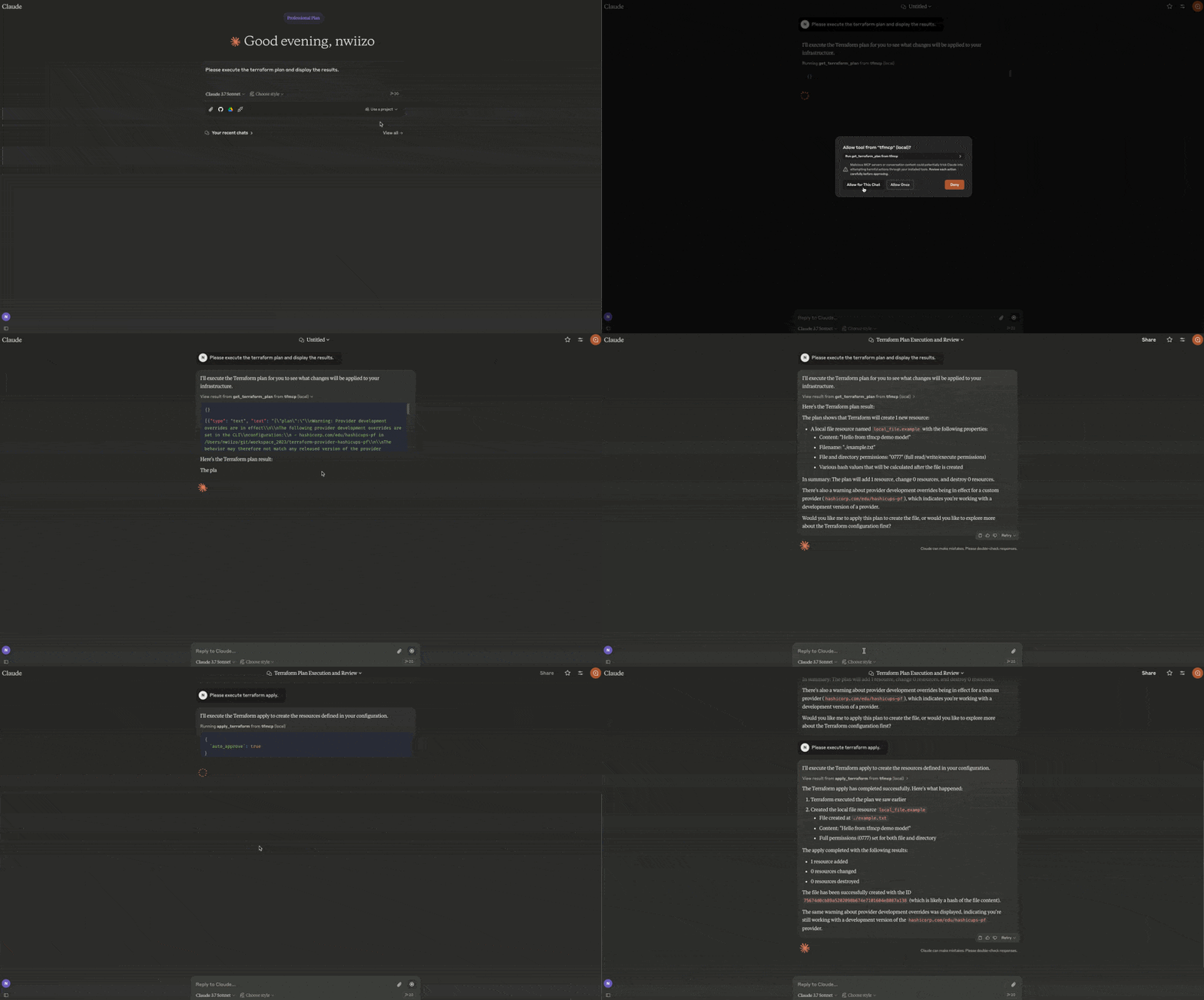
- Reading Terraform configuration files
- Analyzing Terraform plan outputs
- Applying Terraform configurations
- Managing Terraform state
- Creating and modifying Terraform configurations
🎉 Current Release
tfmcp v0.2.1 is the current release:
cargo install tfmcp --version 0.2.1
What's new in v0.2.1
- HCP/TFE read coverage and explicitly gated write operations
- Streamable HTTP with loopback-safe Host and Origin validation
- Project inspection, plan review, lockfile checks, and state-safety workflows
- Terraform 1.15.8 CI and container baseline
- Rust module-boundary and duplicate-code release gates
Features
| Area | Capabilities |
|---|---|
| Local Terraform | Validate, format, plan/apply workflows, import guidance, outputs, providers, dependency graphs, refresh-only flows, and guarded state operations |
| Repository intelligence | Entrypoint/project detection, configuration analysis, quality checks, security checks, module health, plan review, and drift/state-safety inspection |
| Registry | Public/private provider, module, and policy lookup with HashiCorp-compatible aliases |
| HCP Terraform / TFE | Organizations, projects, workspaces, runs, plans, applies, variables, policy sets, variable sets, tags, stacks, and gated operations |
| MCP deployment | stdio and Streamable HTTP, toolsets, resources, health/metrics, sessions, Host/Origin validation, rate limits, TLS wiring, and audit logging |
| Packaging | Cargo, Docker/OCI metadata, MCP Registry metadata, Rust Edition 2024 |
Installation
From Source
# Clone the repository
git clone https://github.com/nwiizo/tfmcp
cd tfmcp

# Build and install
cargo install --path .
From Crates.io
cargo install tfmcp
Using Docker
# Clone the repository
git clone https://github.com/nwiizo/tfmcp
cd tfmcp

# Build the Docker image
docker build -t tfmcp .

# Run the container
docker run -it tfmcp
Requirements
- Rust 1.88.0+ (Rust Edition 2024)
- Terraform CLI 1.15.8 installed and available in
PATH - Claude Desktop (for AI assistant integration)
- Docker (optional, for containerized deployment)
Usage
$ tfmcp --help
✨ A CLI tool to manage Terraform configurations and operate Terraform through the Model Context Protocol (MCP).

Usage: tfmcp [OPTIONS] [COMMAND]

Commands:
  mcp       Launch tfmcp as an MCP server
  analyze   Analyze Terraform configurations
  help      Print this message or the help of the given subcommand(s)

Options:
  -c, --config <PATH>    Path to the configuration file
  -d, --dir <PATH>       Terraform project directory
  -V, --version          Print version
  -h, --help             Print help
Using Docker
When using Docker, you can run tfmcp commands like this:
# Run as MCP server (default)
docker run -it tfmcp

# Run with specific command and options
docker run -it tfmcp analyze --dir /app/example

# Mount your Terraform project directory
docker run -it -v /path/to/your/terraform:/app/terraform tfmcp --dir /app/terraform

# Set environment variables
docker run -it -e TFMCP_LOG_LEVEL=debug tfmcp
Integrating with Claude Desktop
To use tfmcp with Claude Desktop:
If you haven't already, install tfmcp:
cargo install tfmcpAlternatively, you can use Docker:
docker build -t tfmcp .Find the path to your installed tfmcp executable:
which tfmcpAdd the following configuration to
~/Library/Application\ Support/Claude/claude_desktop_config.json:
{
  "mcpServers": {
    "tfmcp": {
      "command": "/path/to/your/tfmcp",  // Replace with the actual path from step 2
      "args": ["mcp"],
      "env": {
        "HOME": "/Users/yourusername",  // Replace with your username
        "PATH": "/usr/local/bin:/usr/bin:/bin:/usr/sbin:/sbin",
        "TERRAFORM_DIR": "/path/to/your/terraform/project"  // Optional: specify your Terraform project
      }
    }
  }
}
If you're using Docker with Claude Desktop, you can set up the configuration like this:
{
  "mcpServers": {
    "tfmcp": {
      "command": "docker",
      "args": ["run", "--rm", "-v", "/path/to/your/terraform:/app/terraform", "tfmcp", "mcp"],
      "env": {
        "TERRAFORM_DIR": "/app/terraform"
      }
    }
  }
}
Restart Claude Desktop and enable the tfmcp tool.
tfmcp will automatically create a sample Terraform project in
~/terraformif one doesn't exist, ensuring Claude can start working with Terraform right away. The sample project is based on the examples included in theexample/demodirectory of this repository.
MCP Tools
tfmcp provides 82 MCP tools for AI assistants:
Core Terraform Operations
| Tool | Description |
|---|---|
init_terraform |
Initialize Terraform working directory |
get_terraform_plan |
Generate and show execution plan |
analyze_plan |
NEW Analyze plan with risk scoring and recommendations |
apply_terraform |
Apply Terraform configuration |
destroy_terraform |
Destroy Terraform-managed infrastructure |
validate_terraform |
Validate configuration syntax |
validate_terraform_detailed |
Detailed validation with guidelines |
get_terraform_state |
Show current state |
analyze_state |
NEW Analyze state with drift detection |
review_terraform_plan |
Review plan risk, blockers, destructive changes, and recommendations |
summarize_plan_for_pr |
Generate markdown plan summary for PR comments |
run_terraform_quality_checks |
Run CI-friendly validation, module health, guideline, and lockfile checks |
inspect_state_safety |
Inspect state readability, drift risk, lockfile status, and blockers |
detect_drift_candidates |
Detect drift candidates from readable state without modifying infrastructure |
prepare_terraform_change |
Generate blockers, warnings, and a recommended change sequence |
list_terraform_resources |
List all managed resources |
set_terraform_directory |
Change active project directory |
Workspace & State (v0.1.9)
| Tool | Description |
|---|---|
terraform_workspace |
NEW Manage workspaces (list, show, new, select, delete) |
terraform_import |
NEW Import existing resources |
terraform_taint |
NEW Taint/untaint resources |
terraform_refresh |
NEW Refresh state |
Code & Output (v0.1.9)
| Tool | Description |
|---|---|
terraform_fmt |
NEW Format code |
terraform_graph |
NEW Generate dependency graph |
terraform_output |
NEW Get output values |
terraform_providers |
NEW Get provider info with lock file |
check_provider_lockfile |
Check .terraform.lock.hcl for reproducible provider selections |
Analysis & Security
| Tool | Description |
|---|---|
analyze_terraform |
Analyze configuration |
inspect_terraform_project |
Inspect local Terraform directories, modules, and likely entrypoints |
detect_terraform_entrypoints |
Detect likely root module entrypoints |
analyze_module_health |
Module health with cohesion/coupling metrics |
get_resource_dependency_graph |
Resource dependencies visualization |
suggest_module_refactoring |
Refactoring suggestions |
get_security_status |
Security scan with secret detection |
Registry
| Tool | Description |
|---|---|
search_providers |
Search providers (HashiCorp-compatible alias) |
search_terraform_providers |
Search providers |
get_provider_details |
Provider details (HashiCorp-compatible alias) |
get_provider_info |
Provider details |
get_provider_docs |
Provider documentation |
get_provider_capabilities |
Provider resources, data sources, functions, and guides |
search_modules |
Search modules (HashiCorp-compatible alias) |
search_terraform_modules |
Search modules |
get_module_details |
Module details |
get_latest_module_version |
Latest module version |
get_latest_provider_version |
Latest provider version |
search_policies |
Search Sentinel/OPA policy libraries |
get_policy_details |
Policy library details |
HCP Terraform / Terraform Enterprise (Read-only)
| Tool | Description |
|---|---|
get_token_permissions |
Inspect configured token account details without exposing the token |
list_terraform_orgs |
List visible organizations |
list_terraform_projects |
List projects in an organization |
list_workspaces |
List workspaces in an organization |
get_workspace_details |
Get workspace details by ID or organization/name |
list_runs |
List workspace runs |
get_run_details |
Get run details |
get_plan_details |
Get plan details |
get_plan_logs |
Get plan logs |
get_plan_json_output |
Get Terraform JSON plan output |
get_apply_details |
Get apply details |
get_apply_logs |
Get apply logs |
get_workspace_policy_sets |
Get policy sets attached to a workspace |
list_workspace_variables |
List workspace variables |
list_variable_sets |
List organization variable sets |
read_workspace_tags |
Read workspace tags |
list_stacks |
List Terraform stacks |
get_stack_details |
Get Terraform stack details |
search_private_modules |
Search private registry modules |
get_private_module_details |
Get private registry module details |
search_private_providers |
Search private registry providers |
get_private_provider_details |
Get private registry provider details |
HCP Terraform / Terraform Enterprise (Gated Operations)
| Tool | Description |
|---|---|
create_workspace |
Create a workspace when ENABLE_TF_OPERATIONS=true |
update_workspace |
Update workspace settings when ENABLE_TF_OPERATIONS=true |
delete_workspace_safely |
Use the safe-delete workspace action when ENABLE_TF_OPERATIONS=true |
create_run |
Queue a run when ENABLE_TF_OPERATIONS=true |
action_run |
Apply, discard, cancel, force-cancel, or force-execute a run when ENABLE_TF_OPERATIONS=true |
create_workspace_variable |
Create a workspace variable when ENABLE_TF_OPERATIONS=true |
update_workspace_variable |
Update a workspace variable when ENABLE_TF_OPERATIONS=true |
attach_policy_set_to_workspace |
Attach a policy set to a workspace when ENABLE_TF_OPERATIONS=true |
create_variable_set |
Create a variable set when ENABLE_TF_OPERATIONS=true |
create_variable_in_variable_set |
Create a variable in a variable set when ENABLE_TF_OPERATIONS=true |
delete_variable_in_variable_set |
Delete a variable from a variable set when ENABLE_TF_OPERATIONS=true |
attach_variable_set_to_workspaces |
Attach a variable set to workspaces when ENABLE_TF_OPERATIONS=true |
detach_variable_set_from_workspaces |
Detach a variable set from workspaces when ENABLE_TF_OPERATIONS=true |
create_workspace_tags |
Create or attach workspace tags when ENABLE_TF_OPERATIONS=true |
MCP Resources
| URI | Description |
|---|---|
terraform://style-guide / /terraform/style-guide |
Terraform style guide |
terraform://module-development / /terraform/module-development |
Terraform module development guide |
terraform://best-practices |
tfmcp security and operational best practices |
/terraform/providers/{namespace}/name/{name}/version/{version} |
HashiCorp-compatible provider documentation template |
Logs and Troubleshooting
The tfmcp server logs are available at:
~/Library/Logs/Claude/mcp-server-tfmcp.log
Common issues and solutions:
- Claude can't connect to the server: Make sure the path to the tfmcp executable is correct in your configuration
- Terraform project issues: tfmcp automatically creates a sample Terraform project if none is found
- Method not found errors: MCP protocol support includes resources/list and prompts/list methods
- Docker issues: If using Docker, ensure your container has proper volume mounts and permissions
Environment Variables
Core Configuration
TERRAFORM_DIR: Set this to specify a custom Terraform project directory. If not set, tfmcp will use the directory provided by command line arguments, configuration files, or fall back to~/terraform. You can also change the project directory at runtime using theset_terraform_directorytool.TFMCP_LOG_LEVEL: Set todebug,info,warn, orerrorto control logging verbosity.TFMCP_DEMO_MODE: Set totrueto enable demo mode with additional safety features.
Security Configuration
ENABLE_TF_OPERATIONS: Set totrueto enable gated HCP Terraform / Terraform Enterprise write tools (default:false)TFMCP_ALLOW_DANGEROUS_OPS: Set totrueto enable apply/destroy operations (default:false)TFMCP_ALLOW_AUTO_APPROVE: Set totrueto enable auto-approve for dangerous operations (default:false)TFMCP_MAX_RESOURCES: Set maximum number of resources that can be managed (default: 50)TFMCP_AUDIT_ENABLED: Set tofalseto disable audit logging (default:true)TFMCP_AUDIT_LOG_FILE: Custom path for audit log file (default:~/.tfmcp/audit.log)TFMCP_AUDIT_LOG_SENSITIVE: Set totrueto include sensitive information in audit logs (default:false)
HCP Terraform / Terraform Enterprise
TFE_ADDRESS: HCP Terraform or Terraform Enterprise base URL (default:https://app.terraform.io)TFE_TOKEN: API token for HCP Terraform / Terraform Enterprise toolsTFE_SKIP_TLS_VERIFY: Set totrueonly for trusted private TFE installations with custom TLSTFE_MAX_RESPONSE_BYTES: Maximum HCP/TFE response bytes returned to MCP clients before truncation (default:65536)
HCP/TFE write tools are disabled by default and fail closed unless
ENABLE_TF_OPERATIONS=true is set. The default toolset keeps write tools
hidden; use --toolsets operations or --toolsets all to expose them.
MCP Transport
TRANSPORT_MODE: MCP transport mode. Usestdio(default) for local desktop clients orstreamable-httpfor remote/CI clients.TRANSPORT_HOST: HTTP bind host for streamable HTTP mode (default:127.0.0.1).TRANSPORT_PORT: HTTP bind port for streamable HTTP mode (default:8080).MCP_ENDPOINT: Streamable HTTP MCP endpoint path (default:/mcp).MCP_HEALTH_ENDPOINT: Health endpoint path (default:/health).MCP_METRICS_ENDPOINT: OTel-compatible JSON metrics snapshot endpoint path (default:/metrics).MCP_SESSION_MODE:statefulfor normal MCP clients orstatelessfor CI-style JSON responses (default:stateful).MCP_HEARTBEAT_INTERVAL: Streamable HTTP SSE keep-alive interval in seconds. Set to0to disable (default:15).MCP_CORS_MODE: Response CORS policy:strict,development, ordisabled(default:strict). MCP request Origin validation remains enabled in all modes.MCP_ALLOWED_ORIGINS: Comma-separated allowed browser origins. Loopback origins are used by default.MCP_ALLOWED_HOSTS: Comma-separated HTTPHost/ authority values accepted by Streamable HTTP. When unset, rmcp's loopback-only defaults apply.MCP_ORGANIZATION_ALLOWLIST: Comma-separated HCP/TFE organization names that remote requests may access.MCP_RATE_LIMIT_GLOBAL: Maximum HTTP requests per minute across the server (0or unset disables).MCP_RATE_LIMIT_SESSION: Maximum HTTP requests per minute perMcp-Session-Id(0or unset disables).MCP_TLS_CERT_FILE: PEM certificate file for HTTPS Streamable HTTP.MCP_TLS_KEY_FILE: PEM private key file for HTTPS Streamable HTTP.
HCP/TFE credentials and addresses are server configuration. tfmcp intentionally
does not accept request-scoped TFE_TOKEN, Authorization, or TFE_ADDRESS
overrides for downstream passthrough. When an organization allowlist is active,
account-wide and ID-only HCP/TFE requests fail closed because their owning
organization cannot be verified locally.
Example streamable HTTP launch:
TRANSPORT_MODE=streamable-http \
TRANSPORT_HOST=127.0.0.1 \
TRANSPORT_PORT=8080 \
tfmcp mcp --toolsets default
The MCP endpoint is http://127.0.0.1:8080/mcp, the health endpoint is
http://127.0.0.1:8080/health, and the metrics endpoint is
http://127.0.0.1:8080/metrics.
Security Considerations
tfmcp includes comprehensive security features designed for production use:
🔒 Built-in Security Features
- Access Controls: Automatic blocking of production/sensitive file patterns
- Operation Restrictions: Dangerous operations (apply/destroy) disabled by default
- Resource Limits: Configurable maximum resource count protection
- Audit Logging: Complete operation tracking with timestamps and user identification
- Directory Validation: Security policy enforcement for project directories
🛡️ Security Best Practices
- Default Safety: Apply/destroy operations are disabled by default - explicitly enable only when needed
- Review Plans: Always review Terraform plans before applying, especially AI-generated ones
- IAM Boundaries: Use appropriate IAM permissions and role boundaries in cloud environments
- Audit Monitoring: Regularly review audit logs at
~/.tfmcp/audit.log - File Patterns: Built-in protection against accessing
prod*,production*, andsecret*patterns - Docker Security: When using containers, carefully consider volume mounts and exposed data
⚙️ Production Configuration
# Recommended production settings
export TFMCP_ALLOW_DANGEROUS_OPS=false    # Keep disabled for safety
export TFMCP_ALLOW_AUTO_APPROVE=false     # Require manual approval
export TFMCP_MAX_RESOURCES=10             # Limit resource scope
export TFMCP_AUDIT_ENABLED=true           # Enable audit logging
export TFMCP_AUDIT_LOG_SENSITIVE=false    # Don't log sensitive data
Contributing
Contributions are welcome! Please feel free to submit a Pull Request.
- Fork the repository
- Create your feature branch (
git checkout -b feature/amazing-feature) - Run quality checks before committing:
cargo fmt --all cargo clippy --all-targets --all-features cargo test --all-features - Commit your changes (
git commit -m 'Add some amazing feature') - Push to the branch (
git push origin feature/amazing-feature) - Open a Pull Request
Release Process
Releases are done manually after the local release gate passes:
- Confirm
Cargo.toml,Cargo.lock,server.json,Dockerfile, README, andCHANGELOG.mduse the target version. - Run the local release gate:
./Release.sh v0.2.1. - Review
CHANGELOG.mdand the generated package. - Commit and push
main, then confirm CI passed for that exact commit. - From the clean commit, publish with
./Release.sh v0.2.1 --publish.
Roadmap
Here are some planned improvements and future features for tfmcp:
For the consolidated v0.2.1 scope and future work, see docs/releases/v0.2-roadmap.md. Release changes are recorded in CHANGELOG.md.
Completed
Basic Terraform Integration Core integration with Terraform CLI for analyzing and executing operations.
MCP Server Implementation Initial implementation of the Model Context Protocol server for AI assistants.
Automatic Project Creation Added functionality to automatically create sample Terraform projects when needed.
Claude Desktop Integration Support for seamless integration with Claude Desktop.
Core MCP Methods Implementation of essential MCP methods including resources/list and prompts/list.
Error Handling Improvements Better error handling and recovery mechanisms for robust operation.
Dynamic Project Directory Switching Added ability to change the active Terraform project directory without restarting the service.
Crates.io Publication Published the package to Crates.io for easy installation via Cargo.
Docker Support Added containerization support for easier deployment and cross-platform compatibility.
Security Enhancements Comprehensive security system with configurable policies, audit logging, access controls, and production-ready safety features.
Module Health Analysis (v0.1.6) Whitebox approach to IaC with cohesion/coupling metrics, health scoring, and refactoring suggestions.
Resource Dependency Graph (v0.1.6) Visualization of resource relationships including explicit and implicit dependencies.
Module Registry Integration (v0.1.6) Search and explore Terraform modules from the registry.
Comprehensive Testing Framework 85+ tests including integration tests with real Terraform configurations.
RMCP SDK Migration (v0.1.8) Migrated to official RMCP SDK with proper tool annotations for better MCP compliance.
Future Architect Guidelines (v0.1.8) Terraform coding standards compliance checks with secret detection and variable quality validation.
In Progress
- Multi-Environment Support Add support for managing multiple Terraform environments, workspaces, and modules.
Planned
Expanded MCP Protocol Support Implement additional MCP methods and capabilities for richer integration with AI assistants.
Performance Optimization Optimize resource usage and response times for large Terraform projects.
Cost Estimation Integrate with cloud provider pricing APIs to provide cost estimates for Terraform plans.
Interactive TUI Develop a terminal-based user interface for easier local usage and debugging.
Integration with Other AI Platforms Extend beyond Claude to support other AI assistants and platforms.
Plugin System Develop a plugin architecture to allow extensions of core functionality.
License
This project is licensed under the MIT License - see the LICENSE file for details.
Установка nwiizo/tfmcp
У этого сервера нет опубликованного пакета — он собирается из исходников. Открой репозиторий и следуй инструкции в README.
▸ github.com/nwiizo/tfmcpFAQ
nwiizo/tfmcp MCP бесплатный?
Да, nwiizo/tfmcp MCP бесплатный — установка в пару кликов через Unyly без оплаты.
Нужен ли API-ключ для nwiizo/tfmcp?
Нет, nwiizo/tfmcp работает без API-ключей и переменных окружения.
nwiizo/tfmcp — hosted или self-hosted?
Self-hosted: сервер запускается локально на твоей машине командой из раздела установки.
Как установить nwiizo/tfmcp в Claude Desktop, Claude Code или Cursor?
Открой nwiizo/tfmcp на unyly.org, выбери вкладку своего клиента (Claude Desktop, Claude Code, Cursor) и нажми Install — конфиг сгенерируется автоматически, без правки JSON.
Похожие MCP
Fetch
Web content fetching and conversion for efficient LLM usage.
AWS KB Retrieval
Retrieval from AWS Knowledge Base using Bedrock Agent Runtime.
 автор: modelcontextprotocol
Spring AI MCP Server
Provides auto-configuration for setting up an MCP server in Spring Boot applications.
llm-analysis-assistant
A very streamlined mcp client that supports calling and monitoring stdio/sse/streamableHttp, and can also view request responses through the /logs page. It also
 автор: xuzexin-hz
Compare nwiizo/tfmcp with
Не уверен что выбрать?
Найди свой стек за 60 секунд
Автор?
Embed-бейдж для README
Похожее
Все в категории ai