Local-first code intelligence — MCP server for Claude Code, Cursor, Windsurf, Zed. Symbol graph, blast-radius, git-pinned memory. 43× fewer tokens than naive gr
Local-first code intelligence — MCP server for Claude Code, Cursor, Windsurf, Zed. Symbol graph, blast-radius, git-pinned memory. 43× fewer tokens than naive grep on the public bench. MIT, zero-config.
Sverklo gives coding agents repo memory: symbols, callers, diffs, blast radius, and git-pinned decisions before they edit. It is an open-source local-first MCP server for Claude Code, Cursor, Windsurf, Codex CLI, and any MCP-speaking coding agent.
Local-first ◦ MIT ◦ no API keys ◦ no code upload ◦ first run downloads a local ONNX model
Use grep when you know the exact string. Use Sverklo when the agent needs relationships: who calls this, what depends on it, what changed, and which project decisions still apply. The public bench covers 180 hand-verified tasks across 6 OSS codebases; the methodology and ground truth live in sverklo/sverklo-bench. Bench · paper · 90-second demo
sverklo prove --no-write --guided --markdown shows central files, a real symbol with callers, why that proof was selected, the exact prompt to paste into your agent, and a small feedback template before any MCP config or instruction files are written. It may cache the local model/index under ~/.sverklo, but it does not mutate your project. sverklo init --dry-run then previews the files init would touch; sverklo init writes the MCP config for your agent, appends local instructions to AGENTS.md or CLAUDE.md, and runs sverklo doctor to verify the handshake. Your code stays on your machine.
Need something shareable? Run sverklo prove --no-write --guided --markdown to print a GitHub/Discord-ready proof receipt from your repo, then post it in the proof thread.
Need local launch planning for the Sverklo account? sverklo marketing runs a local-first Twitter/X agent-team workflow from operator-provided snapshots. It ranks opportunities, drafts seed-content queues, checks profile health, and records human decisions without posting, scraping, replying, liking, reposting, following, or changing the profile.
"The map is not the territory." — Alfred Korzybski
Training data is the map. Your codebase is the territory. Sverklo gives the agent the territory.
If sverklo prove surfaces useful repo context, please post a receipt, correction, grep-better case, or setup-friction report in the proof thread. If it helped, starring the repo also helps other agent-heavy teams find it.
▶ Watch the 90-second demo on YouTube — sverklo init → audit → 37 MCP tools → live Claude Code integration with blast-radius and symbol-graph traversal.
Updates
2026-05-04 — v0.20.2: parser brace-counter + lookup exact-match fixes. Lodash P1 0/10 → 9/10. Overall F1 0.45 → 0.56 (now leader on the public bench). release notes
Your AI agent edits UserService.validate(). It doesn't know 47 other functions call it. It hallucinates getUserByEmail() because that's how its training data spelled it — your code uses findByEmail(). It forgets the design decision you made yesterday because context was compacted. Tests pass because they mock the dependency. Breaking changes ship.
Sverklo drills into your repo before the agent does — symbol graph, blast radius, semantic recall, and git-pinned memory — so the agent reasons about your code instead of pattern-matching from training data.
That's it. sverklo prove --no-write --guided gives you the first useful repo-memory proof from your own codebase before project config changes; sverklo init --dry-run previews every setup target; sverklo init auto-detects your installed AI coding agent (Claude Code, Cursor, Windsurf, Zed), writes the right MCP config, appends instructions to AGENTS.md if present (otherwise CLAUDE.md), and runs sverklo doctor to verify the setup. sverklo prove --markdown makes that proof shareable in the public proof thread. Works on macOS, Linux, and Windows. No API keys. No cloud. Telemetry off by default.
The embedding model (all-MiniLM-L6-v2 ONNX, ~86 MB) is downloaded from HuggingFace on first use into ~/.sverklo/models/ and cached forever — every subsequent run is fully offline.
Want proof before installing? Browse the /report leaderboard — Sverklo audits of 47 popular OSS repos (express, react-hook-form, vite, lodash, prisma, …) with grade cards for dead code, circular deps, coupling, and security.
"But isn't this just…?"
Likely you've seen tools that look adjacent. The honest one-paragraph answers, with detailed comparisons linked.
…just grep with extra steps? No, but tuned grep is genuinely competitive when you know the exact string. On the 180-task bench, sverklo leads overall F1 (0.58 vs smart-grep's 0.34) while using about 35× fewer input tokens than naive grep and one tool call per task. For an AI agent inside a 200K context window, that's the load-bearing axis. For a human at a terminal, grep is still fine.
…just Sourcegraph Cody? Same retrieval surface (hybrid BM25 + vector + graph), different deployment model and license. Cody is source-available with enterprise per-developer pricing ($9-19/dev/mo); sverklo is MIT and runs on a laptop with no signup. Full comparison →
…just Greptile? Greptile is a hosted PR-review bot ($30/dev/mo). Sverklo is local-first MCP. Same risk-scoring goal, opposite deployment model. If your code can't leave the machine for compliance reasons, Greptile isn't an option. Full comparison →
…just Cursor's @codebase? Cursor's indexing is cloud-based and editor-bound. Sverklo runs alongside Cursor as an MCP server, adding the symbol graph, blast-radius, and bi-temporal memory that Cursor's @codebase doesn't expose. Full comparison →
…just Claude Context (Zilliz)? Claude Context requires a Milvus database. Sverklo runs entirely on embedded SQLite — no extra services to manage. Full comparison →
…just Aider's repo-map? Aider's repo-map is a static signal in the system prompt — fine for small repos, doesn't scale past ~100 files. Sverklo is the queryable retrieval layer Aider can call via MCP for larger codebases. They're complementary, not competing. Full comparison →
…a niche memory MCP? Most memory MCPs are wrappers around an external vector DB. Sverklo's memory is bi-temporal (valid_from_sha, valid_until_sha, superseded_by) and pinned to git SHAs, so you can ask "what did this team believe about auth at commit abc123?" and get the answer that was true then. Full comparison vs codebase-memory-mcp →
…what about Aider, Continue, Codex CLI, Claude Code? Those are agents — they generate and apply edits. Sverklo is the retrieval layer the agent calls before writing code. Use both. sverklo init auto-detects which agents you have →
If something is missing here that you'd ask about, open an issue — I'll add it.
What's new in 0.20
Contradiction detection on the bi-temporal memory layer.memories mode:"conflicts" surfaces pairs of active memories that share a pin (file path or symbol name) and may contradict — e.g., "JWT in middleware" vs "JWT in route handler" both pinned to src/auth.ts. Restricted to decision/preference/pattern categories (procedural/context are additive, not contradicting). Same-SHA pairs are skipped. Sorted by shared-pin count and age. Conservative by design: surfaces candidates for the agent or human to review, not auto-resolution. The bi-temporal model already preserved both sides of the contradiction; this just makes them findable.
What's new in 0.19
C# (.cs) language support — community contribution by @NerdChieftain in #22. Tree-sitter (when grammar installed) plus a regex fallback parser. Indexes namespaces (block-scoped + C# 10+ file-scoped), classes, structs, records (plain / record class / record struct), interfaces, enums, methods, constructors, and using directives. Adds [email protected] WASM grammar to the install set. Sverklo now supports 12 languages.
What's new in 0.18
Vue.js (.vue) support. Single-file components are now first-class: the <script> block parses through the existing TS/JS pipeline (with line remapping back to the SFC), Composition API helpers (ref, computed, reactive, defineProps, …) are indexed as symbols, and PascalCase template tags emit relative imports so PageRank sees component graphs. Also fixes a preexisting TS bug where import type { X } from 'y' was missed.
AGENTS.md aware sverklo init. When AGENTS.md exists, the prefer-sverklo block is appended there instead of CLAUDE.md. sverklo doctor flags drift between the two files so multi-agent setups stay in sync.
Windows pathing fixed.sverklo init and sverklo doctor now work on Windows — absolute paths go through path.basename() and stored relativePath is normalized to forward slashes so every downstream consumer is cross-platform.
npm run bench:swe — third-party-reproducible cross-repo eval. Clones 5 OSS repos (express, nestjs, vite, prisma, fastapi), runs 65 grounded questions, prints aggregated recall. PRs that add questions are welcome.
Tree-sitter parser opt-in.sverklo grammars install (~3.5 MB across 6 languages) + SVERKLO_PARSER=tree-sitter routes the indexer through real ASTs for TypeScript/TSX/JavaScript/Python/Go/Rust. Silent regex fallback when grammars aren't installed. Plan to flip the default lives in docs/parser-parity.md.
Workspace shared memory.sverklo workspace memory <name> add/list/search plus remember scope:"workspace" from the agent — write a decision once, query it from every other repo in the workspace. recall blends workspace results under project ones with a [ws] badge.
sverklo memory export — markdown / Notion / JSON. Migrate your team's decision log to wherever it actually lives.
PR-bot inline review.sverklo review --format github-review-json + the action's new inline-comments: true default posts per-line review comments via pulls.createReview, alongside the existing sticky summary.
VS Code extension scaffold at extensions/vscode/ with a pre-built sverklo-vscode-0.1.0.vsix. Inline caller-count decorations on every function header (⟵ 47 callers). Marketplace publish workflow ships dormant; install with code --install-extension extensions/vscode/sverklo-vscode-0.1.0.vsix today.
sverklo digest [--since 7d] — 5-line summary of audit-grade trend, new vs stale memories, and high-PageRank files touched. Wire into a shell-hook on cd for a daily sverklo check-in.
Grep vs Sverklo — the same question, side by side
Every one of these is a query a real engineer asked a real AI assistant last week. Grep gives you lines. Sverklo gives you a ranked answer.
The question
With Grep
With Sverklo
"Where is auth handled in this repo?"
grep -r 'auth' . -- 847 matches across tests, comments, unrelated vars, and one 2021 TODO
search "authentication flow" -- top 5 files ranked by PageRank: middleware, JWT verifier, session store, login route, logout route
impact BillingAccount.charge -- 14 real callers, depth-ranked, with file paths and line numbers
"Is this helper actually used anywhere?"
grep -r 'parseFoo' . -- 4 matches in 3 files. Are any real, or just string mentions? Read each one.
refs parseFoo -- 0 real callers. Zero. Walk the symbol graph, not the text. Delete the function.
"What's load-bearing in this codebase?"
find . -name '*.ts' | xargs wc -l | sort -- the biggest files. Not the most important ones.
overview -- PageRank over the dep graph. The files the rest of the repo depends on, not the ones someone wrote too much code in.
"Review this 40-file PR — what should I read first?"
Read them in the order git diff printed them
review_diff -- risk-scored per file (touched-symbol importance x coverage x churn), prioritized order, flagged production files with no test changes
If the answer to your question is "exact string X exists somewhere," grep wins. Use grep. If the answer is "which 5 files actually matter here, ranked by the graph," you need sverklo.
Works with every MCP editor
Editor
MCP
Skills
Hooks
Auto-setup
Claude Code
yes
yes
yes
sverklo init
Cursor
yes
—
—
sverklo init
Windsurf
yes
—
—
sverklo init
Zed
yes
—
—
sverklo init
VS Code
yes
—
—
manual
JetBrains
yes
—
—
manual
Antigravity
yes
—
—
sverklo init
Codex CLI
yes
—
—
sverklo init
GitHub Copilot CLI
yes
—
—
sverklo init
Any MCP client
yes
—
—
npx sverklo /path
Hero tools
Tool
What it does
search
Hybrid BM25 + vector + PageRank search. Find code without knowing the literal string.
refs
All references to a symbol, with caller context. Proves dead code with certainty.
impact
Walk the symbol graph, return ranked transitive callers — the real blast radius.
review_diff
Risk-scored review of git diff: touched-symbol importance x coverage x churn.
Pre-commit gate — block architectural regressions before they ship
sverklo audit-diff is a local-first incremental quality gate. It reads git diff, runs Tarjan SCC over the modified files' boundary subgraph, and exits non-zero if your diff introduces a new circular dependency or pushes a file's fan-in past the threshold. Designed to run as a .git/hooks/pre-commit step — typical run completes well under 200 ms.
Pre-existing cycles and fan-in spikes don't trip the gate — only violations introduced by your diff. To inspect legacy debt: sverklo audit-diff --show-existing (exit code is unchanged).
Full tool reference
Search — find code without knowing the literal string
Natural-language router — concepts + investigate + refs in one call
overview
Structural codebase map ranked by PageRank importance
lookup
Find any function, class, or type by name (typo-tolerant)
context
One-call onboarding — combines overview, code, and saved memories
ast_grep
Structural pattern matching across the AST, not just text
concepts
Browse the LLM-derived concept index (themes across the codebase)
clusters
Semantic clusters of related symbols, computed offline
patterns
Query symbols tagged with a design pattern (observer, repository, validator, ...)
Impact — refactor without the regression
Tool
What
impact
Walk the symbol graph, return ranked transitive callers (the real blast radius)
refs
Find all references to a symbol, with caller context
deps
File dependency graph — both directions, importers and imports
audit
Lint your codebase for AI-readiness. God nodes, hub files, dead code, circular deps, security smells, A-F health grade — all in one call
Review — diff-aware MR review with risk scoring
Tool
What
review_diff
Risk-scored review of git diff — touched-symbol importance x coverage x churn
critique
Second-pass critique of a review — what did the first read miss
test_map
Which tests cover which changed symbols; flag untested production changes
diff_search
Semantic search restricted to the changed surface of a diff
verify
Verify a quoted code span is still present at the cited SHA — citation gate
Memory — bi-temporal, git-aware, never stale
Tool
What
remember
Save decisions, patterns, invariants — pinned to the current git SHA
recall
Semantic search over saved memories with staleness detection
memories
List all memories with health metrics (still valid / stale / orphaned)
forget
Delete a memory
promote / demote
Move memories between tiers (core / archive)
pin / unpin
Pin a memory to a file path or symbol so recall surfaces it without semantic search
Post-filter primitives — refine the last response without re-querying
Tool
What
grep_results
Grep inside the previous result block instead of re-running the search
head_results
Take the first N hits from the previous response
ctx_peek
Peek at a referenced span by its handle without expanding it fully
ctx_slice
Slice a stored response by line range
ctx_grep
Grep within a stored context window
ctx_stats
Token-budget stats for stored response handles
Index health
Tool
What
status
Index health check, file counts, last update
wakeup
500-token codebase summary for system prompts on agents that can't run MCP
When to reach for sverklo — and when not to
We're honest about this. Sverklo isn't a magic 5x speedup and it doesn't replace grep. It's a sharper tool for specific jobs.
When sverklo earns its keep:
You don't know exactly what to search for
You need to prove dead code (zero references across the whole symbol graph)
You need the blast radius of a refactor before you start
You're reviewing a large PR and need to know what to read first
When grep is still the right tool:
Exact string matching — "does this literal string exist?"
Small codebases under ~50 source files — just read everything
Single-file diffs — git diff + Read is hard to beat
Build and test verification — only Bash runs npm test
If a launch post tells you a tool is great for everything, close the tab.
Common questions
How do I stop Claude Code from hallucinating about my codebase?
Claude generates code from training-data patterns, not your repo. Without a symbol graph, it invents getUserByEmail() when your code uses findByEmail(). Sverklo grounds the agent in your actual symbol graph — lookup and refs resolve names to file:line and prove existence before the agent writes the call. Verifiable retrieval (verify) lets the agent re-check that a quoted span is still present at the cited SHA, so a stale citation gets caught instead of confabulated.
Is there a local-first MCP server for codebase memory?
Yes — sverklo. remember and recall ship a bi-temporal memory layer: every memory is pinned to the git SHA it was authored on, and valid_until_sha + superseded_by preserve a timeline of supersessions instead of overwriting. Recall is hybrid (FTS5 + cosine over an ONNX embedding) and runs entirely in embedded SQLite. No cloud, no API keys, no external vector database — unlike most "memory MCP" projects which require Zilliz, Milvus, or a managed Postgres+pgvector.
Is there an open-source alternative to Sourcegraph Cody I can run locally?
Sverklo is the open-source local alternative to Sourcegraph Cody for codebase Q&A: hybrid BM25 + vector + PageRank retrieval, symbol-graph navigation, MIT-licensed instead of source-available, single-machine instead of Cody's enterprise deployment, and free instead of $9–19 per developer per month. Sverklo doesn't try to ship the same feature set — it's a primitives layer for AI coding agents (37 MCP tools), not a hosted IDE plug-in — but for the "give the agent semantic understanding of my codebase" job, it covers the same surface.
Where does my code go when I use sverklo?
Nowhere. Sverklo runs entirely on your machine. Indexing, search, embeddings, audits, and PR review all execute locally with embedded SQLite plus a local ONNX embedding model. The model itself is downloaded from HuggingFace on first run (~86 MB), cached in ~/.sverklo/models/, and never touched again. Telemetry is opt-in and off by default — sverklo makes zero network calls unless you explicitly run sverklo telemetry enable.
Does sverklo work with Cursor's @codebase or Cursor Tab?
Sverklo runs alongside Cursor's built-in indexing rather than replacing it. Cursor's @codebase ships embedding-based search inside the IDE; sverklo adds the symbol graph, blast radius, diff-aware risk-scored review, and bi-temporal memory that Cursor doesn't expose. Wire sverklo as an MCP server in Cursor and both layers are available to the agent simultaneously. The same setup works for Claude Code, Windsurf, Zed, Antigravity, and anything else that speaks MCP.
Three retrieval techniques you'll only find here
Most code-search MCPs are a single BM25 + vector RRF on top of Milvus or pgvector. Sverklo's recall is built on three named moves that work because they exploit codebase structure, not just text similarity. Each one was added to close a real recall failure on real questions; together they're the reason sverklo's research benchmark hits 99% recall (31 of 32) without a managed vector database.
1. Filename-as-signal retrieval
When a query token matches a filename — even when the body of that file doesn't FTS-match — sverklo pulls every named definition in that file into the candidate set. Conversely, when FTS surfaces a file at all (because of a comment hit, an import line, anything), every definition in that file becomes a plausible answer. This is the single move that closes the "private helper function" gap: the function is too short for embeddings to disambiguate and uses a name no one would grep for, but it lives next to the code that does match. Implemented in src/search/investigate.ts (runDefinitionsByPathTokens, runDefinitionsInFtsFiles).
2. Channelized RRF fusion
Most hybrid retrievers run one Reciprocal Rank Fusion over fts ∪ vector and call it a day. Sverklo runs RRF per channel — FTS, vector, doc-section, path, symbol-name — then fuses the per-channel ranks with channel-specific weights. The path channel is weighted 1.5× because filename matches are precision-skewed; doc chunks score in their own channel so a 200-line markdown section can't drown a 4-line function body. This is structural retrieval, not just lexical-vs-semantic. Implemented in src/search/investigate.ts (per-channel RRF + weighted fusion).
3. Bi-temporal memory with superseded_by lineage
Every memory carries valid_from_sha and valid_until_sha. Updating a memory doesn't overwrite — it inserts a new row, sets valid_until_sha on the old one, and links them via superseded_by. Recall queries naturally exclude invalidated rows, but the timeline view keeps everything, so you can ask "what did this team believe about the auth flow at commit abc123?" and get the answer that was true then. sverklo prune consolidates clusters of similar episodic memories into one semantic note while preserving the lineage. Implemented across src/storage/memory-store.ts and src/memory/prune.ts.
Parse your codebase into functions, classes, types (TS, JS, Vue, Python, Go, Rust, Java, C, C++, Ruby, PHP, C#)
Embed code using all-MiniLM-L6-v2 ONNX (384d, fully local) — or any Ollama model via config
Graph dependencies and compute PageRank (structurally important files rank higher)
Retrieve via channelized RRF — per-channel rank fusion with channel-specific weights, the architectural choice that closes the private-helper-function recall gap
Remember decisions across sessions, pinned to git SHAs (bi-temporal memory)
Watch for file changes and re-index incrementally (~1 s per edit)
Performance
Real measurements on real codebases. Reproducible via npm run bench (methodology).
Search p95 stays under 26 ms even on a 4k-file monorepo
Impact analysis is sub-millisecond — indexed SQL join, not a string scan
24 languages: 10 first-class structural parsers plus 14 regex-fallback languages
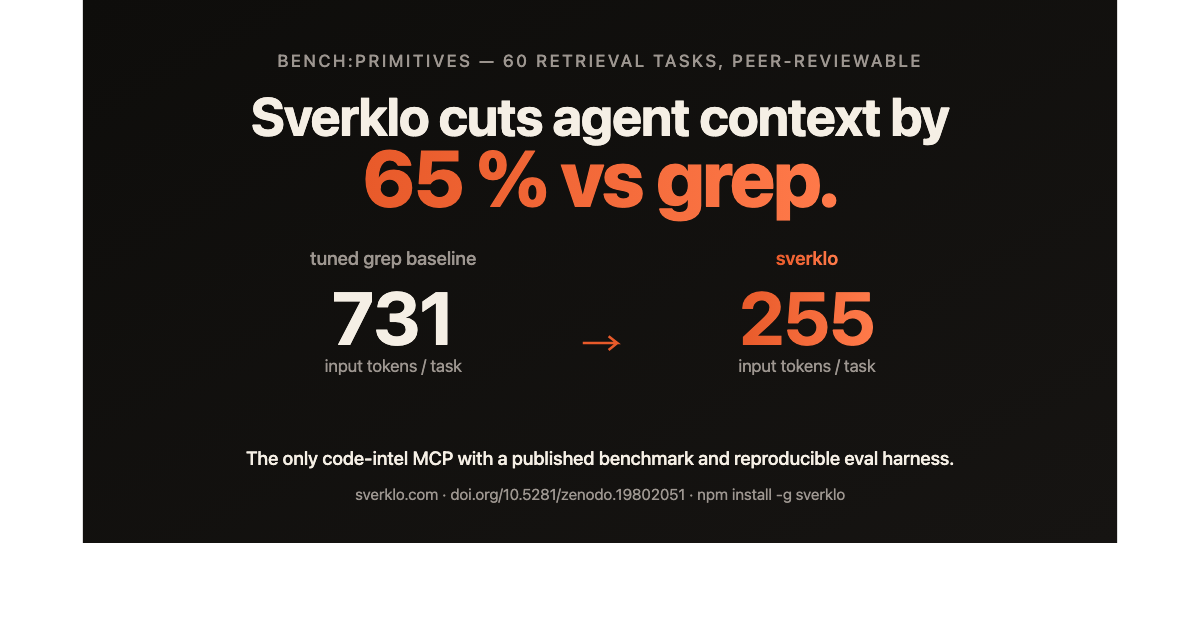
Retrieval benchmark — bench:primitives
Hybrid retrieval F1 vs grep baselines on a 180-task hand-verified evaluation across six OSS codebases (express, lodash, sverklo, requests, flask, fastapi). Public report at sverklo.com/bench/ — including every slice where sverklo loses. Methodology repo: github.com/sverklo/sverklo-bench.
Latest published 180-task run (sverklo v0.20.21, May 2026):
baseline
F1
avg input tokens
tool calls
naive-grep
0.25
22,704
6.3
smart-grep (tuned)
0.34
714
3.2
jcodemunch-mcp
0.29
1,907
1.2
GitNexus
0.30
630
1.2
sverklo
0.58
652
1.0
Sverklo leads overall F1, dominates P4 file-dependency questions, and keeps the honest loss slice visible: dead-code detection is where grep-style baselines remain strongest. Token economy: about 35× fewer input tokens than naive grep, with a single tool call per task.
Reproduce: npm run bench:quick. Filter with BASELINES=sverklo,jcodemunch DATASETS=express npm run bench:quick.
Submitting a baseline? Open a PR adding benchmark/src/baselines/<your-tool>.ts — auto-bench CI runs on the PR (express dataset, ~10 min) and posts a results-table comment back. See .github/workflows/auto-bench.yml.
Quick Start
Three ways to install. Pick whichever matches your setup.
Click the badge for your editor. Cursor / VS Code prompt to confirm, then sverklo's MCP config is written automatically. Restart the editor and the 37 tools appear in the tool list. No npm install required — npx resolves it on first use.
📦 Global install (Claude Code, Windsurf, Zed, Antigravity, any MCP client)
Start with proof, then wire the agent. sverklo prove --no-write --guided prints central files, a real caller graph, why that symbol was selected, and a prompt to paste into your agent without writing MCP config or instruction files. sverklo init --dry-run previews setup targets. sverklo init auto-detects which AI coding agents you have (Claude Code, Cursor, Windsurf, Zed, Antigravity) and writes the right MCP config files. Add --markdown or --receipt for a shareable proof artifact, then post it in the proof thread. Idempotent — safe to re-run. If sverklo doesn't appear in your agent after restart, run sverklo doctor --agent claude or the matching agent name.
Per-agent config locations (sverklo init writes these for you):
Claude Code: .mcp.json at project root + appends to CLAUDE.md (or AGENTS.md if present)
Cursor: .cursor/mcp.json
Windsurf: ~/.windsurf/mcp.json
VS Code: .vscode/mcp.json
JetBrains: Settings → Tools → MCP Servers
Antigravity: ~/.gemini/antigravity/mcp_config.json (global; re-run sverklo init per project)
For agents we don't auto-detect, drop this in their MCP config:
Use the full binary path (which sverklo) — some clients spawn subprocesses without inheriting $PATH.
🔧 From source (contributors / custom builds)
git clone https://github.com/sverklo/sverklo.git
cd sverklo
npm install
npm run build
npm link
sverklo init    # in your project directory
Use this if you're contributing, debugging the indexer, or want to run a not-yet-published build. The npm link step makes sverklo resolvable globally from the local checkout.
To run the bench:
npm run bench:quick
Output lands in benchmark/results/<timestamp>/.
Git worktrees
Yes, sverklo works with git worktree. Run sverklo init inside each worktree — that gives you per-worktree isolation:
Index lives at ~/.sverklo/<basename>-<hash>/index.db, keyed by absolute path. Two worktrees of the same repo → two independent databases.
Memory journal lives at <worktree>/.sverklo/memories.jsonl, inside the worktree itself. Bi-temporal SHA pinning means each memory still answers "what was true at commit X?" correctly across branch switches within one worktree.
.git linkfile: nothing special needed. Sverklo shells out to git with cwd: rootPath; git CLI handles the worktree linkfile transparently.
MCP config: keep args: ["."] from the worktree root (the default sverklo init writes). Pointing at the main checkout from a worktree would defeat per-branch isolation.
Multiple concurrent Claude Code sessions across different worktrees: safe by default. Different rootPaths = different DB files = no contention.
sverklo init adds .sverklo/ to your .gitignore automatically so the per-worktree journal doesn't get committed.
Any MCP client (one-shot via npx)
npx sverklo /path/to/your/project
No global install needed. npx resolves and runs sverklo on first call. Use this in CI, ephemeral sandboxes, or any host where you don't want a global install.
Installs the bundled Skill (procedural instructions teaching Claude when to reach for search, impact, review_diff, remember, etc.) without touching your global skills directory.
First run note: The ONNX embedding model (~90 MB) downloads automatically on first launch. Takes ~30 seconds, then every subsequent run is offline-capable.
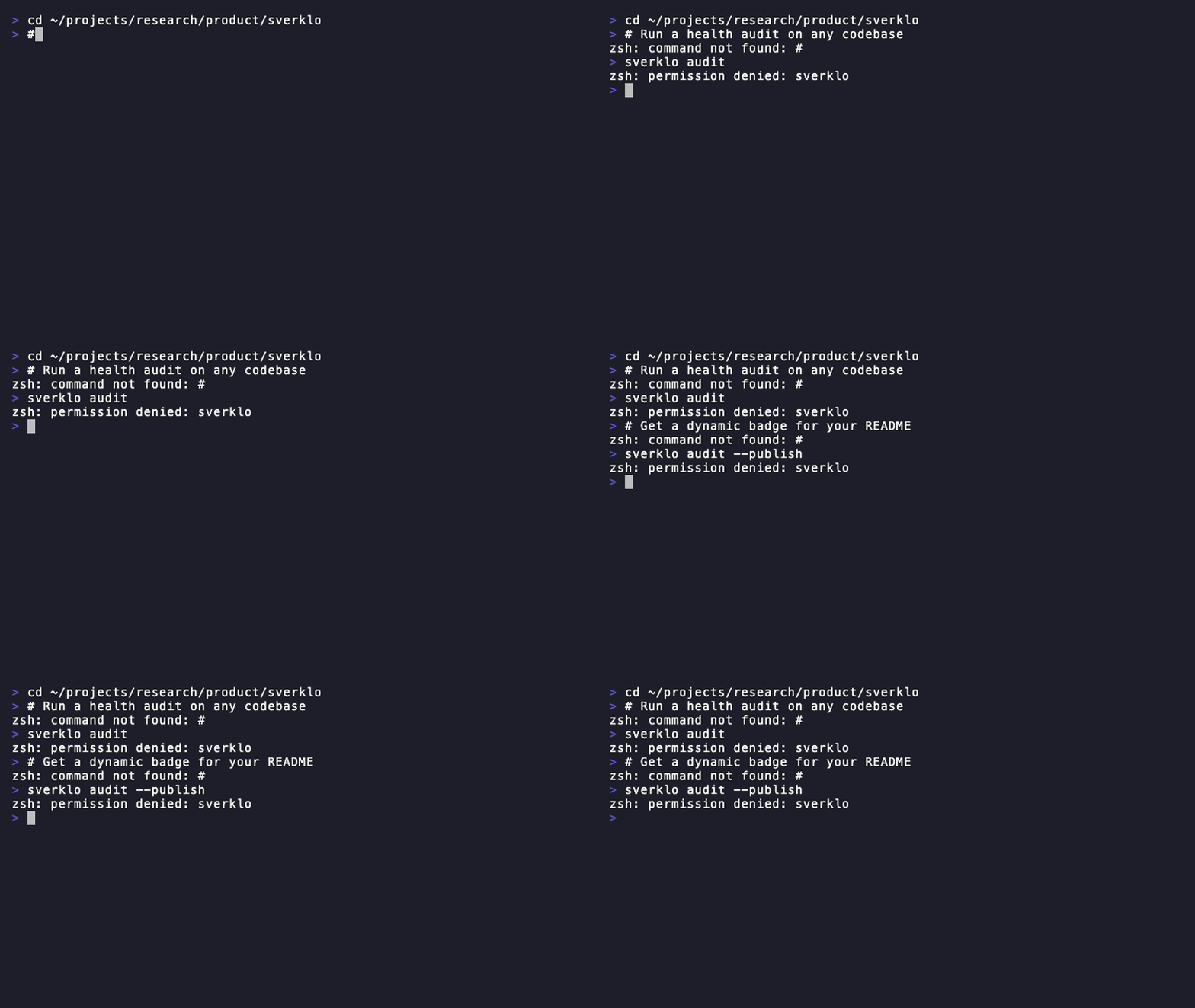
Most lints check syntax. sverklo audit lints whether your codebase is legible to an AI agent: high blast-radius "god nodes" the agent will trip on, hub files that cascade widely on every change, orphan symbols that might be dead code or might be public API, circular dependencies that confuse the symbol graph, and a security smell scan. Outputs an A-F health grade you can pin as a README badge.
sverklo audit                     # markdown report in the terminal
sverklo audit --format html --open  # self-contained HTML you can share
sverklo audit --badge             # A-F shield markdown for your README
sverklo audit --format sarif      # GitHub code-scanning alerts
sverklo audit --format json       # machine-readable for CI gates
Six formats: markdown, html, json, sarif, csv, badges. Pair with impact (the MCP tool) when you want to see the per-symbol blast radius before refactoring.
CLI tools
Sverklo ships a CLI for CI and local use: sverklo review --ci --fail-on high for risk-scored diff review (auto-detects PR ref in GitHub Actions), sverklo audit for codebase health reports, and a GitHub Action that posts review comments on PRs. Run sverklo audit-prompt or sverklo review-prompt to get battle-tested workflow prompts you can paste into any agent.
Claude Code hooks recipe
Sverklo plays well with Claude Code hooks. The simplest hook to wire is a post-tool-use review: after Claude makes file edits, run sverklo review against the working tree and surface any high-risk findings in the agent transcript. Add this to ~/.claude/settings.json:
The trailing || true keeps the hook from blocking edits when sverklo isn't installed or the working tree has no diff yet. For project-scoped hooks, put the same block in .claude/settings.json at the repo root instead.
Telemetry
Off by default. Sverklo makes zero network calls unless you explicitly run sverklo telemetry enable. If you opt in, we collect only anonymous usage metrics (no code, no queries, no file paths). Full schema and implementation details in TELEMETRY.md.
Open Source, Open Core
The full MCP server is free and open source (MIT). All 37 tools, no limits, no telemetry, no "free tier" — that's not where the line is.
Sverklo Pro (later this year) adds smart auto-capture of decisions, cross-project pattern learning, and larger embedding models. Sverklo Team adds shared team memory and on-prem deployment.
The open-core line: Pro adds new things, never gates current things. Anything in the OSS server today stays in the OSS server forever.
If you use Sverklo or its benchmarks (bench:primitives, bench:swe) in research, please cite:
Groshin, N. (2026). Sverklo: A Local-First Code Intelligence MCP Server and a Cross-Repository Software Engineering Benchmark. Zenodo. https://doi.org/10.5281/zenodo.19802051
BibTeX:
@misc{groshin2026sverklo,
  author    = {Groshin, Nikita},
  title     = {{Sverklo}: A Local-First Code Intelligence {MCP} Server and a Cross-Repository Software Engineering Benchmark},
  year      = {2026},
  publisher = {Zenodo},
  doi       = {10.5281/zenodo.19802051},
  url       = {https://doi.org/10.5281/zenodo.19802051}
}
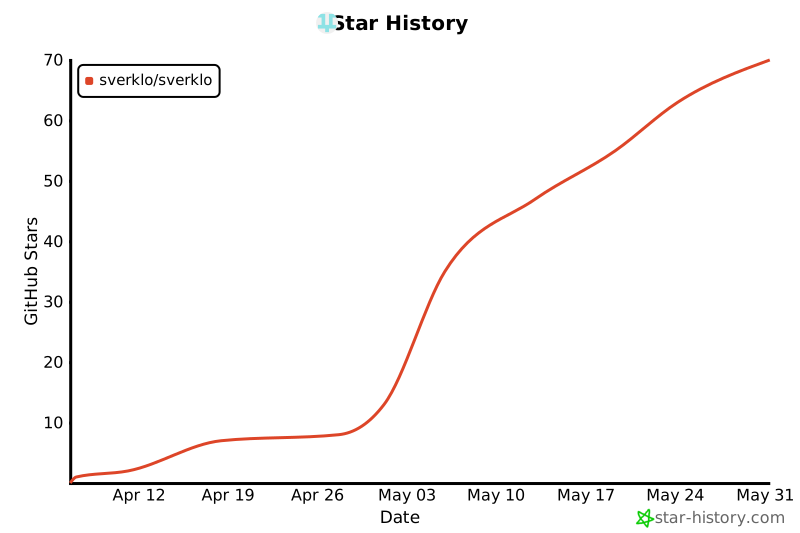
Star history
If sverklo saved your AI from inventing function names that don't exist in your codebase, the most useful thing you can do is ⭐ star this repo and share with one teammate.