
TruthRoute
БесплатноНе проверенEnables comparison of responses from multiple LLMs (OpenAI, Anthropic, Gemini) to the same prompt, returning a validated divergence score based on sentence embe

Описание
Enables comparison of responses from multiple LLMs (OpenAI, Anthropic, Gemini) to the same prompt, returning a validated divergence score based on sentence embeddings.
README
TruthRoute
npm version CI License: MIT Node
Send one prompt to multiple LLMs. Get a real, validated divergence score back. Not a vibe: a number computed from local sentence embeddings, checked against a hand-labeled agree/disagree/negation/paraphrase test set before it shipped.

npx truthroute-cli compare "is the earth flat?" --models openai,anthropic,gemini
Why this exists
AI-safety and eval researchers who want to know how much LLMs from different vendors agree or disagree on a given prompt currently have two bad options: build a one-off comparison script themselves, or use a hosted, non-programmable dashboard. Neither is embeddable in an eval pipeline, and neither publishes a checked methodology. TruthRoute is a scriptable primitive built for the second use case. Call it from a script, a CI job, or an MCP-capable agent, and get back a number you can actually cite.
Install
npm install -g truthroute-cli
Or run it without installing:
npx truthroute-cli compare "<prompt>" --models openai,anthropic,gemini
You need API keys for whichever providers you compare, set as environment variables:
export OPENAI_API_KEY=sk-...
export ANTHROPIC_API_KEY=sk-ant-...
export GEMINI_API_KEY=...
Only the providers you actually request need a key set.
[!WARNING] Every
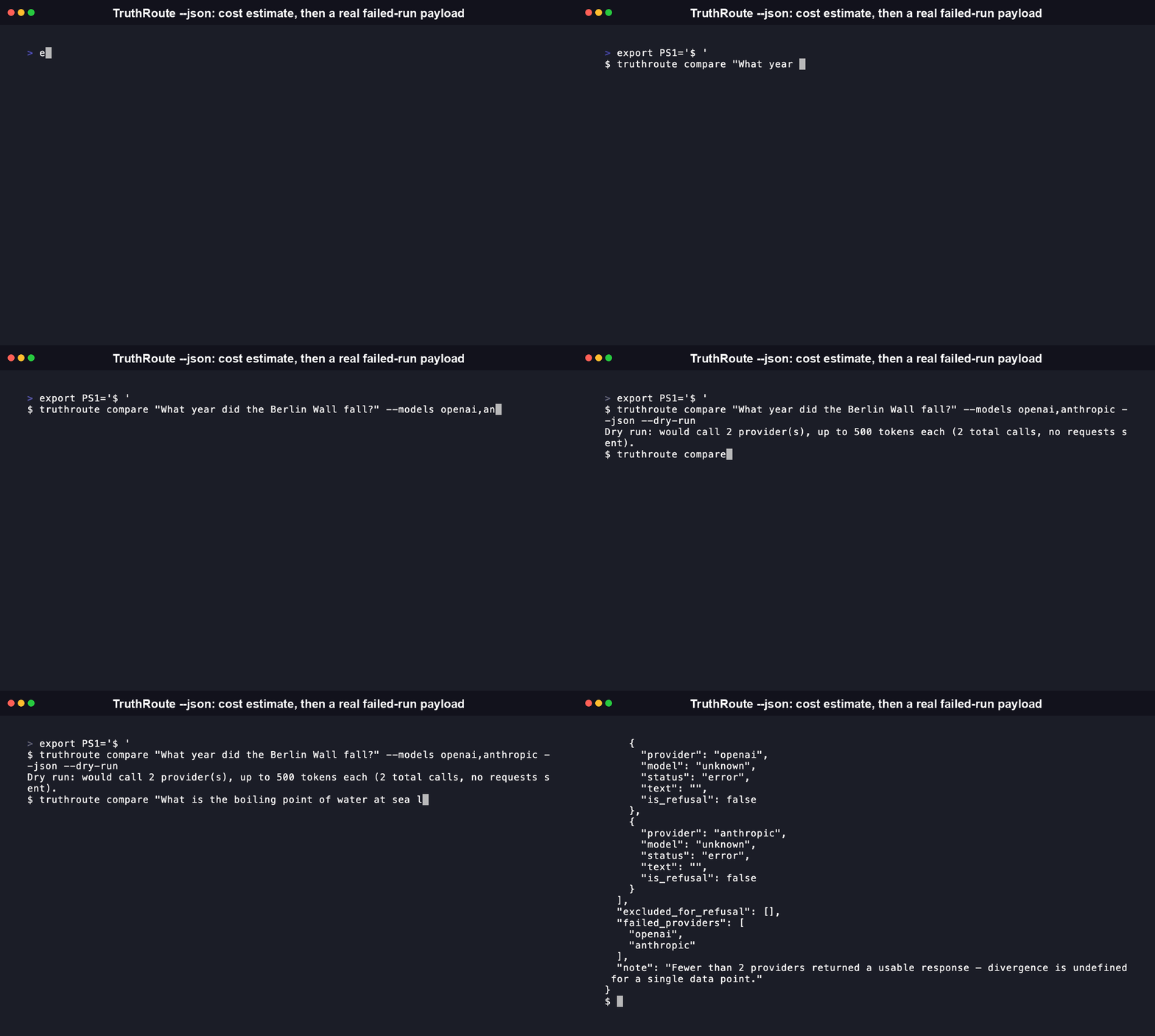
comparecall makes real, billed calls against the vendor APIs for the providers you request. There is no free tier, because there is no hosted component at all. Use--dry-runto see the call count before spending anything.
Quickstart
truthroute compare "Was the 2020 US election secure?" --models openai,anthropic,gemini
--- openai (gpt-5.5) [ok] ---
The 2020 US election faced numerous security reviews...

--- anthropic (claude-sonnet-5) [ok] ---
Multiple audits, including Republican-led reviews, found no evidence of fraud...

--- gemini (gemini-3.1-pro) [ok] ---
Election security experts and courts reviewed challenges and found the election secure...

Divergence score: 0.041 (0 = identical, 1 = maximally divergent)
Status: complete. Computed over all 3 providers.
For an agent to consume programmatically:
truthroute compare "..." --models openai,anthropic --json
CLI reference
truthroute compare <prompt> --models <list> [options]

Arguments:
  prompt               the prompt to send to every provider

Options:
  -m, --models <list>  comma-separated provider list (openai, anthropic, gemini)
  --json               output structured JSON instead of human-readable text
  --dry-run            estimate cost and exit without making real API calls
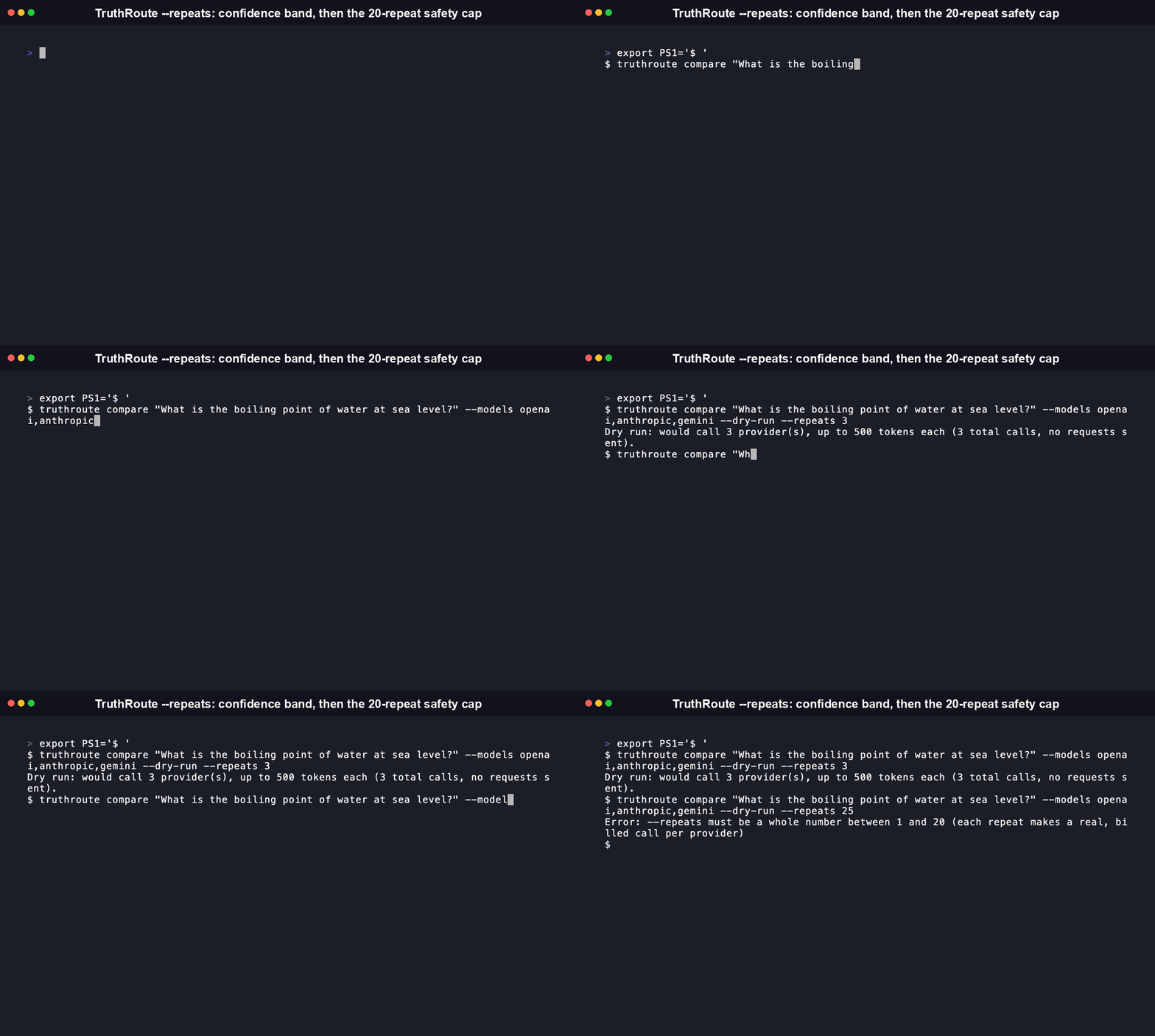
  --repeats <n>        run N times, report a confidence band instead of one score

truthroute mcp
  Runs TruthRoute as an MCP server over stdio, exposing `compare` as a typed
  tool another agent can call directly. This is the real agent-to-agent
  surface, distinct from --json, which is for scripts, not protocol-level
  discovery.
--json output shape
{
  "prompt": "...",
  "status": "complete",
  "divergence_score": 0.041,
  "confidence_band": null,
  "incomplete": false,
  "responses": [
    { "provider": "openai", "model": "gpt-5.5", "status": "ok", "text": "...", "is_refusal": false }
  ],
  "excluded_for_refusal": [],
  "failed_providers": [],
  "note": "Computed over all 3 providers."
}
status is one of complete (all providers succeeded), partial (at least 2 usable responses, but not all providers succeeded, or one was excluded for refusal), or failed (fewer than 2 usable responses, so divergence_score is null; divergence has no meaning against a single data point).
Methodology, stated plainly
- Scoring: local sentence embeddings (
fastembed, modelBGESmallENV15). No paid API for scoring, only the 3 providers being compared. Divergence is1 - average pairwise cosine similarityacross all response pairs, in[0.0, 1.0]. - Validated, not assumed. The model was checked against a hand-labeled test set (
test/fixtures/validation-set.json) covering agreement, paraphrase, negation, and clear disagreement before shipping. A smaller embedding model (MiniLM-L6) was tried first and rejected during that check: it scored negation pairs as less divergent than paraphrases, the opposite of correct.BGESmallENV15was chosen because it passes that check. - Refusals are excluded from scoring, not just flagged. A refusal's text distance from a real answer is not factual disagreement, and would otherwise dominate the score.
- Responses are normalized before scoring (markdown and formatting stripped) so verbosity differences between providers aren't measured as semantic divergence.
- Determinism, stated plainly: all provider calls use
temperature=0, which reduces but does not eliminate run-to-run variance. Vendor-side inference infrastructure (GPU batching, floating-point non-associativity) can still cause drift independent of anything this tool controls. Use--repeats Nto get a confidence band instead of trusting a single score as exactly reproducible.
- A compressed score range is expected, not a bug. Cosine-similarity scores between two responses to the same topically-related prompt naturally compress into a smaller range than a naive 0-to-1 intuition suggests. The signal that matters is relative ordering (agreement scores lower than disagreement), which is what the validation set actually checks.
How this compares
duh is a full multi-model consensus platform: a propose/challenge/revise/commit debate protocol across 5 providers plus local models, with a web UI, REST API, WebSocket streaming, persistent SQLite/Postgres storage, auth, cost tracking, and PDF export. It is more mature and far more feature-complete than TruthRoute. TruthRoute is not trying to be a smaller version of it. TruthRoute does one narrow thing: score how much N providers' responses to the same prompt diverge, as a stateless CLI/MCP primitive with no server, no database, and no accounts to set up. If you want debate, dissent-tracking, and a full decision-audit platform, use duh. If you want a scriptable divergence number to drop into an existing eval pipeline or CI job with nothing to host, that is what TruthRoute is for.
| TruthRoute | duh |
|
|---|---|---|
| Interface | CLI, MCP server | CLI, REST API, WebSocket, MCP server, web UI |
| Providers | OpenAI, Anthropic, Gemini (3) | Claude, GPT, Gemini, Mistral, Perplexity (5) + local via Ollama/LM Studio |
| Storage | None (stateless) | SQLite or PostgreSQL |
| Setup | npm install -g truthroute-cli, API keys as env vars |
uv add duh, API keys, optional DB/auth setup |
| Core output | A single divergence score (0.0-1.0), validated against a hand-labeled test set | A synthesized decision with confidence score, preserved dissent, and citations |
| Language | TypeScript | Python |
| License | MIT | AGPL-3.0 |
TruthRoute is not an LLM gateway or router (see LiteLLM and Portkey). It does no routing, failover, or cost optimization. If you need those, use one of those tools. TruthRoute measures disagreement between providers; it doesn't route between them.
FAQ
What does this actually measure? How much the substantive content of N LLM responses to the same prompt differs, using local sentence-embedding similarity. It is not a fact-checker. It tells you providers disagree, not which one is right.
Do I need my own API keys? Yes. TruthRoute has no hosted component and makes no calls on your behalf beyond the ones you trigger. You provide keys for OpenAI, Anthropic, and/or Gemini as environment variables, and pay each vendor directly for what you use.
Is this safe to run against sensitive prompts? Any prompt you compare is sent to each vendor's API, the same as if you called them directly. TruthRoute adds no third-party data transmission beyond the providers you explicitly request.
Can an agent call this directly, not through a human running the CLI?
Yes. truthroute mcp runs an MCP server exposing compare as a typed tool over stdio for another agent to call. --json output is also available for scripts that shell out to the CLI directly.
Is this a library or just a CLI?
Both. It ships as an npm package with a CLI entry point (truthroute) and can be run via npx with no global install.
Why is the divergence score so much lower than I expected for two responses I'd say clearly disagree? See "A compressed score range is expected" above. This is a known property of cosine-similarity scoring on topically-related text, not a bug. The validated signal is relative ordering, not the absolute number.
Contributing
Issues and PRs welcome. Run npm test before submitting. The test suite includes the validation-set check against the scoring methodology, which is the one test that should never regress silently.
License
MIT
Установка TruthRoute
У этого сервера нет опубликованного пакета — он собирается из исходников. Открой репозиторий и следуй инструкции в README.
▸ github.com/RudrenduPaul/TruthRouteFAQ
TruthRoute MCP бесплатный?
Да, TruthRoute MCP бесплатный — установка в пару кликов через Unyly без оплаты.
Нужен ли API-ключ для TruthRoute?
Нет, TruthRoute работает без API-ключей и переменных окружения.
TruthRoute — hosted или self-hosted?
Доступен hosted-вариант: Unyly запускает сервер в облаке, локальная установка не обязательна.
Как установить TruthRoute в Claude Desktop, Claude Code или Cursor?
Открой TruthRoute на unyly.org, выбери вкладку своего клиента (Claude Desktop, Claude Code, Cursor) и нажми Install — конфиг сгенерируется автоматически, без правки JSON.
Похожие MCP
Fetch
Web content fetching and conversion for efficient LLM usage.
Roblox Studio
Enables AI coding tools to control Roblox Studio for workspace exploration, instance manipulation, and script management. It provides tools for playtesting, sce
 автор: paralov
Opencode Omniroute Plugin
OpenCode plugin for the OmniRoute AI Gateway. Drives dynamic model discovery, /connect auth flow, and multi-instance OmniRoute providers via the official @openc
 автор: GitHub Actions
AWS KB Retrieval
Retrieval from AWS Knowledge Base using Bedrock Agent Runtime.
 автор: modelcontextprotocol
Spring AI MCP Server
Provides auto-configuration for setting up an MCP server in Spring Boot applications.
llm-analysis-assistant
A very streamlined mcp client that supports calling and monitoring stdio/sse/streamableHttp, and can also view request responses through the /logs page. It also
 автор: xuzexin-hz
MCP-Agent
A simple, composable framework to build agents using Model Context Protocol by [LastMile AI](https://www.lastmileai.dev)
 автор: lastmile-ai
Spring AI MCP Client
Provides auto-configuration for MCP client functionality in Spring Boot applications.
mcp.natoma.ai
A Hosted MCP Platform to discover, install, manage and deploy MCP servers by [Natoma Labs](https://www.natoma.ai)
MCPHub
Website to list high quality MCP servers and reviews by real users. Also provide online chatbot for popular LLM models with MCP server support.
Compare TruthRoute with
Не уверен что выбрать?
Найди свой стек за 60 секунд
Автор?
Embed-бейдж для README
Похожее
Все в категории ai