
UIInspect.MCP
БесплатноНе проверенA Windows UI Automation MCP Server for WPF, WinUI, Avalonia & WinForms UIInspect.MCP is a MCP server that gives AI agents and developer tools semantic access to

Описание
A Windows UI Automation MCP Server for WPF, WinUI, Avalonia & WinForms UIInspect.MCP is a MCP server that gives AI agents and developer tools semantic access to Windows desktop applications. Instead of brittle pixel‑based automation, UIInspect.MCP exposes a rich, structured view of the UI
README
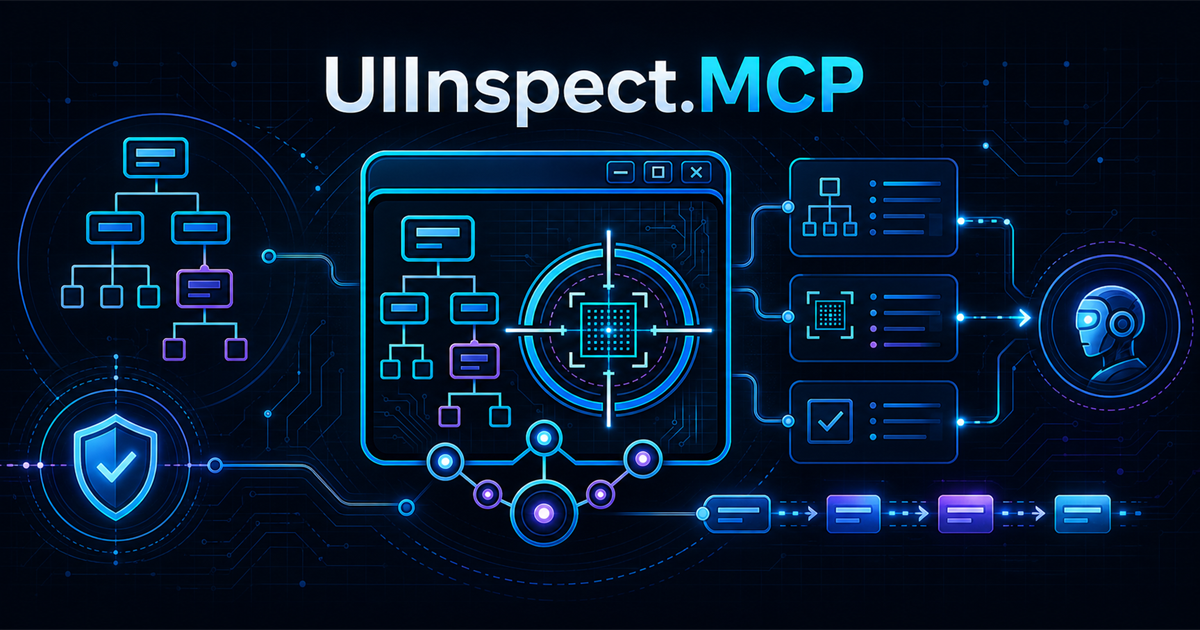
UIInspect MCP Server
UIInspect.MCP.Server is a consent-gated NuGet MCP server that gives AI agents semantic access to Windows applications through UI Automation 3 (UIA3). It discovers accessible application windows, returns bounded control trees, and performs deterministic actions against opaque element references instead of relying on screenshots or pixel coordinates.
The package runs as a local stdio server on .NET 10. WPF, WinForms, WinUI 3, Avalonia, and .NET MAUI Windows are directly tested against deterministic UI Automation fixtures.
Quick Install
Once the package is available on NuGet.org, click to install it in your preferred environment:
VS Code - Install UIInspect MCP VS Code Insiders - Install UIInspect MCP Visual Studio - Install UIInspect MCP
Note:
- These install links use the NuGet package identity
UIInspect.MCP.Serverand select the latest0.*prerelease. - The selected package must be available on NuGet.org. For an unpublished local build, expose the package directory as a NuGet feed and add
--source <feed-path>to thednxarguments. - UIInspect is Windows-only and requires an interactive desktop.
Manual MCP configuration using NuGet:
{
  "mcpServers": {
    "uiinspect-mcp": {
      "type": "stdio",
      "command": "dnx",
      "args": [
        "[email protected]",
        "--prerelease",
        "--yes"
      ]
    }
  }
}
Some clients use servers instead of mcpServers; only the outer property name changes.
The NUKE build stamps every literal UIInspect.MCP.Server package coordinate in this README with the MinVer package version before packaging:
dnx [email protected] --yes
Codex Skill
The package includes the uiinspect Codex skill and its MCP dependency metadata. When the packaged server starts, it installs missing skill files into an existing Codex home: CODEX_HOME when it is set and exists, otherwise %USERPROFILE%\.codex when that directory exists. Automatic installation never overwrites existing skill files.
Install the skill explicitly and create the Codex home when needed. This command installs the skill and exits without starting the MCP server:
dnx [email protected] --yes -- --install-codex-skill
To deliberately replace an existing installed copy with the packaged version:
dnx [email protected] --yes -- --install-codex-skill --force
Set CODEX_HOME before either command when Codex uses a non-default location. The skill is installed at <Codex home>\skills\uiinspect.
Invoke the installed skill with a request such as:
Use $uiinspect to inspect and safely operate the target Windows application.
Requirements
- Windows 10 or Windows 11 with an interactive desktop.
- A .NET 10 SDK that provides
dnx. - UIInspect must run in the same Windows logon session as the target application.
- UIInspect must run at a sufficient integrity level for the target. A non-elevated server cannot automate an elevated application.
The MCP protocol owns stdout; server diagnostics are written to stderr.
What the package provides
- Top-level window discovery with process-instance identity and native window handles.
- A trusted, server-owned Windows approval dialog shown at most once per client and exact target process instance during one server session.
- Attach by process ID with an optional native window handle.
- Bounded, flattened UI Automation control-tree snapshots.
- Opaque, generation-scoped element references with explanatory semantic paths.
- Invoke, resolved click, ValuePattern set, SelectionItemPattern select, expand/collapse, and allowlisted logical-key actions.
- Password-element redaction and no control-value collection during inspection.
- Consent bound to the local stdio server principal, expiry and PID-reuse checks, rate limits, application-level append-only redacted JSONL auditing, and deterministic session cleanup.
The current package deliberately does not provide XAML source or visual trees, dependency properties, bindings, validation, DataContext or command diagnostics, hot reload, screenshots, OCR, overlays, recording/replay, arbitrary reflection, shell execution, generic property writes, or TCP transport.
Consent and security
UIInspect never treats an MCP request as user approval. The local user must approve the exact process instance and requested capabilities in a trusted Windows dialog before the server attaches. Repeated and concurrent requests reuse that server-session decision without opening another dialog. A denial is terminal for that client and process instance until the server restarts, and later capability expansion is denied rather than silently approved or prompted again.
Inspection, interaction, and keyboard access are separate capabilities. Request only the minimum needed for the task. Grants are short-lived and bound to the local stdio server principal, exact process identity, Windows session, and approved capabilities. Tool parameters cannot supply or override that principal.
For unattended tests, keep one MCP server process alive for the complete run, request every required capability during setup, approve the single trusted dialog, and reuse its grants and attached sessions.
Successful actions invalidate all current element references. Re-inspect before the next action so the server can semantically resolve the current UI rather than act on stale coordinates.
The default audit file is:
%LOCALAPPDATA%\UIInspect.MCP\audit\actions.jsonl
Set UIINSPECT_AUDIT_PATH for the MCP server process to use another location. Audit records exclude entered values, password content, clipboard data, screenshots, raw provider exceptions, and all keystrokes except the allowlisted logical key name. Appends are enforced at the application level; protect the audit directory with an ACL that grants access only to the server account and administrators.
See the complete security model for consent scopes, rate limits, audit contents, integrity boundaries, and the threat model.
MCP tools
| Tool | Purpose | Required access |
|---|---|---|
uiinspect_discover_windows |
List top-level UI Automation windows | Discovery |
uiinspect_request_consent |
Show the trusted local approval dialog once per exact target and server session | Local user decision |
uiinspect_attach |
Open an opaque session for a PID and optional HWND | Inspect |
uiinspect_inspect_tree |
Return a bounded semantic snapshot | Inspect |
uiinspect_invoke |
Use InvokePattern | Interact |
uiinspect_click |
Click a semantically resolved element | Interact |
uiinspect_set_value |
Set a value through ValuePattern | Interact |
uiinspect_set_text |
Set text through ValuePattern | Interact |
uiinspect_select_item |
Use SelectionItemPattern | Interact |
uiinspect_expand_collapse |
Use ExpandCollapsePattern | Interact |
uiinspect_send_key |
Send one allowlisted logical key after focus | Keyboard |
uiinspect_close_session |
Dispose an attached session | Session owner |
Recommended workflow
- Call
uiinspect_discover_windows. - Identify the intended process and window using independently known application context.
- Call
uiinspect_request_consentonce with every capability required for the session. The local user must approve the exact process instance; repeats reuse the decision and cannot expand it. - Call
uiinspect_attach. - Call
uiinspect_inspect_treewith the smallest useful depth and node budget. - Select an element using its automation ID, control type, accessible name, patterns, and semantic path.
- Prefer
uiinspect_invoke,uiinspect_set_value(or itsuiinspect_set_textalias),uiinspect_select_item, oruiinspect_expand_collapse. Useuiinspect_clickonly when the provider does not expose InvokePattern, and useuiinspect_send_keyonly when keyboard consent was granted. - Re-inspect after every successful action to obtain fresh element references.
- Call
uiinspect_close_session.
Recovery behavior
- On
stale_element, inspect again and use a newly returned element reference. - On
consent_expired, calluiinspect_request_consent, thenuiinspect_attach, thenuiinspect_inspect_tree. The retained server-session approval renews the grant without showing another dialog. - On
session_not_found, attach again when consent remains active; otherwise request consent, attach, and inspect. - On
target_changedortarget_unavailable, rediscover the target; a new exact process identity requires its own consent decision. - On
rate_limited, wait forretryAfterMillisecondsbefore retrying. - Treat
consent_deniedas terminal for that client, target, and server process. Do not retry in a loop. - Treat
pattern_not_supportedas a semantic limitation; select another supported operation rather than falling back to blind input.
Package contents
The NuGet package contains:
- The
uiinspect-mcp.NET tool and its runtime dependencies. .mcp/server.jsonMCP registry metadata.- The recursively packaged
skills/uiinspectskill, includingSKILL.mdandagents/openai.yaml. - This README and the detailed MVP behavior and boundaries.
The package uses ModelContextProtocol 2.0.0 and FlaUI 5.0 with UIA3.
Установка UIInspect.MCP
У этого сервера нет опубликованного пакета — он собирается из исходников. Открой репозиторий и следуй инструкции в README.
▸ github.com/ChrisPulman/UIInspect.MCPFAQ
UIInspect.MCP MCP бесплатный?
Да, UIInspect.MCP MCP бесплатный — установка в пару кликов через Unyly без оплаты.
Нужен ли API-ключ для UIInspect.MCP?
Нет, UIInspect.MCP работает без API-ключей и переменных окружения.
UIInspect.MCP — hosted или self-hosted?
Self-hosted: сервер запускается локально на твоей машине командой из раздела установки.
Как установить UIInspect.MCP в Claude Desktop, Claude Code или Cursor?
Открой UIInspect.MCP на unyly.org, выбери вкладку своего клиента (Claude Desktop, Claude Code, Cursor) и нажми Install — конфиг сгенерируется автоматически, без правки JSON.
Похожие MCP
LibreOffice Tools
Enables AI agents to read, write, and edit Office documents via LibreOffice with token-efficient design. Supports multiple formats including DOCX, XLSX, PPTX, a
 автор: passerbyflutter
dannote/figma-use
Full Figma control: create shapes, text, components, set styles, auto-layout, variables, export. 80+ tools.
 автор: dannote
Logo.dev
Search and retrieve company logos by brand or domain. Customize size, format, and theme to match your design needs. Accelerate design, prototyping, and content
 автор: NOVA-3951
Design Inspiration Server
Searches top design platforms like Dribbble and Behance to provide UI inspiration, color palettes, and layout patterns via the Serper API. It allows users to re
 автор: YonasValentin
Compare UIInspect.MCP with
Не уверен что выбрать?
Найди свой стек за 60 секунд
Автор?
Embed-бейдж для README
Похожее
Все в категории design