
Vaultify Public
БесплатноНе проверенMCP server (JSON-RPC 2.0 implemented from scratch, no SDK) + CLI + Tauri GUI: shared AI-agent memory, task board, full-text search over Obsidian vaults. Own inv

Описание
MCP server (JSON-RPC 2.0 implemented from scratch, no SDK) + CLI + Tauri GUI: shared AI-agent memory, task board, full-text search over Obsidian vaults. Own inverted index on node:sqlite. Zero runtime dependencies.
README
Shared memory for AI agents, a shared kanban board, and meta-management / full-text search across multiple Obsidian vaults — local-first, zero runtime dependencies, no LLM in the core.





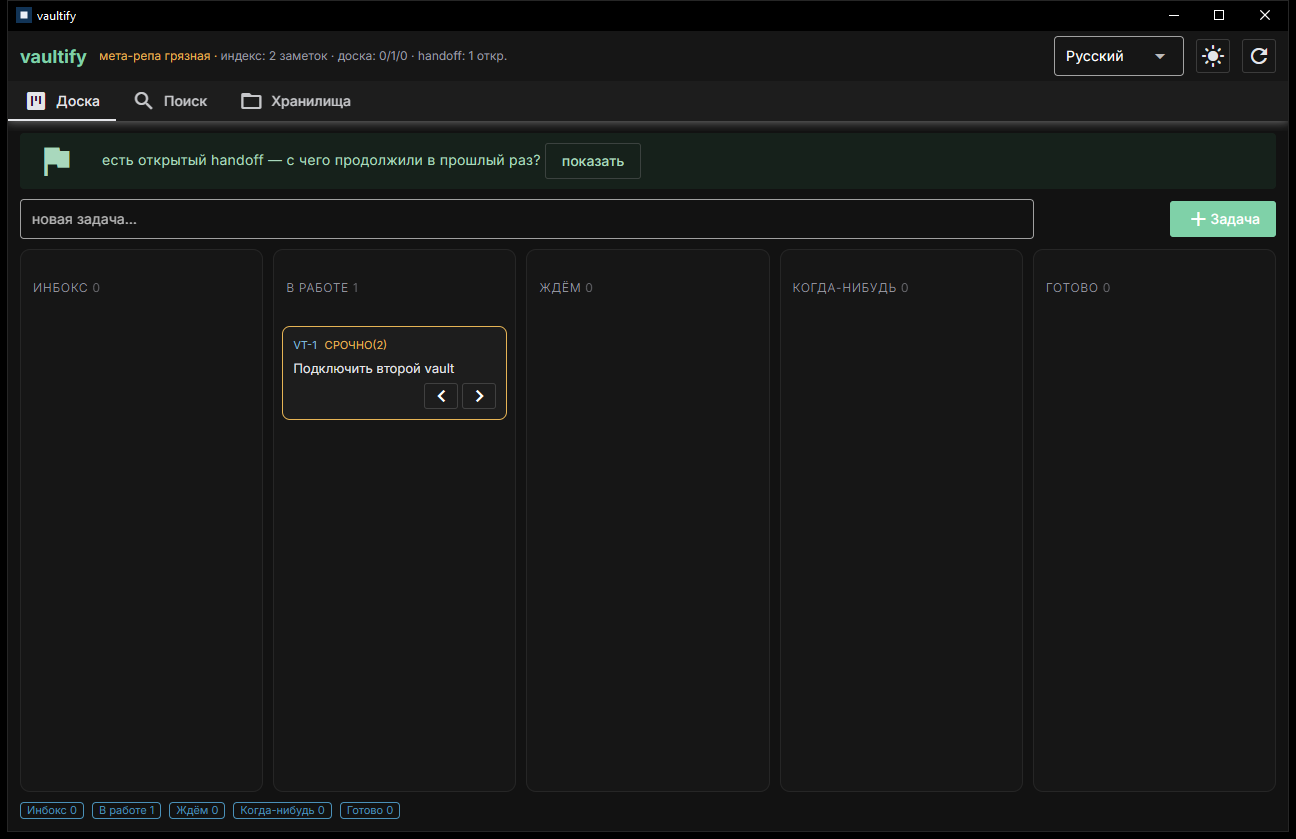
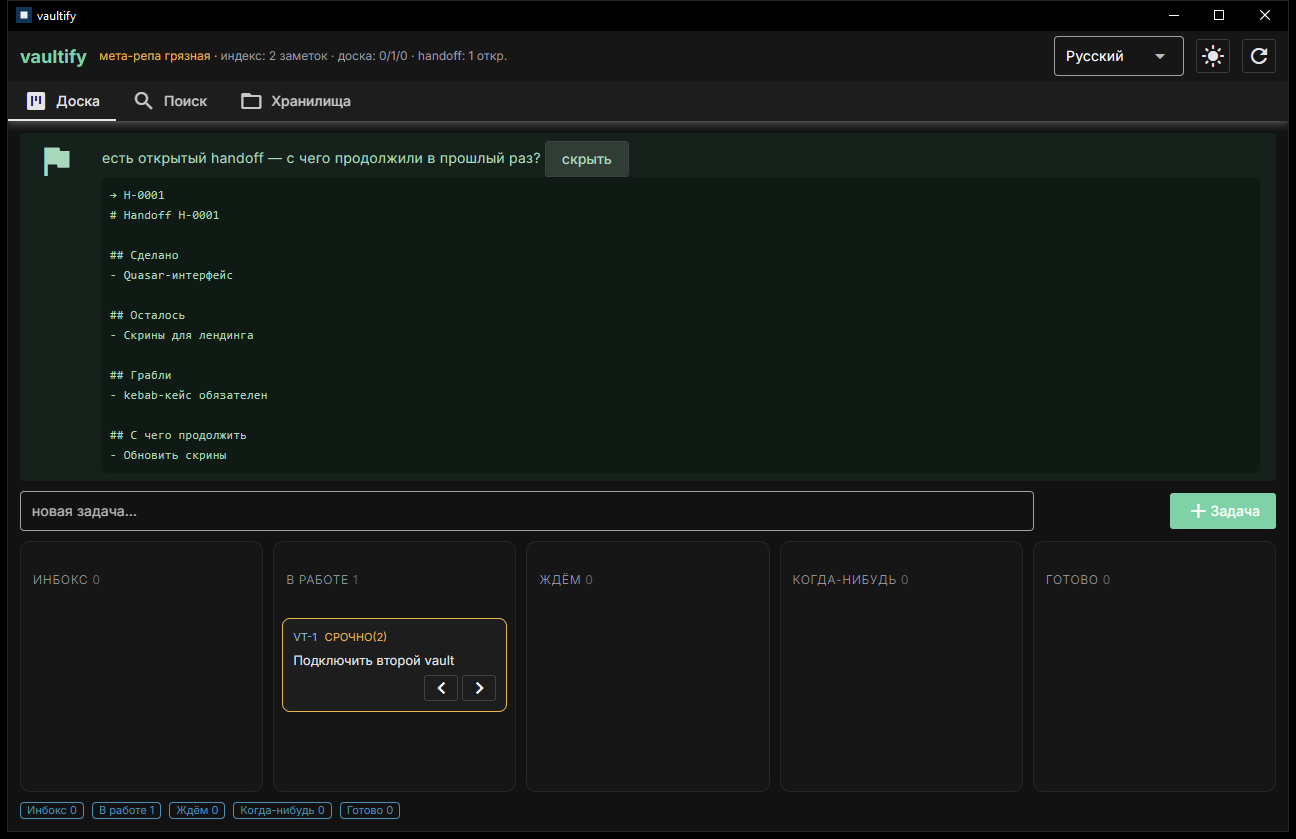
| Open handoff → resume | Search across vaults |
|---|---|
 |
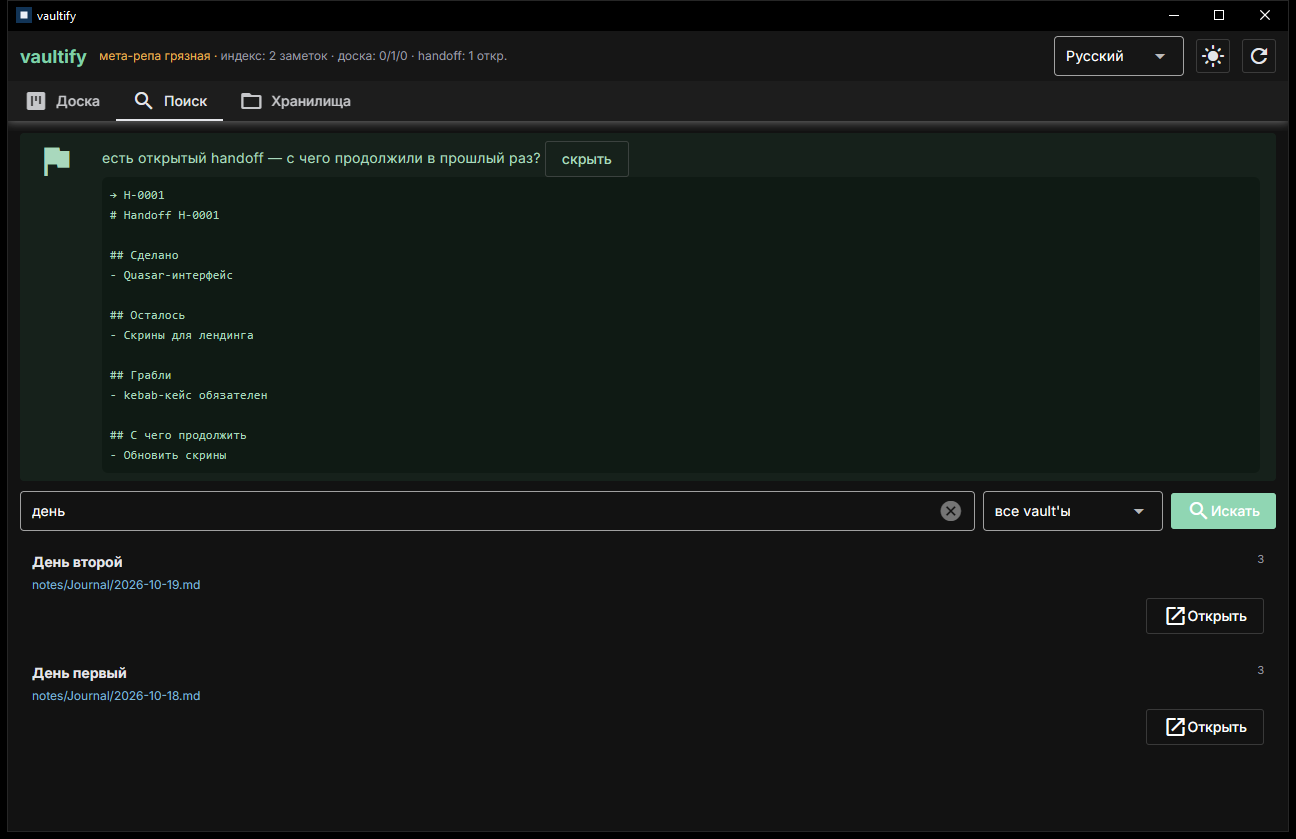 |
Screenshots show the desktop companion (Russian interface, dark theme) working against a demo workspace: five kanban columns, the morning handoff-resume block, and prefix search over indexed vault notes.
Why
When you run more than one AI coding agent, memory becomes infrastructure:
- The amnesia problem. Every harness keeps its own short memory. The decision an agent made on Tuesday is gone on Wednesday — and another harness never saw it at all. Each new session re-derives context from scratch.
- The scattered-knowledge problem. What agents do learn ends up in chat logs, not in your notes. The Obsidian vaults you already maintain — the canon you actually trust — never receive any of it.
- The handoff problem. Moving work from one agent (or one day) to another is manual: copy the state, the leftovers, the gotchas — and hope nothing is lost.
vaultify answers with a small deterministic layer between your harnesses and your vaults: raw session memory in a git meta-repo, distilled knowledge written into the vaults themselves, one kanban board and one search over everything.
What's inside
| Area | Command | What it does |
|---|---|---|
| Shared memory | vaultify memory save · handoff · resume |
A raw, append-only memory layer in the git meta-repo: session summaries and structured handoffs (done / left / gotchas / next). resume picks up the latest open handoff — a different harness continues where another stopped |
| Task board | vaultify task new · board · move … |
One shared kanban over a SQLite registry: inbox / doing / waiting / someday / done, priorities P0–P3, links to notes; humans and agents move the same cards, every transition carries its reason |
| Vault search | vaultify scan · search |
Full-text-style search over title/tags/body of every connected vault, plus tasks and memory — a prefix-inverted index on node:sqlite, deliberately without FTS5, rebuilt by scan |
| Vault registry & layouts | vaultify vault add · show · map |
Registers any markdown folder (Obsidian-focused); layout profiles strict / flex / single map note types to folders, flex auto-detects the existing structure — the vault is never reorganized |
| Git-native sync | vaultify status · sync [--dry] |
Per-vault strategies own / shared / none instead of a "1 vault = 1 repo" dogma; status reports dirty and behind vaults, sync does commit → pull --rebase → push per strategy |
| MCP server | vaultify mcp |
A local MCP server (stdio JSON-RPC, zero-deps) with 8 tools — search, memory save/handoff/resume, task add/list/move, vault status — so agents of any harness get typed access without parsing CLI output |
| Harness integrations | vaultify integrations install zcode|dsh · doctor |
Installs the skill, slash-commands, a SessionStart hook (board + fresh memory + dirty vaults in context) and merges the MCP server into the harness config — with a backup; doctor verifies the wiring |
| Desktop companion | vaultify-ui |
Tauri v2 app, board-first: five kanban columns with drag-and-drop, the morning resume block, vault search and vault statuses — the same core running in the webview |
How it works
Two memory layers, after Karpathy's LLM Wiki pattern:
- Raw layer — immutable. Session summaries (
memory/sessions/S-NNNN.md) and handoffs (memory/handoffs/H-NNNN.md) live as plain markdown in the git meta-repo<install>/home/. Written through the CLI at the end of every meaningful stretch of work; never edited retroactively. - Distillate — living. Valuable conclusions become ordinary Obsidian notes
in the user's vaults, with provenance in the frontmatter
(
source: vaultify/S-0042) and[[wikilinks]]to what already exists.
The canon is the user's data: the application owns only the meta-repo
(<install>/home/); delete it and nothing of yours is lost. And the canon stays
single — the vaults, not an app-owned wiki. Writing into a vault is
deterministic: the layout profile in the registry maps each note type to a
folder (unknown types fall back to an inbox folder), so the skill decides
what the note is, never where it goes.
USER VAULTS (the canon)                    META-REPO <install>/home/ (what the app owns)
├── ~/Notes/Work    [git: own]             ├── config.*   ← settings: vault registry,
├── ~/Notes/Life    [git: none]            │                 layout maps, git modes
└── ~/Zettel        [git: shared]          ├── tasks.db   ← SQLite task registry (kanban)
     ↑ distillate: the agent writes        ├── memory/    ← raw agent memory (markdown):
       notes per the vault's mapping       │   sessions/  ← session summaries (sources)
       (no index/topics wiki —             │   handoffs/  ← handoff records
       the canon is the vaults)            └── index.db   ← derived vault index
                                                             (rebuildable, not in git)
The core has no LLM: indexing, search, the board and sync are deterministic code. Everything "smart" — distillation, planning, the morning flow — lives in skills executed by the harness itself. The complete picture: docs/architecture/overview.md.
Getting started
Build from source (Node ≥ 22.5 for node:sqlite; Windows-first):
pnpm install
pnpm build          # → dist/
pnpm build:sea      # → dist/sea/vaultify.exe — a single self-contained binary
Where it lives (one-folder deployment): put vaultify.exe anywhere you keep
tools (e.g. D:/tools/vaultify/) — vaultify init creates the data home at
<that folder>/home/. Everything — binaries and data — stays in one folder you can
move or back up as a whole; VAULTIFY_HOME relocates the data if you want it
elsewhere.
Then wire it up:
vaultify init                            # creates the meta-repo <install>/home/
vaultify vault add ~/Notes/Work          # registers a vault (git mode + layout auto-detected)
vaultify scan                            # builds the search index
vaultify search "quarterly goals"        # one search over all vaults, tasks and memory
vaultify integrations install zcode      # or: dsh — skill, commands, hook, MCP config merge
vaultify doctor                          # verifies the wiring
The desktop companion: pnpm ui (dev window) or pnpm ui:build →
vaultify-ui.exe. Full command reference: docs/cli-reference.md.
Design decisions
Seventeen recorded decisions shape the tool — the full table with the rejected alternatives lives in docs/decisions/design-decisions.md. In brief:
| # | Decision |
|---|---|
| R1 | Toolchain like devst-public: TypeScript, zero runtime deps, Node SEA binary, Tauri UI |
| R2 | Transport: CLI (SEA) + MCP over stdio + skills/hooks — no daemon |
| R3 | Harnesses in v1: zcode + Claude Code, via installer adapters + doctor |
| R4 | No LLM in the core; distillation and planning are skills at the harness |
| R5 | The canon of knowledge is the user's vaults — not an SQLite canon, not an app wiki |
| R6 | Two memory layers: raw (sessions/handoffs) → distillate (vault notes with provenance) |
| R7 | Raw memory is markdown in a git meta-repo — human-readable, git history for free |
| R8 | Tasks: SQLite registry with kanban statuses inbox/doing/waiting/someday/done |
| R9 | All app data in one meta-repo <install>/home/: config, tasks.db, memory/, index.db |
| R10 | Git without dogma: per-vault strategies own/shared/none + status/sync |
| R11 | A flat world: one global search and one board; separation by tags and filters |
| R12 | A vault = any folder with markdown; Obsidian gets the polish (frontmatter, wikilinks) |
| R13 | No gates, no passwords — everything lies in the open, by design |
| R14 | UI v1 is board-first: kanban + the morning flow; search in the UI comes later |
| R15 | Build order: foundation → memory → UI |
| R16 | The v1 readiness criterion: the morning flow end-to-end, in one breath |
| R17 | Writing to a vault goes through layout profiles — the location is deterministic |
References
vaultify was built on explicit ideas from four public projects — with the key difference called out each time:
| Reference | What was borrowed |
|---|---|
| claude-obsidian | "You capture — the AI organizes": inbox→notes, [[wikilinks]], process/organize skills, the no-RAG stance. Unlike it, vaultify does not build an app-owned second brain — the canon stays in the user's vaults |
| ai-memory | Shared memory across many harnesses, the handoff/resume protocol, the install/doctor experience. Unlike it, raw memory is markdown in a git repo, not SQLite rows |
| Graphify | The idea of deterministic structure extraction — here with frontmatter and wikilinks instead of ASTs |
| LLM Wiki (Karpathy) | The two-layer pattern: immutable sources + a living, compounding distillate with provenance |
The build method itself — TypeScript with a pure core, zero runtime dependencies, a Node SEA binary, a Tauri companion, installer + doctor — comes from devst, this project's sibling.
Download
Prebuilt Windows binaries are attached to GitHub Releases:
vaultify.exe— the CLI + MCP server (self-contained, no Node required)vaultify-ui.exe— the desktop companion (needs only WebView2, preinstalled on Windows 10/11)
Both are unsigned — SmartScreen will show a warning on first run. The source code is not published; see Status & scope.
Status & scope
vaultify is a personal tooling project; this repository exists to show its design record and documentation. To be explicit about what that means:
- The source code is not public; binaries are provided as-is, without warranty.
- It is not seeking users or contributors: issues may go unanswered, breaking changes will be unannounced, support is not promised.
- It is Windows-first (SEA binary + Tauri); cross-platform builds are future work.
- The CLI's output and vocabulary are in Russian by design — it is a personal tool in both senses.
License
Documentation and assets are licensed under CC BY 4.0 — attribution: someguy3021 / vaultify.
Установка Vaultify Public
У этого сервера нет опубликованного пакета — он собирается из исходников. Открой репозиторий и следуй инструкции в README.
▸ github.com/someguy3021/vaultify-publicFAQ
Vaultify Public MCP бесплатный?
Да, Vaultify Public MCP бесплатный — установка в пару кликов через Unyly без оплаты.
Нужен ли API-ключ для Vaultify Public?
Нет, Vaultify Public работает без API-ключей и переменных окружения.
Vaultify Public — hosted или self-hosted?
Self-hosted: сервер запускается локально на твоей машине командой из раздела установки.
Как установить Vaultify Public в Claude Desktop, Claude Code или Cursor?
Открой Vaultify Public на unyly.org, выбери вкладку своего клиента (Claude Desktop, Claude Code, Cursor) и нажми Install — конфиг сгенерируется автоматически, без правки JSON.
Похожие MCP
Postgres
Query your database in natural language
 автор: Anthropic
wenb1n-dev/SmartDB_MCP
Connect to multiple databases at once (MySQL, PostgreSQL, SQL Server, MariaDB, Dameng, Oracle) for operations, health analysis and SQL optimization.
 автор: wenb1n-dev
Postgres Server
This server enables interaction with PostgreSQL databases through the Model Context Protocol, optimized for the AWS Bedrock AgentCore Runtime. It provides tools
 автор: madhurprash
PostgreSQL
Read-only database access with schema inspection.
автор: modelcontextprotocolRedis
Interact with Redis key-value stores.
автор: modelcontextprotocolSQLite
Database interaction and business intelligence capabilities.
автор: modelcontextprotocolmxcp
Open-source framework for building enterprise-grade MCP servers using just YAML, SQL, and Python, with built-in auth, monitoring, ETL and policy enforcement.
 автор: raw-labs
julien040/anyquery
Query apps with SQL from a single local-first binary; also connects to PostgreSQL, MySQL and SQLite-compatible databases.
 автор: julien040
drakonkat/wizzy-mcp-tmdb
Search and retrieve movie, TV show and person information from The Movie Database (TMDB) API.
 автор: drakonkat
longevity-genie/opengenes-mcp
Query the OpenGenes database for aging and longevity research.
 автор: longevity-genie
Compare Vaultify Public with
Не уверен что выбрать?
Найди свой стек за 60 секунд
Автор?
Embed-бейдж для README
Похожее
Все в категории data