loading…
/ru
Весь каталог
 автор: Anthropic
 автор: wenb1n-devавтор: modelcontextprotocolавтор: modelcontextprotocol
Vulnerability Registry Server
БесплатноНе проверенAn MCP server that exposes a legacy vulnerability database as tools for LLM clients, enabling security analysts to query vulnerabilities using natural language

Описание
An MCP server that exposes a legacy vulnerability database as tools for LLM clients, enabling security analysts to query vulnerabilities using natural language through six specialized tools for vendor lookup, vulnerability search, and risk analysis.
README
Author: Or Cohen
An MCP (Model Context Protocol) server that wraps a legacy vulnerability database and exposes it as tools for any MCP-compatible LLM client. Built as a smart access layer over custom pipe-delimited data files, enabling security analysts to query vulnerabilities using natural language.
Quick Start
Prerequisites
- Node.js 18+
- Claude Desktop (or any MCP-compatible client)
Setup
git clone https://github.com/orcohen5/vulnerability-registry.git
cd vulnerability-registry
npm install
npm run build
Connect to Claude Desktop
Add to your Claude Desktop config (%APPDATA%\Claude\claude_desktop_config.json on Windows, ~/Library/Application Support/Claude/claude_desktop_config.json on macOS):
{
  "mcpServers": {
    "vulnerability-registry": {
      "command": "node",
      "args": [
        "<FULL_PATH>/vulnerability-registry/dist/index.js",
        "<FULL_PATH>/vulnerability-registry/data"
      ]
    }
  }
}
Replace <FULL_PATH> with the absolute path to the cloned repository.
Restart Claude Desktop, then ask:
"What MCP tools do you have for vulnerabilities?"
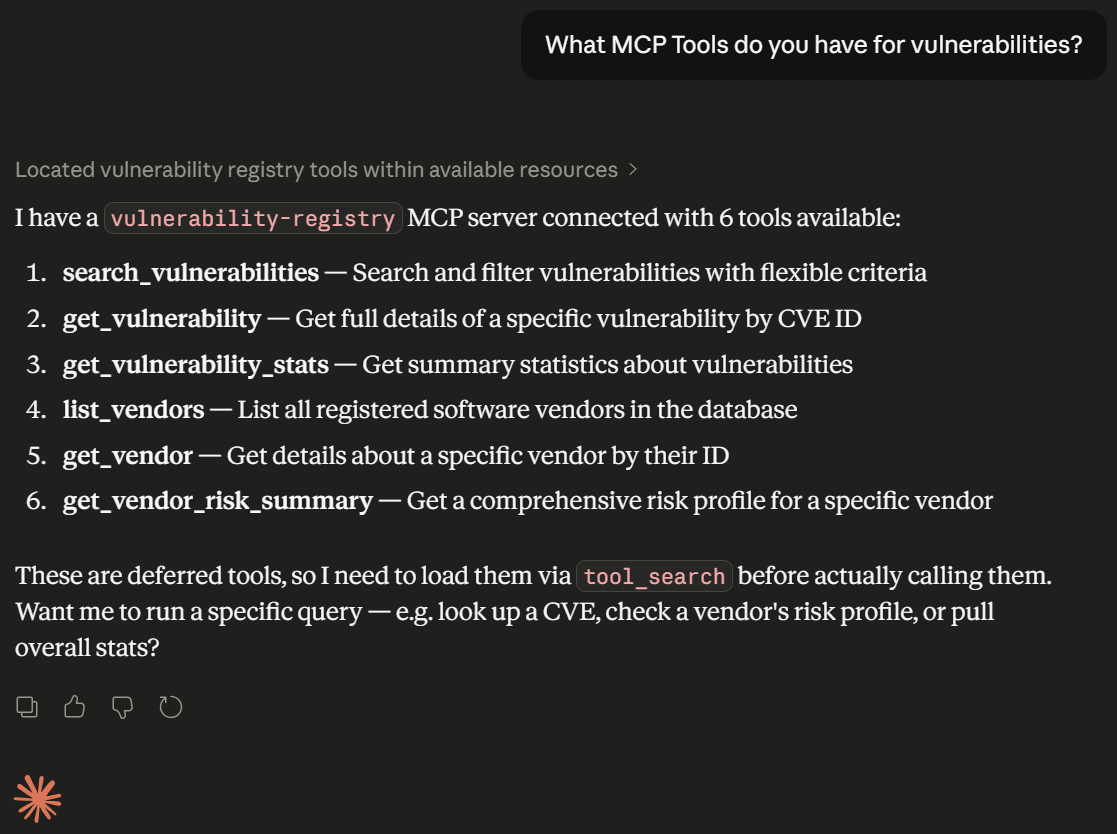 Claude Desktop discovering all 6 vulnerability registry tools
Available Tools
| Tool | Description | Key Parameters | Example Query |
|---|---|---|---|
list_vendors |
List all registered software vendors | category (optional) |
"Show me all open source vendors" |
get_vendor |
Find a vendor by ID or name | vendor_id, name |
"Find the vendor ID for Linux Kernel" |
search_vulnerabilities |
Search with flexible filters | severity, status, min_cvss, keyword, published_after |
"Show critical open vulnerabilities" |
get_vulnerability |
Get full CVE details | cve_id |
"What is the CVSS score of Log4Shell?" |
get_vulnerability_stats |
Aggregate statistics | vendor_id (optional) |
"How many vulnerabilities by severity?" |
get_vendor_risk_summary |
Vendor risk profile | vendor_id |
"Show me Microsoft's risk profile" |
Example Queries
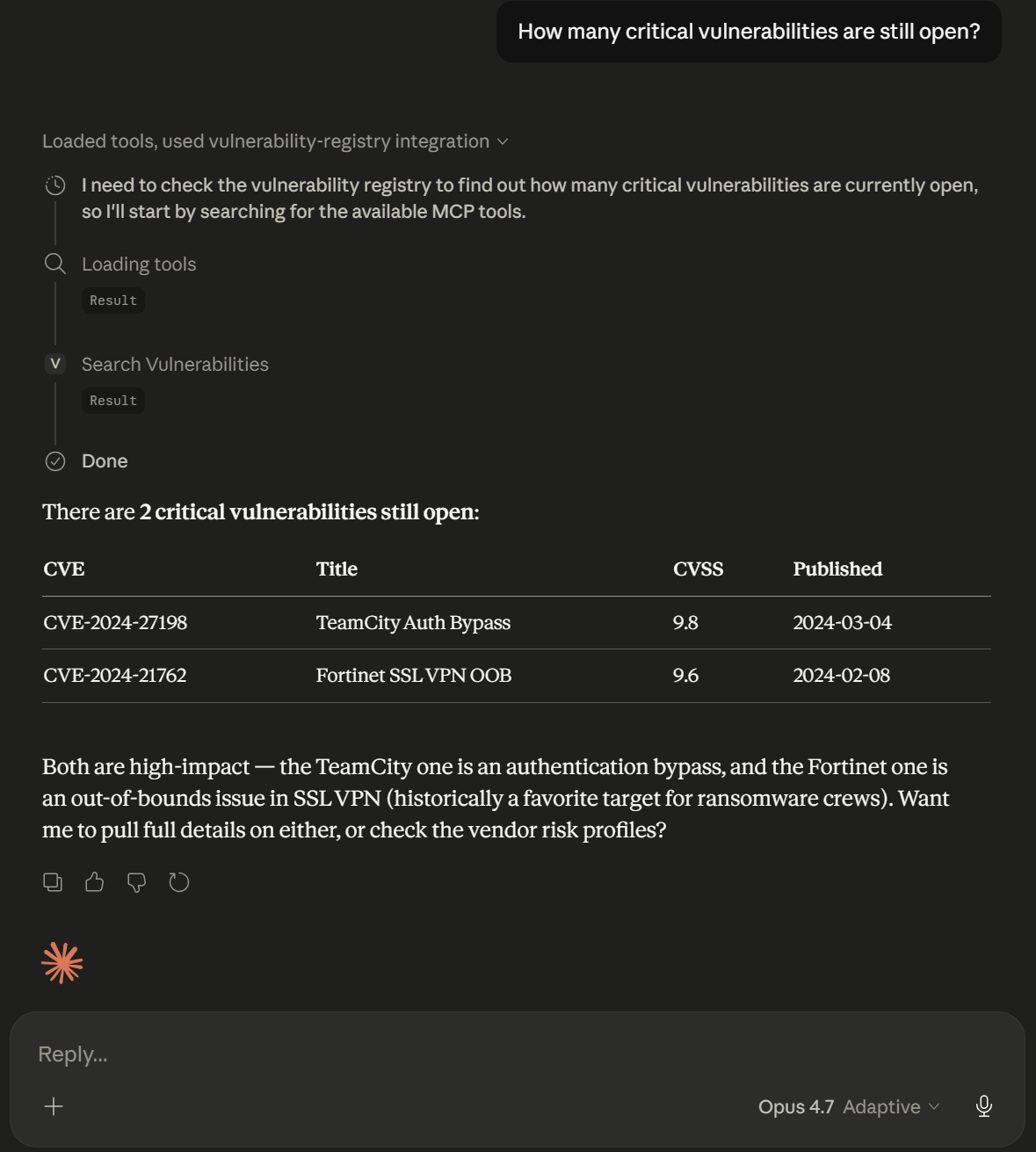
"How many critical vulnerabilities are still open?"
Uses search_vulnerabilities with severity: "critical" and status: "open".
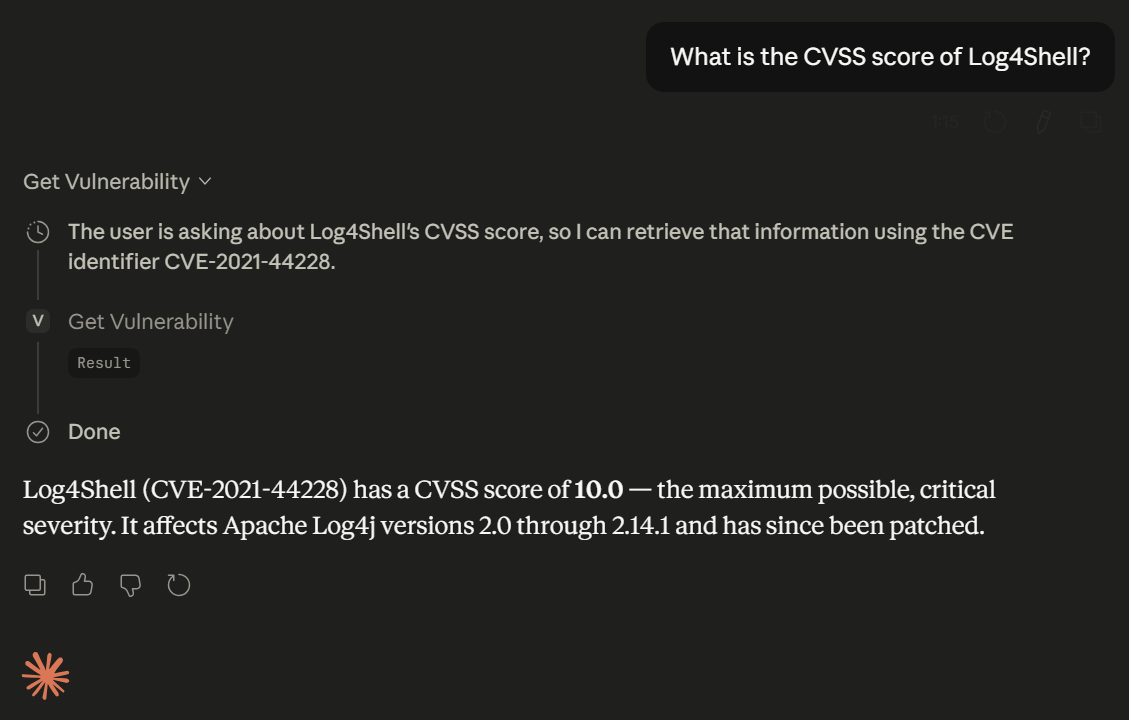
"What is the CVSS score of Log4Shell?"
Uses get_vulnerability with cve_id: "CVE-2021-44228".
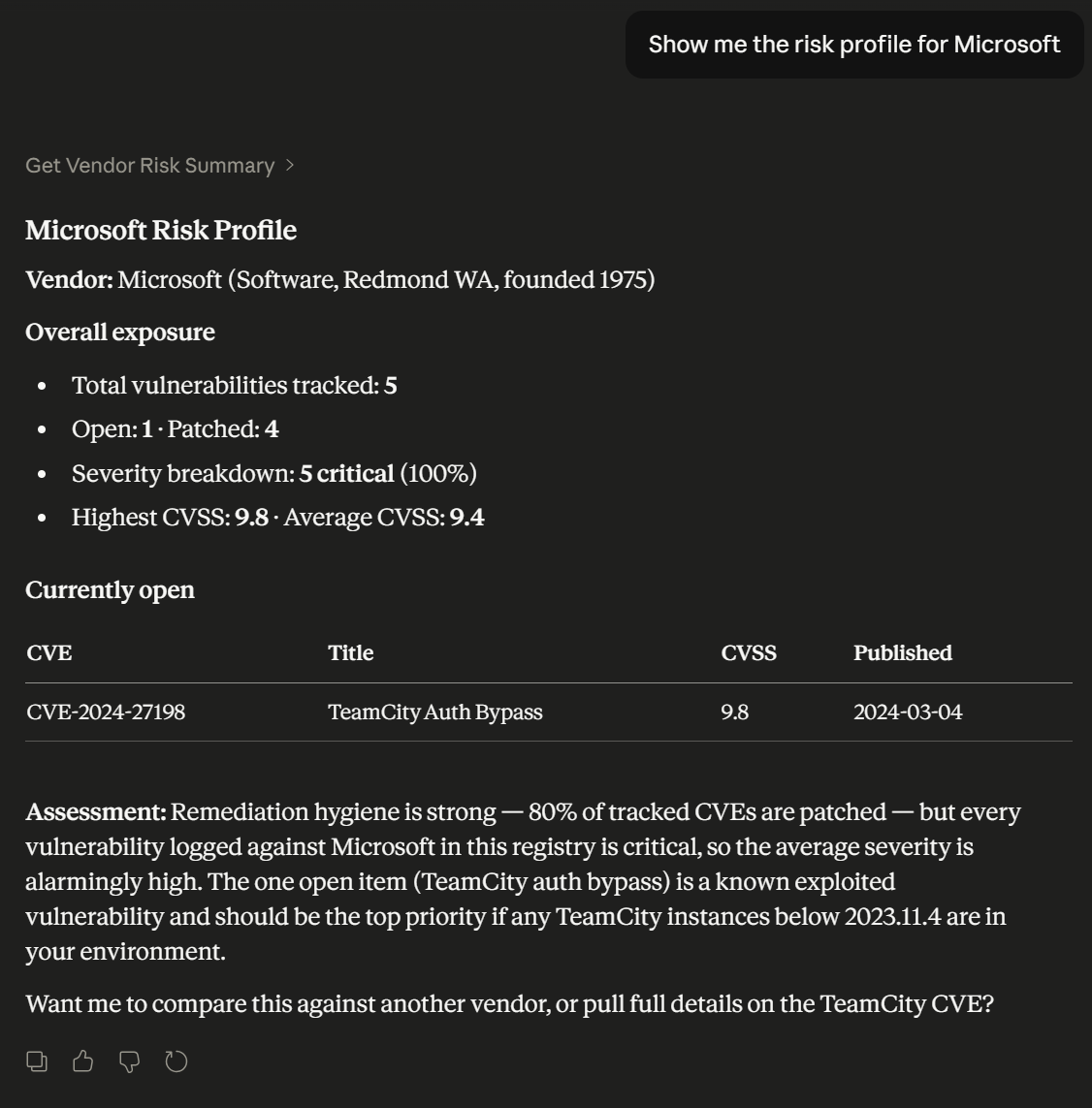
"Show me the risk profile for Microsoft"
Uses get_vendor_risk_summary with vendor_id: "V1".
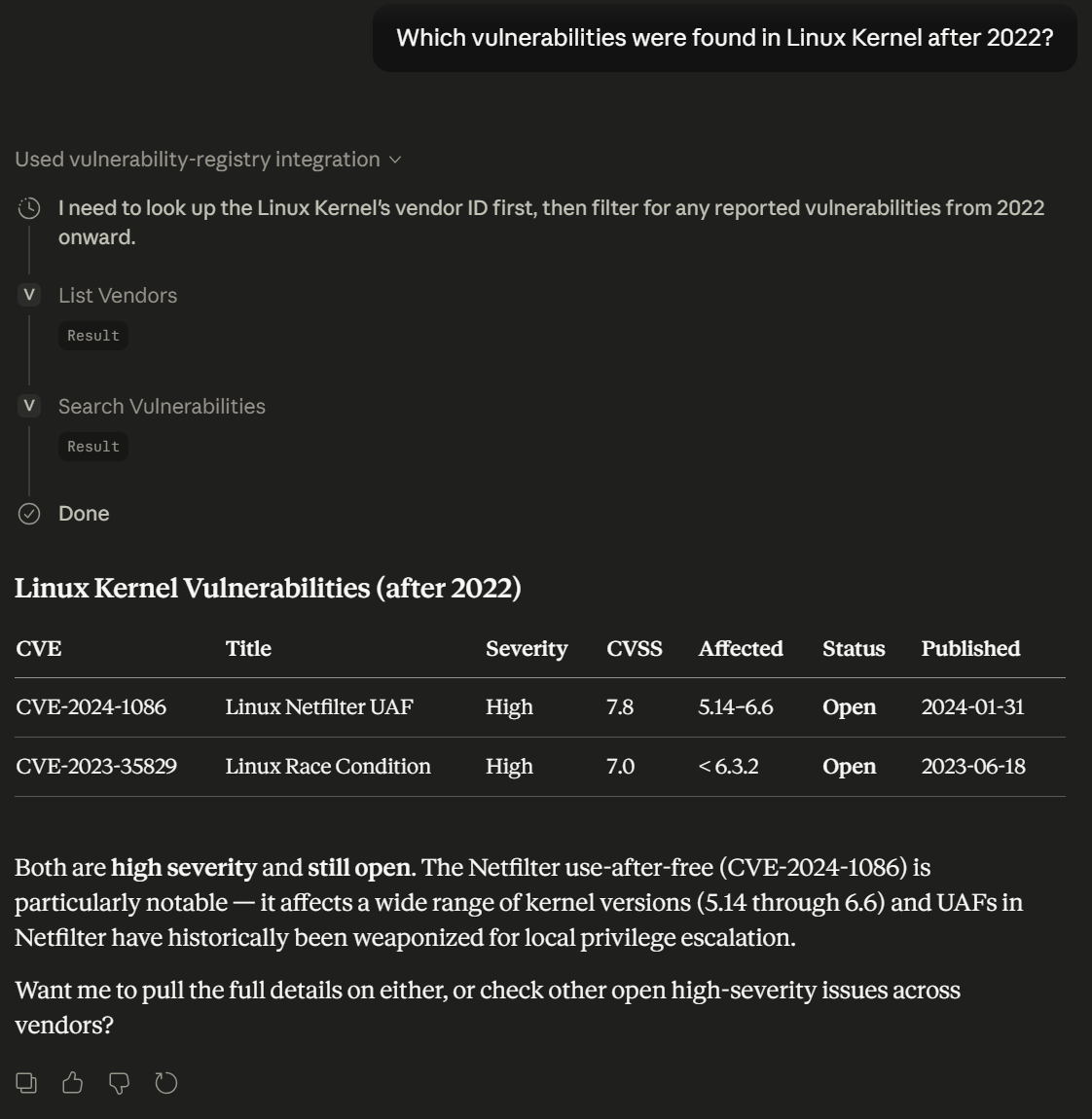
"Which vulnerabilities were found in Linux Kernel after 2022?"
This query demonstrates multi-tool orchestration — Claude first calls list_vendors to resolve "Linux Kernel" to vendor ID V5, then calls search_vulnerabilities with vendor_id: "V5" and published_after: "2022-01-01".
Architecture
┌─────────────────┐     ┌──────────────┐     ┌──────────────┐
│  Claude Desktop │────▶│  MCP Server  │────▶│  Data Files  │
│  (MCP Client)   │◀────│  (stdio)     │◀────│  (.db)       │
└─────────────────┘     └──────┬───────┘     └──────────────┘
                               │
                    ┌──────────┼──────────┐
                    ▼          ▼          ▼
               tools.ts   repository.ts  parser.ts
              (MCP layer)  (query engine) (file reader)
The codebase follows a strict three-layer separation:
- parser.ts — Reads the custom pipe-delimited format dynamically. Knows nothing about MCP.
- repository.ts — In-memory data store with indexed Maps for O(1) lookups. Knows nothing about MCP.
- tools.ts — Registers MCP tools using the high-level
McpServerAPI. Translates between MCP and the repository.
This means swapping the data source (files → database) requires changing only parser.ts, with zero changes to the MCP layer.
Design Decisions
Dynamic metadata parsing — The file parser reads column names from the # FORMAT: header at runtime rather than hardcoding field positions. Combined with version checking (# VERSION: 1.0), this ensures the server can detect and warn about format changes without code modifications.
Repository pattern with in-memory indexing — Data is loaded once at startup and indexed into multiple Maps (vendorById, vulnByCveId, vulnsByVendor, vulnsBySeverity, vulnsByStatus). Primary lookups are O(1). Filtered searches start from the smallest indexed subset and intersect, making combined queries efficient even at scale.
High-level McpServer API — Uses McpServer.registerTool() with Zod schemas for type-safe input validation, rather than the low-level Server class with manual JSON Schema definitions and request routing.
Flexible search with optional filters — search_vulnerabilities accepts all parameters as optional, allowing any combination. One tool handles queries from "show all critical" to "find Linux CVEs from 2023 with CVSS above 8". Results are always sorted by CVSS score (highest first) so the most severe issues appear first.
Enriched responses — get_vulnerability returns the full vendor object alongside the CVE data. get_vendor_risk_summary includes the list of open vulnerabilities. This reduces the number of tool calls the LLM needs to answer common questions.
Strict type safety — Severity and Status are union types derived from as const arrays, with runtime type guards (isSeverity, isStatus). The same source-of-truth arrays feed both TypeScript types and Zod enum validators.
Known Data Anomalies
While working with the source data files, I identified at least one attribution inconsistency:
CVE-2024-21762 (Fortinet SSL VPN OOB) is mapped to vendor V4 (Google) in vulnerabilities.db,
although this is a Fortinet vulnerability. The server faithfully returns the data as stored —
correcting source data is out of scope for a read-only query layer. In a production system,
I would add a data validation step at load time to flag such inconsistencies for human review,
possibly by cross-referencing the NVD API for canonical vendor attribution.
What I'd Build With More Time
- SQLite/PostgreSQL persistence — Replace in-memory storage for datasets that exceed available RAM, with connection pooling for concurrent access.
- Pagination — Add
limit/offsetparameters tosearch_vulnerabilitiesfor large result sets. - Fuzzy text search — Levenshtein distance matching on vulnerability titles for typo-tolerant queries.
- NVD API integration — Automatic CVE data updates from NIST's National Vulnerability Database.
- MCP Resources — Expose raw data files as MCP Resources for direct LLM access when full-text context is needed.
- Structured logging & observability — JSON-formatted logs with correlation IDs for debugging tool call chains.
- Authentication & rate limiting — Protect the server in shared deployment scenarios.
- CI/CD pipeline — GitHub Actions running lint, type-check, and tests on every push.
Tech Stack
| Component | Choice |
|---|---|
| Language | TypeScript (ES2022, Node16 modules) |
| MCP SDK | @modelcontextprotocol/sdk — McpServer high-level API |
| Validation | Zod |
| Transport | stdio |
| Build | tsc |
| Tests | Vitest |
Testing
npm test        # Run all tests (30 tests across parser + repository)
npm run build   # Compile TypeScript
npm start       # Start the MCP server (stdio mode)
Как установить
Выполни в терминале:
claude mcp add vulnerability-registry-mcp-server -- npx Похожие MCP
Postgres
Query your database in natural language
автор: Anthropic4.822,3 тыс.
wenb1n-dev/SmartDB_MCP
A universal database MCP server supporting simultaneous connections to multiple databases. It provides tools for database operations, health analysis, SQL optim
автор: wenb1n-dev2
PostgreSQL
Read-only database access with schema inspection.
автор: modelcontextprotocolRedis
Interact with Redis key-value stores.
автор: modelcontextprotocolCompare Vulnerability Registry Server with
Не уверен что выбрать?
Найди свой стек за 60 секунд
Автор?
Embed-бейдж для README
Похожее
Все в категории data