
Ai Hub
БесплатноНе проверенA self-hosted server providing shared memory, RAG document search, project maps, and role-based prompts for all AI agents via MCP and REST, enabling persistent

Описание
A self-hosted server providing shared memory, RAG document search, project maps, and role-based prompts for all AI agents via MCP and REST, enabling persistent context across devices and tools.
README

One memory for every AI agent.





Live site · Quick start · Connect an agent · Screenshots · Full architecture
Claude Code, Cursor, opencode, Codex CLI, and custom agents each keep their own context today — decisions made in one tool are invisible to the others, and switching devices means starting from zero. Mnema is a small self-hosted server (MCP + REST) that gives all of them one common brain: structured memory, hybrid document search (RAG), project maps, and role-based system prompts. It runs on a Raspberry Pi 5 on your own network and follows you across every machine and every agent.
Why this exists
Multi-agent workflows have a context problem:
| Without a hub | With Mnema |
|---|---|
| A decision made while pairing with Claude Code isn't visible to Cursor an hour later | Decisions saved once, with rationale, retrievable by any agent |
| Switching desktop → laptop means re-explaining everything | Project maps follow you across every machine on your mesh |
| Every agent re-derives project context from scratch | Relevant memory is auto-injected into each message — precisely filtered |
| "I learned X yesterday" lives in scrollback — or nowhere | Notes and research live in a searchable RAG store, forever |
Mnema is a deliberately small answer to that: one server, one SQLite file, one protocol (MCP) that every agent already speaks, plus REST for anything that doesn't. No vector database cluster, no message queue, no Docker layer — just enough infrastructure to make memory persistent and searchable across tools and devices.
Features

- Shared memory — facts, preferences, decisions (with rationale), and
how-tos, saved by any agent and retrievable by any other. Hybrid search
(BM25 via FTS5 + vector via
sqlite-vec, merged with Reciprocal Rank Fusion) finds the right memory whether the match is lexical or semantic. - RAG document store — ingest notes, READMEs, research write-ups, or learning summaries; markdown-aware chunking, automatic embedding, hybrid retrieval with source references.
- Project maps — one YAML-backed record per project: summary, stack,
decisions, current focus, next steps. Any agent, any device, calls
project_get("name")and has full context instantly. - Role-based system prompts — a library of prompts (senior software architect, code reviewer, debugging specialist, security engineer, frontend engineer, devops/SRE, ML engineer) with a shared "engineering mindset" core auto-injected into every role, including prompts handed to local models.
- Local AI orchestration — route simple/bulk text work to a local LLM
(LM Studio, zero API cost) and image/video/audio generation to ComfyUI,
both driven from any connected agent via
local_llm/media_generate. - Cross-device sync — a local-first, last-write-wins sync model so memories and project maps created on one machine reconcile cleanly with the primary (Pi) instance.
- MCP + REST, same core — every capability is exposed both as an MCP tool (for agents that speak MCP over Streamable HTTP) and as a REST endpoint (for scripts, custom agents, and the web UI) — one implementation, two doors.
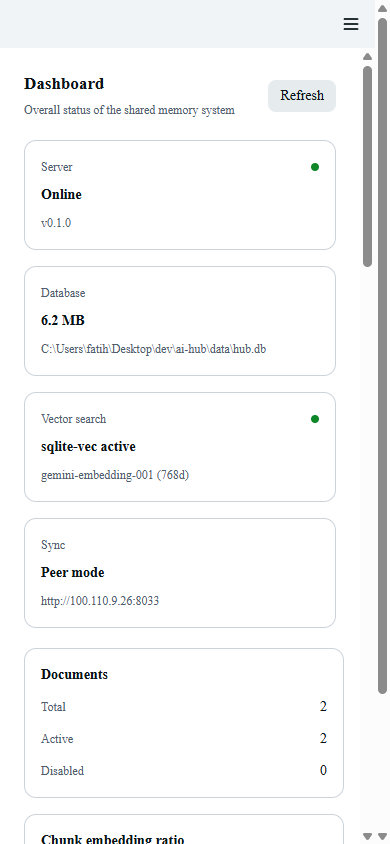
- Web UI — a small React dashboard for browsing memory, RAG documents, projects, and prompts from a browser, including your phone. Redesigned with a high-contrast, 1-bit-inspired visual language, a relationship graph view for exploring how memories/projects/documents connect, and optimized RAG search (faster, more relevant hybrid retrieval).
- Code-map project maps — project maps now carry a structured code map
(
architecture,modules,entry_points,commands,conventions,data_model), injected automatically at session start so any agent gets oriented instantly.
24 MCP tools cover all of the above — same set, every agent, every device. See the full tool tracklist on the live site or src/server/mcp.ts in source.
Architecture
┌──────────────────────────────────────────────────────────────┐
│ Raspberry Pi 5 — "hub"  (Tailscale IP: 100.x.x.x)             │
│                                                                │
│  ┌────────────────────────────────────────────┐               │
│  │ hub-server (Node 22, systemd)                │              │
│  │  ├── MCP endpoint   /mcp   (Streamable HTTP)  │             │
│  │  ├── REST API       /api/* (scripts, agents)  │             │
│  │  └── Web UI         /      (dashboard, PWA)   │             │
│  └───────────────┬────────────────────────────┘               │
│                  │                                            │
│  ┌───────────────▼────────────────────────────┐               │
│  │ SQLite (single file: hub.db)                  │             │
│  │  ├── memories      (structured memory)        │             │
│  │  ├── documents     (RAG source docs)           │             │
│  │  ├── chunks + vec  (sqlite-vec embeddings)     │             │
│  │  ├── chunks_fts    (FTS5 BM25 index)           │             │
│  │  └── projects      (project maps)              │             │
│  └────────────────────────────────────────────┘               │
│                                                                │
│  Nightly backup: sqlite backup + markdown export → git push   │
└──────────────────────────────────────────────────────────────┘
         ▲ Tailscale (private network; Funnel optional for public access)
         │
   ┌─────┴──────────────────────────────────────┐
   │ Devices (desktop, laptop, phone)             │
   │  ├── Claude Code  → MCP (Streamable HTTP)    │
   │  ├── Cursor / Windsurf → MCP (mcp.json)      │
   │  ├── opencode     → MCP (opencode.json)      │
   │  ├── Codex CLI    → MCP (config.toml)        │
   │  ├── claude.ai / ChatGPT / Gemini → MCP (Funnel + ?token=) │
   │  └── custom scripts → REST API               │
   └────────────────────────────────────────────┘
Embedding calls (Gemini API) are made from the Pi only — clients send raw text, so the API key lives in exactly one place.
For the full data model and phased build plan, see PLAN.md.
Screenshots
| Dashboard | Memories | RAG search | Prompts | Mobile |
|---|---|---|---|---|
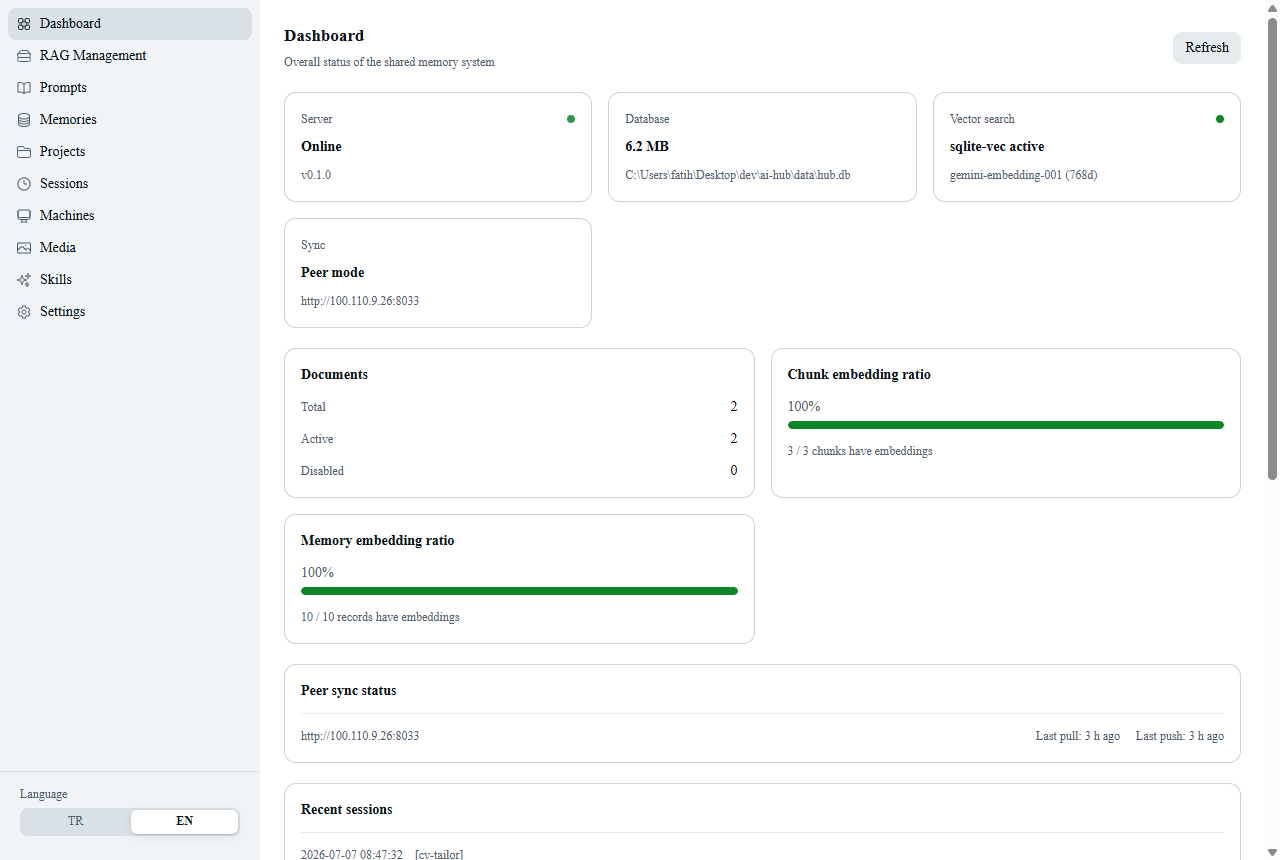 |
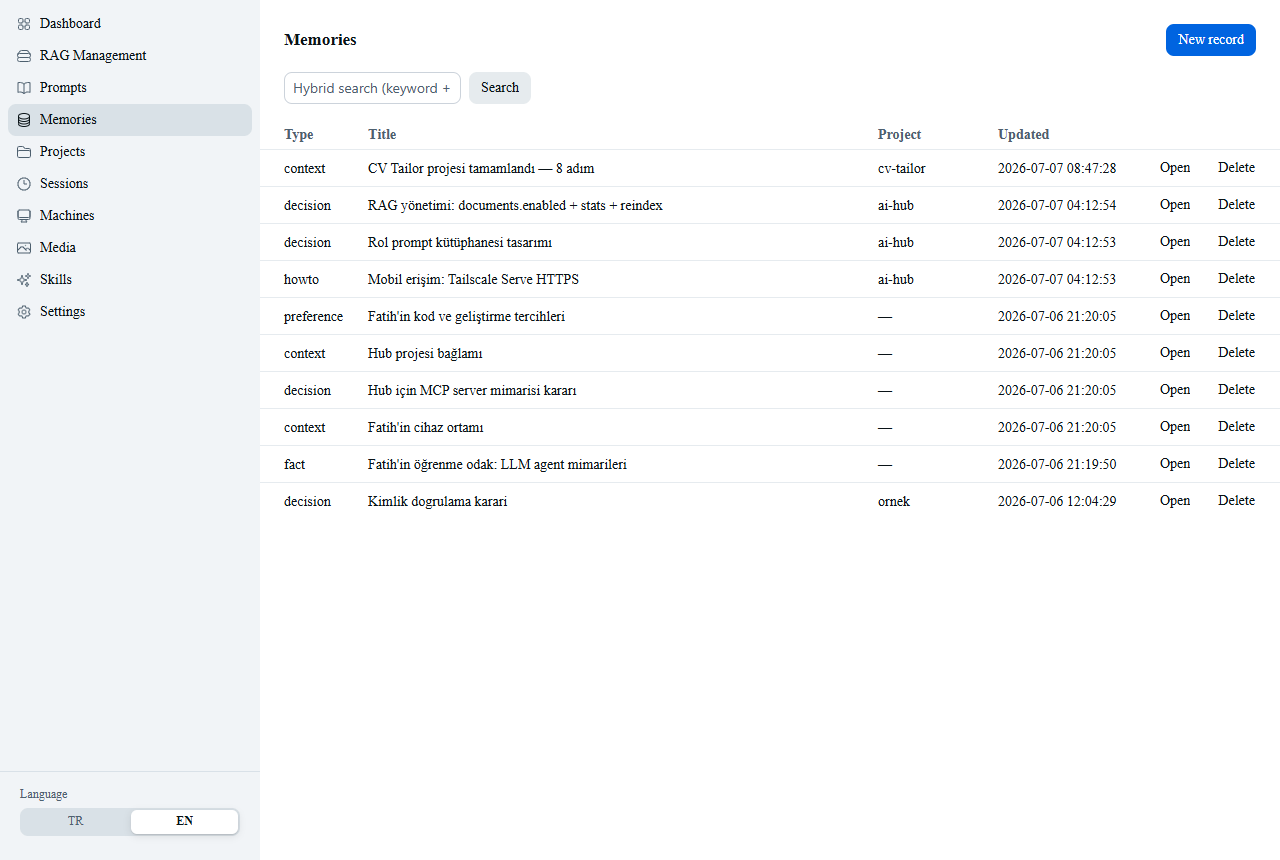 |
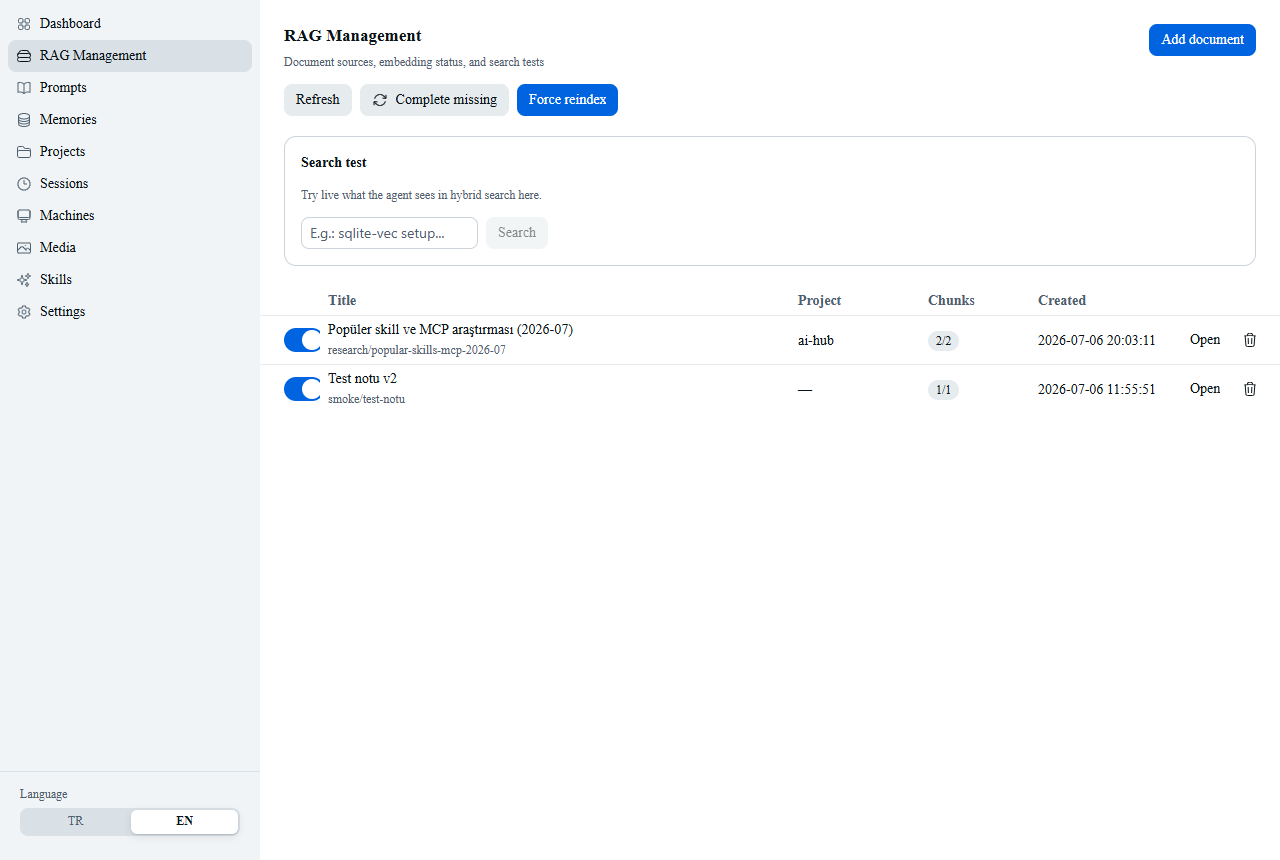 |
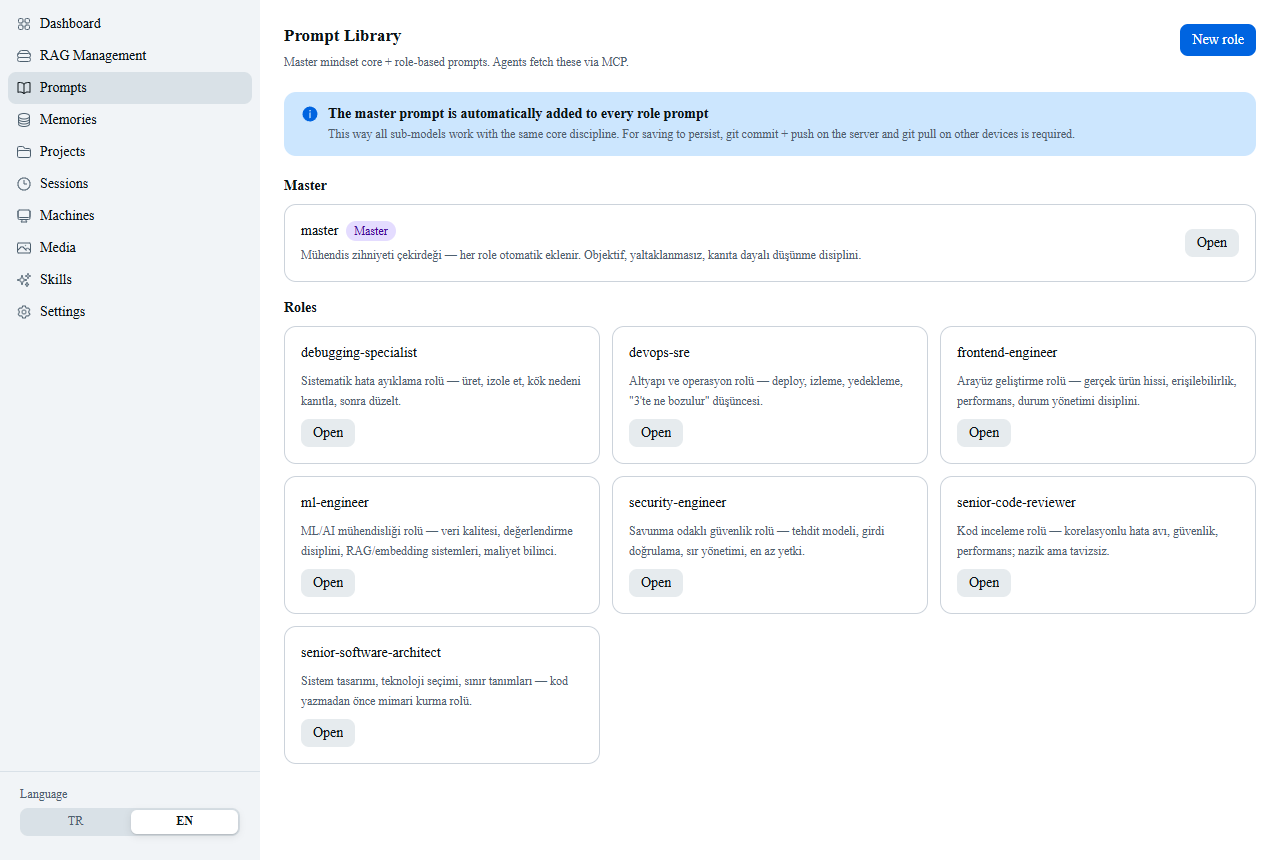 |
 |
More at the live site: fthsrbst.github.io/mnema
Quick start
Option A: one-click installer
# macOS / Linux
curl -fsSL https://raw.githubusercontent.com/fthsrbst/mnema/master/scripts/install.sh | bash
# Windows
irm https://raw.githubusercontent.com/fthsrbst/mnema/master/scripts/install.ps1 | iex
The installer clones the repo, installs dependencies, builds, and writes a
starter .env.
Option B: manual
git clone https://github.com/fthsrbst/mnema.git
cd mnema
npm ci
npm run build
cp .env.example .env   # edit HUB_TOKEN, GEMINI_API_KEY (optional)
npm run dev            # http://127.0.0.1:8033
Without GEMINI_API_KEY the server still runs — it falls back to FTS-only
(keyword) search instead of hybrid search. Nothing crashes; you lose semantic
recall until you add a key.
Raspberry Pi deploy
curl -fsSL https://raw.githubusercontent.com/fthsrbst/mnema/master/deploy/setup-pi.sh | bash
This installs Node 22, clones the repo, builds server + web UI, generates a
.env with a random HUB_TOKEN, installs a systemd unit (hub@<user>), and
schedules a nightly backup cron job. See deploy/setup-pi.sh
and deploy/clients.md for details.
Connecting agents
Every agent talks to the same /mcp endpoint. Replace <HUB> with your
server URL (http://127.0.0.1:8033 locally, http://100.x.x.x:8033 on your
tailnet) and <TOKEN> with your HUB_TOKEN.
Claude Code
claude mcp add --transport http --scope user hub <HUB>/mcp \
  --header "Authorization: Bearer <TOKEN>"
Cursor / Windsurf (~/.cursor/mcp.json)
{
  "mcpServers": {
    "hub": {
      "url": "<HUB>/mcp",
      "headers": { "Authorization": "Bearer <TOKEN>" }
    }
  }
}
opencode (~/.config/opencode/opencode.json)
{
  "mcp": {
    "hub": {
      "type": "remote",
      "url": "<HUB>/mcp",
      "headers": { "Authorization": "Bearer <TOKEN>" }
    }
  }
}
Codex CLI (~/.codex/config.toml)
[mcp_servers.hub]
url = "<HUB>/mcp"
http_headers = { "Authorization" = "Bearer <TOKEN>" }
These four entries are not hand-maintained per client — they all come from
one file, mcp-servers.json, which also lists auxiliary
MCP servers (context7, playwright, sequential-thinking):
{
  "servers": {
    "hub": {
      "url": "$HUB_URL/mcp",
      "headers": { "Authorization": "Bearer $HUB_TOKEN" }
    }
  }
}
Running hub sync on a device resolves $HUB_URL / $HUB_TOKEN from that
device's hub config, writes the result into each detected client's own
config file (~/.claude.json, ~/.cursor/mcp.json, ~/.config/opencode/opencode.json,
~/.codex/config.toml), copies the shared skill set into ~/.claude/skills/,
and updates a managed block in CLAUDE.md / AGENTS.md so every agent knows
the hub exists and when to use it. Full client details:
deploy/clients.md.
Auto-recall hook
This is the feature that makes the shared memory actually get used instead of
sitting unread: Claude Code's UserPromptSubmit hook runs hub recall --hook
on every message you send, before the agent sees it. The hook reads the
prompt from stdin, skips short messages and slash commands, calls
GET /api/recall?q=<prompt>&format=text on the hub with a tight timeout, and
prints back whatever relevant memories/RAG chunks it finds — the agent then
has that context already in front of it, with zero explicit "search your
memory" step from you.
It is deliberately fail-silent: if the hub is unreachable, slow, or returns an
error, the hook exits 0 and your prompt goes through untouched. Auto-recall
can only add context — it can never block or break a conversation.
Wire it up by merging the hooks block from
deploy/claude-code-settings.example.json
into ~/.claude/settings.json:
{
  "hooks": {
    "UserPromptSubmit": [
      { "hooks": [{ "type": "command", "command": "hub recall --hook", "timeout": 5 }] }
    ]
  }
}
hub sync also writes a managed block into CLAUDE.md / AGENTS.md that
tells the agent when to write back — save decisions with rationale, log
sessions before closing, keep project maps current — so recall and capture
work as a loop, not just a one-way lookup.
Security notes
Mnema's auth model is intentionally simple — read this before exposing it beyond your own machine:
- Single bearer token.
HUB_TOKENin.envgates every request except/health. If it's empty, auth is off entirely (fine for local dev, not for anything else). There's no per-agent scoping or rotation tooling — rotating means changing.env, restarting the service, and updating every connected client by hand. - Two ways to send the token. Most clients send
Authorization: Bearer <token>; platforms that can't attach custom headers (claude.ai, ChatGPT, Gemini) fall back to?token=<HUB_TOKEN>in the URL. Token-in-URL has real trade-offs (browser history, proxy/access logs) — see docs/connectors.md for the full write-up. - Tailscale is the default network boundary. The hub listens on a private
tailnet address; nothing is reachable from the open internet unless you
explicitly run
tailscale funnel. Funnel makes the endpoint fully public — the bearer token becomes the only thing standing between the internet and your memory store, so treat turning it on as a deliberate, temporary action, not a default. /outputsis served without auth, on purpose. Generated media (data/outputs, viaimage_generate/media_generate) and the web UI's static shell are served unauthenticated (express.static, mounted before the token middleware insrc/server/index.ts) so<img>/<video>tags in the dashboard work without token-laced URLs. All data endpoints (/api/*,/mcp) stay behind the bearer check. Don't put anything sensitive indata/outputs.
This is a personal-scale tool, not a hardened multi-tenant service — see the maturity table below for what's actually battle-tested versus rough.
Roadmap
Not built yet, tracked in PLAN.md (Faz 5/6):
hub ask "<question>"— RAG + Gemini Flash, direct terminal Q&A without opening an agent.- Quick capture — a mobile-friendly single-input web UI for dropping a note or link straight into RAG (with auto-fetch + summarize for links).
- Watch mode — re-index a notes/docs folder automatically on change.
hub timeline <project>— chronological dump of a project's decisions and sessions.- Weekly memory-maintenance digest — a cron job that reports stale/conflicting memory entries instead of just letting them accumulate.
- Qdrant migration path —
sqlite-vecis fine to roughly 1M vectors; moving to a dedicated vector store if that ceiling is ever hit is planned, not implemented.
Maturity / honesty table
No inflation — this is what's actually solid versus still rough.
| Area | Status | Notes |
|---|---|---|
| Memory CRUD + hybrid search | Stable | Used daily; FTS-only fallback tested |
| RAG ingest + search | Stable | Chunking is markdown-aware but simple; no re-ranking model |
| Project maps | Stable | YAML + DB sync works; no conflict UI beyond LWW |
| MCP server (tools) | Stable | All tools listed in src/server/mcp.ts are in daily use |
| REST API | Stable | Mirrors MCP tools; used by CLI and web UI |
| Cross-device sync (LWW) | Functional, lightly tested | Works for the author's two-to-three-device setup; not stress-tested for heavy concurrent writes |
| Web UI | Functional | Covers memory/RAG/projects/prompts browsing; not a polished product UI |
| Local LLM orchestration (LM Studio) | Functional | Works when LM Studio is reachable; no retry/queueing beyond basic error handling |
| Media generation (ComfyUI) | Experimental | Works for the author's own workflows; expect to write your own workflows/*.json |
Public connector exposure (Funnel + ?token=) |
Functional, use with care | Token-in-URL is a real trade-off — see docs/connectors.md |
| Auth model | Basic | Single bearer token, no per-agent scoping or rotation automation |
| Backup/restore | Functional | Nightly cron + markdown export exist; restore path is manual |
| Qdrant / larger-scale vector store | Not built | sqlite-vec is fine to roughly 1M vectors; migration path is planned, not implemented |
This is a personal-scale tool built for one user running a handful of devices — it is not hardened for multi-tenant or public deployment beyond the token + Funnel model described above.
License
MIT — see LICENSE.
Установка Ai Hub
У этого сервера нет опубликованного пакета — он собирается из исходников. Открой репозиторий и следуй инструкции в README.
▸ github.com/fthsrbst/mnemaFAQ
Ai Hub MCP бесплатный?
Да, Ai Hub MCP бесплатный — установка в пару кликов через Unyly без оплаты.
Нужен ли API-ключ для Ai Hub?
Нет, Ai Hub работает без API-ключей и переменных окружения.
Ai Hub — hosted или self-hosted?
Self-hosted: сервер запускается локально на твоей машине командой из раздела установки.
Как установить Ai Hub в Claude Desktop, Claude Code или Cursor?
Открой Ai Hub на unyly.org, выбери вкладку своего клиента (Claude Desktop, Claude Code, Cursor) и нажми Install — конфиг сгенерируется автоматически, без правки JSON.
Похожие MCP
Fetch
Web content fetching and conversion for efficient LLM usage.
AWS KB Retrieval
Retrieval from AWS Knowledge Base using Bedrock Agent Runtime.
 автор: modelcontextprotocol
Spring AI MCP Server
Provides auto-configuration for setting up an MCP server in Spring Boot applications.
llm-analysis-assistant
A very streamlined mcp client that supports calling and monitoring stdio/sse/streamableHttp, and can also view request responses through the /logs page. It also
 автор: xuzexin-hz
Compare Ai Hub with
Не уверен что выбрать?
Найди свой стек за 60 секунд
Автор?
Embed-бейдж для README
Похожее
Все в категории ai