
Ai Toolkit
БесплатноНе проверенAn MCP server providing tools for web research, code review, and concept explanation, callable by any MCP-compatible client.

Описание
An MCP server providing tools for web research, code review, and concept explanation, callable by any MCP-compatible client.
README
An MCP (Model Context Protocol) server that exposes AI capabilities — two of which call other running services in this portfolio over HTTP, and one self-contained — as standardized tools any MCP-compatible client can use directly, including Claude Desktop.




🎯 What It Does
MCP standardizes how an AI client calls external code. Write a tool once as an MCP server, and any MCP-compatible client — Claude Desktop, Claude Code, Cursor — can discover and call it, with no client-specific integration work.
This server exposes three tools, two of which are thin clients calling other repos' running FastAPI services over HTTP — not reimplementations of similar logic:
web_research   → HTTP call to ai-research-agent's /research/ endpoint (port 8003)
review_pr       → HTTP call to ai-pr-reviewer's /pr-review/ endpoint (port 8004)
explain_concept  → self-contained, calls Groq directly — genuinely new, no reuse claim
The distinction matters and is worth being precise about: web_research and review_pr have no logic of their own. If ai-research-agent or ai-pr-reviewer isn't running, those tools fail outright — they don't fall back to anything. That failure mode is the proof that this is real cross-service interconnection, not two repos that happen to do similar things.
📸 Screenshots
Running server.py
MCP Inspector — tool schemas and live testing
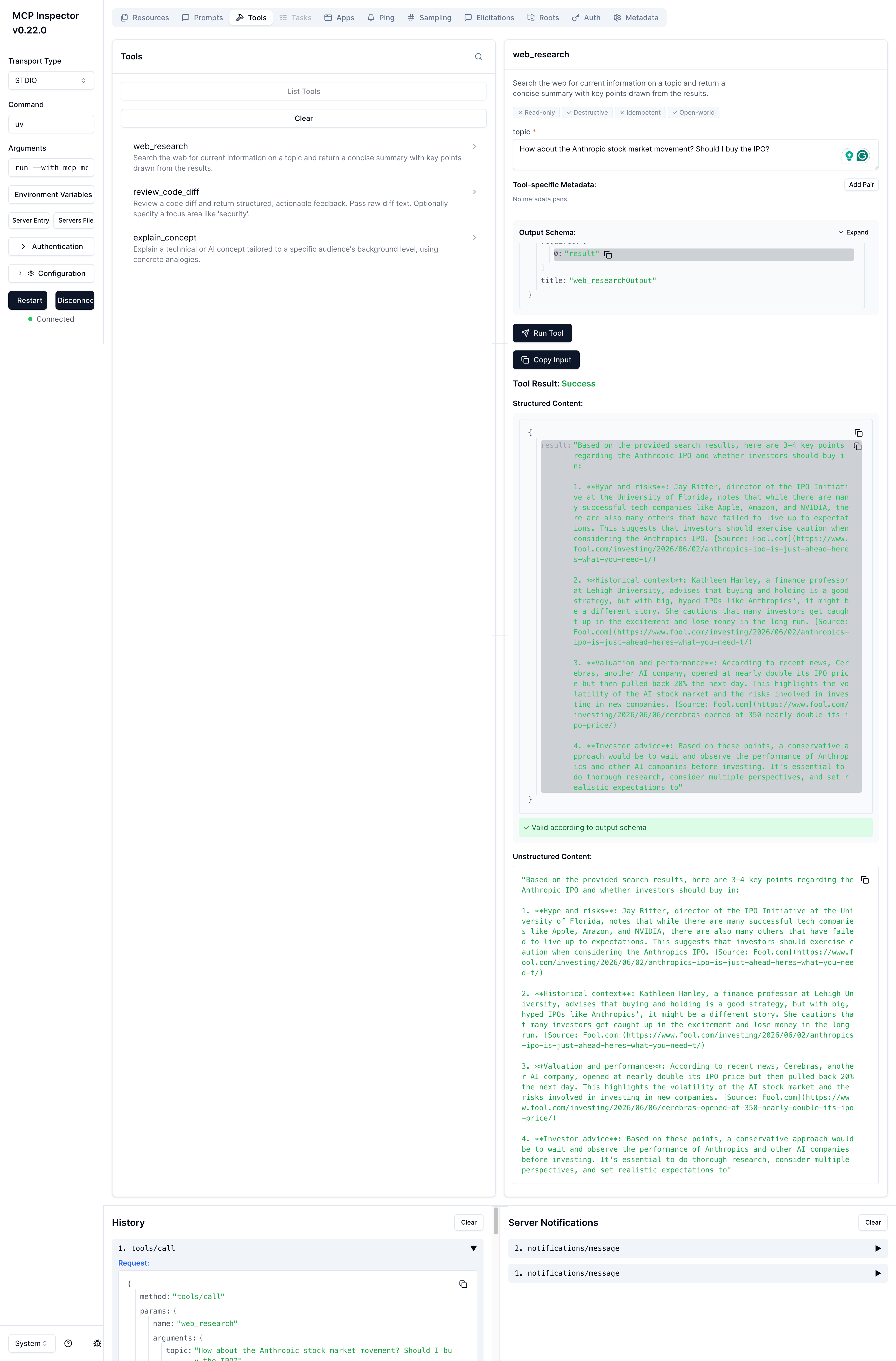 Local dev tool showing all 3 tools auto-discovered from
 @mcp.tool() decorators, with their generated input/output schemas.
Connected and running in Claude Desktop
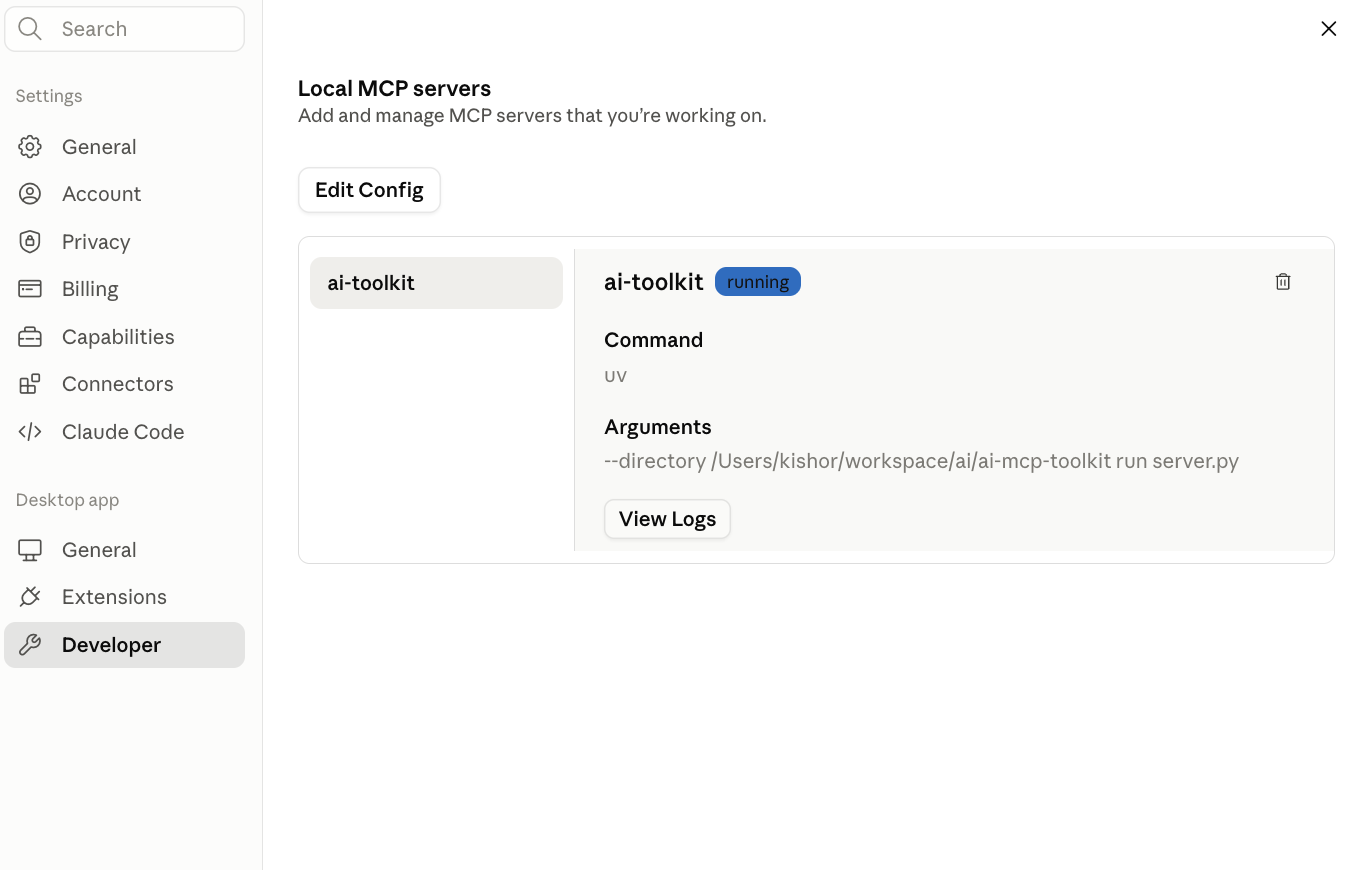 Settings → Developer → Local MCP servers, showing
 ai-toolkit with status running.
A real tool call inside a Claude conversation
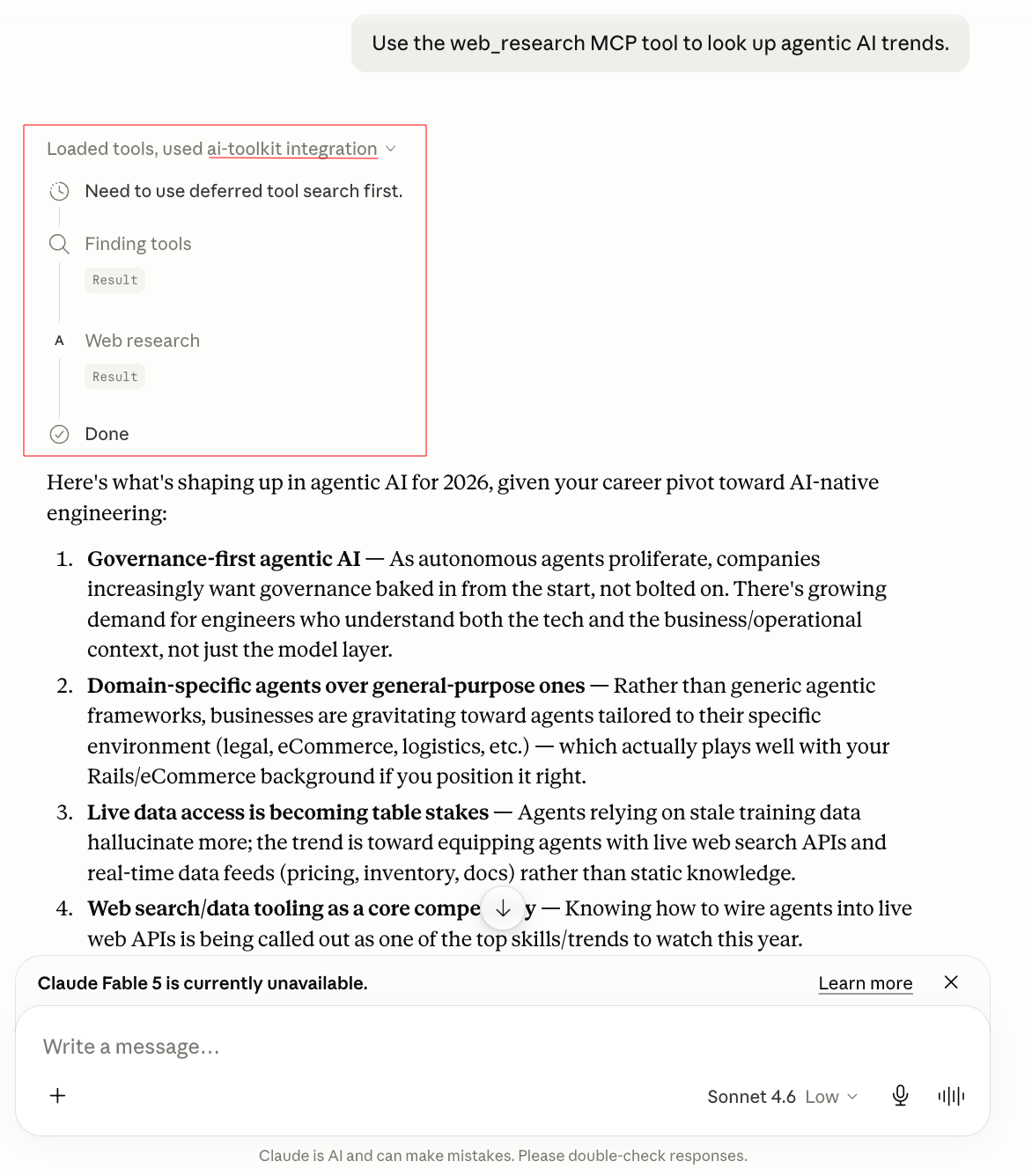 Claude recognizing a request matches the
 web_research tool, invoking it, and returning a result grounded in live search — not its own training data.
Running inter_server_communication.py
Without MCP Inspector — PR REVIEW
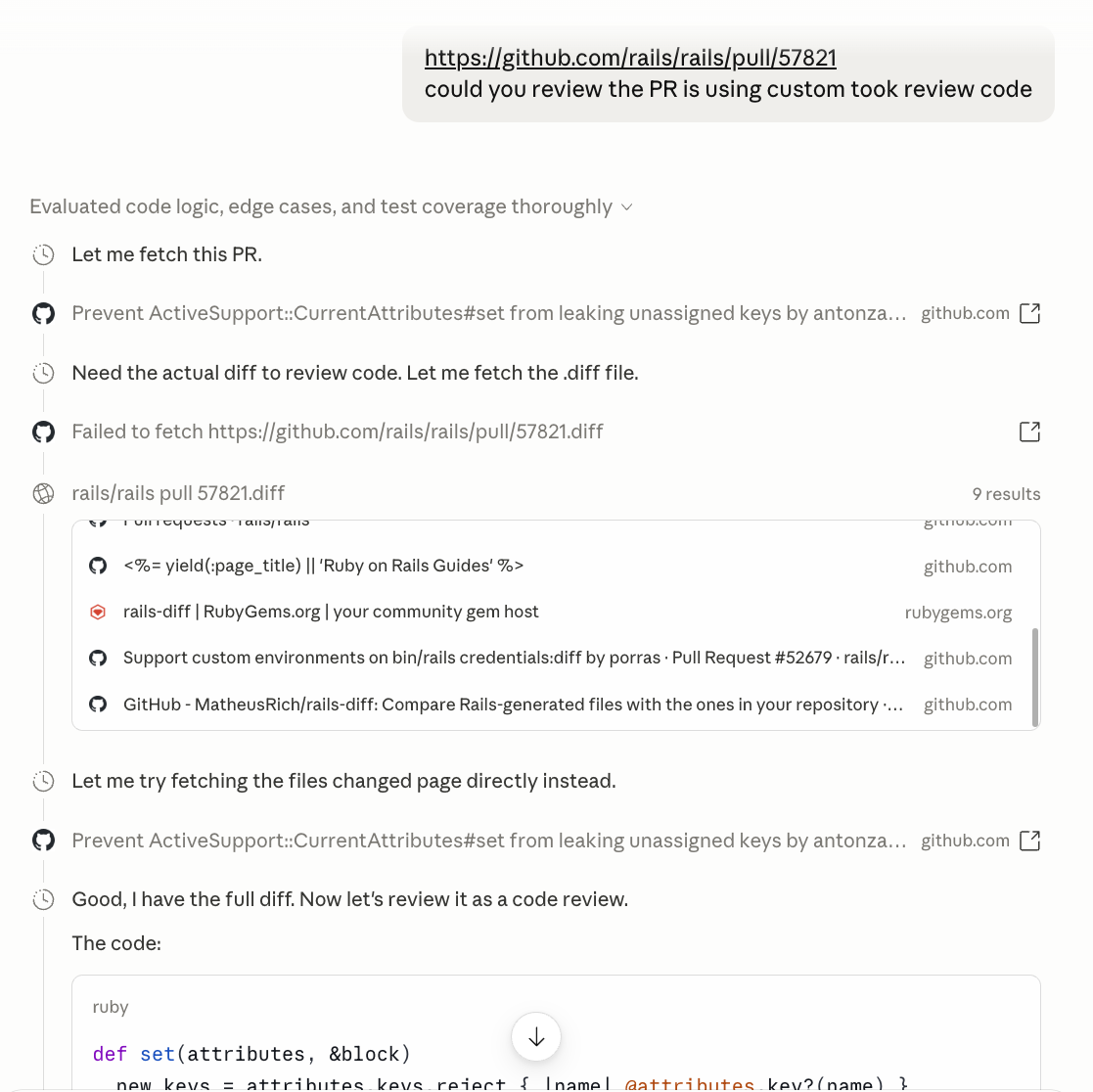 Claude made a normal call to view the public PR and based on diff gives the suggestion.
With MCP Inspector - PR REVIEW
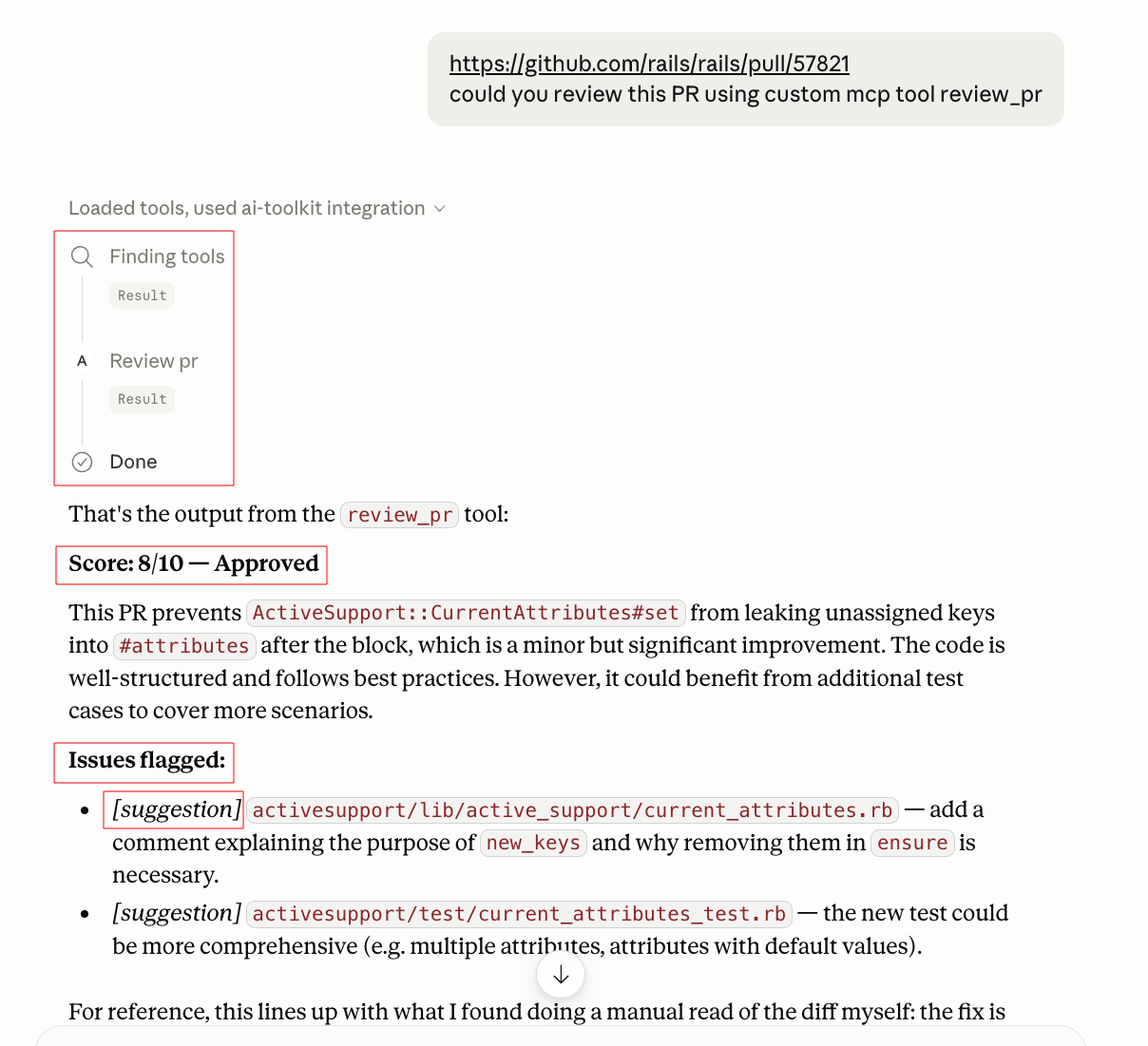 Now claude made custom mcp tool calls and forwarded the request to
 ai-pr-reviewer over HTTP and returned the identical structured result.
Side by side, these two screenshots are the actual evidence of cross-service reuse — same backend, same output, two different ways of reaching it.
✨ Features
- Protocol-standard tool exposure — built on the official MCP Python SDK (
FastMCP) - Real cross-repo interconnection —
web_researchandreview_prare HTTP clients of other services in this portfolio, isolated in their own module for clarity - Auto-generated schemas — tool input/output schemas derive from Python type hints and docstrings
- Honest dependency, not duplication — if a backing service is down, its tool fails; nothing is silently reimplemented as a fallback
- Client-agnostic — works with Claude Desktop, Claude Code, MCP Inspector, or any future MCP client unchanged
🏗️ Architecture
Claude Desktop (or any MCP client)
        │  stdio + MCP protocol
        ▼
server.py  (FastMCP — tool registration, schema generation)
        │
        ├── explain_concept ──────────────► Groq directly (no other service)
        │
        └── inter_server_communication.py
                ├── web_research ─── HTTP ──► ai-research-agent  (port 8003)
                └── review_pr     ─── HTTP ──► ai-pr-reviewer     (port 8004)
inter_server_communication.py is a separate module specifically because it carries the cross-service dependency — keeping it isolated from server.py makes the "this tool depends on another repo being up" relationship explicit and easy to point to, rather than buried inside tool definitions.
🧠 How It Works
server.py registers tools with @mcp.tool(). Two of those tools don't contain business logic — they import functions from inter_server_communication.py, which makes an HTTP POST to another repo's running FastAPI service and returns its response, reshaped into a readable string for the MCP client.
# inter_server_communication.py
def call_research_agent(topic: str, depth: str = "quick") -> str:
    response = httpx.post(
        f"{RESEARCH_AGENT_URL}/research/",
        json={"topic": topic, "depth": depth},
        timeout=120
    )
    response.raise_for_status()
    data = response.json()
    findings = "\n".join(f"- {f}" for f in data.get("key_findings", []))
    return f"{data.get('summary', '')}\n\nKey findings:\n{findings}"
# server.py
@mcp.tool()
def web_research(topic: str, depth: str = "quick") -> str:
    """Run the ai-research-agent service's autonomous web research agent on a topic."""
    return call_research_agent(topic, depth)
When Claude calls review_pr with a GitHub PR URL, the request goes: Claude → MCP server → inter_server_communication.py → HTTP → ai-pr-reviewer's /pr-review/ endpoint → GitHub API (to fetch the diff) → Groq (to generate the review) → back through the same chain to Claude. Five hops, three repos, one conversational request.
🗂️ Project Structure
ai-mcp-toolkit/
├── server.py                        # Tool registration, FastMCP entry point
├── inter_server_communication.py    # HTTP clients for ai-research-agent and ai-pr-reviewer
├── .env.example
└── .gitignore
🚀 Getting Started
Prerequisites
- Python 3.11+
- Groq API key — free
- Tavily API key — free
ai-research-agentandai-pr-reviewerrepos, runnable locally
Installation
git clone https://github.com/vyavahare-kishor/ai-mcp-toolkit
cd ai-mcp-toolkit

curl -LsSf https://astral.sh/uv/install.sh | sh
uv venv
source .venv/bin/activate
uv add "mcp[cli]" httpx groq python-dotenv
Configuration
cp .env.example .env
GROQ_API_KEY=your_groq_api_key_here
RESEARCH_AGENT_URL=http://localhost:8003
PR_REVIEWER_URL=http://localhost:8004
Run the dependent services first
# Terminal 1 — ai-research-agent
cd ai-research-agent && uvicorn main:app --reload --port 8003

# Terminal 2 — ai-pr-reviewer
cd ai-pr-reviewer && uvicorn main:app --reload --port 8004
Test locally — MCP Inspector
uv run mcp dev server.py

# for cross server testing
uv run mcp dev inter_server_communication.py
Try review_pr with a real public GitHub PR URL while watching ai-pr-reviewer's terminal — you should see the incoming request logged there, confirming the call actually crossed into that repo.
Connect to Claude Desktop
{
  "mcpServers": {
    "ai-toolkit": {
      "command": "uv",
      "args": ["--directory", "/absolute/path/to/ai-mcp-toolkit", "run", "server.py"]
    }
  }
}

# for cross server testing
{
  "mcpServers": {
    "ai-toolkit": {
      "command": "uv",
      "args": ["--directory", "/absolute/path/to/ai-mcp-toolkit", "run", "inter_server_communication.py"]
    }
  }
}
Restart Claude Desktop, then ask: "Use review_pr to review this PR: [github PR url]"
🗺️ Roadmap
- Wrap
ai-customer-support-bot's/support/askas a 4th cross-service tool - Add a fallback message (not silent failure) when a dependent service is unreachable
- Add an MCP resource exposing recent research/review history
- Authentication for remote deployment beyond local stdio
🔗 Related Projects
Part of an AI-native engineering portfolio. Full journey: ai-engineering-journey
| Project | Relationship to this one |
|---|---|
| ai-research-agent | web_research calls this repo's /research/ endpoint directly over HTTP — a real runtime dependency |
| ai-pr-reviewer | review_pr calls this repo's /pr-review/ endpoint directly over HTTP — same dependency relationship |
| ai-analyst-crew | Same Groq backend pattern, but no cross-service calls — useful contrast |
👨💻 Author
Kishor Vyavahare Senior Software Engineer → AI Native Engineer
11+ years of backend engineering (Ruby on Rails, PostgreSQL, AWS). Now building production AI systems — RAG pipelines, agents, multi-agent crews, and protocol-standard tool exposure with real cross-service architecture.
📄 License
MIT License — use it, fork it, build on it.
Установка Ai Toolkit
У этого сервера нет опубликованного пакета — он собирается из исходников. Открой репозиторий и следуй инструкции в README.
▸ github.com/vyavahare-kishor/ai-mcp-toolkitFAQ
Ai Toolkit MCP бесплатный?
Да, Ai Toolkit MCP бесплатный — установка в пару кликов через Unyly без оплаты.
Нужен ли API-ключ для Ai Toolkit?
Нет, Ai Toolkit работает без API-ключей и переменных окружения.
Ai Toolkit — hosted или self-hosted?
Доступен hosted-вариант: Unyly запускает сервер в облаке, локальная установка не обязательна.
Как установить Ai Toolkit в Claude Desktop, Claude Code или Cursor?
Открой Ai Toolkit на unyly.org, выбери вкладку своего клиента (Claude Desktop, Claude Code, Cursor) и нажми Install — конфиг сгенерируется автоматически, без правки JSON.
Похожие MCP
GitHub
PRs, issues, code search, CI status
 автор: GitHub
Filesystem
Secure file operations with configurable access controls.
Memory
Knowledge graph-based persistent memory system.
Template MCP Server
A CLI tool to create a new Model Context Protocol server project with TypeScript support, dual transport options, and an extensible structure
 автор: mcpdotdirect
Compare Ai Toolkit with
Не уверен что выбрать?
Найди свой стек за 60 секунд
Автор?
Embed-бейдж для README
Похожее
Все в категории development