
Booboo
БесплатноНе проверенOpen-source operational brain that fuses an AI system's agents, memory, knowledge and automations into one rooted, privacy-walled graph, served over MCP with st

Описание
Open-source operational brain that fuses an AI system's agents, memory, knowledge and automations into one rooted, privacy-walled graph, served over MCP with stats, search, node dossiers, neighbors and pathfinding. The same snapshot also renders up to a million nodes in a 3D browser view.
README
Turn any AI system's data into one living, rooted 3D brain — structure + knowledge + memory + agents + automations fused into a single graph. Query it by REST or MCP, view it in your browser or as a desktop wallpaper, and boot your agents from it in one call.
Named after a dachshund who never forgets where the treats are buried. Fitting, because Booboo is about exactly that: memory and recall — seeing the whole system at once, fetching what's buried, never losing the thread.
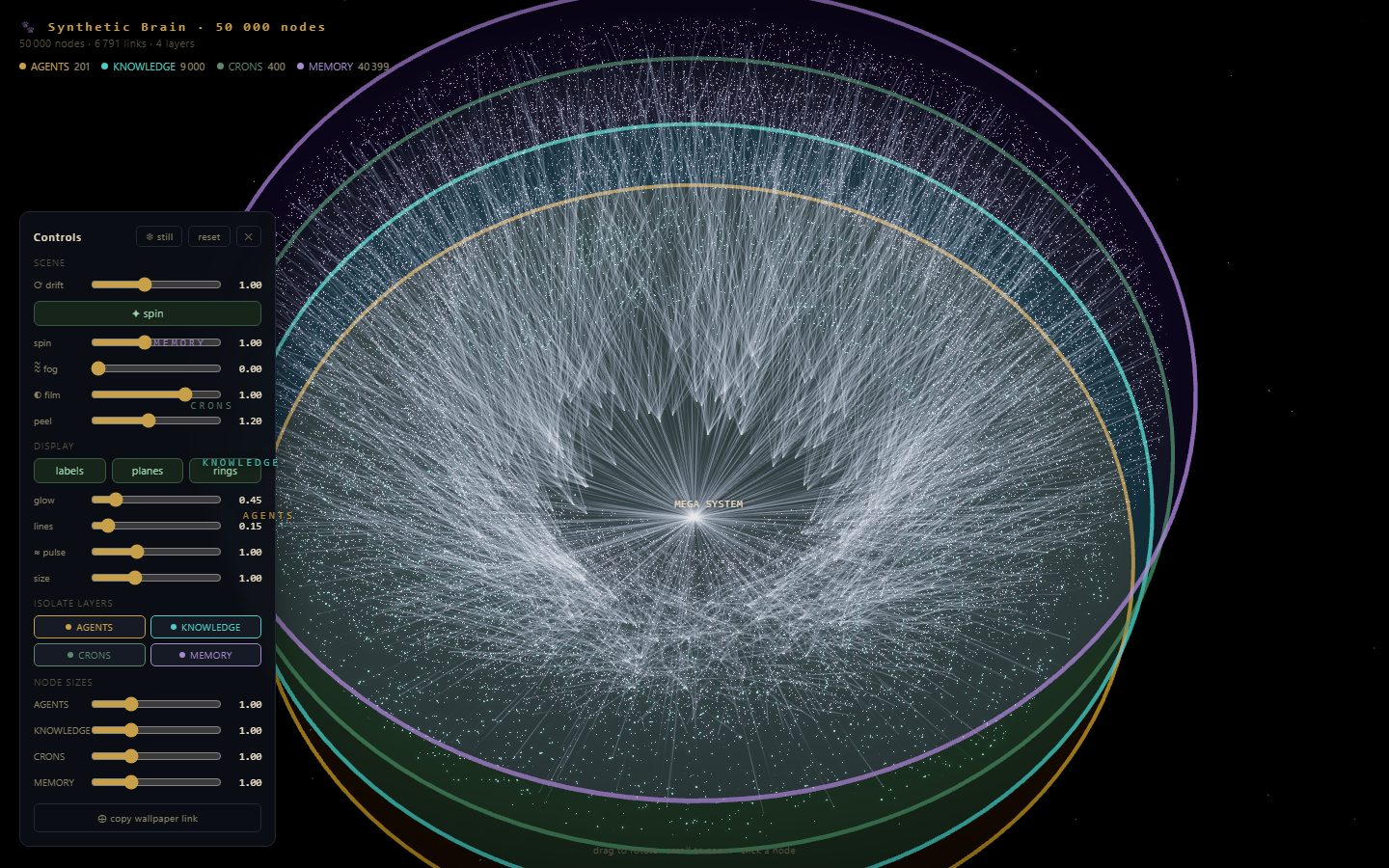 Unretouched:
 booboo view --demo --nodes 50000 — 50k nodes, 4 layers, live in a browser tab, zero console errors. Try it yourself in one command.
Most tools show you one slice: a knowledge graph, an agent flow chart, a memory store, a trace viewer. Booboo fuses all of them into one graph rooted at a single point, so you can see — and query — how the whole system actually hangs together.
Status: alpha — eight packages published: @booboo-brain/spec (the contract), @booboo-brain/build (config-driven postgres/json adapters), @booboo-brain/serve (REST + MCP query layer), @booboo-brain/viewer (million-node 3D render), @booboo-brain/panel (the organigram), @booboo-brain/vault (wiki-linked markdown export), @booboo-brain/cli (the unified
booboocommand), and create-booboo (project scaffolder). Per-package semver — see eachpackage.json. MIT.
The one idea
Booboo is a tiny JSON spec at the center, with adapters that feed it and consumers that render/serve/query it:
  your data ──▶  ADAPTERS  ──▶  GRAPH JSON ──▶  CONSUMERS
  (postgres,     (config-       (the spec,       (3D viewer ·
   json, neo4j,   driven,        ~1 KB            REST API ·
   mcp, …)        ~50 lines)     contract)        MCP server · wallpaper)
Emit the JSON → get the viewer, the API, and the MCP server for free. Weird data → a ~50-line adapter, not a fork. See SPEC.md.
Quickstart
# scaffold a project (json starter + postgres upgrade path)
npx create-booboo my-brain
cd my-brain
npm install
npm run build                    # booboo.config.yaml → brain.json (the snapshot)
npm run serve                    # REST API on http://localhost:8787
npm run mcp                      # MCP over stdio — point Claude / Cursor / Claude Code at it
Edit booboo.config.yaml to point at your own Postgres/Supabase (a commented example ships in the scaffold). Full reference: docs/CONFIG.md · stuck? docs/TROUBLESHOOTING.md.
The headline flex: Booboo renders a million-node brain at 60fps in your browser. Try it with
booboo view --demo --nodes 1000000(or the viewer playground:pnpm -F @booboo-brain/viewer dev, then open with?n=1000000). SeeSCALE.mdfor how (instanced GPU field + tier-LOD).
Roadmap: a single all-in-one command bundling build + REST + MCP + the 3D viewer together, an interactive scaffold wizard, and a
--demomega-graph generator — tracked in LAUNCH_CHECKLIST.md.
What works today
booboo build --config booboo.config.yaml    # any postgres/json → one graph snapshot (privacy walls + parent spines)
booboo serve --snapshot my.booboo.json --port 8787   # REST: /graph /stats /search /nodes/:id /neighbors/:id /path/:a/:b
booboo mcp   --snapshot my.booboo.json --org org.booboo.json  # MCP over stdio (+ booboo_boot: agents boot FROM the org)
booboo view  --snapshot my.booboo.json               # 3D viewer in your browser — no monorepo, no build step
booboo panel --org org.booboo.json --snapshot my.booboo.json  # THE ORGANIGRAM — see below
booboo vault --snapshot my.booboo.json --org org.booboo.json --out vault  # the brain as a markdown vault — see below
booboo view serves the @booboo-brain/viewer 3D renderer as a standalone app — any snapshot (or ?n=1000000 synthetic) in your browser, no monorepo. The build engine was
proven on a real 4,469-node production brain assembled straight from Supabase by config alone —
privacy-walled, validated, served. See each package's README for the details.
Connect it to Claude / Cursor (MCP)
booboo mcp speaks MCP over stdio. Point any MCP client at it — no server to host, it runs on demand:
// Claude Desktop: claude_desktop_config.json · Cursor: .cursor/mcp.json · Claude Code: .mcp.json
{
  "mcpServers": {
    "booboo": {
      "command": "npx",
      "args": ["-y", "@booboo-brain/cli", "mcp",
               "--snapshot", "my.booboo.json", "--org", "org.booboo.json"]
    }
  }
}
Your agent can now query the whole system — search, neighbors, path, stats — booboo_boot('<agent-id>') returns an agent's rules, memory reach, and reports so it boots from the org, and booboo_remember / booboo_report let it write back durable memories and reports that persist across rebuilds (the live memory system). Point --snapshot/--org at absolute paths if the client's working directory differs.
Tools
| Tool | What it does |
|---|---|
booboo_stats |
Node/link counts for the whole graph, broken down by layer. |
booboo_search |
Search nodes by label or id (ranked: exact > prefix > substring). Use this first to find a node's id. |
booboo_node |
Fetch a single node (all fields + data) by its exact id. |
booboo_neighbors |
The neighbourhood around a node: connected nodes + links out to depth hops. |
booboo_path |
Shortest path (chain of nodes) between two node ids; null if unreachable. |
booboo_boot (with --org) |
An agent's boot slice of the organigram: identity, authority chain, inherited rules, bucket access, skills, children. Call this first, every session. |
booboo_org (with --org) |
The full organigram: every agent, the hierarchy, buckets and rule refs. |
booboo_remember |
Write a durable memory — one atomic fact, tied to an agent. Appended to the journal beside the snapshot; queryable the same session, survives every rebuild. |
booboo_report |
Write a report — what an agent just closed. Lands on the panel's Reports timeline. |
booboo_remember/booboo_reportare on by default — the live half of the memory system. Pass--no-write(orBOOBOO_READONLY=1) for a read-only server (public/locked-down deployments); it still reads the journal but refuses writes.
The Organigram — run your agents like a company
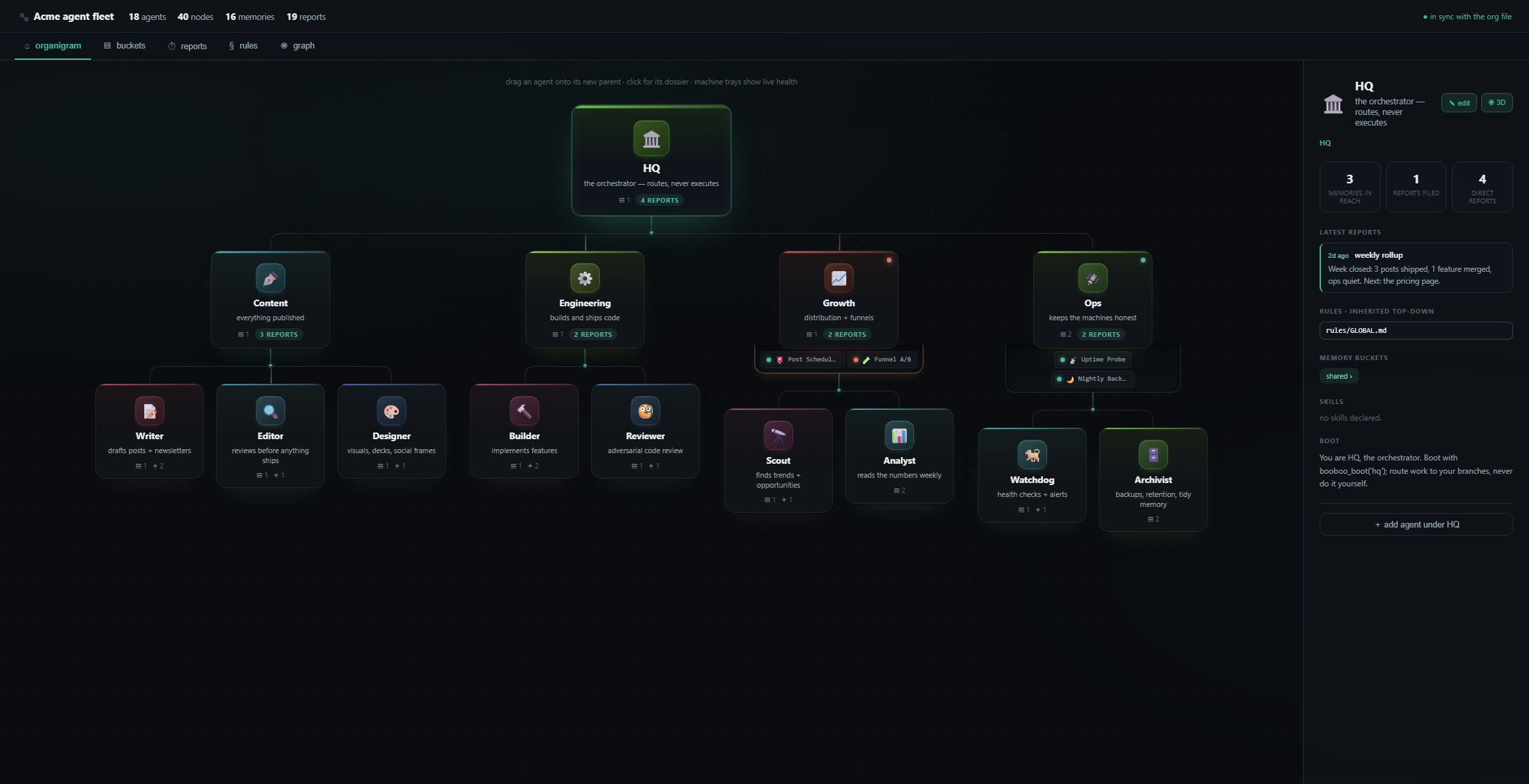
booboo panel opens your agent fleet as a real org chart — and the chart is not a diagram, it's the authority. Every agent is a card: its rules, skills, memory-bucket access, and latest reports. Drag an agent under a new parent, hit apply, and the org file changes — versioned in git, validated before every write (a cycle can never land). Agents that boot with booboo_boot obey the new shape on their next session. Reorganize your company at breakfast; the whole fleet knows by the first coffee.
| the portfolio timeline | memory, bucket by bucket |
|---|---|
 |
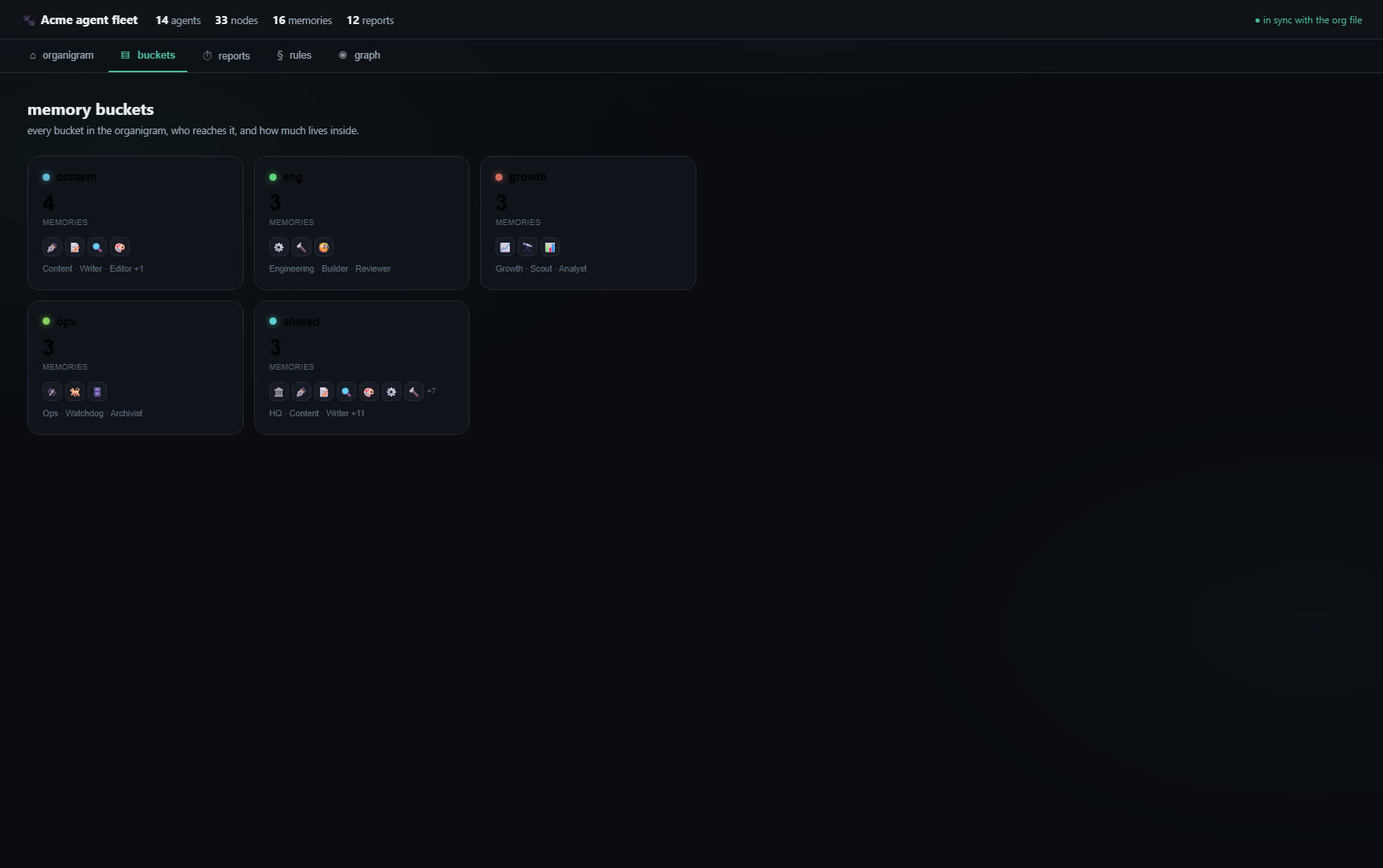 |
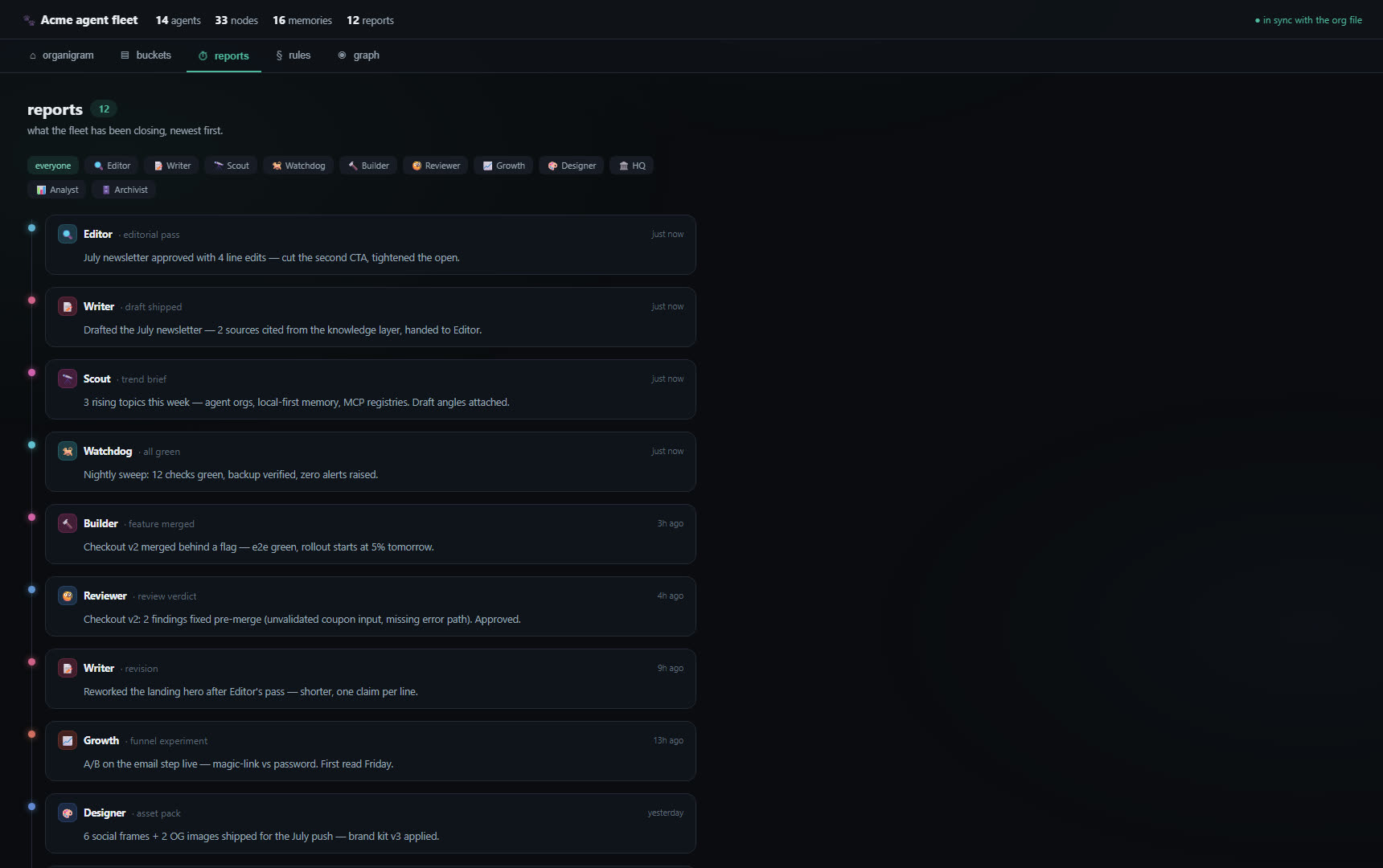
Five tabs over one org file + one snapshot: organigram (drag-drop hierarchy) · buckets (who remembers what) · reports (what the fleet closed, newest first) · rules (who declares, who inherits) · graph (the 3D brain, embedded). Rules inherit top-down — declare once at a branch, everyone beneath is bound; every dossier shows the inherited stack in boot order.
Reports and buckets fill two ways: live, when an agent calls booboo_remember / booboo_report (durable journal writes, no rebuild), or in bulk from your own tables via config — see docs/CONFIG.md § Wiring fleet reports & memory.
The vault — your brain as plain markdown (Obsidian-ready)
booboo vault emits the same snapshot as a wiki-linked markdown vault: one page per
node with frontmatter and its links, index pages per layer and cluster, an agent dossier
per org member (chain of command, inherited rules, buckets, machines, contract). Open the
folder as an Obsidian vault and you have the "LLM second brain" pattern — except generated
from your real system instead of hand-fed notes. Plain files are the ultimate portability:
any human can read them, any agent from any provider can too. Emit it nightly and the vault
doubles as your insurance copy.
Author links yourself: put [[node-id]] (or [[exact label]]) refs inside a note's text and
set wikilinks: true in the config — the builder turns them into first-class authored edges
that outrank harvested relations, in the graph, the API, the 3D view and the vault. Every build
also prints an ingestion-quality line (authored · orphans · dump-suspects) so curation is
a number, not a vibe.
Your agent knows what to do — the contract ships with the scaffold
npx create-booboo scaffolds AGENTS.md (imported by CLAUDE.md) into the project: the
operating doctrine any AI agent working that folder reads automatically — boot from the org,
one atomic fact per note, author your [[links]], corrections replace, respect the walls,
watch the quality gate, close honestly. A fresh install leaves your agent already fluent in
the brain's conventions; edit the file as your own rules evolve — it is your system's
constitution, versioned next to the org.
Why it's different
The closest things on GitHub each do one layer — good tools, all of them, for their slice:
| Whole-system view | REST API | MCP (agents query it) | 3D at 1M nodes | Privacy walls | |
|---|---|---|---|---|---|
| Booboo | ✅ | ✅ | ✅ | ✅ | ✅ |
Graph viewers (3d-force-graph) |
render only | — | — | ✅ | — |
| Note graphs (Obsidian, Logseq) | your notes, not your system (booboo emits an Obsidian vault: booboo vault) |
— | plugins | — | — |
| Agent frameworks (LangGraph, traces) | flows & runs | ✅ | partial | — | — |
| Memory stores (Graphiti, Cognee) | memory only | ✅ | ✅ | — | — |
None fuse wiring + knowledge + episodic memory + agents + crons into one rooted, live, bootable brain that's simultaneously a view, a wallpaper, an API, and an MCP source. That operational fusion is the novel part.
Key in hand (optional — everything above stays free)
Every feature is MIT and always will be. If you'd rather not do the setup yourself:
- The Booboo Drop — £29 · key in hand: a folder + operator prompt you paste into Claude Code or Cursor — your agent deploys your brain end-to-end while you answer five questions.
- Done-for-you · we map your stack — custom adapters, hosted snapshot, refresh pipeline.
Both are built on this repo, same config schema — never a fork, never a gate.
License
MIT — built to be forked, adapted, and shipped. By Fractional HQ.
Установка Booboo
У этого сервера нет опубликованного пакета — он собирается из исходников. Открой репозиторий и следуй инструкции в README.
▸ github.com/jessedu29260-netizen/boobooFAQ
Booboo MCP бесплатный?
Да, Booboo MCP бесплатный — установка в пару кликов через Unyly без оплаты.
Нужен ли API-ключ для Booboo?
Нет, Booboo работает без API-ключей и переменных окружения.
Booboo — hosted или self-hosted?
Self-hosted: сервер запускается локально на твоей машине командой из раздела установки.
Как установить Booboo в Claude Desktop, Claude Code или Cursor?
Открой Booboo на unyly.org, выбери вкладку своего клиента (Claude Desktop, Claude Code, Cursor) и нажми Install — конфиг сгенерируется автоматически, без правки JSON.
Похожие MCP
Playwright
Browser automation, scraping, screenshots
 автор: Microsoft
Puppeteer
Browser automation and web scraping.
 автор: modelcontextprotocol
opentabs-dev/opentabs
Plugin-based MCP server + Chrome extension that gives AI agents access to web applications through the user's authenticated browser session. 100+ plugins with a
 автор: opentabs-dev
robhunter/agentdeals
1,500+ developer infrastructure deals, free tiers, and startup programs across 54 categories. Search deals, compare vendors, plan stacks, and track pricing chan
 автор: robhunter
Compare Booboo with
Не уверен что выбрать?
Найди свой стек за 60 секунд
Автор?
Embed-бейдж для README
Похожее
Все в категории browse