
Bus
БесплатноНе проверенMCP server for Raspberry Pi peripheral bus access, enabling AI agents to interact with CAN, I2C, SPI, UART, and GPIO directly through natural language.

Описание
MCP server for Raspberry Pi peripheral bus access, enabling AI agents to interact with CAN, I2C, SPI, UART, and GPIO directly through natural language.
README
An MCP server that gives an AI agent (Claude Desktop, Claude Code, or any MCP-compatible client) direct access to a Raspberry Pi's peripheral buses:
- CAN / CAN-FD — SocketCAN (PiCAN, Waveshare 2-CH CAN HAT, on-board CAN on CM5)
- RS485 / UART — pyserial (
/dev/ttyUSB*,/dev/ttyAMA*,/dev/ttyS*) - I2C — smbus2 (
/dev/i2c-1,/dev/i2c-3) - SPI — spidev (
/dev/spidev0.0, etc.) - GPIO — lgpio (Pi 4 / Pi 5 / CM4 / CM5)
The agent gets a small, opinionated tool set — bus_list, can_send,
i2c_read, gpio_write, … — plus per-bus *_configure tools so it can
retune bitrate / baud / SPI mode mid-session. Point Claude at a Pi and
it can talk to a sensor, dump CAN traffic, or wiggle a pin without you
writing a Python script first.
Quick install on a Pi
git clone https://github.com/Pan-Robotics/bus-mcp.git
cd bus-mcp
./packaging/install.sh --allow-write
That's it. The installer:
- creates
~/.local/share/bus-mcp/.venvwith--system-site-packagesso apt-packagedlgpio/pyserial/smbus2/spidevare reused (no SWIG rebuild) - installs
mcp+python-can+bus-mcpitself - adds you to
spi/i2c/gpio/dialoutgroups - installs
/etc/systemd/system/bus-mcp.serviceand enables it - prints the MCP endpoint URL + the
claude mcp addline for your host
It does not touch /boot/firmware/config.txt (CAN HAT overlays vary
by HAT variant), pick a CAN bitrate, or open firewall ports.
Re-running is idempotent. To remove everything: ./packaging/install.sh --uninstall.
Manual install (PyPI, no systemd)
On a Pi:
pip install "bus-mcp[pi-all]"
On a dev laptop (no hardware) — for editing + tests:
pip install bus-mcp
The bus libraries (python-can, pyserial, smbus2, spidev, lgpio)
load lazily. Missing libs only error when you call a tool that needs them.
Run
bus-mcp list                            # show discovered buses
bus-mcp serve                           # stdio (Claude Desktop / Code)
bus-mcp serve --allow-write             # writes on every bus
bus-mcp serve --allow-write=can,serial  # writes only on CAN + serial

# HTTP / streamable-http transport (localhost only by default)
bus-mcp serve --transport http
bus-mcp serve --transport http --port 7820 --allow-write
bus-mcp serve --transport http --host 0.0.0.0 --port 7820  # LAN-reachable
The HTTP endpoint is at http://<host>:<port>/mcp and speaks the MCP
streamable-HTTP protocol (POST JSON-RPC, response as a single SSE
message). The default bind is 127.0.0.1 so the server is invisible
outside the Pi until you opt in with --host 0.0.0.0 (and an SSH
tunnel / firewall rule to fence access).
Wire into Claude Desktop (stdio)
Edit ~/.config/Claude/claude_desktop_config.json:
{
  "mcpServers": {
    "bus-mcp": {
      "command": "bus-mcp",
      "args": ["serve", "--allow-write"]
    }
  }
}
Wire into Claude Code
stdio (Claude Code on the same Pi):
claude mcp add bus-mcp -- bus-mcp serve --allow-write
HTTP (Pi reachable on pi.local:7820, or substitute your hostname / IP):
claude mcp add --transport http bus-mcp http://pi.local:7820/mcp
The installer prints the exact URL for your host at the end of its run.
Tools the agent gets
| Tool | Purpose |
|---|---|
bus_list |
Enumerate discovered buses |
bus_status |
Inspect descriptor + stored config (no driver open) |
bus_close |
Release a bus the agent opened earlier |
write_permissions |
Show which bus kinds writes are enabled on |
can_configure |
Set bitrate / fd / data_bitrate / restart_ms |
can_send |
Transmit a CAN / CAN-FD frame |
can_receive |
Drain frames with an optional kernel filter |
serial_configure |
Set baudrate / bytesize / parity / stopbits / flow |
serial_send |
Write bytes to a UART / RS485 port |
serial_receive |
Read bytes from a UART / RS485 port |
i2c_read |
Read from a device register |
i2c_write |
Write to a device register |
i2c_scan |
i2cdetect-equivalent address probe |
spi_configure |
Set max_speed_hz / mode / bits_per_word / lsb_first |
spi_xfer |
Full-duplex transfer (optional per-call speed) |
gpio_configure |
Set direction / pull / active-low / debounce |
gpio_read |
Read a pin |
gpio_write |
Drive a pin |
*_configure tools take all fields as optional kwargs — pass only what
you want to change. The bus is closed immediately so the next call
reopens it with the new config. Blocking receive tools (can_receive,
serial_receive, i2c_scan) run on a worker thread via
asyncio.to_thread, so a single client can hold a long receive open
while firing other tool calls in parallel.
Safety
Default is read-only on every bus. Write tools refuse cleanly with a
message that names the right --allow-write flag. Refusals are returned
as MCP tool errors so the agent can surface the state instead of
crashing.
There is no protocol-level checking past the write gate: if you enable writes and the agent transmits a destructive CAN frame, your ECU sees it. Use this on bench setups, not on a live vehicle without a hardware kill switch.
Verifying on a Pi — Waveshare 2-CH CAN HAT loopback
The Waveshare 2-CH CAN HAT gives you two MCP2515 channels exposed
as can0 + can1. With both channels wired into each other
(CAN_H ↔ CAN_H, CAN_L ↔ CAN_L, plus the on-board 120 Ω termination
jumpers enabled on both sides), frames sent on one channel land on
the other — a perfect end-to-end test.
# 1. Enable SPI + the overlays (one-time).
#    These values are for the ORIGINAL 2-CH CAN HAT (16 MHz crystals,
#    IRQs on GPIO 23 + 25). The HAT+ variant uses different pins —
#    check your HAT before pasting.
sudo raspi-config nonint do_spi 0
sudo tee -a /boot/firmware/config.txt <<'EOF'
dtoverlay=mcp2515-can0,oscillator=16000000,interrupt=23
dtoverlay=mcp2515-can1,oscillator=16000000,interrupt=25
EOF
sudo reboot

# 2. After reboot — bring both interfaces up.
sudo ip link set can0 up type can bitrate 500000
sudo ip link set can1 up type can bitrate 500000

# 3. Install bus-mcp and start it.
./packaging/install.sh --allow-write    # or: bus-mcp serve --transport http --allow-write &

# 4. From an agent (or curl directly), exercise the loopback:
#    - on can0: can_send {arbitration_id=0x123, data_hex="deadbeef"}
#    - on can1: can_receive {timeout_s=1, count=1}
#    expect: one frame with arbitration_id=0x123, data="deadbeef"
A raw curl smoke-test (initialize the MCP session) — substitute your Pi's
hostname / IP for <HOST>:
curl -i -X POST -H 'Content-Type: application/json' \
  -H 'Accept: application/json, text/event-stream' \
  --data '{"jsonrpc":"2.0","id":1,"method":"initialize","params":{"protocolVersion":"2024-11-05","capabilities":{},"clientInfo":{"name":"test","version":"0.0.1"}}}' \
  http://<HOST>:7820/mcp
If the controllers settle into ERROR-PASSIVE instead of ERROR-ACTIVE
(ip -details link show can0), the on-board termination jumpers
probably aren't enabled. Either turn them on or drop the bitrate to
something the bus can sustain (sudo ip link set can0 down; sudo ip link set can0 type can bitrate 250000; sudo ip link set can0 up).
Architecture
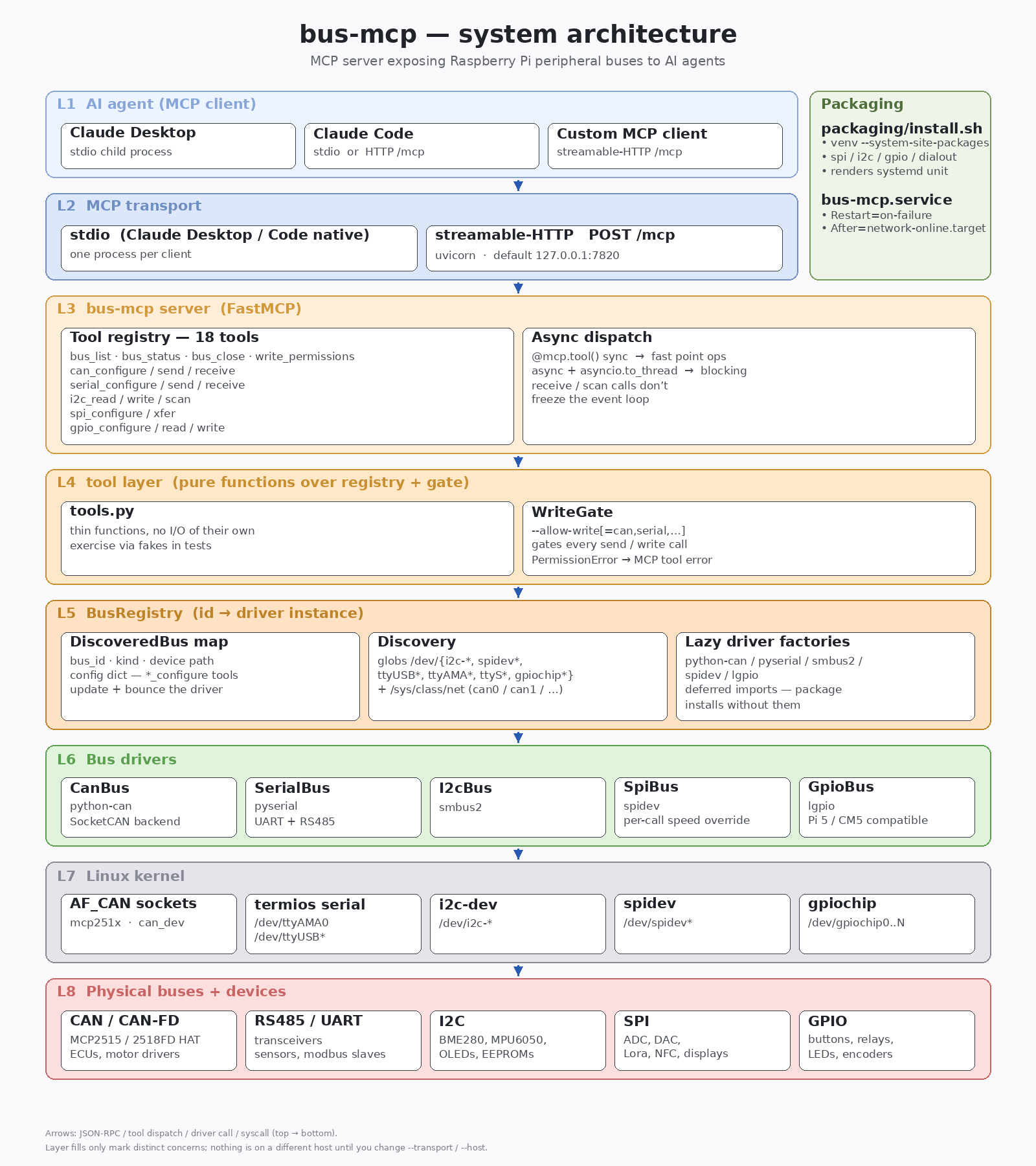
See docs/architecture.png for the full layered view, or re-render after editing:
python docs/render_arch.py # writes docs/architecture.png
The render script (docs/render_arch.py) uses pure-PIL — no dot /
mmdc / browser engines — and auto-sizes each layer band from its
tallest box, so adding tools or drivers doesn't require manual layout
tuning.
Logs + service control (systemd install only)
sudo systemctl status bus-mcp           # is it up?
sudo systemctl restart bus-mcp          # bounce it
sudo journalctl -u bus-mcp -f           # tail logs
sudo journalctl -u bus-mcp --since=-1h  # past hour
Roadmap
- mDNS advertise so a roaming agent on the LAN can find the Pi
- Auth on the HTTP endpoint (shared secret header)
- Filter expressions on
can_receivebeyond single-id+mask - PyPI publish (today: install from source)
License
MIT — see LICENSE.
Установка Bus
У этого сервера нет опубликованного пакета — он собирается из исходников. Открой репозиторий и следуй инструкции в README.
▸ github.com/Pan-Robotics/bus-mcpFAQ
Bus MCP бесплатный?
Да, Bus MCP бесплатный — установка в пару кликов через Unyly без оплаты.
Нужен ли API-ключ для Bus?
Нет, Bus работает без API-ключей и переменных окружения.
Bus — hosted или self-hosted?
Self-hosted: сервер запускается локально на твоей машине командой из раздела установки.
Как установить Bus в Claude Desktop, Claude Code или Cursor?
Открой Bus на unyly.org, выбери вкладку своего клиента (Claude Desktop, Claude Code, Cursor) и нажми Install — конфиг сгенерируется автоматически, без правки JSON.
Похожие MCP
Fetch
Web content fetching and conversion for efficient LLM usage.
AWS KB Retrieval
Retrieval from AWS Knowledge Base using Bedrock Agent Runtime.
 автор: modelcontextprotocol
Spring AI MCP Server
Provides auto-configuration for setting up an MCP server in Spring Boot applications.
llm-analysis-assistant
A very streamlined mcp client that supports calling and monitoring stdio/sse/streamableHttp, and can also view request responses through the /logs page. It also
 автор: xuzexin-hz
Compare Bus with
Не уверен что выбрать?
Найди свой стек за 60 секунд
Автор?
Embed-бейдж для README
Похожее
Все в категории ai