
Cafecito
БесплатноНе проверенEnables AI agents to coordinate on a shared repository using commutativity-proven parallel landing and regenerative merge, avoiding rebase conflicts through sym

Описание
Enables AI agents to coordinate on a shared repository using commutativity-proven parallel landing and regenerative merge, avoiding rebase conflicts through symbol-level leases.
README
An integration control plane for AI agent fleets. Prove independence when you can. Re-derive when you can't. Never resolve a conflict.
Status: pre-1.0 — a working single-repo control plane (current version: see releases). The physics is validated (phase0/, bench/); the engine, MCP server, fleet (
swarm/watch), PR gateway (ingest), memoized gates, and wave-parallel landing all run for real — and every feature since v0.1 landed through cafecito itself. Not yet: multi-repo, webhooks/hosted App. Sharp edges remain.

34 unedited seconds: three agents branch from the same commit; two commute and land in parallel, the third collides and is regenerated from both intents by a live reconciler call — gated, trailer-stamped, main green. Run it yourself: examples/demo.sh.
Quickstart
pipx install cafecito          # PyPI · or git+https://github.com/cafecitohq/cafecito for main
cafecito init --repo /path/to/your/repo --test-cmd "python3 -m pytest -q"
claude mcp add cafecito -- cafecito serve --repo /path/to/your/repo
Or skip the wiring and summon the fleet directly:
cafecito swarm "add rate limiting to the API, a retry helper, and tests for both" --agents 3
cafecito watch        # in another terminal: the live fleet dashboard
swarm plans the goal into independent tasks, pre-claims leases, runs the agents in
parallel, and lands everything through the gate — commuting changes in parallel, collisions
regenerated, contradictions escalated to you. Workers that drift outside their assigned
paths get contained at the oracle's granularity: the symbols they actually wrote are
leased before the changeset enters the pipeline (whole files only when a file can't be
analyzed), so a fleet never knowingly races itself — and a sibling editing a different
symbol in the same file doesn't wait, because symbol-disjoint writers commute. watch
shows it happening live:
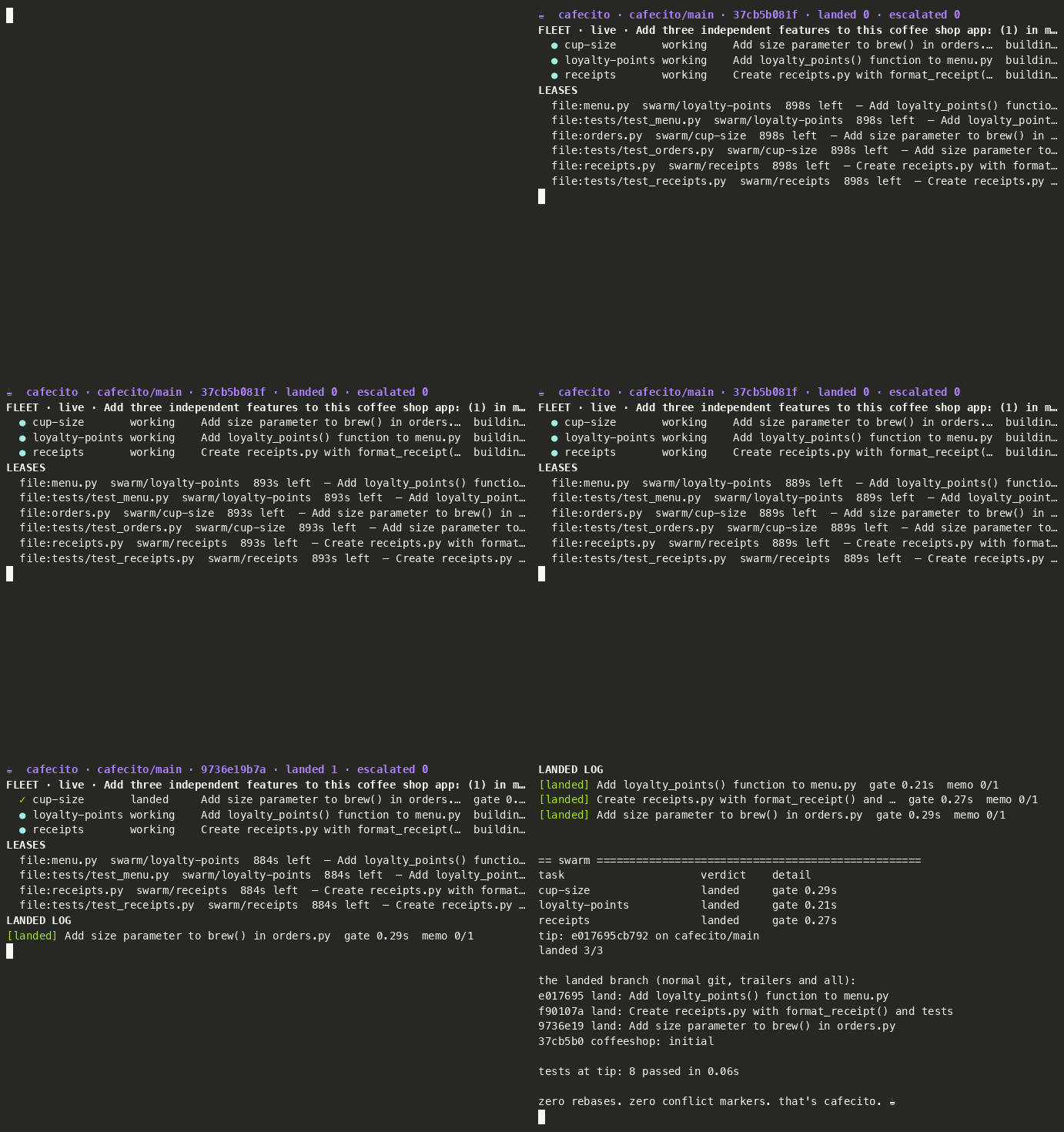
(Real recording: one sentence → three agents → three gated landings → green main, 31s.
Reproduce it: python3 examples/demo_swarm.py.)
Since v0.1, every feature of cafecito has been landed through cafecito — the story (including the release we broke and what it taught us) is in docs/building-itself.md.
Any MCP-capable agent then coordinates through four tools: sync (get the landed tip or a
ready worktree), reserve (advisory leases on symbols before starting work), submit (land a
committed changeset), status. Commuting changesets land immediately; collisions are
regenerated from both intents by a reconciler; every landing passes a real test gate; main
is materialized as a normal git branch (cafecito/main). Agents never rebase and never see a
conflict marker. Humans drive it from the shell: cafecito submit | status | log | advance —
or keep opening ordinary GitHub PRs and let cafecito ingest land them through the plane.
Symbol-level write sets for Python, TypeScript/JavaScript, and Go (stdlib scanners —
anything unanalyzable widens safely to file granularity); other languages land at file
granularity today. Verification facts: with gate_mode: full, every landing gates on the whole test
suite — but verdicts are content-addressed by input closure, so only tests the landing
actually touched execute; the rest inherit facts. Closures resolve Python, TypeScript/
JavaScript, and Go test inputs (import graphs, runner configs, lockfiles; Go rides whole
packages) — and anything the analysis can't see through statically (tsconfig paths,
bundler aliases, workspaces, go:embed, …) simply runs the test instead of trusting a fact. Bare gate worktrees get prepared by your
--setup-cmd (npm ci, pip install -e .) before tests run. Gate isolation: the gate
executes candidate code, so isolation: sandbox (macOS) runs every test invocation with the
network denied and file writes confined to the gate's own worktree; a container backend
(docker/podman, --network=none) ships experimental. Unavailable backends redden the gate —
never a silent fallback to unisolated runs. Facts are keyed by isolation mode, so a green
minted with the network open can't satisfy a sandboxed gate. Generated files (lockfiles etc.)
skip merging and the reconciler:
declare cafecito init --generated "package-lock.json=npm install --package-lock-only" and
conflicts re-run the generator against the merged sources — in our TypeScript corpus that
was 58 of 60 real conflicts. Prove it locally: python3 -m cafecito.tests.smoke.
The problem
Run five coding agents against one repo and you'll watch them gridlock: the first merge to
main forces every other agent to rebase, rerun tests, and rejoin the queue. Merge queues
serialize integration, so fleet throughput is capped at 1 / CI-duration no matter how many
agents you run — and CI spend grows quadratically as everyone re-tests everyone else's rebases.
The bottleneck isn't git's storage; it's three assumptions from the human era:
- Line-based merge semantics — the system can't distinguish "independent" from "colliding," so it assumes collision.
- Whole-repo serialization — every landing invalidates every other candidate.
- Integration coupled to CI wall-clock — position changes in the queue trigger full re-tests whose results were already knowable.
The bet
Agent fleets invert the cost model of software integration: generation is nearly free; verification and coherence are scarce. Once regenerating code costs pennies, merging text is the wrong operation. cafecito is built on two primitives that follow:
- Commutativity-proven parallel landing. Changesets carry symbol-level write sets. Provably disjoint changes land in parallel — no rebase, no re-test (verification results are content-addressed facts, not rituals). Only true collisions serialize.
- Regenerative merge. When changes truly collide, no one "resolves the conflict": a fresh agent regenerates the overlapping region once, from both changes' intents and acceptance tests, gated by CI.
Coordination also moves earlier: agents take short leases on symbols at intent time, so contention is discovered before work is wasted, not at merge time.
Git stays as the interop boundary — main is always materialized as a normal git branch for
humans, CI, and deploy tooling. Agents talk to the control plane through an MCP server and
never run git rebase.
Vocabulary, used strictly throughout: changesets land; collisions commute, regenerate, or escalate; merge is reserved for git's textual mechanism and the market category it replaces (see SPEC.md §1.1).
Repository layout
| Path | What | Status |
|---|---|---|
| phase0/ | Falsification experiments A (commutativity rate) and B (regenerative-merge success rate) on real repos | active |
| SPEC.md | Protocol: changesets, leases, landed log, verification facts, MCP surface | v0 — all surfaces implemented |
| cafecito/ | The product: oracle (py/ts/js/go/json write sets), engine (commute/regenerate/escalate, memoized gates, wave-parallel admission), MCP server, swarm/watch/ingest, CLI — pip installable, zero dependencies |
active |
| sdk/ | TypeScript / Python client SDKs | design |
| gateway/ | Git gateway: materialized branch, advance, and PR ingestion (cafecito ingest, proven on PR #1); webhooks/hosted App pending |
shipped in cafecito/ |
| bench/ | MergeBench — a real 33-agent burst: 5.5h serial queue vs 1.37h cafecito (10-min CI), 93.5 vs 16.2 CI-hours, landed for real with green main | active |
| PLAN.md | Full project plan, roadmap, and competitive analysis | living doc |
Run the Phase 0 experiments
cd phase0
python3 run_corpus.py --repos <clones...>                           # A + conflict scan, many repos
python3 experiment_a.py --repo <path-to-clone> --since 2024-06-01   # commutativity rate
python3 find_conflicts.py --repo <path-to-clone>                    # attributed conflict corpus
python3 experiment_b.py --repo <path-to-clone> --max-pairs 5        # regenerative merge
python3 validate_b.py --repo <path-to-clone>                        # dual test-suite validation
python3 agent_corpus.py --repo <clone> --targets <files...>         # uncoordinated-fleet corpus
Python 3.10+ and git ≥ 2.38. Stdlib only — no dependencies. See phase0/README.md for methodology and current numbers.
License
Apache-2.0. Contributions require DCO sign-off — see CONTRIBUTING.md.
"cafecito" started as the codename and won the vote to stay. The coffee is load-bearing. Home: cafeci.to · code: github.com/Cafecitohq/cafecito
Установка Cafecito
У этого сервера нет опубликованного пакета — он собирается из исходников. Открой репозиторий и следуй инструкции в README.
▸ github.com/Cafecitohq/cafecitoFAQ
Cafecito MCP бесплатный?
Да, Cafecito MCP бесплатный — установка в пару кликов через Unyly без оплаты.
Нужен ли API-ключ для Cafecito?
Нет, Cafecito работает без API-ключей и переменных окружения.
Cafecito — hosted или self-hosted?
Self-hosted: сервер запускается локально на твоей машине командой из раздела установки.
Как установить Cafecito в Claude Desktop, Claude Code или Cursor?
Открой Cafecito на unyly.org, выбери вкладку своего клиента (Claude Desktop, Claude Code, Cursor) и нажми Install — конфиг сгенерируется автоматически, без правки JSON.
Похожие MCP
Fetch
Web content fetching and conversion for efficient LLM usage.
AWS KB Retrieval
Retrieval from AWS Knowledge Base using Bedrock Agent Runtime.
 автор: modelcontextprotocol
Spring AI MCP Server
Provides auto-configuration for setting up an MCP server in Spring Boot applications.
llm-analysis-assistant
A very streamlined mcp client that supports calling and monitoring stdio/sse/streamableHttp, and can also view request responses through the /logs page. It also
 автор: xuzexin-hz
Compare Cafecito with
Не уверен что выбрать?
Найди свой стек за 60 секунд
Автор?
Embed-бейдж для README
Похожее
Все в категории ai