
Chinese History
БесплатноНе проверенA traceable Chinese-history MCP server that enables querying of nine classical Chinese texts (e.g., 史记, 汉书) with citations and honest status labels. It provides

Описание
A traceable Chinese-history MCP server that enables querying of nine classical Chinese texts (e.g., 史记, 汉书) with citations and honest status labels. It provides four tools to search events, persons, places, and qualities, all with provenance.
README
CI PyPI License: MIT Data: CC BY 4.0 Python 3.9+ Dependencies: zero MCP Release
A traceable Chinese-history MCP server. Four Model Context
Protocol tools over 9 classical Chinese
texts (pre-Qin to Wei-Jin — 史记 / 汉书 / 后汉书 / 三国志 / 左传 / 论语 / 孟子 /
吕氏春秋 / 资治通鉴). Every result carries a 【book → chapter → paragraph】
citation, and honestly reports its review_status — the server never claims
per-item human review it doesn't have.
一个可溯源的中国历史故事 MCP server:按事件 / 人物 / 今地名 / 品质四轴查询 先秦-汉魏九部正史子书,每条返回都带原文出处,机器生成/机审内容如实标注。
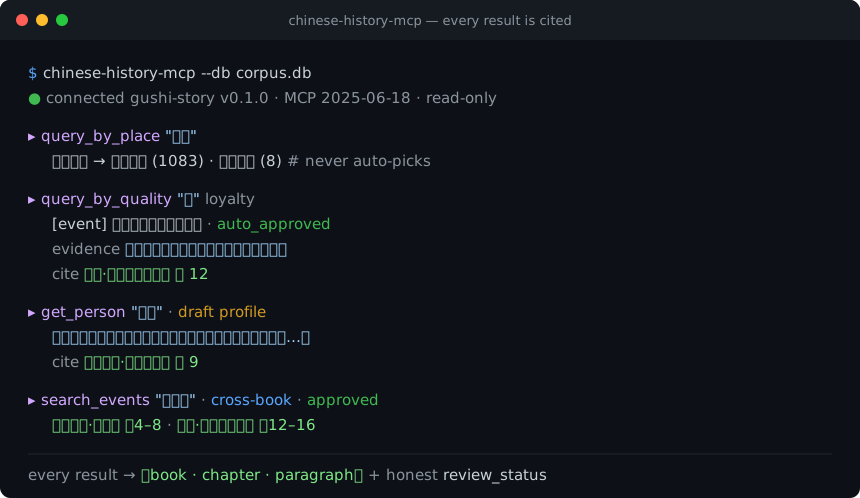
- Zero runtime dependencies — pure Python standard library. No
pip installof a framework, no MCP SDK; the whole server is auditable in a few files. - Read-only — opens the corpus with
mode=ro+PRAGMA query_only; never writes. - Honest by construction — machine-generated punctuation / translation and machine-adjudicated status are labeled in every response (AIGC-compliant).
Why this exists: as of mid-2026 the public MCP ecosystem has no classical Chinese / Chinese-history server. This fills that gap. Income expectation is zero; the goal is a useful public good.
Contents: The four tools · Install & run · The corpus database · Honesty · Data & provenance · Design notes
The four tools
| tool | input | returns |
|---|---|---|
search_events |
keyword / book / person / limit |
Cross-book fused historical events with per-source provenance (book · chapter · paragraph + role: primary/detailed/brief/comment/corroborating). canonical_summary is an LLM-fused machine narrative. |
get_person |
name (given name or alias) |
Person profile (LLM-synthesized, draft) + others' appraisals (verbatim source quotes, each cited) + attributed qualities + events mentioning them. |
query_by_place |
place (today's place name) / limit |
Ancient stories set on the land of a modern place, with citations. Same-name-different-place returns candidates for you to disambiguate — it never silently picks one. Directional/regional generic names are excluded. |
query_by_quality |
quality (from a 55-term controlled vocabulary, e.g. 忠 loyalty, 谋略 strategy) / limit / include_draft |
Representative events and people for a quality, each with an original-text evidence_quote and rationale. |
Each tool call returns JSON. Multi-source events, person appraisals, and place/quality edges all carry the exact 【book → chapter → paragraph】 they came from — that is the point of the server.
Install & run
Requires Python 3.9+ (standard library only — nothing else is installed). The server speaks MCP over stdio (newline-delimited JSON-RPC 2.0).
pip install chinese-history-mcp
# then (after downloading corpus.db from Releases — see below):
chinese-history-mcp --db /path/to/corpus.db
Or run without installing, straight from a checkout:
PYTHONPATH=src python3 -m storyextractor.mcp.server --db /path/to/corpus.db
Configure in an MCP client
Claude Desktop (claude_desktop_config.json), Cline, Continue, etc. — add one
stdio server. After pip install chinese-history-mcp:
{
  "mcpServers": {
    "chinese-history": {
      "command": "chinese-history-mcp",
      "args": ["--db", "/path/to/corpus.db"]
    }
  }
}
Alternative: run from a checkout (no install), or with uvx
{
  "mcpServers": {
    "chinese-history": {
      "command": "python3",
      "args": ["-m", "storyextractor.mcp.server", "--db", "/path/to/corpus.db"],
      "env": { "PYTHONPATH": "src" },
      "cwd": "/absolute/path/to/chinese-history-mcp"
    }
  }
}
Or zero-install with uv:
uvx chinese-history-mcp --db /path/to/corpus.db.
Try one handshake by hand
printf '%s\n' \
  '{"jsonrpc":"2.0","id":1,"method":"initialize","params":{"protocolVersion":"2025-06-18","capabilities":{}}}' \
  '{"jsonrpc":"2.0","id":2,"method":"tools/list"}' \
  '{"jsonrpc":"2.0","id":3,"method":"tools/call","params":{"name":"query_by_quality","arguments":{"quality":"忠","limit":2}}}' \
  | chinese-history-mcp --db /path/to/corpus.db
Demo + hallucination comparison
python3 scripts/mcp_demo.py --db /path/to/corpus.db runs a scripted tour of
all four tools (also a minimal MCP-client reference). See
docs/MCP_DEMO.md for a side-by-side of a bare LLM
(fabricated / uncitable) vs. this server (cited) on the same questions.
The corpus database
corpus.db is not in this repository (it is a ~90 MB binary). Download it
from this repo's Releases and point --db at it, or set
STORYEXTRACTOR_DB=/path/to/corpus.db.
The database is read-only at runtime. If you host it on a read-only medium,
make sure the release artifact was produced with
sqlite3 corpus.db "VACUUM INTO 'corpus_release.db'" (single file, no
-wal/-shm sidecars).
Honesty (please read)
This server is designed for provenance, not to launder machine output as scholarship. Downstream clients and LLMs must not present its results as "individually human-reviewed." Every response labels what it is:
- Events
review_status='approved'— mostly machine bulk-approved credible inferences, not per-item human review. - Person profiles
review_status='draft'— LLM-synthesized, not human-vetted. - Quality mappings —
auto_approved= multi-LLM machine consensus,draft= pending review;evidence_quoteis a real substring of the source,rationaleis an LLM's reasoning. - Place mappings — mostly multi-LLM machine consensus (
auto_approved), a few human-approved; confidence is bucketed high/medium/doubtful. - Text — original is public-domain 白文 with machine-generated punctuation/segmentation; vernacular translation is fully machine-generated.
The server also does not eliminate downstream hallucination: it gives you citable retrieval facts; an LLM built on top can still confabulate around them. The citations are anchors for human verification.
Scope is the 9 texts above — "not found" means "not in this corpus," not "did not happen."
Data & provenance
- Original text: public-domain classical Chinese 白文 (unpunctuated base text from public-domain editions), with self-produced, machine-generated punctuation and segmentation (not copied from any modern annotated/collated edition).
- Vernacular translation: machine-generated across the whole corpus.
- Annotations (events / entities / places / qualities): machine-assisted, with human review gating on selected layers; status is reported per record.
License
- Code (this repository): MIT — see LICENSE.
- Corpus data (
corpus.db, distributed via Releases): CC BY 4.0.
The text layer is self-produced (punctuation/segmentation) over public-domain base text, so it is distributed freely; machine-generated attributes are labeled throughout for AIGC compliance.
Design notes
- Pure stdlib hand-written stdio JSON-RPC 2.0 (
initialize/tools/list/tools/call+ping/ notifications). No third-party MCP SDK. - Read-only DB access (
src/storyextractor/mcp/db.py):mode=ro+PRAGMA query_only; the migration-runningdb.connectis never used at serve time. - Tests:
python3 tests/test_mcp_server.py(read-only enforcement, protocol shapes/error codes, honestreview_status, alias token-exact matching + disambiguation, LIKE-wildcard escaping) — builds a temporary fixture DB, so it runs withoutcorpus.db.
Contributing & project meta
- CONTRIBUTING.md — how to run tests/lint and the principles this project holds to.
- CHANGELOG.md — release history.
- SECURITY.md — threat surface (read-only, no network) and how to report issues.
Issues and pull requests are welcome. Please keep the constraints in mind:
zero runtime dependencies, read-only, every result cited, honest review_status.
Установить Chinese History в Claude Desktop, Claude Code, Cursor
unyly install chinese-history-mcpСтавит в Claude Desktop, Claude Code, Cursor и VS Code — сам разбирается с npx, uvx и сборкой из исходников.
Впервые? Поставь CLI: curl -fsSL https://unyly.org/install | sh
Или настроить вручную
Выполни в терминале:
claude mcp add chinese-history-mcp -- uvx chinese-history-mcpFAQ
Chinese History MCP бесплатный?
Да, Chinese History MCP бесплатный — установка в пару кликов через Unyly без оплаты.
Нужен ли API-ключ для Chinese History?
Нет, Chinese History работает без API-ключей и переменных окружения.
Chinese History — hosted или self-hosted?
Self-hosted: сервер запускается локально на твоей машине командой из раздела установки.
Как установить Chinese History в Claude Desktop, Claude Code или Cursor?
Открой Chinese History на unyly.org, выбери вкладку своего клиента (Claude Desktop, Claude Code, Cursor) и нажми Install — конфиг сгенерируется автоматически, без правки JSON.
Похожие MCP
GitHub
PRs, issues, code search, CI status
 автор: GitHub
Filesystem
Secure file operations with configurable access controls.
Memory
Knowledge graph-based persistent memory system.
Template MCP Server
A CLI tool to create a new Model Context Protocol server project with TypeScript support, dual transport options, and an extensible structure
 автор: mcpdotdirect
Compare Chinese History with
Не уверен что выбрать?
Найди свой стек за 60 секунд
Автор?
Embed-бейдж для README
Похожее
Все в категории development