
Docverity
БесплатноНе проверенMCP server that enables coding agents to check documentation claims against source code, detecting drift and suggesting fixes.

Описание
MCP server that enables coding agents to check documentation claims against source code, detecting drift and suggesting fixes.
README
AI made documentation rot an epidemic.
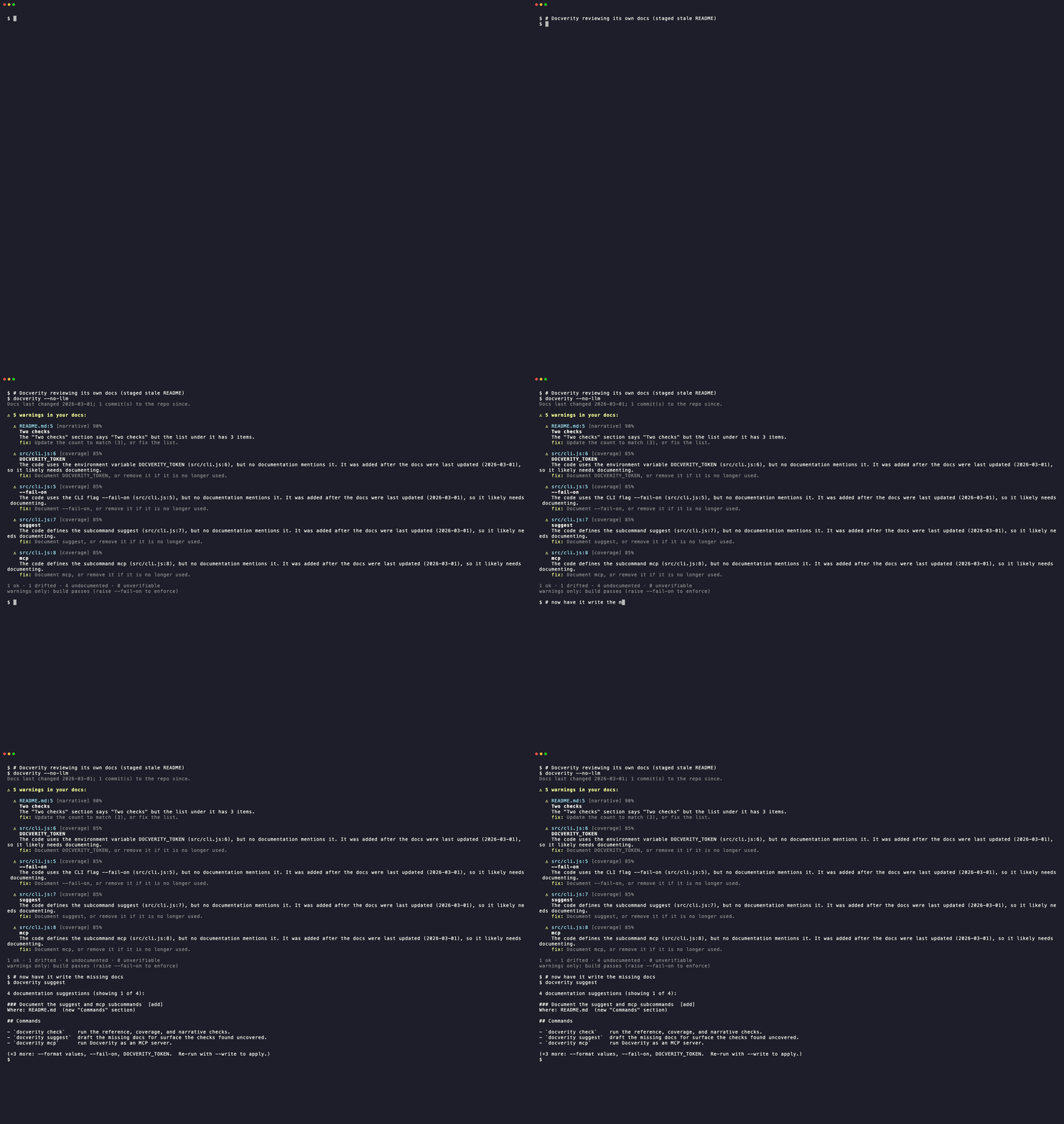
Code changes by the hour, and AI assistants only make it faster. Documentation does not keep up. Docverity reads your documentation, extracts the concrete claims it makes about the codebase, and checks each one against the source. Drift becomes a failing check in CI, the same way a broken test would.
Tools like doctest and mdbook test run the code blocks embedded in your
docs. Docverity verifies the prose around them: the flags, options, environment
variables, paths, and behavior your documentation describes are checked against
what the code actually does.
The checks
Docverity runs several complementary checks:
- Reference checker: deterministic, no API key, instant. Catches docs that mention files, CLI flags, environment variables, or symbols that no longer exist anywhere in the source.
- Claim verifier: LLM-backed, catches prose-level semantic drift: "the
default timeout is 30s", "this returns a list", "set
FOO=barto enable X". Runs whenANTHROPIC_API_KEY(orANTHROPIC_AUTH_TOKEN) is set. - Coverage: the reverse direction, surface the code exposes that the docs never mention. Deterministically it catches CLI flags, environment variables, subcommands, and accepted option/enum values. When a model is reachable it also runs a capability pass that catches undocumented behavior a token match cannot see: a new mode, an output format, an integration surface, a changed default. On by default, reported as warnings.
- Narrative: whether a section that describes the system is still a faithful account of it. Deterministically it flags a section whose stated count disagrees with its list ("three checks" above four bullets). With a model it flags a descriptive section, a pipeline or enumeration, that omits a step the code actually runs, the failure mode where no single claim is false but the account is incomplete.
In a git repository, coverage is history-aware: it finds the last commit that touched the docs and elevates any undocumented surface the code added after that point (a far stronger "you forgot to document this" signal than a bare token absence), and reports how many commits the docs now lag behind. It degrades silently outside git or in a shallow clone.
Works free out of the box. Gets smarter with a key.
Docverity is not JavaScript-only. The reference checker is language-agnostic (it searches the source tree for tokens), and coverage detects environment variables and flags in Python, Go, Java, and Ruby as well as JS/TS. It reads Markdown, reStructuredText, AsciiDoc, and plain-text docs.
Every finding has a severity: error (a reader acts on it and gets burned)
or warning (real but not blocking). By default only errors fail the build, so
a slight issue is reported without breaking CI. Tune it with --fail-on.
Install
npm install -g docverity
Or run without installing:
npx docverity
Usage
From your repo root:
docverity
By default it checks README.md and every .md file under docs/. Pass files
explicitly to narrow the scope, and use -C to point at another root:
docverity -C path/to/repo
Skip the model entirely for a fast, deterministic-only run:
docverity --no-llm
When a model is available, Docverity runs an adjudication pass that dismisses the false positives a token matcher can't tell from real drift (illustrative examples, flags documented as removed, other tools' commands). It finds a model in this order, and needs no setup if you already use Claude Code:
ANTHROPIC_API_KEY(orANTHROPIC_AUTH_TOKEN),- the
claudeCLI (Claude Code) if it is on your PATH, using your subscription, - when running as an MCP server, the host's model via MCP sampling.
Options
| Flag | Description |
|---|---|
-C, --root <dir> |
Repo root to check (default: current directory). |
--no-llm |
Deterministic checks only; no API calls. |
--model <id> |
Model for the LLM engine (default claude-opus-4-8). |
--no-coverage |
Skip the code-to-docs check for undocumented flags/env vars. |
--fail-confidence <n> |
Minimum confidence (0..1) to report a finding. Default 0.7. |
--fail-on <level> |
Lowest severity that fails the build: error (default), warning, info, or none. |
--strict |
Also fail on unverifiable claims. |
--format <fmt> |
pretty (default), json, or github. |
Docverity fails CI the way a linter would. Exit codes: 0 clean (or warnings
only), 1 a finding at or above --fail-on severity, 2 a configuration error
(e.g. an invalid --fail-confidence/--fail-on or a missing doc file) so a
typo can never mask real drift with a green build.
Draft the missing docs
Detection tells you what's missing; suggest writes it for you. It reads what
the code exposes and drafts the documentation to cover everything the docs
don't, real markdown, grounded in a deterministic scan of the undocumented
surface and in the source so the prose is accurate:
docverity suggest
By default it prints the drafted improvements (a command's options table, an
environment-variables section, a revised pipeline). Pass --write to append
them to a doc file between replaceable markers, additive, so nothing you wrote
is overwritten and re-running refreshes the same block:
docverity suggest --write           # appends to README (or the first doc)
docverity suggest --write --into docs/cli.md
suggest needs a model, found the same way the check does (ANTHROPIC_API_KEY,
the claude CLI, or an MCP host).
In CI (GitHub Actions)
name: docs
on: [pull_request]
jobs:
  docverity:
    runs-on: ubuntu-latest
    steps:
      - uses: actions/checkout@v4
      - uses: actions/setup-node@v4
        with:
          node-version: 22
      - run: npx docverity --format github
        env:
          ANTHROPIC_API_KEY: ${{ secrets.ANTHROPIC_API_KEY }}
With --format github, drifted claims appear as inline annotations on the
changed lines of the pull request.
Use it from an agent (MCP)
Docverity ships an MCP server so a coding agent can check docs as a tool and fix drift in the same turn it changed the code. Add it to your MCP client:
{
  "mcpServers": {
    "docverity": {
      "command": "npx",
      "args": ["docverity", "mcp"]
    }
  }
}
This exposes one tool, check_docs, which returns each drifted claim with its
file, line, the stale text, code evidence, a confidence score, and a suggested
fix the agent can apply directly. It runs the deterministic engine by default
(fast, free, no key); pass llm: true to also verify prose claims. It accepts
root, docs, coverage (default true), and failConfidence (default 0.7).
When the host supports MCP sampling, findings are adjudicated and the capability
pass runs using the host's model, with no API key of docverity's own. In a git
repo the summary also reports docsLastChanged and commitsSinceDocs, so the
agent knows how far the docs lag the code it just changed.
A SKILL.md is included so the agent knows when to reach for it (after editing code, before a release, when asked whether the docs are correct).
How it works
Docverity makes several passes and merges the results:
- Extract: parse each doc into atomic claims (a flag, a path, an env var, a symbol, a subcommand, or a prose assertion).
- Locate: search the source tree (via ripgrep when available) for evidence of each claim. Documentation files are excluded from evidence: a claim must be backed by code, not by the docs restating it.
- Verify drift (docs to code): the reference engine confirms each token still exists; the LLM engine judges prose claims (values, defaults, behavior) against the located evidence and returns ok / drifted / unverifiable.
- Coverage (code to docs): scan the public surface the code exposes (flags, env vars, subcommands, option values) and report what the docs never mention. With a model, a capability pass adds undocumented behavior; in a git repo, surface the code added after the docs last changed is elevated.
- Narrative: check that sections describing the system (a pipeline, an enumeration) are still complete and self-consistent accounts of the code.
- Adjudicate: when a model is reachable, hand the candidate findings back to it to drop the false positives a token matcher cannot tell from real drift (illustrative examples, flags documented as removed, other tools' tokens).
- Report: pretty output, machine-readable JSON, or GitHub annotations, each finding carrying a severity.
License
MIT
Установка Docverity
У этого сервера нет опубликованного пакета — он собирается из исходников. Открой репозиторий и следуй инструкции в README.
▸ github.com/deveshagarwal/docverityFAQ
Docverity MCP бесплатный?
Да, Docverity MCP бесплатный — установка в пару кликов через Unyly без оплаты.
Нужен ли API-ключ для Docverity?
Нет, Docverity работает без API-ключей и переменных окружения.
Docverity — hosted или self-hosted?
Self-hosted: сервер запускается локально на твоей машине командой из раздела установки.
Как установить Docverity в Claude Desktop, Claude Code или Cursor?
Открой Docverity на unyly.org, выбери вкладку своего клиента (Claude Desktop, Claude Code, Cursor) и нажми Install — конфиг сгенерируется автоматически, без правки JSON.
Похожие MCP
GitHub
PRs, issues, code search, CI status
 автор: GitHub
Filesystem
Secure file operations with configurable access controls.
Memory
Knowledge graph-based persistent memory system.
Template MCP Server
A CLI tool to create a new Model Context Protocol server project with TypeScript support, dual transport options, and an extensible structure
 автор: mcpdotdirect
Compare Docverity with
Не уверен что выбрать?
Найди свой стек за 60 секунд
Автор?
Embed-бейдж для README
Похожее
Все в категории development