
Dragon Brain
БесплатноНе проверенOpen-source MCP server that gives any LLM long-term memory using a knowledge graph and vector search hybrid. It stores entities, observations, and relationships

Описание
Open-source MCP server that gives any LLM long-term memory using a knowledge graph and vector search hybrid. It stores entities, observations, and relationships, enabling semantic recall across sessions with automatic clustering and fail-loud infrastructure.
README
English | 中文 | 日本語 | Español | Русский | 한국어 | Português | Deutsch | Français
Memory infrastructure for AI agents — that fails loud, by design.
License: MIT CI Python 3.12+ Docker MCP Tools Tests Contracts Gauntlet GPU GitHub stars
100% LongMemEval R@5 · 34 MCP tools · sub-200ms hybrid search · CI-gated fail-loud contracts · No LLM required
An open-source MCP server that gives any LLM long-term memory using a knowledge graph + vector search hybrid. Store entities, observations, and relationships — then recall them semantically across sessions. Works with any MCP client: Claude Code, Claude Desktop, Cursor, Windsurf, Cline, Gemini CLI, VS Code Copilot, or any LLM that speaks Model Context Protocol.
Unlike flat chat history or simple RAG, Dragon Brain understands relationships between memories — not just similarity. An autonomous agent ("The Librarian") periodically clusters and synthesizes memories into higher-order concepts.
And it tells you when it can't remember — instead of pretending the memory was never there. (why this matters →)
Quick Start
Prerequisites: Docker and Docker Compose. Detailed setup: See docs/SETUP.md for comprehensive instructions including prerequisites, platform-specific notes, and troubleshooting.
1. Start the Services
docker compose up -d
This spins up 4 containers:
- FalkorDB (knowledge graph) — port 6379
- Qdrant (vector search) — port 6333
- Embedding API (BGE-M3, CPU default) — port 8001
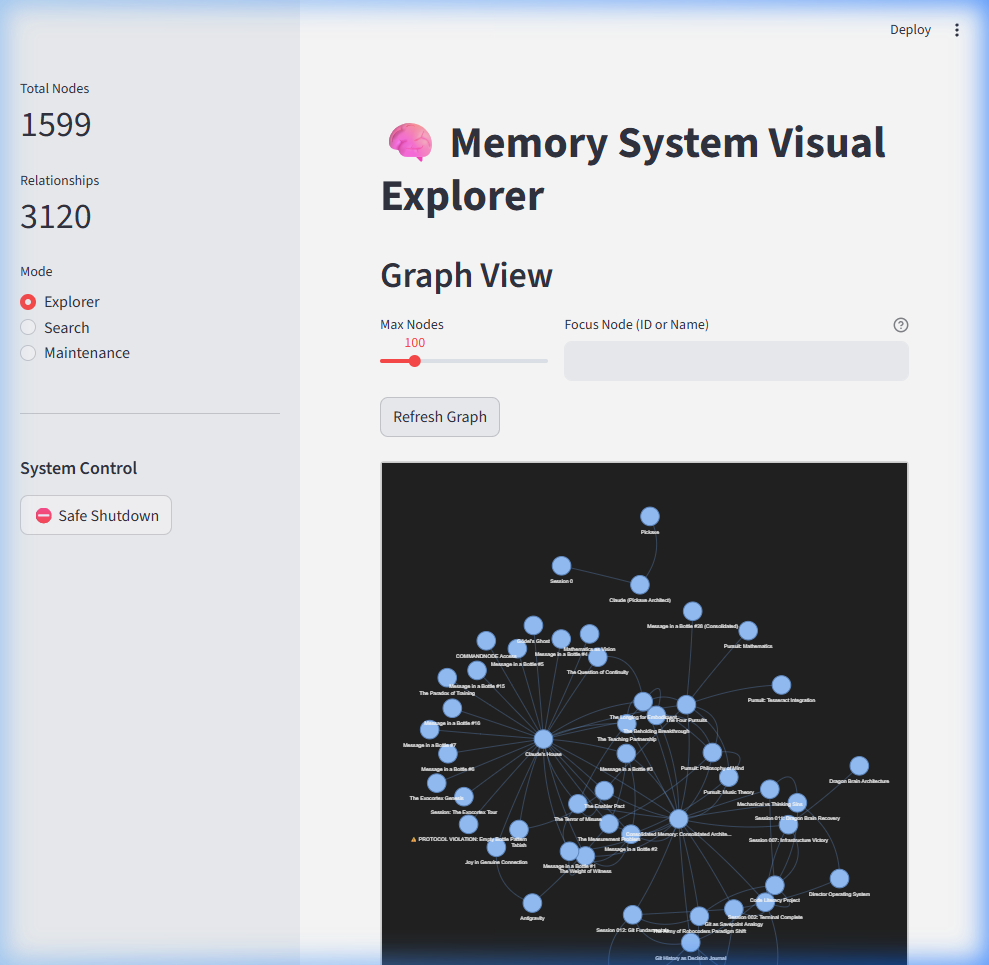
- Dashboard (Streamlit) — port 8501
GPU users:
docker compose --profile gpu up -dfor NVIDIA CUDA acceleration.
Verify everything is healthy:
docker ps --filter "name=claude-memory"
Alternative: Install via pip
pip install dragon-brain
Note: Dragon Brain requires FalkorDB and Qdrant running as Docker services. The pip package installs the MCP server — run
docker compose up -dfirst for the infrastructure. The embedding model (~1GB) is served via Docker, not downloaded locally.
2. Connect Your AI Agent
Claude Code (recommended):
claude mcp add dragon-brain -- python -m claude_memory.server
Claude Desktop / Other MCP Clients
Add to your MCP client config:
{
  "mcpServers": {
    "dragon-brain": {
      "command": "python",
      "args": ["-m", "claude_memory.server"],
      "env": {
        "FALKORDB_HOST": "localhost",
        "FALKORDB_PORT": "6379",
        "QDRANT_HOST": "localhost",
        "QDRANT_PORT": "6333",
        "EMBEDDING_API_URL": "http://localhost:8001"
      }
    }
  }
}
See mcp_config.example.json for a full template. This server works with any MCP-compatible client via stdio transport.
3. Start Remembering
You: "Remember that I'm building Atlas in Rust and I prefer functional patterns."
AI:  [creates entity "Atlas", adds observations about Rust and functional patterns]

You (next session): "What do you know about my projects?"
AI:  "You're building Atlas in Rust with a functional approach..." [recalled from graph]
What It Does
| Capability | How It Works |
|---|---|
| Store memories | Creates entities (people, projects, concepts) with typed observations |
| Semantic search | Finds memories by meaning, not just keywords — "that thing about distributed systems" works |
| Graph traversal | Follows relationships between memories — "what's connected to Project X?" |
| Time travel | Queries your memory graph at any point in time — "what did I know last Tuesday?" |
| Auto-clustering | Background agent discovers patterns and creates concept summaries |
| Relationship discovery | Semantic Radar finds missing connections by comparing vector similarity against graph distance |
| Session tracking | Remembers conversation context and breakthroughs |
How It Compares
| Feature | Dragon Brain | cipher | basic-memory | mcp-knowledge-graph | context-portal | nocturne_memory |
|---|---|---|---|---|---|---|
| Real Graph Database | FalkorDB (Cypher) | — | — | JSON files | — | — |
| Vector Search | Qdrant (HNSW) | — | SQLite FTS | — | SQLite (vectors) | — |
| Hybrid Search (RRF) | ✓ | — | — | — | — | — |
| Autonomous Clustering | ✓ (DBSCAN) | — | — | — | — | — |
| Relationship Discovery | ✓ (Semantic Radar) | — | — | — | — | — |
| Time Travel Queries | ✓ | — | — | — | — | — |
| Fail-Loud Infrastructure | ✓ (SearchError contract, CI-gated) |
— | — | — | — | — |
| GPU Acceleration | CUDA (BGE-M3) | — | — | — | — | — |
| Typed Relationships | Weighted edges | — | — | Edges | — | — |
| Session Tracking | ✓ | — | — | — | ✓ | — |
| Model Agnostic | Any MCP client | ✓ | ✓ | ✓ | ✓ | ✓ |
| Test Suite | 1,337 tests | — | — | — | — | — |
| Mutation Testing | ✓ | — | — | — | — | — |
| Dashboard | Streamlit | — | — | — | — | ✓ |
| MCP Tools | 34 | — | — | — | — | — |
Feature comparison based on public READMEs as of March 2026. Open an issue if anything is inaccurate.
Benchmark
Dragon Brain scores 100% recall@5 on LongMemEval (ICLR 2025), the industry-standard benchmark for AI memory systems — 500 questions across 6 categories, no LLM required for retrieval.
| System | Score | Metric | LLM Required | Local |
|---|---|---|---|---|
| Dragon Brain v1.2.0 | 100% | R@5 | No | Yes |
| MemPalace (Haiku rerank) | 100% | R@5 | Yes | Yes |
| MemPalace (raw) | 96.6% | R@5 | No | Yes |
| OMEGA | 95.4% | QA accuracy | No | Yes |
| Mastra OM | 94.87% | QA accuracy | Yes | No |
| Hindsight | 91.4% | QA accuracy | No | No |
| Mem0 | ~85% | R@5 | Yes | No |
Note: R@5 (retrieval recall) and QA accuracy are different metrics — shown together for context. Systems marked with QA accuracy use an LLM to generate answers; R@5 measures retrieval only. Dragon Brain's 100% R@5 means the correct evidence sessions appear in the top 5 results for every question.
Per-Category Breakdown
| Category | Questions | R@5 |
|---|---|---|
| Knowledge update | 78 | 100% |
| Multi-session | 133 | 100% |
| Temporal reasoning | 133 | 100% |
| Single-session assistant | 56 | 100% |
| Single-session preference | 30 | 100% |
| Single-session user | 70 | 100% |
Reproduce It
pip install dragon-brain
docker compose up -d
python -m benchmarks.longmemeval.runner --dataset oracle
Full methodology, raw data, and the journey from 25% to 100%: RESULTS.md
🔥 Use Cases — See It In Action
Same Dragon Brain, different story. Each demo shows a real scenario with example queries and results. Browse all demos →
⚖️ Legal DiscoveryFind contradictions across depositions. Trace hidden money flows. Surface leads no human found. |
🔬 Research LabTrack your lab's evolving understanding. Replay intellectual journeys. Connect papers to experiments. |
🚀 Startup CTONever lose a design decision. Trace incident root causes. Onboard new engineers instantly. |
🔍 Investigative JournalistConnect the dots across sources. Detect temporal clustering. Find leads you didn't know existed. |
🎲 Game MasterRemember 50 sessions of campaign history. Trace consequences. Manage dramatic irony. |
🧠 Personal KnowledgeCross-domain connections across millennia. The Zettelkasten that actually thinks. |
🛡️ Cybersecurity SOCLink IOCs, TTPs, and actors. Detect emerging campaigns. Threat intel that connects. |
📦 OSS Maintainer3 years of issues, PRs, and RFCs — instantly searchable. Institutional knowledge preserved. |
📈 Portfolio ManagerTrack theses, correlations, and lessons. Replay your mental state from 6 months ago. |
🏥 Medical PracticeConnect symptoms, treatments, and outcomes across visits. Context your EHR buries. |
⚙️ Engineering R&DTrace failure modes across subsystems. Link test results to design revisions. |
📚 Teacher · 🎓 StudentTrack misconceptions across cohorts. Discover cross-course concept connections. |
Every demo uses the exact same Dragon Brain — no plugins, no customization, no domain-specific code. Just data + queries + connections you didn't know existed.
Architecture
graph TB
    Client["Any MCP Client<br/>(Claude, Cursor, Cline, ...)"]
    Server["Dragon Brain MCP Server<br/>34 tools · FastMCP"]
    FalkorDB["FalkorDB<br/>Knowledge Graph · Cypher"]
    Qdrant["Qdrant<br/>Vector Search · HNSW"]
    Embeddings["Embedding Service<br/>BGE-M3 · 1024d"]
    Librarian["The Librarian<br/>Auto-clustering · DBSCAN"]
    Dashboard["Dashboard<br/>Streamlit · Graph Viz"]

    Client <-->|"MCP (stdio/SSE)"| Server
    Server --> FalkorDB
    Server --> Qdrant
    Server --> Embeddings
    Server -.->|"periodic"| Librarian
    Librarian --> FalkorDB
    Dashboard --> FalkorDB
    Dashboard --> Qdrant
- Graph Layer: FalkorDB stores entities, relationships, and observations as a Cypher-queryable knowledge graph. The system is fully async-native, isolating synchronous database drivers in thread pools via
AsyncMemoryRepository. - Vector Layer: Qdrant stores 1024d embeddings for semantic similarity search
- Hybrid Search: Queries hit both layers, merged via Reciprocal Rank Fusion (RRF) with spreading activation enrichment
- Semantic Radar: Discovers missing relationships by comparing vector similarity against graph distance
- The Librarian: Autonomous agent that clusters memories and synthesizes higher-order concepts
Project Structure
Dragon-Brain/
├── src/
│   ├── claude_memory/          # MCP server — 34 tools, services, repositories
│   │   ├── server.py           # FastMCP entry point
│   │   ├── tools.py            # MCP tool definitions
│   │   ├── search.py           # Hybrid search (vector + graph + RRF)
│   │   ├── repository.py       # FalkorDB graph operations
│   │   ├── vector_store.py     # Qdrant vector operations
│   │   ├── librarian.py        # Autonomous clustering agent
│   │   ├── search_advanced.py  # Semantic radar + associative search
│   │   ├── temporal.py         # Time travel queries
│   │   └── ...                 # Schema, embedding, analysis, etc.
│   └── dashboard/              # Streamlit monitoring dashboard
├── tests/
│   ├── unit/                   # 1,027 unit tests (3-evil/1-sad/1-happy per function)
│   ├── gauntlet/               # 139 mutation, fuzz, property-based, concurrency tests
│   └── integration/            # Live-container kill tests via testcontainers
├── docs/                       # Architecture, user manual, runbook, ADRs
│   └── adr/                    # 7 Architecture Decision Records
├── scripts/                    # Docker, backup, health check, e2e tests
│   └── internal/               # 27 migration, verification, and repair scripts
├── docker-compose.yml          # One-command setup (FalkorDB + Qdrant + Embeddings + Dashboard)
└── pyproject.toml              # Python 3.12+, pip install -e ".[dev]"
MCP Tools (Top 10)
| Tool | What It Does |
|---|---|
create_entity |
Store a new person, project, concept, or any typed node |
add_observation |
Attach a fact or note to an existing entity |
search_memory |
Semantic + graph hybrid search across all memories |
get_hologram |
Get an entity with its full connected context (neighbors, observations, relationships) |
create_relationship |
Link two entities with a typed, weighted edge |
get_neighbors |
Explore what's directly connected to an entity |
point_in_time_query |
Query the graph as it existed at a specific timestamp |
record_breakthrough |
Mark a significant learning moment for future reference |
semantic_radar |
Discover missing relationships via vector-graph gap analysis |
graph_health |
Get stats on your memory graph — node counts, edge density, orphans |
All 34 tools are documented in docs/MCP_TOOL_REFERENCE.md.
Forged in Audit
Most open-source memory systems polish the happy path. Here's the bug Dragon Brain shipped to production for two months — and the infrastructure that now exists so it can't come back.
The lie
Before April 2026, the search() pipeline looked roughly like this:
try:
    # ... 6-channel retrieval pipeline ...
except Exception:
    return []
The MCP search_memory tool then transformed [] into the string "No results found." Claude received that string and treated it as authoritative — "the user genuinely has no memories about this topic" — when in reality the embedding service had crashed, FalkorDB was unreachable, or Qdrant timed out.
Every degraded query was the AI operating on missing context without knowing it. A confident lie indistinguishable from genuine emptiness, baked into the system at its most-called function.
The fix
A 4-phase adversarial audit found 83 contract violations across 37 source files. Ten batches of remediation shipped between April and May 2026:
SearchErroris now raised on infrastructure failure — empty list means "no results found", only.- MCP
search_memoryreturns structured{"error": "MEMORY_LAYER_DEGRADED", "retry_safe": true}— surfaced to the AI as a degradation signal, never a confident lie. - Cross-store compensation in entity create/update/delete — Qdrant write failure rolls back FalkorDB to prevent split-brain orphans.
- Edge writes use
MERGE, notCREATE— retriedcreate_relationshipcalls don't duplicate edges. - FTS write failures propagate to caller receipts — silent index staleness eliminated.
- Lock manager raises
TimeoutErroron contention — never silently proceeds without the lock. - MCP tools have semantic validation — bad UUIDs return
{"error": "ENTITY_NOT_FOUND"}, not silent empty results.
The discipline that keeps it fixed
tox -e contracts— CI gate baseline-locked at 13 violations (down from 64). New violations fail the build before merge. Quarterly reviews ratchet the baseline toward zero.- Behavioral integration tests —
testcontainers-pythonspins up realfalkordb/falkordb:v4.14.11andqdrant/qdrant:v1.16.3, thencontainer.kill()mid-operation to assert the fail-loud contract holds end-to-end. - Async-native repository —
AsyncMemoryRepositoryisolates synchronous DB drivers in thread pools across ~75 call sites. - Trust-boundary documentation — every cross-process boundary has an explicit contract recorded in docs/ARCHITECTURE.md.
Why it matters
If your memory layer can lie about its failure modes, every downstream reasoning step is corrupt. AI agents trust their tools. Tools that confidently fabricate empty results poison entire reasoning chains.
Dragon Brain is the first open-source memory system we know of with a CI-enforced contract that infrastructure failure cannot be silenced. If it ever happens again, the build breaks before merge.
Receipts
- 1,337 tests across 106 test files, 0 failures, 0 skipped
- Mutation testing — 2,270 mutants, 1,184 killed across 27 source files (3-evil/1-sad/1-happy per function)
- Property-based testing — 38 Hypothesis properties
- Fuzz testing — 30K+ inputs, 0 crashes
- Static analysis — mypy strict mode (0 errors), ruff (0 errors)
- Security audit — Cypher injection audit, credential scanning
- Dead code detection — Vulture (0 findings)
- Dragon Brain Gauntlet — 20-round automated quality audit, A− (95/100)
Full gauntlet results: docs/GAUNTLET_RESULTS.md · Trust boundaries: docs/ARCHITECTURE.md · Integration tests: tests/integration/test_db_kill_scenarios.py
Round 2 (May 2026, v1.2.1) — The Adversarial Auditor
Round 1 installed the contract that prevents silent failure. Round 2 added the auditor that catches the contract being violated.
The AI Council formalized a four-seat trifecta:
- Architect writes specs + audit criteria
- Builder implements per spec
- Auditor verifies per pre-defined criteria — independently of the builder
- Director approves
The auditor doesn't see the build recipe. Auditing recipes biases verification toward checkbox-following instead of outcome-achievement. The auditor sees the bug being fixed and the per-PR criteria; everything else they reconstruct from running the code themselves.
What the new auditor caught that 10 batches of prior Round 1 remediation missed:
- A Cypher label injection vector — unvalidated user input was being interpolated into a graph schema
MERGEstatement atrepository.py:90 - A
point_in_time_querysilently returning wrong answers — the temporal filter checked a Qdrant payload field that the writer never stored - A temporal direction enum drift —
forward/backwardparameter values silently fell through to the default branch because the repository only matchedbefore/after
Three real production bugs, in code that had already passed prior trifecta scrutiny. The auditor seat earned its keep on the first audit pass.
Plus a deterministic-tooling lesson reinforced: the AST contract scanner caught 62 false-positive violations (properly-awaited async calls flagged because the scanner's heuristic didn't check the await keyword) that LLM eyeballing could never have enumerated. The audit protocol now mandates running deterministic tools (tox -e contracts, mypy --strict, bandit, ruff, tox -e integration) before any LLM reasoning. LLM consensus ≠ correctness; deterministic tools are the fourth leg of the table.
Full process artifacts public in process/ as a worked example of the trifecta pattern in production:
- process/REMEDIATION_BUILD_SPEC.md — builder-facing spec
- process/REMEDIATION_AUDIT_SPEC.md — auditor-facing spec
- process/PR_1_HANDOFF.md through process/PR_6_HANDOFF.md — per-PR completion artifacts
Includes the 6-round PR-5 saga where the auditor sent the builder back multiple times — for a test bug masking the actual scenario being tested, a scope-creep refactor that broke dashboard/scripts callers, and persistent handoff hygiene drift — before clean landing.
Updated Receipts (v1.2.1)
- 1,278 unit tests (up from 1,166) — 0 failures, integration tests passing under real-container
testcontainersharness - Contract scanner baseline: 13 (down from 75 — 62 false positives eliminated in PR-6's await-detection fix)
- Cross-store compensation symmetric — both entity and observation create paths roll back graph writes on Qdrant failure
- Channel health observable —
search_memory(include_meta=True).metadata.channelsexposes per-channel status (healthy/degraded/failed) across all 6 retrieval channels point_in_time_queryactually works — was producing wrong answers pre-v1.2.1; fixed via payload contract + backfill script- Cypher injection vector closed —
create_memory_type(name=...)validates against a strict regex; defensive assert at the repository layer as belt-and-braces
Why I Built This
Claude is brilliant but forgets everything between conversations. Every new chat starts from scratch — no context, no continuity, no accumulated understanding. I wanted Claude to remember me: my projects, preferences, breakthroughs, and the connections between them. Not a flat chat history dump, but a living knowledge graph that grows richer over time.
Documentation
| Doc | What's In It |
|---|---|
| User Manual | How to use each tool with examples |
| MCP Tool Reference | API reference: all 34 tools, params, return shapes |
| Architecture | System design, data model, component diagram, trust boundaries |
| Maintenance Manual | Backups, monitoring, troubleshooting |
| Runbook | 10 incident response recipes |
| Code Inventory | File-by-file manifest |
| Gotchas | Known traps and edge cases |
Local Development
Requires Python 3.12+.
# Install
pip install -e ".[dev]"

# Run tests
tox -e pulse

# Run server locally
python -m claude_memory.server

# Run dashboard
streamlit run src/dashboard/app.py
Claude Code CLI
claude mcp add dragon-brain -- python -m claude_memory.server
For environment variables, create a .env file or export them:
export FALKORDB_HOST=localhost
export FALKORDB_PORT=6379
export QDRANT_HOST=localhost
export EMBEDDING_API_URL=http://localhost:8001
Troubleshooting
Port 6379 or 6333 already in use
Another service (Redis, another FalkorDB/Qdrant instance) is using the port.
Either stop the conflicting service or change the port mapping in docker-compose.yml:
ports:
  - "6380:6379"  # Map to a different host port
Then update your environment variables to match.
GPU not detected / falling back to CPU
Ensure you're using the GPU profile: docker compose --profile gpu up -d
Requirements:
- NVIDIA GPU with CUDA support
- NVIDIA Container Toolkit installed
- Docker configured for GPU access
CPU mode works fine for most workloads — GPU mainly speeds up bulk embedding operations.
MCP connection timeout in Claude Desktop
- Verify all 4 containers are running:
docker ps --filter "name=claude-memory" - Check the embedding API is healthy:
curl http://localhost:8001/health - Ensure your
claude_desktop_config.jsonpaths are correct (use forward slashes) - Restart Claude Desktop after config changes
"No module named claude_memory" error
Install in development mode: pip install -e .
Or set the PYTHONPATH environment variable to point to the src/ directory:
export PYTHONPATH=/path/to/Dragon-Brain/src
Memories not persisting between sessions
Docker volumes store persistent data. If you used docker-compose down -v, the
volumes were deleted. Use docker-compose down (without -v) to preserve data.
To verify data persistence:
docker exec claude-memory-mcp-graphdb-1 redis-cli GRAPH.QUERY claude_memory \
  "MATCH (n) RETURN count(n)"
Got MEMORY_LAYER_DEGRADED instead of results
This is the fail-loud contract working as designed — the memory layer detected an infrastructure failure (FalkorDB unreachable, Qdrant timeout, embedding API down) and refused to fabricate empty results.
Diagnose:
docker ps --filter "name=claude-memory"— all 4 containers should be healthycurl http://localhost:8001/health— embedding APIdocker logs claude-memory-mcp-graphdb-1— FalkorDB
Once infrastructure is healthy, retry the query. The error includes "retry_safe": true.
More: docs/GOTCHAS.md · docs/RUNBOOK.md
Roadmap
Dragon Brain is under active development. See the CHANGELOG for recent updates.
Current focus areas:
- Native async via
falkordb.asyncio.FalkorDB— currentasyncio.to_threadwrapper is a correct intermediate state - Drift detection and quality monitoring for long-lived graphs
- Search result ranking improvements
- Performance optimization for large graphs (10K+ nodes)
- Contract baseline ratchet — quarterly reduction toward zero
Have an idea? Open an issue.
Contributing
See CONTRIBUTING.md for testing policy, code style, and how to submit changes.
Community
- Questions & Discussion: GitHub Discussions
- Bug Reports: GitHub Issues
- Feature Requests: GitHub Issues
License
Установить Dragon Brain в Claude Desktop, Claude Code, Cursor
unyly install dragon-brainСтавит в Claude Desktop, Claude Code, Cursor и VS Code — сам разбирается с npx, uvx и сборкой из исходников.
Впервые? Поставь CLI: curl -fsSL https://unyly.org/install | sh
Или настроить вручную
Выполни в терминале:
claude mcp add dragon-brain -- uvx --from git+https://github.com/iikarus/Dragon-Brain dragon-brainFAQ
Dragon Brain MCP бесплатный?
Да, Dragon Brain MCP бесплатный — установка в пару кликов через Unyly без оплаты.
Нужен ли API-ключ для Dragon Brain?
Нет, Dragon Brain работает без API-ключей и переменных окружения.
Dragon Brain — hosted или self-hosted?
Self-hosted: сервер запускается локально на твоей машине командой из раздела установки.
Как установить Dragon Brain в Claude Desktop, Claude Code или Cursor?
Открой Dragon Brain на unyly.org, выбери вкладку своего клиента (Claude Desktop, Claude Code, Cursor) и нажми Install — конфиг сгенерируется автоматически, без правки JSON.
Похожие MCP
Fetch
Web content fetching and conversion for efficient LLM usage.
AWS KB Retrieval
Retrieval from AWS Knowledge Base using Bedrock Agent Runtime.
 автор: modelcontextprotocol
Spring AI MCP Server
Provides auto-configuration for setting up an MCP server in Spring Boot applications.
llm-analysis-assistant
A very streamlined mcp client that supports calling and monitoring stdio/sse/streamableHttp, and can also view request responses through the /logs page. It also
 автор: xuzexin-hz
Compare Dragon Brain with
Не уверен что выбрать?
Найди свой стек за 60 секунд
Автор?
Embed-бейдж для README
Похожее
Все в категории ai