
Drift
БесплатноНе проверенRead-only stdio MCP server for Drift AI. Exposes blame / trace / log / rejected / show_event as tools.

Описание
Read-only stdio MCP server for Drift AI. Exposes blame / trace / log / rejected / show_event as tools.
README
drift_ai
Vendor-neutral handoff for AI coding tasks — between Claude, GPT, Gemini, DeepSeek, local LLMs. Reads from Claude Code, Codex, Cursor, Aider. Local-first.
🧠 AI coding breaks when you switch agents
Claude stalls. Codex refuses. Cursor goes off-track.
You spend 30 minutes re-explaining context you already solved.
- What decisions were made?
- What approaches already failed?
- Which file you were editing?
👉 None of that survives a session.
❌ Git tracks code — not AI reasoning
Git shows what changed.
It does NOT tell you:
- why it was written
- what was rejected
- which agent produced it
- what context led here
That reasoning disappears.
✅ Drift solves this
Drift is git blame for AI decisions
⚡ Before / After
Before
- Copy-paste chat history
- Re-explain everything
- Lose decisions
- AI repeats mistakes
After
- Structured markdown brief
- Decisions + rejected paths included
- Resume instantly
- No re-explaining
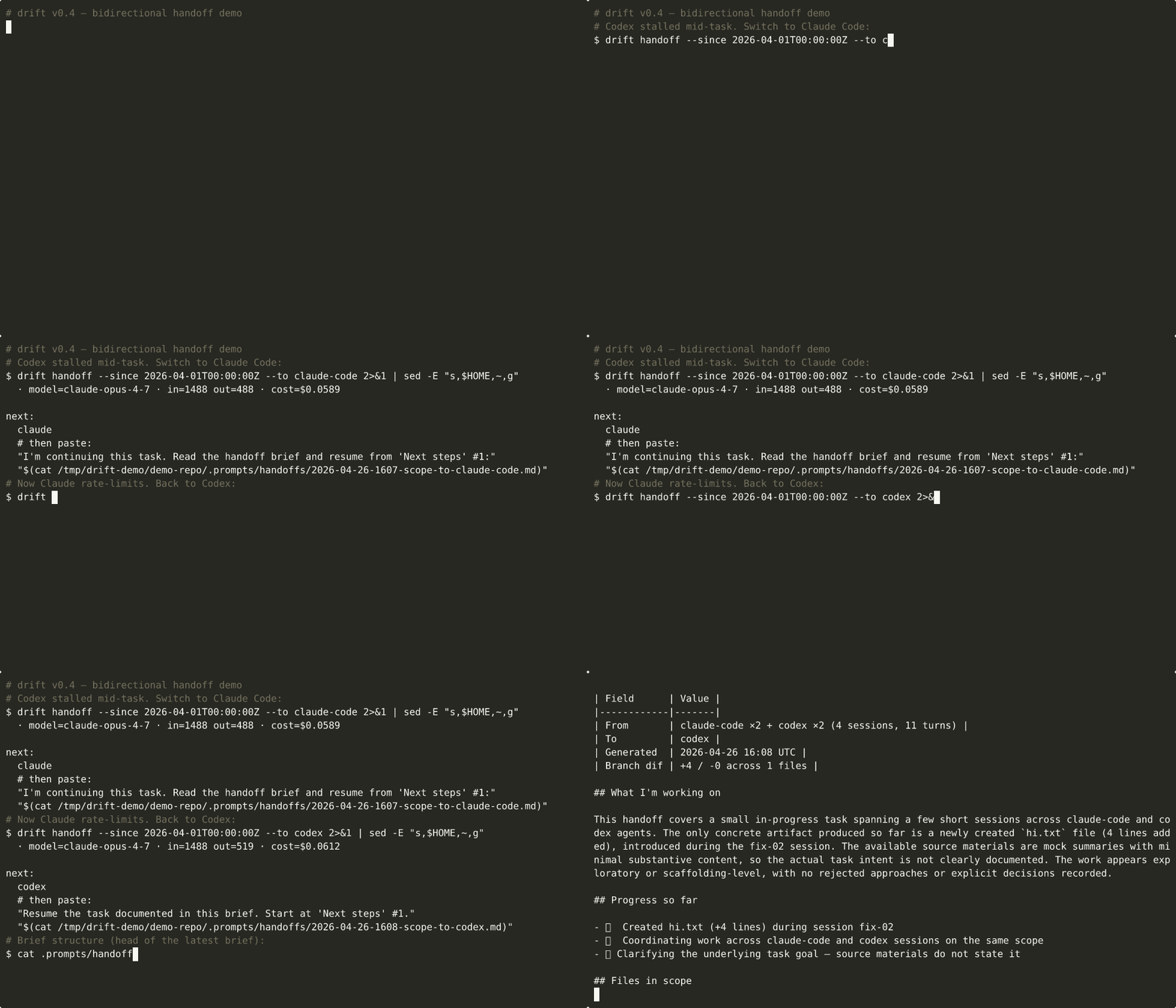
The problem: Your AI coding agent stalled — refused, rate-limited, or just got dumb. Now you need to transfer 30 minutes of context to another agent. Re-pasting a chat history doesn't work; the new agent doesn't know which decisions are settled, which approaches you already rejected, or which file you were halfway through.
drift handoff packages your in-progress task into a markdown brief
any LLM can absorb cold:
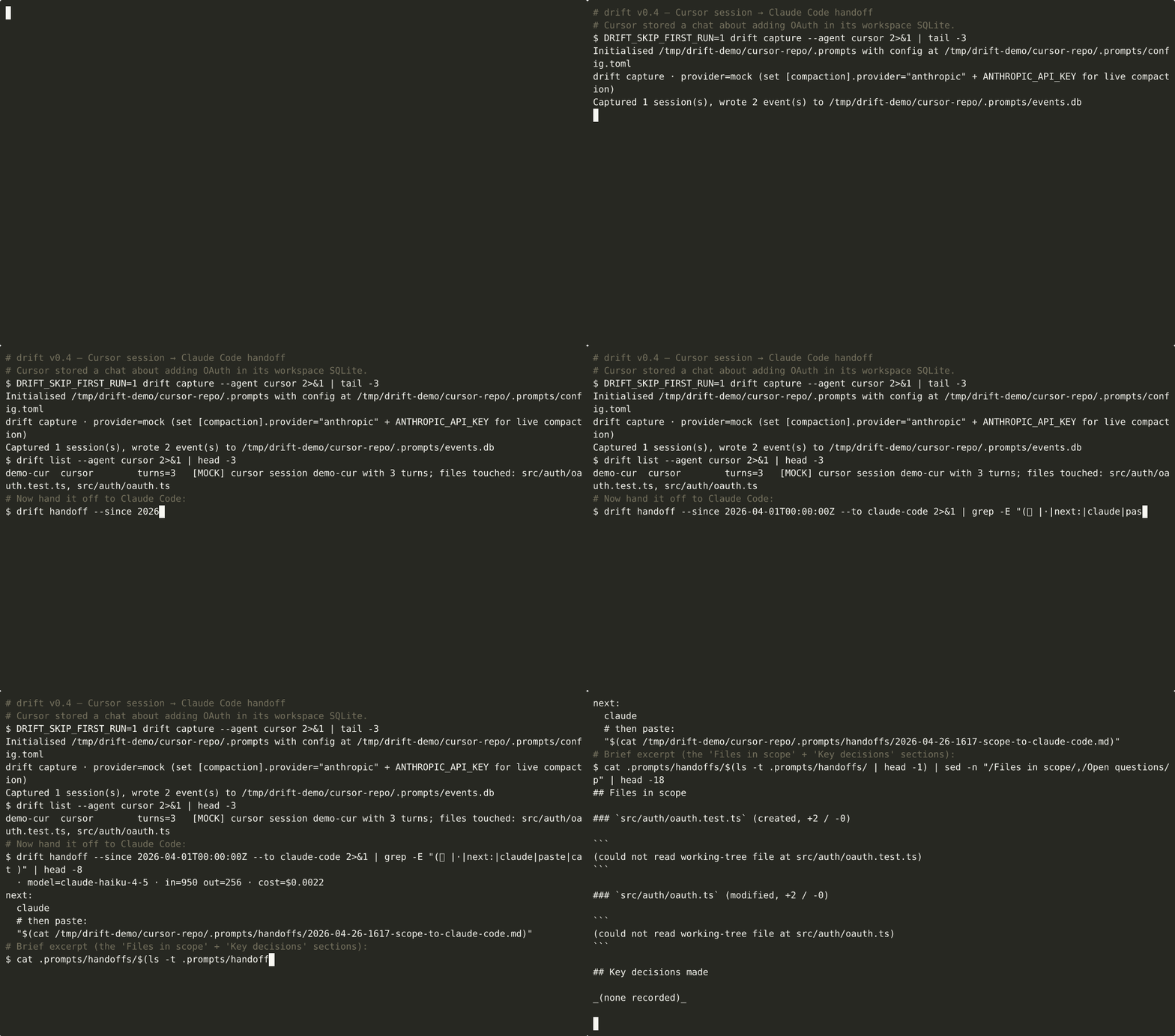
$ drift handoff --branch feature/oauth --to claude-code
⚡ scanning .prompts/events.db
⚡ extracting file snippets and rejected approaches
⚡ compacting brief via claude-opus-4-7
✅ written to .prompts/handoffs/2026-04-25-1530-feature-oauth-to-claude-code.md
The brief lists what you've decided, what you tried and rejected, what's open, and where to resume. Paste it into the next agent and they pick up mid-task without you re-explaining.
drift is built on top of an attribution engine that watches the
local session logs of your AI coding agents (Claude Code, Codex,
Cursor, Aider...), LLM-compacts each completed session, stores the
result in .prompts/ inside your git repo, and binds each session to
its matching commit via git notes. The handoff feature is the
cross-agent task-transfer wedge; the attribution engine powers
drift blame / drift log underneath.
After installation, drift log still shows multi-agent attribution per
commit:
commit abc1234 — Add OAuth login
   💭 [claude-code] 7 events accepted, 0 rejected
   💭 [codex]       3 events accepted, 1 rejected
   ✋ [human]       2 manual edits
…and drift blame still resolves any line back to its full timeline.
See docs/VISION.md for the broader thesis.
Why drift exists
AI coding stopped being a single-agent workflow. A real session today involves:
- Switching agents mid-task: Claude rate-limits, Codex stalls, the model goes off the rails — refusing tasks, hallucinating tool calls, or producing low-quality output. You move to another agent and burn 10 minutes re-explaining what you'd already decided and rejected.
- Forgetting your own work: a week later,
git blametells you which line you wrote, but not which prompt produced it, which approach was settled, or why. - Onboarding teammates with zero context: they see the code, but the reasoning lived in someone else's chat history on someone else's laptop.
drift turns that disposable AI trail into durable project memory:
- Capture, locally:
drift capture(anddrift watchfor live mode) reads the session JSONL your agents already write under~/.claude/projects/and~/.codex/sessions/. Nothing leaves your machine except an optional Anthropic compaction call you can turn off. - Compact, into markdown: each session becomes a small markdown
summary in
.prompts/sessions/— decisions kept, approaches rejected, files touched. Cheap to read, cheap to grep, survives any vendor migration because it's just text in your repo. - Bind, to commits:
drift bind/drift auto-bindattaches each session to the commit it produced viagit notes(refs/notes/drift). The link travels with the repo; it does not pollute commit history. - Hand off, when you switch agents:
drift handoff --branch <b> --to <agent>produces a brief the next agent can absorb cold — what's done, what's open, what was already rejected, and where to resume. - Reverse-lookup, when you forget:
drift blame <file> [--line N]returns the full timeline behind a line of code: which session, which prompt, which agent, plus the human edits that landed on top. - Forward-lookup, when you remember the session but not the diff:
drift trace <session-id>lists everyCodeEventthat session produced. - Audit, across a release:
drift logisgit logwith a per-agent summary under each commit — useful when you need to answer "how much of this release was AI vs. human" without trusting LOC ratios.
Net effect: multi-agent AI coding becomes something you can hand off, review, and reconstruct months later — instead of a chat history that disappears the next time you close a tab.
Install
Homebrew (macOS arm64/x86_64, Linux arm64/x86_64):
brew install ShellFans-Kirin/drift/drift
crates.io (Rust 1.85+ toolchain required):
cargo install drift-ai
Pre-built binaries (GitHub Releases):
curl -sSfL https://github.com/ShellFans-Kirin/drift_ai/releases/latest/download/drift-v0.4.2-$(uname -m)-unknown-linux-gnu.tar.gz \
  | tar xz -C /tmp && sudo mv /tmp/drift /usr/local/bin/drift
drift --version
From source:
git clone https://github.com/ShellFans-Kirin/drift_ai.git
cd drift_ai
cargo install --path crates/drift-cli
Privacy & secrets
drift does not scrub session content. Anything you typed into your
Claude Code / Codex session — including secrets you may have pasted —
will be mirrored into .prompts/ and, by default, committed to your repo.
Two knobs today:
- Set
[attribution].db_in_git = falsein.prompts/config.tomlto keepevents.dblocal only. - Review
.prompts/sessions/beforegit add.
By default, db_in_git = true (teams share blame via the repo). For
solo repos or sensitive content, flip it to false — see
Configuration.
A future release will add a regex-based redaction pass. For full
coverage today, pair drift with
gitleaks or
trufflehog as a
pre-commit hook.
If you routinely paste secrets into AI sessions, wait for the redaction pass before enabling
drifton shared repos.
The first time you run drift capture, you'll see a one-shot notice
restating the above; press Enter to acknowledge. Set
DRIFT_SKIP_FIRST_RUN=1 to suppress in CI.
See docs/SECURITY.md for the full threat model and roadmap.
Quickstart
Six commands, zero config:
cd your-git-repo
drift init                                          # scaffold .prompts/
drift capture                                       # pull sessions from ~/.claude + ~/.codex
drift handoff --branch feature/oauth --to claude   # task transfer (since v0.2)
drift blame src/foo.rs                              # reverse lookup: who wrote what
drift trace <session-id>                            # forward lookup: session → events
drift install-hook                                  # auto-run after each commit
drift handoff is the v0.2 headline feature: package your in-progress
task into a brief the next agent can absorb cold. See §Handoff
for the full flow.
Verified from /tmp with zero prior state:
rm -rf /tmp/drift-smoke && mkdir -p /tmp/drift-smoke && cd /tmp/drift-smoke
git init -q && git config user.email "x@y" && git config user.name x
drift init && drift capture && drift list
Handoff — cross-agent task transfer
drift handoff reads your local events.db (built up by drift capture
or drift watch), filters down to the sessions in the scope you ask
for, and produces a markdown brief structured for handoff:
- What I'm working on — 3-5 sentences of intent (LLM-compacted).
- Progress so far — done / in-progress / not-started bullets.
- Files in scope — modified ranges with ±5 lines of context.
- Key decisions — with session+turn citations.
- Rejected approaches — pre-extracted from session tool errors.
- Open questions / blockers.
- Next steps.
- How to continue — the prompt to paste into the target agent.
# scope by branch (recommended): all sessions whose commits land on this
# branch since it diverged from main
drift handoff --branch feature/oauth --to claude-code

# scope by time
drift handoff --since 2026-04-25T08:00:00Z --to codex

# single-session debug
drift handoff --session abc12345-xxx --print

# pipe to clipboard or another tool
drift handoff --branch feature/oauth --print | pbcopy
The default model is claude-opus-4-7 — the brief is what the next
agent reads verbatim, so narrative quality matters more than for the
per-session compaction in v0.1. Each handoff costs ≈ $0.10–$0.30 USD
at Opus rates. To trade narrative for ~30× cost reduction, drop to
Haiku in .prompts/config.toml:
[handoff]
model = "claude-haiku-4-5"   # default is "claude-opus-4-7"
Live mode — event-driven watcher
drift watch is an event-driven daemon backed by the platform's native
file-system notifications (FSEvents on macOS, inotify on Linux,
ReadDirectoryChangesW on Windows). It coalesces rapid writes against the
same session file inside a 200ms window, so a long running Claude Code
or Codex session produces one capture pass per idle moment, not one
per tool call. State is persisted to ~/.config/drift/watch-state.toml
so a restart resumes rather than rescans. Ctrl-C finishes the
current capture and exits cleanly.
drift watch
# drift watch · event-driven; Ctrl-C to stop
#   watching /home/you/.claude/projects
#   watching /home/you/.codex/sessions
#   first run; capturing every session seen
# drift capture · provider=anthropic
# Captured 10 session(s), wrote 192 event(s) to .prompts/events.db
# ...
# drift watch · interrupt received; exiting after last capture
Cost transparency
Every Anthropic compaction call is logged to compaction_calls in
events.db with input / output / cache token counts and a computed USD
cost (built-in pricing table per model; cross-check against
https://www.anthropic.com/pricing before trusting as invoice-ready).
drift cost
# drift cost — compaction billing
#   total calls      : 10
#   input tokens     : 120958
#   output tokens    : 6582
#   cache creation   : 0
#   cache read       : 0
#   total cost (USD) : $0.1539

drift cost --by model
# ── grouped by model (descending cost)
#   key                    calls   input_tok   output_tok     cost (USD)
#   claude-haiku-4-5          10      120958         6582        $0.1539

drift cost --by session
# ── grouped by session (descending cost)
#   key                                     calls   input_tok   output_tok     cost (USD)
#   4b1e2ba0-621c-4977-af3f-2a9df5ac45ec        2       51696         2448        $0.0564
#   ad01ae46-156f-403b-b263-dd04a232873a        1       33662         2390        $0.0456
#   ...
Filter with --since <date>, --until <date>, --model <name>.
Switching from Opus to Haiku on the same 10-session corpus takes
compaction from $2.91 → $0.15 — a ~19× reduction at the cost of
slightly terser summaries.
Cost across providers (v0.4 multi-LLM)
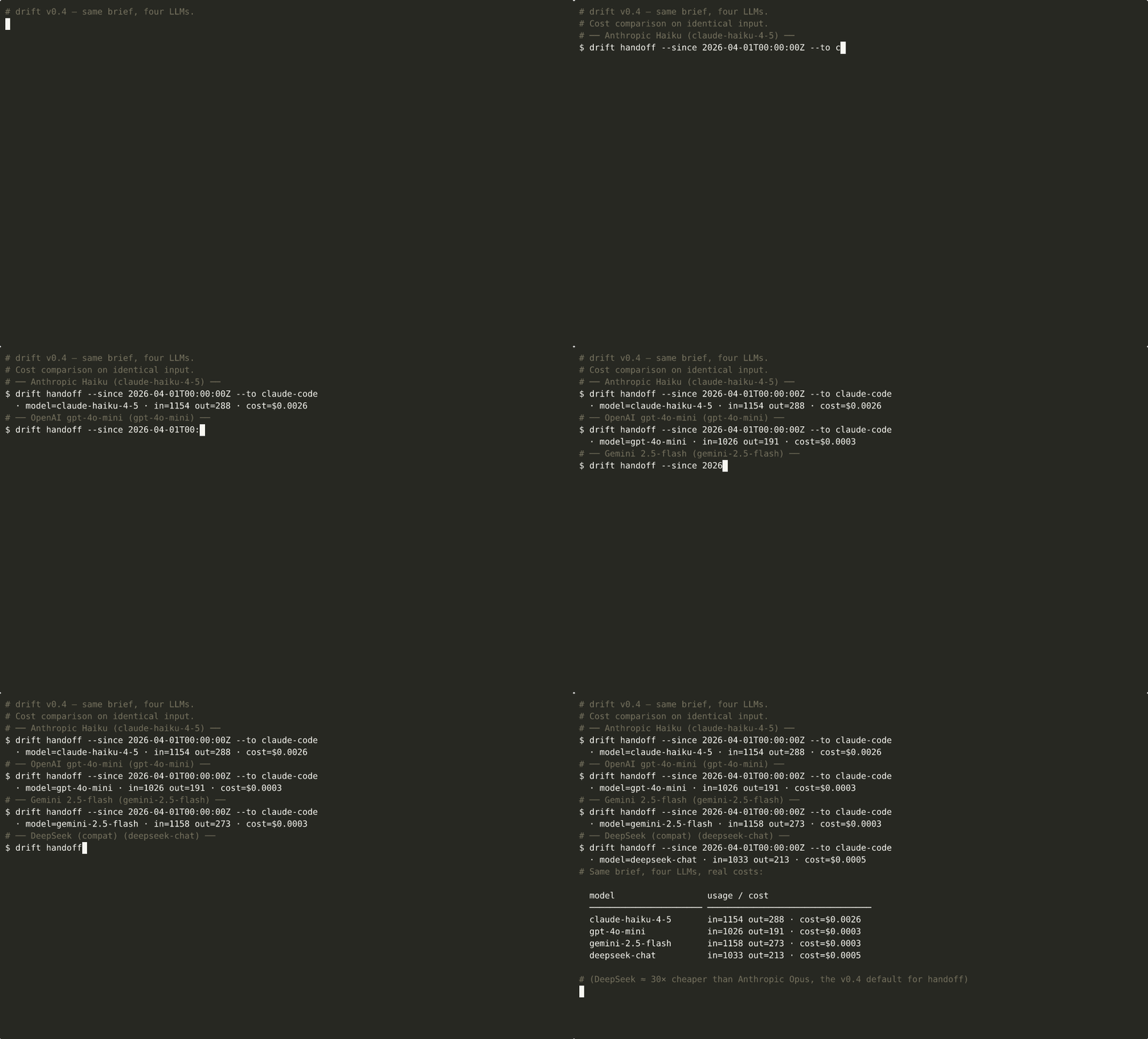
Same 4-turn fixture session, different provider for the handoff brief:
| Provider | Model | Cost USD | Latency |
|---|---|---|---|
| Anthropic | claude-haiku-4-5 | $0.0028 | 2281 ms |
| OpenAI | gpt-4o-mini | $0.0003 | 3201 ms |
| Gemini | gemini-2.5-flash | $0.0003 | 1505 ms |
| DeepSeek (compat) | deepseek-chat | $0.0005 | 1906 ms |
| Ollama | local model | $0 | varies |
DeepSeek vs default Anthropic Opus on a real handoff: roughly 30×
cheaper at similar narrative quality. Switch with one line in
.prompts/config.toml — see Configuration.
Source: docs/V030-V040-SMOKE.md + docs/V042-BUGFIX-VERIFY.md.
AI-native blame
drift blame is the reverse lookup. Given a line of code, it returns
the full timeline of who touched it (multi-agent + human edits), with
each entry linked back to the originating session and prompt.
See docs/VISION.md for the three core scenarios:
reverse (drift blame), forward (drift trace), and audit
(drift log).
MCP integration
Drift AI ships its own stdio MCP server (drift mcp). Any
MCP-compatible client can call the five read-only tools — drift_blame,
drift_trace, drift_rejected, drift_log, drift_show_event — to
query the attribution store without spawning a subshell.
Claude Code (one command):
claude mcp add drift -- drift mcp
Codex:
codex mcp add drift -- drift mcp
Tools are read-only by design — anything that mutates state
(capture / bind / sync) stays CLI-only.
Commands
| Command | Purpose |
|---|---|
drift init |
scaffold .prompts/ + project config |
drift capture |
one-shot: discover sessions, compact, attribute |
drift watch |
background daemon, debounced re-capture |
drift handoff [--branch B --to A --print --output P] |
v0.2 — cross-agent task brief |
drift list [--agent A] |
list captured sessions |
drift show <id> |
render a compacted session |
drift blame <file> [--line N] [--range A-B] |
reverse lookup |
drift trace <session-id> |
forward lookup |
drift diff <event-id> |
single event's unified diff |
drift rejected [--since DATE] |
list rejected AI suggestions |
drift log [-- <git-args>] |
git log + per-agent session summaries |
drift bind <commit> <session> |
attach a session to a commit note |
drift auto-bind |
timestamp-pair every session to its closest commit |
drift install-hook |
install a non-blocking post-commit hook |
drift sync push|pull <remote> |
push/pull refs/notes/drift |
drift config get|set|list |
global + project TOML merge |
drift mcp |
run the stdio MCP server |
Configuration
Global: ~/.config/drift/config.toml
Project (overrides): <repo>/.prompts/config.toml
[attribution]
db_in_git = true          # default — teams share blame via the repo

[connectors]
claude_code = true
codex = true
aider = false             # feature-gated stub

[compaction]
provider = "anthropic"      # default; switch to "mock" for offline / testing
model = "claude-haiku-4-5"  # or claude-sonnet-4-6 / claude-opus-4-7

[handoff]
model = "claude-opus-4-7"   # narrative-quality is the value; switch to
                            # "claude-haiku-4-5" for ~30x cost reduction
ANTHROPIC_API_KEY: required for the live API compaction path. When
it's unset, drift_ai transparently falls back to MockProvider and
every summary is labelled [MOCK] so you never mistake a fallback
run for a real one — nothing else in the pipeline changes.
How drift compares to Cursor / Copilot history, Cody, and git blame
itself: docs/COMPARISON.md.
Honest limitations (v0.4.2)
- Human-edit detection is SHA-ladder only — we do not claim authorship,
the
humanslug means "no AI session produced this". See VISION.md. Bash python -c "open(...).write(...)"is best-effort; anything the shell lexer misses is caught by the SHA ladder and attributed tohuman.- Codex
reasoningitems are encrypted; we count them, we do not surface them. - Cost totals use a hardcoded pricing table — cross-check against https://www.anthropic.com/pricing before treating as invoice-ready.
- Context-window truncation is deterministic head+tail elision (Strategy 1); hierarchical summarization (Strategy 2) is stubbed behind a feature flag for a future release.
About
drift is an independent open-source project by
@ShellFans-Kirin
(shellfans.dev). It is not affiliated with
Anthropic, OpenAI, or any other vendor whose agents it integrates with —
drift is built on top of their session logs, not by them.
Originally built for myself when I kept losing context between Codex stalls and Claude rate-limits. The v0.2
drift handofffeature is the part I personally use most.
License
Apache 2.0 — see LICENSE.
Contributing
See CONTRIBUTING.md — it walks through adding a new connector using the Aider stub as the worked example.
Установка Drift
У этого сервера нет опубликованного пакета — он собирается из исходников. Открой репозиторий и следуй инструкции в README.
▸ github.com/ShellFans-Kirin/drift_aiFAQ
Drift MCP бесплатный?
Да, Drift MCP бесплатный — установка в пару кликов через Unyly без оплаты.
Нужен ли API-ключ для Drift?
Нет, Drift работает без API-ключей и переменных окружения.
Drift — hosted или self-hosted?
Self-hosted: сервер запускается локально на твоей машине командой из раздела установки.
Как установить Drift в Claude Desktop, Claude Code или Cursor?
Открой Drift на unyly.org, выбери вкладку своего клиента (Claude Desktop, Claude Code, Cursor) и нажми Install — конфиг сгенерируется автоматически, без правки JSON.
Похожие MCP
Fetch
Web content fetching and conversion for efficient LLM usage.
AWS KB Retrieval
Retrieval from AWS Knowledge Base using Bedrock Agent Runtime.
 автор: modelcontextprotocol
Spring AI MCP Server
Provides auto-configuration for setting up an MCP server in Spring Boot applications.
llm-analysis-assistant
A very streamlined mcp client that supports calling and monitoring stdio/sse/streamableHttp, and can also view request responses through the /logs page. It also
 автор: xuzexin-hz
MCP-Agent
A simple, composable framework to build agents using Model Context Protocol by [LastMile AI](https://www.lastmileai.dev)
 автор: lastmile-ai
Spring AI MCP Client
Provides auto-configuration for MCP client functionality in Spring Boot applications.
mcp.natoma.ai
A Hosted MCP Platform to discover, install, manage and deploy MCP servers by [Natoma Labs](https://www.natoma.ai)
MCPHub
Website to list high quality MCP servers and reviews by real users. Also provide online chatbot for popular LLM models with MCP server support.
MCP Servers Rating and User Reviews
Website to rate MCP servers, write authentic user reviews, and [search engine for agent & mcp](http://www.deepnlp.org/search/agent)
mkinf
An Open Source registry of hosted MCP Servers to accelerate AI agent workflows.
Compare Drift with
Не уверен что выбрать?
Найди свой стек за 60 секунд
Автор?
Embed-бейдж для README
Похожее
Все в категории ai