
Fadlie
БесплатноНе проверенMCP server for DataHub that detects duplicate datasets across platforms and governance gaps, enabling users to apply governance from one twin to another with dr

Описание
MCP server for DataHub that detects duplicate datasets across platforms and governance gaps, enabling users to apply governance from one twin to another with dry-run by default.
README
The same data lives in four systems. Your catalog knows every path between them. Only one copy is governed.
Fadlie is an MCP agent for DataHub. It finds datasets that hold the same data across different platforms, then finds the governance — owners, domain, descriptions, PII tags, glossary terms — that stopped at one of them. It can level the difference, and it never writes a value it did not read from a dataset it names.
Built for Build with DataHub: The Agent Hackathon, on the contest's own
showcase-ecommerce dataset. Every number below is produced by a script in this
repository, against a live DataHub instance.
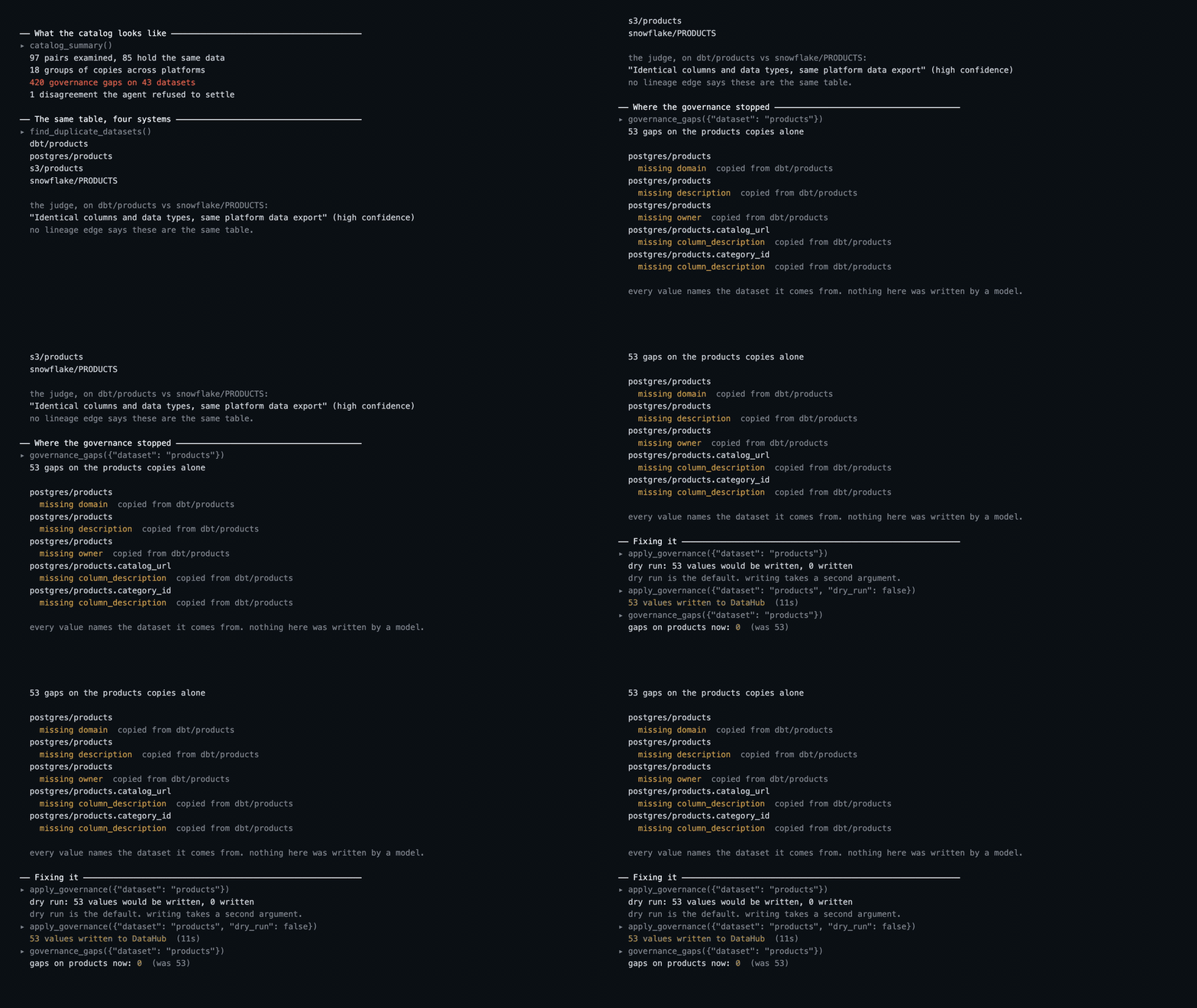
Sixteen seconds of a real run against the deployed agent: 97 pairs examined, 18
groups of copies, 53 gaps on the products copies alone — then zero. The full
video, two minutes and forty seconds, is at
https://youtu.be/YXff0HNRAwU.
Every finding, browsable, nothing to install: https://benewende-dev.github.io/fadlie/ — each gap with the dataset its value would be copied from, the judge's reason for every pair, and the one conflict Fadlie refuses to settle. That page is generated from examples/ by a script that connects to nothing.
What the measurements found
Run python scripts/mesurer-jumeaux.py to reproduce all of this.
The lineage graph tells you nothing about whether two datasets hold the same data. The graph is a single component: 103 nodes, 161 edges, no isolated dataset. All 88 same-name pairs are connected — and so is every one of the 316 pairs picked at random. Connectivity carries no information whatsoever.
Distance carries almost none. Set the threshold at 4 hops and you catch 86 of the 88 same-name pairs, along with 199 of the 316 strangers. There is no cut that keeps the twins and drops the rest.
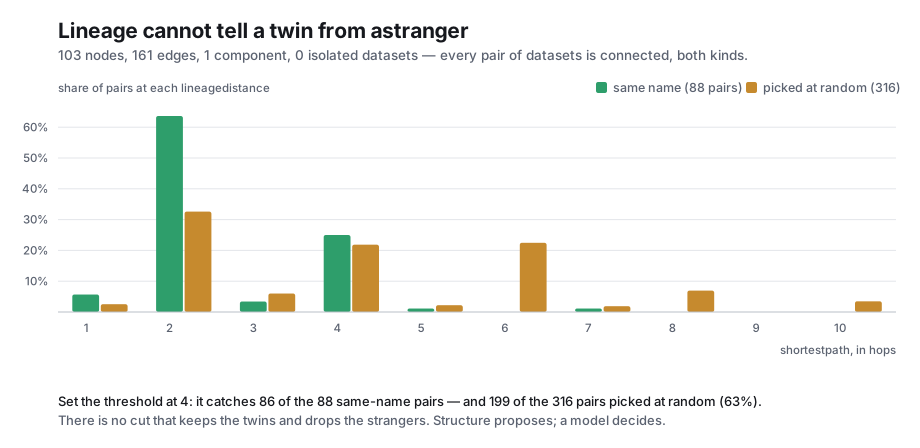
python scripts/capturer-lignage.py writes the numbers behind that figure to
examples/lineage_graph.json, and
scripts/dessiner-le-lignage.py draws it from that file without touching the
network. The capture also checks something the figure depends on: charts and
dashboards hang off the graph as leaves that cannot be traversed, so dropping
them leaves 90 nodes and 123 edges and not one distance changes — verified
across all 4 489 pairs rather than assumed.
Names tell you almost as little. Three of fifteen same-name groups are not
the same thing: four Tableau datasets called Custom SQL Query share 0 % of
their columns; promotions shares 9 %.
And the governance does not travel. Eleven tables exist identically on dbt,
Snowflake, Postgres and S3 — 100 % column overlap, customers has the same 22
columns in all four. On the datapack as it ships, dbt/customers has three
owners, a domain and a description; its three twins have none, none and none.
Twelve identical columns are annotated on one side and bare on the other, and
customers.customer_id carries the PII_Data tag on Postgres alone.
Ask that catalog where the personal data is, and it answers with two datasets, with the confidence of something that has looked.
The live demo no longer matches that paragraph, and that is the point. Fadlie has since levelled three of the eighteen groups on the running instance —
customers,orders,products— writing 102, 60 and 53 values that it read from their twins. The run captured in examples/ counts 373 gaps left on 46 datasets, so there is plenty still to try. That total moves a little between runs — the judge confirms 83, 84 or 85 of the same 97 pairs — while the structural findings do not move at all. Reload the datapack into a fresh DataHub and the numbers above come back exactly.
How it decides
Structure suggests. A model decides. Nothing is invented.
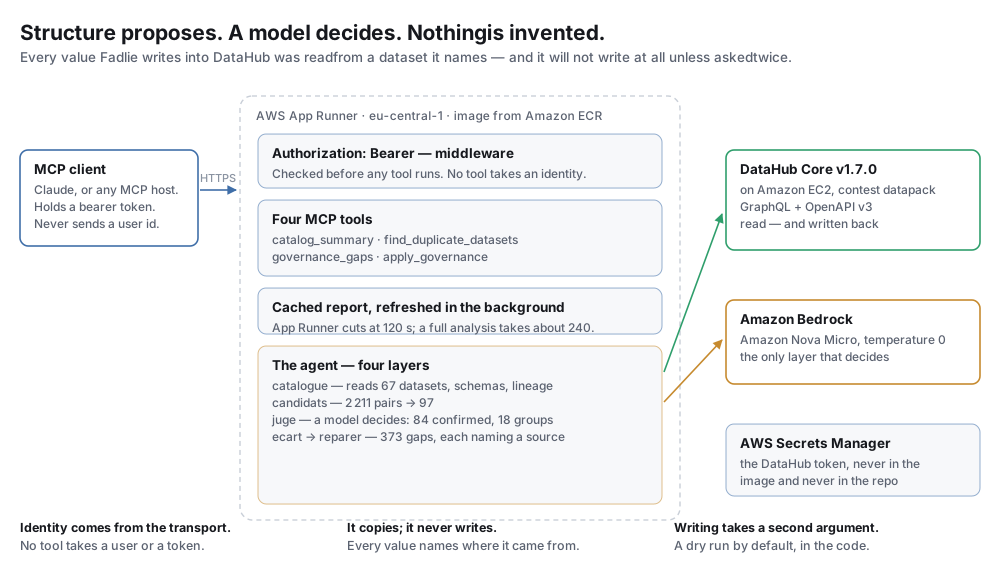
| Layer | What it does | Why it cannot be the last word |
|---|---|---|
catalogue |
reads schemas, governance, lineage | — |
candidats |
2 211 pairs → 97 | of those 97, the judge threw out 13 |
juge |
Amazon Nova Micro, temperature 0 | it decides; it never guesses on its own |
ecart |
what one twin has and another lacks | — |
python scripts/mesurer-le-juge.py puts the judge against 16 pairs drawn from
the real catalog, chosen to be hard in both directions: replicas that differ
in case and column count, reference tables of identical shape, aggregates
computed from a table rather than copied from it, and the four homonymous
Tableau queries that share only measure names. 16 out of 16. Ten runs of the
same pair give the same verdict ten times.
Two rules that shape everything
Fadlie copies; it never writes. No value put into the catalog is produced by
a model. Each one comes from a dataset that already carried it, and every
proposal names its source — Ecart refuses to exist without one. A description
generated by a machine is indistinguishable from a description written by the
team that knows the data; six months later nobody can tell which is which.
A disagreement is not a gap. snowflake/ORDER_DETAILS sits in Ecommerce
Operations while its three twins sit in Data Platform Team. Fadlie reports it
and does not choose. Someone decided, or someone erred, and neither is an
agent's call. The conflict is in
examples/governance_gaps_all.json, with
the four datasets and their two answers.
A failure must not look like good news
The judge raises rather than returns "different". If it could silently fail, Fadlie would report no duplicates found — a catalog in good order. Nobody audits good news. So the server probes the model before its first verdict, and both real failure modes are verified: a bare model id (Frankfurt requires the regional inference profile) and credentials without Bedrock access.
The tools
| Tool | What it returns |
|---|---|
catalog_summary |
pairs examined, groups found, gaps, disagreements |
find_duplicate_datasets |
the groups, with the judge's verdict for each pair |
governance_gaps |
every gap, each naming the dataset it would be copied from |
apply_governance |
writes them. Dry run by default |
No tool takes a user, a token, or an identity — authorisation comes from the
Authorization header, and a check enforces it because nothing in the language
does.
Running it
cp .env.example .env && $EDITOR .env
set -a && . ./.env && set +a

python -m pytest tests/          # 77 tests, no network, no bill
python -m fadlie check           # reads config, connects to nothing
python -m fadlie report          # the full analysis, printed
python -m fadlie serve           # the MCP server, locally

python scripts/mesurer-jumeaux.py    # every number in this README
python scripts/mesurer-le-juge.py    # the judge against 16 hard pairs
python scripts/verifier-mcp.py       # 24 checks through a real MCP client
What it runs on
- DataHub Core v1.7.0 on EC2, loaded with the contest's
showcase-ecommercedatapack — 67 datasets across Snowflake, dbt, Postgres, S3, Tableau, PowerBI and Looker. - Amazon Bedrock, Amazon Nova Micro as the judge, in
eu-central-1. - AWS App Runner for the MCP server, over HTTPS.
Licence
Apache License 2.0 — see LICENSE.
Установка Fadlie
У этого сервера нет опубликованного пакета — он собирается из исходников. Открой репозиторий и следуй инструкции в README.
▸ github.com/benewende-dev/fadlieFAQ
Fadlie MCP бесплатный?
Да, Fadlie MCP бесплатный — установка в пару кликов через Unyly без оплаты.
Нужен ли API-ключ для Fadlie?
Нет, Fadlie работает без API-ключей и переменных окружения.
Fadlie — hosted или self-hosted?
Self-hosted: сервер запускается локально на твоей машине командой из раздела установки.
Как установить Fadlie в Claude Desktop, Claude Code или Cursor?
Открой Fadlie на unyly.org, выбери вкладку своего клиента (Claude Desktop, Claude Code, Cursor) и нажми Install — конфиг сгенерируется автоматически, без правки JSON.
Похожие MCP
GitHub
PRs, issues, code search, CI status
 автор: GitHub
Filesystem
Secure file operations with configurable access controls.
Memory
Knowledge graph-based persistent memory system.
Template MCP Server
A CLI tool to create a new Model Context Protocol server project with TypeScript support, dual transport options, and an extensible structure
 автор: mcpdotdirect
Compare Fadlie with
Не уверен что выбрать?
Найди свой стек за 60 секунд
Автор?
Embed-бейдж для README
Похожее
Все в категории development