
FastMCP LaTeX Server (Tex )
БесплатноНе проверенMCP server that renders LaTeX to PDF via pdflatex, supporting raw LaTeX and Jinja2 templates with artifact generation.

Описание
MCP server that renders LaTeX to PDF via pdflatex, supporting raw LaTeX and Jinja2 templates with artifact generation.
README
MseeP.ai Security Assessment Badge
FastMCP LaTeX Server (tex-mcp)
A small FastMCP-based Microservice that renders LaTeX to PDF. The server exposes MCP tools
to render raw LaTeX or templates and produces artifacts (a .tex file and .pdf)
under src/artifacts/.
This repository is prepared to run locally and to be loaded by Claude Desktop (via the
Model Context Protocol). The default entrypoint is run_server.py.
Demo
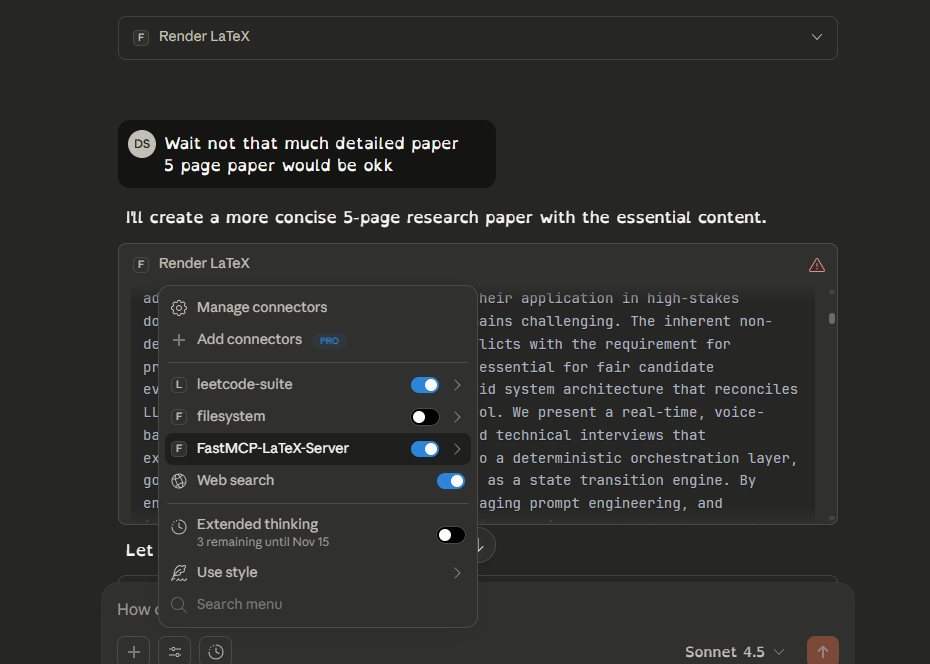
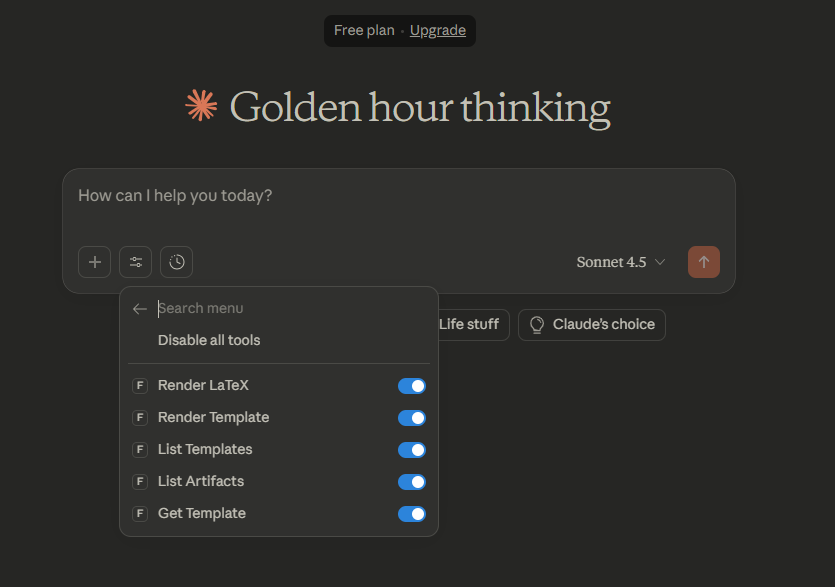
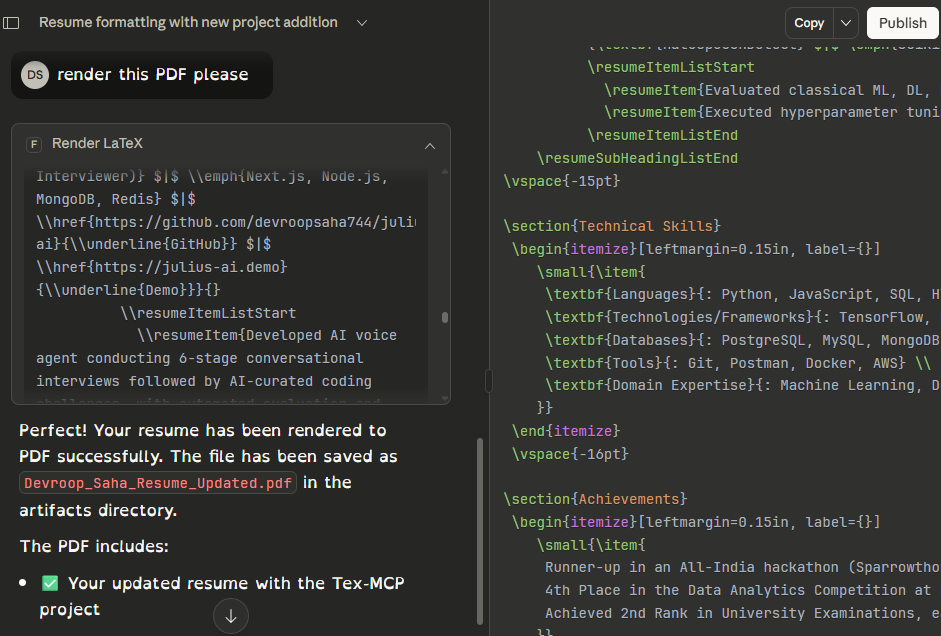
Quick features
- Render raw LaTeX to
.texand (optionally).pdfusing pdflatex - Render Jinja2 templates and compile to PDF
- Designed to run as an MCP server for Claude Desktop and other MCP-capable clients
Tools exposed by this MCP server
- Total tools: 5
- render_latex_document — write LaTeX and optionally compile to PDF
- render_template_document — render a Jinja2 template and optionally compile
- list_templates — list available templates
- list_artifacts — list files produced in
src/artifacts/ - get_template — return the raw contents of a template file so clients can inspect it before rendering
Getting started (local development)
Prerequisites
- Python 3.10+ (the project uses modern pydantic/fastapi stack)
- LaTeX toolchain (pdflatex) for PDF compilation (optional; if missing, server returns .tex only)
- Create a project virtualenv and install deps
Clone from GitHub
If you want to work from the canonical repository on GitHub, clone it first:
git clone https://github.com/devroopsaha744/TexMCP.git
cd TexMCP
After cloning you can follow the venv creation and install steps below.
python -m venv .venv
. .\\.venv\\Scripts\\Activate.ps1
python -m pip install --upgrade pip
pip install -r requirements.txt
- Run the server directly (stdio mode - used by Claude Desktop)
. .\\.venv\\Scripts\\Activate.ps1
python .\\run_server.py
# or run the venv python explicitly if you don't activate
.# .venv\\Scripts\\python.exe run_server.py
If run in stdio mode the server will speak MCP over stdin/stdout (this is what Claude Desktop
expects when it spawns the process). If you prefer HTTP, edit run_server.py and switch the
transport to http (see commented code) and run via uv run or uvicorn.
- Artifacts
Rendered outputs are placed in src/artifacts/. For each job you should see a .tex file and
— if pdflatex is available — a matching .pdf.
Templates
- Several example templates live in
src/mcp_server/templates/. There are 15 templates included (for examplesample_invoice.tex.j2,sample_letter.tex.j2,sample_resume.tex.j2). Uselist_templatesto get the full list programmatically. The templates are deliberately simple and ready to customize — add your own.tex.j2files to that folder to expand the catalog.
Included templates (in src/mcp_server/templates/)
default.tex.j2(base example template)sample_invoice.tex.j2sample_invoice2.tex.j2sample_letter.tex.j2sample_report.tex.j2sample_resume.tex.j2sample_presentation.tex.j2sample_certificate.tex.j2sample_coverletter.tex.j2sample_poster.tex.j2sample_thesis.tex.j2sample_receipt.tex.j2sample_recipe.tex.j2sample_poem.tex.j2sample_cv.tex.j2
Integration with Claude Desktop (quick)
Recommended: use the fastmcp CLI installer which will set things up to run from the project directory and use the project venv.
From your project root (with the venv already created and deps installed):
fastmcp install claude-desktop run_server.py --project C:\\Users\\DEVROOP\\Desktop\\tex-mcp
This ensures uv runs inside the project directory and uses the project's environment. After the installer runs, fully quit and restart Claude Desktop.
Manual Claude Desktop config
If you edit Claude's config yourself (Windows: %APPDATA%\\Claude\\claude_desktop_config.json), add a single server entry that points to the project Python executable. Example (replace paths if needed):
{
  "mcpServers": {
    "FastMCP-LaTeX-Server": {
      "command": "C:\\\\Users\\\\DEVROOP\\\\Desktop\\\\tex-mcp\\\\venv\\\\Scripts\\\\python.exe",
      "args": [
        "C:\\\\Users\\\\DEVROOP\\\\Desktop\\\\tex-mcp\\\\run_server.py"
      ],
      "cwd": "C:\\\\Users\\\\DEVROOP\\\\Desktop\\\\tex-mcp",
      "transport": "stdio"
    }
  }
}
Notes
- Do NOT point Claude at the virtualenv
activatescript — it is a shell helper and not an executable. Point Claude to thepython.exeinside the venv (or touv.exeinside the venv if you installeduv). - After any config changes, fully restart Claude Desktop.
Docker
This project includes a Dockerfile so you can run the MCP server in a container.
Build (no LaTeX):
docker build -t fastmcp-latex:latest .
Build with LaTeX (larger image):
docker build --build-arg INSTALL_TEX=1 -t fastmcp-latex:with-tex .
Run (HTTP mode exposed on port 8000):
docker run -p 8000:8000 --rm --name fastmcp-latex fastmcp-latex:latest
Notes
- The container sets
MCP_TRANSPORT=httpby default. Inside the container the server binds to0.0.0.0:8000. - If you want to run the server in
stdiomode in a container you can override the env var:
docker run -e MCP_TRANSPORT=stdio ...
Artifact persistence
- To persist rendered artifacts on the host, bind mount the
src/artifactsdirectory:
docker run -p 8000:8000 -v $(pwd)/src/artifacts:/app/src/artifacts fastmcp-latex:latest
You can Use a Model Context Protocol / FastMCP client library (Like OpenAI Responses API) in your agent code to call tools programmatically. For example, in Python you can use the mcp or fastmcp client (see library docs) to connect to http://localhost:8000/mcp and call render_latex_document with arguments.
Security notes
- If you expose the HTTP endpoint beyond localhost, secure it (TLS, firewall, or authentication) — rendering arbitrary LaTeX can pose risks (shell commands in templates, large resource use).
Contributing
Thanks for wanting to contribute! See CONTRIBUTING.md for the development workflow, commit style, and how to open issues and pull requests.
License
This project is released under the MIT License — see LICENSE.
Установка FastMCP LaTeX Server (Tex )
У этого сервера нет опубликованного пакета — он собирается из исходников. Открой репозиторий и следуй инструкции в README.
▸ github.com/devroopsaha744/TexMCPFAQ
FastMCP LaTeX Server (Tex ) MCP бесплатный?
Да, FastMCP LaTeX Server (Tex ) MCP бесплатный — установка в пару кликов через Unyly без оплаты.
Нужен ли API-ключ для FastMCP LaTeX Server (Tex )?
Нет, FastMCP LaTeX Server (Tex ) работает без API-ключей и переменных окружения.
FastMCP LaTeX Server (Tex ) — hosted или self-hosted?
Self-hosted: сервер запускается локально на твоей машине командой из раздела установки.
Как установить FastMCP LaTeX Server (Tex ) в Claude Desktop, Claude Code или Cursor?
Открой FastMCP LaTeX Server (Tex ) на unyly.org, выбери вкладку своего клиента (Claude Desktop, Claude Code, Cursor) и нажми Install — конфиг сгенерируется автоматически, без правки JSON.
Похожие MCP
GitHub
PRs, issues, code search, CI status
 автор: GitHub
Filesystem
Secure file operations with configurable access controls.
Memory
Knowledge graph-based persistent memory system.
Template MCP Server
A CLI tool to create a new Model Context Protocol server project with TypeScript support, dual transport options, and an extensible structure
 автор: mcpdotdirect
Compare FastMCP LaTeX Server (Tex ) with
Не уверен что выбрать?
Найди свой стек за 60 секунд
Автор?
Embed-бейдж для README
Похожее
Все в категории development