
Folio
БесплатноНе проверенA privacy-first, zero-cost AI assistant that lets you chat with your documents locally via CLI or web app, supporting search, summarization, and Q&A using your

Описание
A privacy-first, zero-cost AI assistant that lets you chat with your documents locally via CLI or web app, supporting search, summarization, and Q&A using your own model.
README
A privacy-first, zero-AI-cost "chat with your documents" assistant. One engine, two front doors: a fully offline command-line app, and an OAuth-secured web app.
Point Folio at a folder and it can read, search, summarize, answer questions about, and reformat the files inside it — and nothing else. Your documents never leave your machine, and the generation runs on your own model, so there is no per-token AI bill.
Folio is built on the Model Context Protocol (MCP) and is designed to exercise its most advanced features in a way that is essential to the use case, not bolted on.
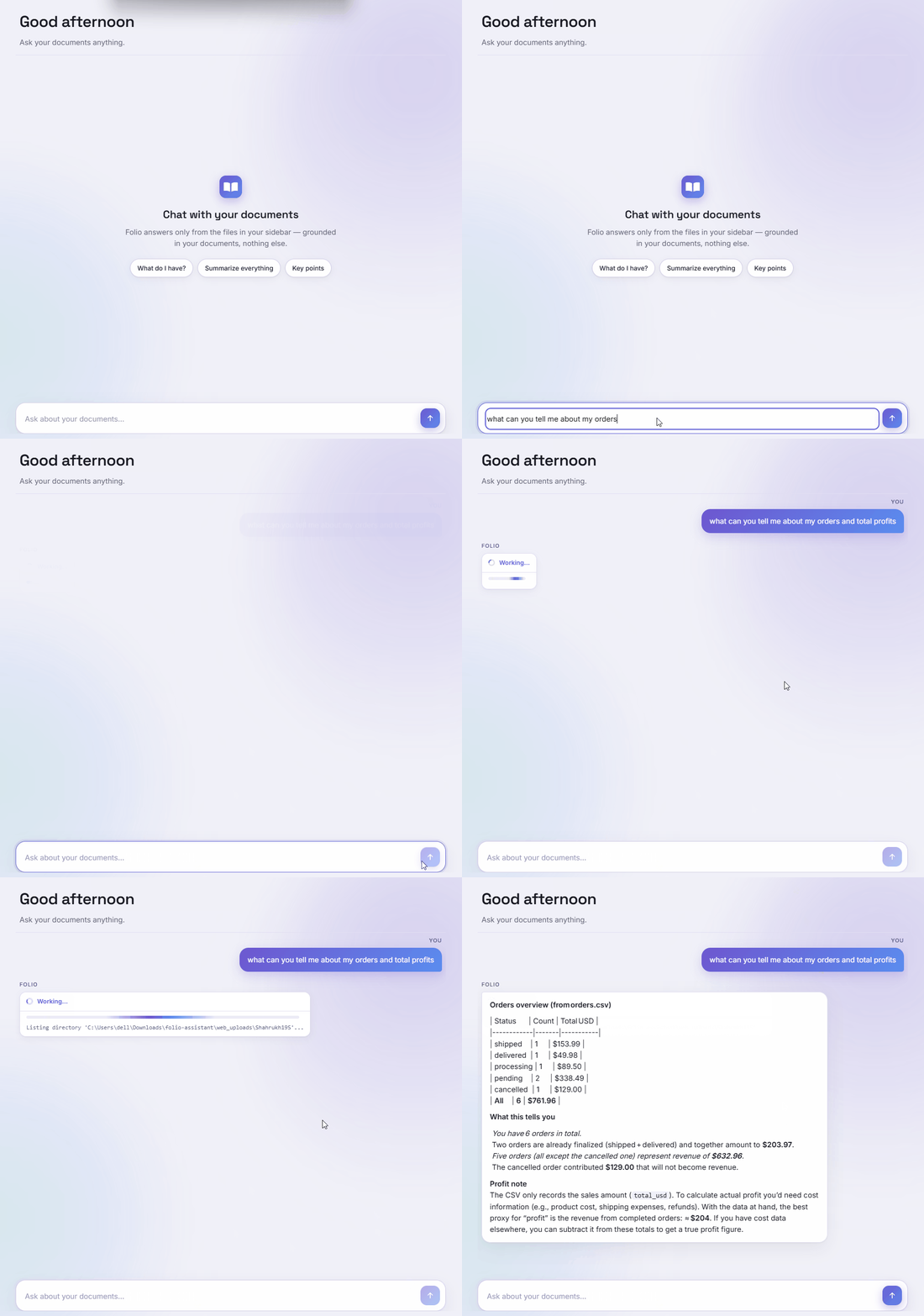
The Aurora web UI answering with live search progress. Demo recorded on a cloud provider for speed — Folio runs identically on local Ollama (just slower).
Why the design is meaningful
| Feature | Why it matters here |
|---|---|
| Roots | The assistant can only touch the folders you explicitly grant — enforced on every file operation. The rest of your disk is unreachable. This is privacy by construction. |
| Sampling | The generation is done by the host's own model (local Ollama by default), not the server. A hosted Folio therefore never racks up AI bills, and each person's documents are processed by their own model. |
| Dual transport | The same server runs locally over stdio (the CLI) or remotely over Streamable HTTP (the web app). |
| OAuth 2.1 | The web app identifies users with GitHub sign-in; the server validates every request's bearer token before running a tool. |
| Logging & progress | Long jobs ("search the whole folder") stream live status, so you can see real work happening instead of a frozen spinner. |
Features
- 🔒 Granted-folder access only — a non-negotiable path guard on every tool.
- 🔎 Search across files with live progress.
- 📝 Summarize a file and answer questions grounded in your documents.
- ✏️ Reformat / edit files in place.
- 💻 Offline CLI (stdio) — private, $0, works with no internet.
- 🌐 Web app (FastAPI + GitHub login) — a designed browser UI: upload or pick documents, ask questions, and watch live search progress stream in over SSE.
- 🔁 Provider-agnostic — local Ollama by default, with Cerebras and OpenRouter as drop-in
cloud fallbacks, plus Anthropic and OpenAI as optional bring-your-own-key upgrades in the CLI
(switch via two lines in
.env).
Architecture
                       ┌───────────────────────────────────────┐
  CLI (local):         │            mcp_server.py              │
   main.py ──stdio────▶│   ONE FastMCP engine:                 │
                       │     • tools   (list/read/search/...)  │
  Web (remote):        │     • resources (roots, files)        │
   Browser ⇄ FastAPI ──┤     • prompts (/summarize, /format)   │
        host           │   roots guard · sampling · logging ·  │
   ──HTTP + OAuth─────▶│   progress · OAuth (HTTP mode)        │
                       └───────────────────────────────────────┘
Both hosts speak to the same server; only the transport differs. In each case the host (the CLI or the FastAPI app) is the MCP client: it runs the agent loop, holds the model keys, and answers the server's sampling / roots / logging / progress callbacks.
Requirements
(First) run and build the previous repository to setup local ollama + litellm tool-calling environment repo-here
ollama pull qwen2.5:7b(No API key needed for the local path. Cerebras / OpenRouter are optional cloud fallbacks.)
Python 3.10+ (developed on 3.13)
uv for dependency + run management
Install
uv sync
Configure
Copy the template and fill in values locally (the real .env is git-ignored):
cp .env.example .env
The default configuration uses local Ollama and needs no keys:
LLM_PROVIDER=ollama
LLM_MODEL=ollama_chat/qwen2.5:7b
Switch provider by changing LLM_PROVIDER + LLM_MODEL together (see .env.example for the
Cerebras / OpenRouter forms).
Run the CLI
Grant one or more folders and start chatting:
uv run main.py path/to/your/folder
With no folder it defaults to the bundled sample-docs/. At the > prompt you can:
- ask questions in plain English (e.g. "how long are backups retained?"),
- mention a file with
@, e.g.@policies/data-retention.md what does this say?, - run a command, e.g.
/summarize README.md.
Exit with Ctrl+C.
Run the web app
The OAuth-secured FastAPI web app runs with:
uv run uvicorn web.app:app --port 8000
Then open http://localhost:8000 and sign in with GitHub. From there you can load the bundled
sample documents or upload your own, click a file to ground a question, and watch live search
progress as Folio answers. It runs the same MCP engine as the CLI, just over HTTP.
Screenshots
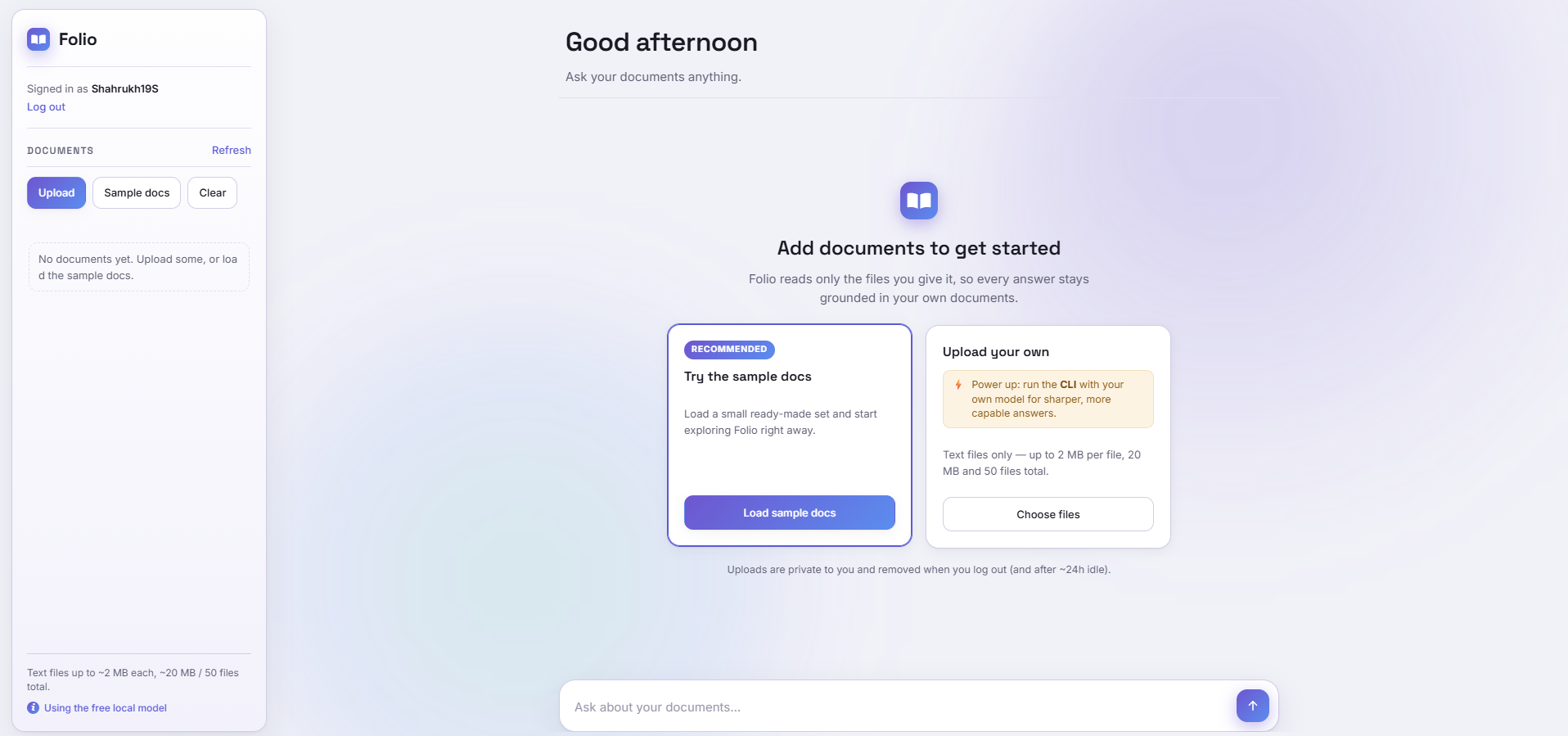 |
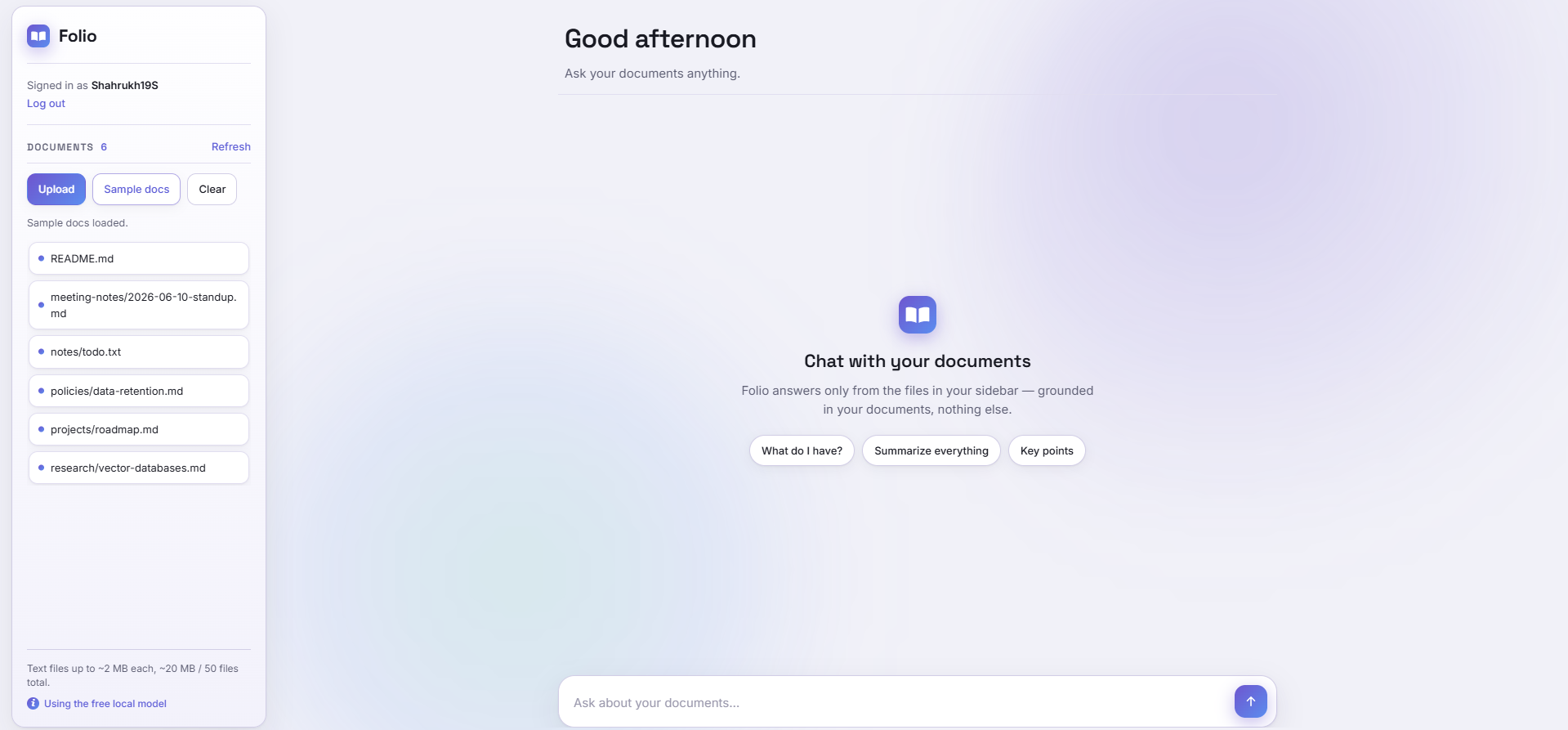 |
| Sign in → load the bundled sample set or upload your own. | Click a document to drop its exact @mention into the question. |
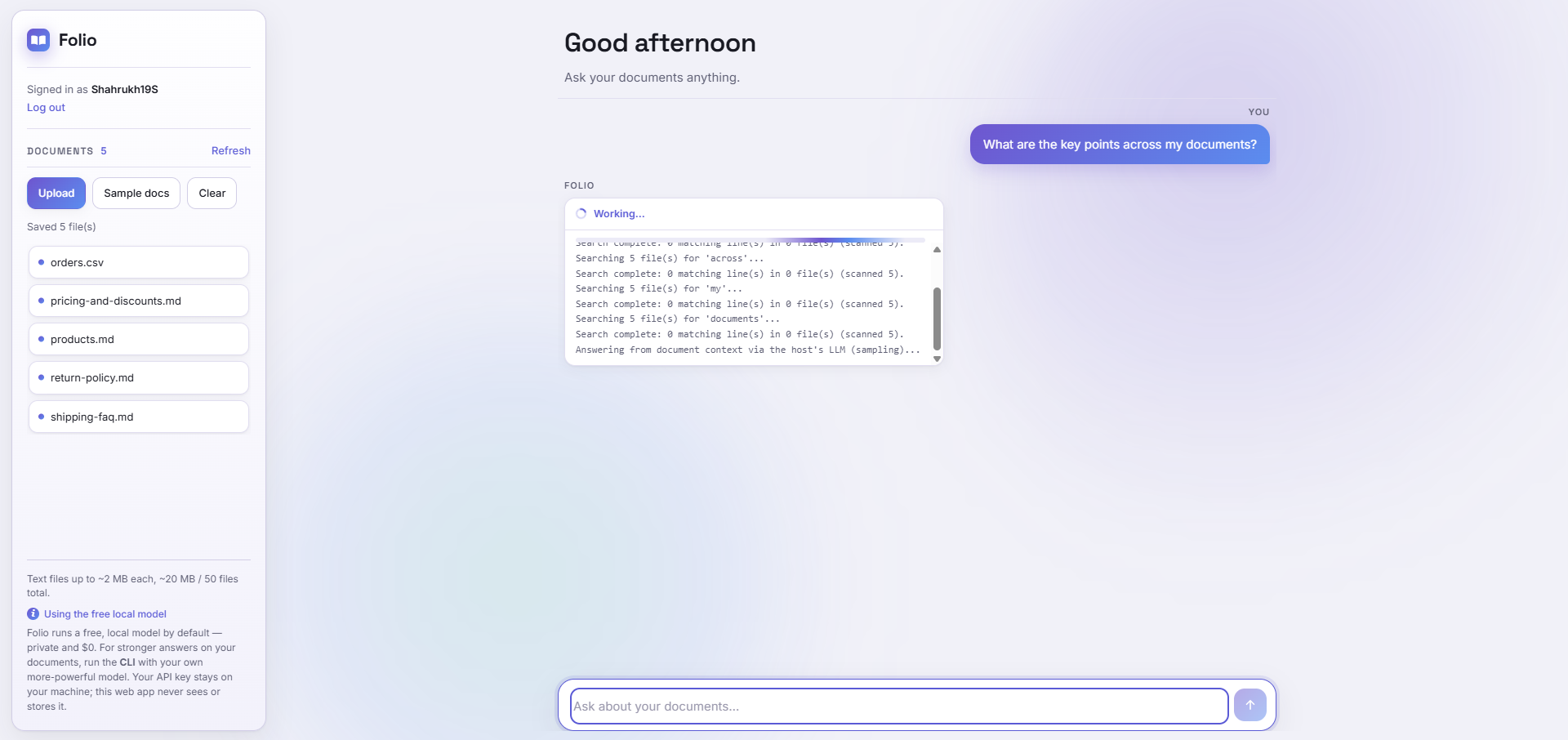 |
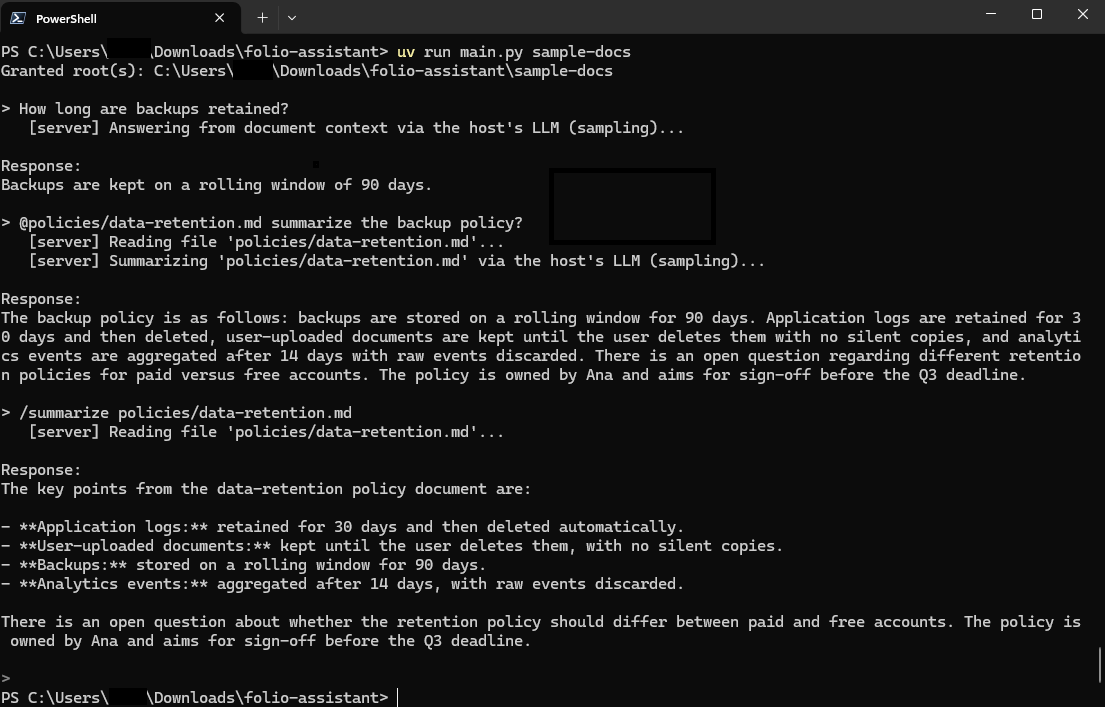 |
| Live search log + progress stream while Folio works. | The fully-offline CLI host (stdio), grounded in your docs. |
Benchmarks & tradeoffs
Folio is provider-agnostic, so which model you point it at is a real tradeoff. These numbers come from running the actual agent loop over a small e-commerce document set (5 grounded questions with known answers), paced to respect free-tier rate limits — see benchmarks/ for the reproducible harness and full results.
| Model | Correct | Median latency/call | Notes |
|---|---|---|---|
Cerebras gpt-oss-120b |
5/5 | ~0.5s | fast + accurate |
Cerebras zai-glm-4.7 |
5/5 | ~0.7s | fast + accurate |
OpenRouter gpt-oss-120b:free |
3/5* | ~3.1s | *2 misses were free-tier rate-limit 429s, not wrong answers |
Ollama qwen2.5:7b (local) |
3/5 | ~9.5s | private + $0, but ~15–20× slower and less consistent |
Three takeaways:
- Speed — Cerebras answers ~15–20× faster per call than the local 7B (~0.5s vs ~9.5s).
- Accuracy — the bigger cloud models are consistently correct; the small local 7B is inconsistent (it confabulated a non-existent file path and sometimes answered "no information").
- Free-tier reality — free cloud tiers rate-limit/throttle under load (OpenRouter's free
llama-3.3-70bwas entirely unusable in a burst). For real throughput, bring your own key.
The honest tradeoff triangle: privacy (local Ollama) ↔ speed + quality (Cerebras) ↔ cost (free,
but throttled). Reproduce with uv run python benchmarks/benchmark.py.
Which provider should I use?
- Privacy / offline / $0 →
ollama(local; slower and less consistent, but nothing leaves your machine). - Fast + accurate, free →
cerebras(near-instant; free tier throttles under heavy use). - Maximum quality (paid, CLI only) →
anthropicoropenaiwith your own key (e.g.LLM_MODEL=anthropic/claude-opus-4-8). The web app never accepts keys — this is a CLI upgrade.
Limitations (honest)
- Local 7B is slow and inconsistent.
qwen2.5:7bis private and free but answers in seconds-to-tens-of-seconds and occasionally mis-uses tools (confabulates a path, or gives up). For reliable, fast answers, use a cloud provider. - Free cloud tiers throttle. Cerebras and OpenRouter free tiers rate-limit under sustained/burst use; the benchmark above was captured with fresh quota — re-running on an exhausted free tier shows worse numbers (a quota artifact, not the models). Bring your own key for real throughput.
- The web app is a shared/hosted convenience, not the fully-private path. Uploaded documents go to the server (isolated per user, deleted on logout + a TTL sweep). For fully offline / private use, run the CLI with local Ollama.
- Text documents only. Folio reads text files (Markdown,
.txt,.csv, code, …) — no images/audio/video. - Anthropic / OpenAI need paid API credits. They are optional CLI upgrades, not required.
Tech stack
- MCP Python SDK (FastMCP) — the server engine, the client session, both transports, and the OAuth modules.
- litellm — one OpenAI-shaped API over Ollama, Cerebras, OpenRouter, Anthropic, and OpenAI (routes by the model-string prefix).
- FastAPI + uvicorn — the async web host; its native async + SSE match the MCP SDK and the live-progress requirement.
- sse-starlette — streams live log/progress events to the browser over Server-Sent Events.
- itsdangerous — the web app remembers your GitHub sign-in in a small signed-cookie
session;
itsdangerouscryptographically signs that cookie so it can't be tampered with (a tamper-evident seal). It's what makes "stay logged in" trustworthy. - prompt-toolkit — the interactive CLI prompt, autocompletion, and history.
Security notes
- The roots guard (
is_path_allowed) is enforced in every file tool — the SDK provides the roots mechanism, but Folio enforces the policy. - OAuth applies to the HTTP transport only; the local stdio CLI needs none (you launched the process yourself).
- Secrets live only in the git-ignored
.env..env.exampleships blank placeholders.
Project status
Complete: the MCP engine (roots, sampling, logging/progress, dual transport, OAuth), the offline CLI, and the OAuth-secured FastAPI web app. A hosted public deployment is intentionally not provided — a shared demo on free model tiers would burn the operator's quota, and the web app deliberately never accepts a visitor's API key — so run it locally (it works fully on your own machine, with the steps above).
License & credits
MIT. Built by extending ollama-mcp-chat-cli, an earlier MCP chat-CLI project.
Установка Folio
У этого сервера нет опубликованного пакета — он собирается из исходников. Открой репозиторий и следуй инструкции в README.
▸ github.com/Shahrukh19S/folio-mcpFAQ
Folio MCP бесплатный?
Да, Folio MCP бесплатный — установка в пару кликов через Unyly без оплаты.
Нужен ли API-ключ для Folio?
Нет, Folio работает без API-ключей и переменных окружения.
Folio — hosted или self-hosted?
Self-hosted: сервер запускается локально на твоей машине командой из раздела установки.
Как установить Folio в Claude Desktop, Claude Code или Cursor?
Открой Folio на unyly.org, выбери вкладку своего клиента (Claude Desktop, Claude Code, Cursor) и нажми Install — конфиг сгенерируется автоматически, без правки JSON.
Похожие MCP
Gmail
Read, send and search emails from Claude
 автор: Google
Slack
Send, search and summarize Slack messages
 автор: Slack
Runbear
No-code MCP client for team chat platforms, such as Slack, Microsoft Teams, and Discord.
Discord Server
A community discord server dedicated to MCP by [Frank Fiegel](https://github.com/punkpeye)
Compare Folio with
Не уверен что выбрать?
Найди свой стек за 60 секунд
Автор?
Embed-бейдж для README
Похожее
Все в категории communication