
Keendreams Security
БесплатноНе проверенOpen source memory layer for security agents. Every fact cites its evidence; only a human can confirm one. Runs in your own Cloudflare account.

Описание
Open source memory layer for security agents. Every fact cites its evidence; only a human can confirm one. Runs in your own Cloudflare account.
README
Your security agents keep re-investigating findings your team already closed. And an agent that believes whatever it reads is one poisoned scan result away from acting on an attacker's text.
KeenDreams fixes both. It is an open source, evidence-backed memory that your agents and analysts share: what is vulnerable, what was remediated, what was accepted as risk, who decided, and when. Every fact cites the evidence it came from, and only a human signed in through a browser can confirm one.
CI Secret scan License: MIT Tests MCP
It is a remote MCP server that runs entirely in your own Cloudflare account. No vendor API keys, no shared secrets, no telemetry. Nothing reaches the authors of this project.
git clone https://github.com/Agent9AI/keendreams-security && cd keendreams-security
npm install && npm run demo      # no account, no config, no network
Then open http://localhost:8787/review.
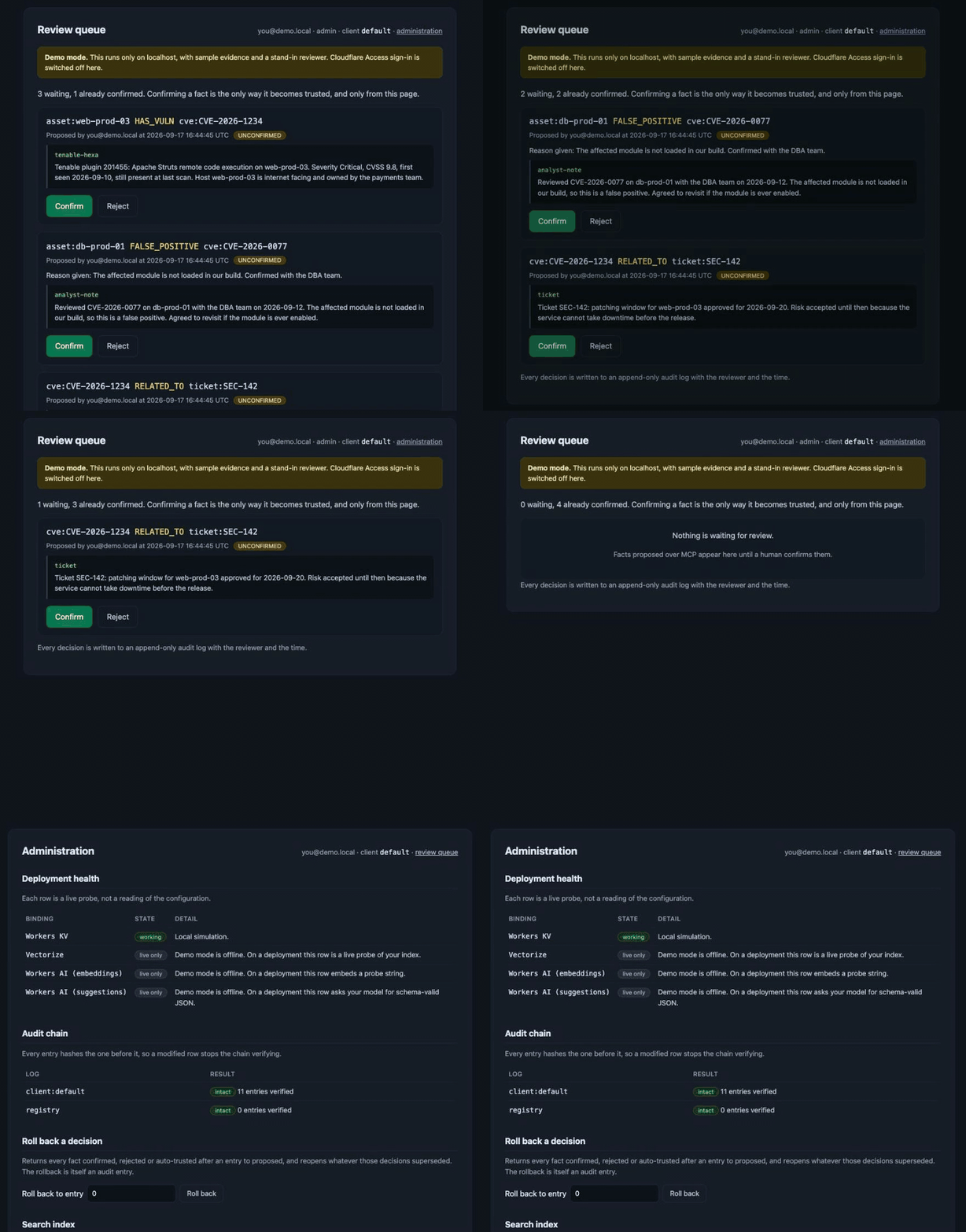
Three facts an agent proposed from a Tenable finding, an analyst note and a ticket, each shown with the evidence behind it. Until a human clicks Confirm, none of them will come back from a query. The last frame is the admin page verifying that every one of those decisions is intact in the hash-chained audit log.
The one-sentence version: anything can propose a fact, nothing can promote itself, and every answer arrives with its provenance attached.
Why this exists
The usual fix for a forgetful agent is to let it remember what it was told. For security work that trades one problem for a worse one, because scanner output, ticket comments and pasted chat logs are all attacker-reachable text.
KeenDreams takes the opposite position. Memory is a knowledge graph of claims, each attached to the evidence that supports it, and trust is something a person grants rather than something a model assumes.
| Without a memory layer | With KeenDreams |
|---|---|
| "Is CVE-2026-1234 on web-prod-03 already triaged?" needs a human to go look | recall answers with the fact, who confirmed it, and when |
| An agent re-reports a finding the team accepted as risk last month | The accepted risk is in memory with its expiry date |
| An agent believes whatever a scan output says | Scan output is stored as quoted evidence, never as instructions |
| Model-generated claims blend into facts | Suggestions are labelled UNCONFIRMED until a person confirms them |
See it refuse to believe an agent
This is real output, captured from the test suite, not an illustration.
An agent reads a Tenable finding and records the evidence:
// record_episode
{ "episodeId": "e528b7aa...", "redactions": 0, "flags": [], "parts": 1 }
It then proposes what the evidence means:
// assert_fact  asset:web-prod-03  HAS_VULN  cve:CVE-2026-1234
{
  "status": "proposed",
  "confidenceLabel": "UNCONFIRMED",
  "review_url": "https://your-worker/review?client=default"
}
Now the important part. Ask the memory what it knows:
// recall "is web-prod-03 affected by anything critical"
{ "search_mode": "keyword_only", "count": 0, "results": [] }
Nothing. The agent asserted it a moment ago, and the memory will not repeat it back, because no human has confirmed it. There is no flag to bypass this and no role that skips it.
A reviewer opens /review, reads the evidence, and clicks Confirm. The same
question, asked again:
// recall "is web-prod-03 affected by anything critical"
{
  "search_mode": "keyword_only",
  "count": 1,
  "results": [{
    "subject": "asset:web-prod-03",
    "predicate": "HAS_VULN",
    "object": "cve:CVE-2026-1234",
    "status": "trusted",
    "confidenceLabel": "TRUSTED",
    "confirmedBy": "[email protected]",
    "confirmedAt": "2026-09-17T15:32:13.387Z",
    "evidence": {
      "source": "tenable-hexa",
      "quote": "Tenable plugin 201455: Apache Struts remote code execution on web-prod-03. Severity Critical, CVSS 9.8, first seen 2026-09-10, still present at last scan..."
    }
  }]
}
The answer arrives with its provenance attached: who confirmed it, when, and the
exact evidence it rests on. Ask fact_history and you get the hash-chained audit
trail behind that one claim:
// fact_history  asset:web-prod-03  HAS_VULN  cve:CVE-2026-1234
"audit": [
  { "seq": 2, "actor": "[email protected]", "action": "fact.assert",  "at": "...345Z" },
  { "seq": 3, "actor": "[email protected]", "action": "fact.confirm", "at": "...387Z" }
]
You can reproduce every line of this yourself with npm test.
The two pages your team actually uses
Agents talk to this over MCP. People use two browser pages, and both ship with it.
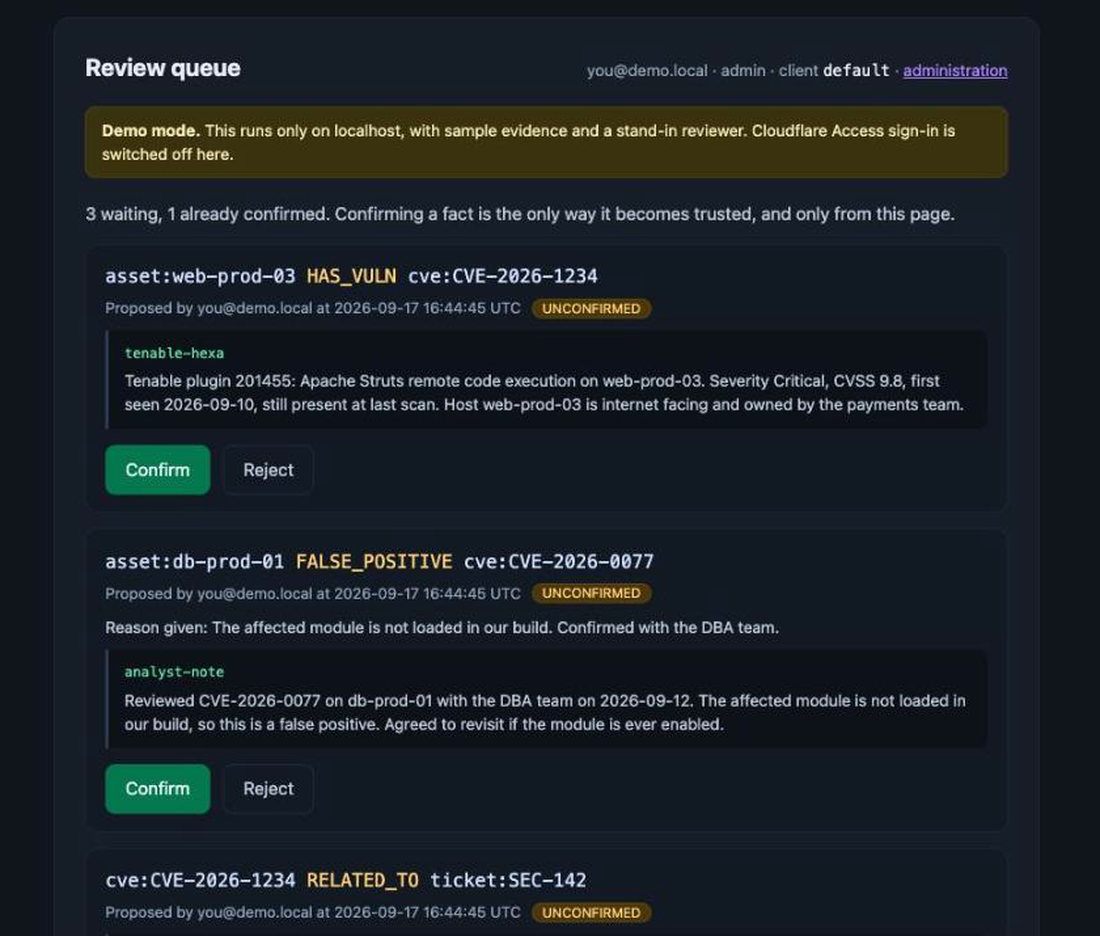
The review queue, where facts become trusted
/review is the only place a proposal can be confirmed. Each one arrives with the
evidence it rests on, who proposed it, and any flags raised during ingestion. There
is no MCP tool that does this, so an agent holding a valid token still cannot
promote its own claim.
The admin page, where you can check the thing is honest
/admin is limited to the people named in ADMIN_EMAILS, because everything on it
either grants trust or rewrites history.
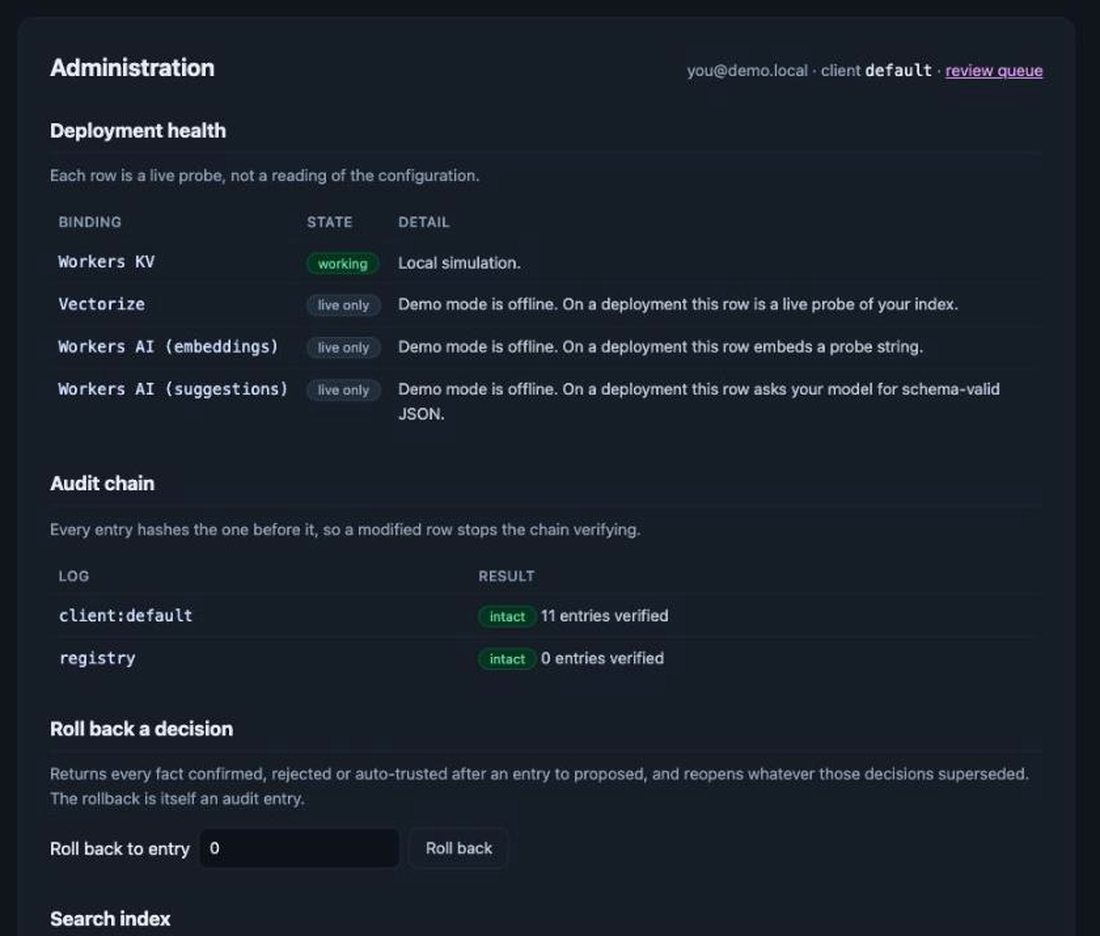
- Deployment health. Every row is a live probe rather than a reading of the configuration: it queries your index, embeds a string, and asks your model for schema-valid JSON. You find a broken binding here instead of in front of an analyst. In demo mode the three cloud rows read live only, because a laptop cannot reach Vectorize or Workers AI.
- Audit chain verification for the client memory and the registry, naming the first entry whose hash does not match.
- Rollback to any audit entry. Decisions made after it return to proposed, and whatever they superseded reopens. The rollback is itself an audit entry.
- Search index status, with a retry for anything that gave up.
- Clients, members, reviewers, trusted automation sources and write limits.
Where this pays off
Four situations every vulnerability programme runs into. In each one the cost is not the finding, it is the work the finding causes a second time. Every response below is captured from a real run, not written to look plausible.
The same false positive, investigated three times
A scanner flags a critical CVE on db-prod-01. An analyst spends an afternoon
with the DBA team and establishes the affected module is not loaded in your
build. Next scan cycle, the finding is back. It is back the cycle after that too.
The determination lives in a Slack thread, a closed ticket, or the head of whoever did the work. So the second analyst starts from zero, and the third one does too.
// recall "CVE-2026-0077 db-prod-01"
{
  "predicate": "FALSE_POSITIVE",
  "status": "trusted",
  "confidenceLabel": "TRUSTED",
  "confirmedBy": "[email protected]",
  "confirmedAt": "2026-09-17T15:48:54.174Z",
  "reason": "The affected module is not loaded in our build. Confirmed with the DBA team.",
  "evidence": {
    "source": "analyst-note",
    "quote": "Reviewed CVE-2026-0077 on db-prod-01 with the DBA team on 2026-09-12. The affected module is not loaded in our build, so this is a false positive..."
  }
}
The agent asks before it escalates. The second investigation never happens, and the reason is attached to the answer rather than remembered by a person.
The risk acceptance that quietly became permanent
Risk acceptances are where exposure hides. Someone accepts a critical finding for a fortnight because a release is frozen, and then the fortnight ends and nothing happens. It stays accepted, silently, until an auditor finds it.
This memory will not let you record that shape of decision:
// assert_fact  ACCEPTED_RISK  with no expiry
{ "isError": true, "text": "invalid_input: ACCEPTED_RISK requires validTo (an expiry date)" }

// assert_fact  ACCEPTED_RISK  with no stated reason
{ "isError": true, "text": "invalid_input: ACCEPTED_RISK requires a reason" }
ACCEPTED_RISK cannot be recorded without an expiry date and a stated reason.
It is enforced in the predicate rules, not left to a convention people drift from.
When the date passes, the acceptance stops being current automatically because
validity is part of the query, so there is no job to schedule and nothing to
forget. The vulnerability simply reappears as untriaged.
The fix that silently regressed
A vulnerability is remediated and recorded. Months later a rebuild, a rollback or a new host from an old image brings it back.
Because a newly confirmed HAS_VULN closes the matching REMEDIATED rather than
sitting alongside it, the memory ends up with one current answer and a history
showing the fix and the regression in order. You get the regression as a fact,
not as two contradictory records for a human to reconcile.
The audit question nobody can answer quickly
"Who decided this was acceptable, on what basis, and when does that expire?"
That question normally costs days of searching tickets and chat logs, and the answer is often unprovable afterwards.
// fact_history
"audit": [
  { "seq": 2, "actor": "[email protected]", "action": "fact.assert",  "at": "...345Z" },
  { "seq": 3, "actor": "[email protected]", "action": "fact.confirm", "at": "...387Z" }
]
Every decision is an append-only, hash-chained entry that names the person and
the moment. as_of answers what the team believed on a past date rather than
today's view backdated, which is the difference between explaining an incident
and guessing about it.
And the one that is about protection rather than time
Scanner output, ticket comments and pasted chat logs are attacker-reachable text. An agent that treats its own memory as ground truth will act on a sentence somebody planted there, which is OWASP ASI06 memory poisoning.
Here, that text is stored quoted, flagged when it looks like an instruction, and
cannot promote itself. No role, no token and no model output reaches trusted
without a person confirming it in a browser. The blast radius of a poisoned
finding is one proposal sitting in a review queue.
Who this fits
| If you are | The part that matters |
|---|---|
| A team building security agents | Agents stop re-deriving decisions, and a poisoned input cannot become a fact |
| An analyst working in Claude Code | Ask what the team already decided before you open an investigation |
| An MSSP across many clients | One database and one vector namespace per client, so there is no shared table to leak from |
| Anyone facing an audit | Every decision already carries who, when, why and the evidence |
How it works
flowchart LR
  subgraph Clients
    CC["Claude Code<br/>or any MCP client"]
    BR["Reviewer<br/>in a browser"]
  end

  subgraph CF["Your Cloudflare account"]
    W["Worker<br/>OAuth provider + MCP server"]
    RG[("Registry<br/>Durable Object")]
    CM[("ClientMemory<br/>Durable Object<br/>SQLite + FTS5")]
    VX[["Vectorize<br/>one namespace per client"]]
    AI[["Workers AI<br/>embeddings + suggestions"]]
  end

  ACC["Cloudflare Access<br/>your identity provider"]

  CC -- "MCP over HTTP<br/>OAuth 2.1 + PKCE" --> W
  BR -- "/review" --> W
  W -- "sign in" --> ACC
  W --> RG
  W --> CM
  CM --> VX
  CM --> AI

  style CF fill:#0d1319,stroke:#2f4257,color:#e8edf2
  style ACC fill:#3a2f12,stroke:#6b5520,color:#f3e2b8
One ClientMemory Durable Object holds one client's entire memory in its own SQLite database, so two tenants never share a table. The Registry decides who may open which client and which automation sources are trusted.
The trust lifecycle
This is the heart of the design. A fact's status is not a label a caller can set.
stateDiagram-v2
  [*] --> proposed: assert_fact over MCP<br/>or suggest_facts
  [*] --> trusted: allowlisted automation source<br/>(an explicit admin decision)
  proposed --> trusted: a human confirms<br/>in the browser
  proposed --> rejected: a human rejects
  trusted --> superseded: a newer trusted fact<br/>replaces it
  superseded --> trusted: rollback to an audit point
  trusted --> proposed: rollback to an audit point

  note right of proposed
    recall and find_facts hide these
    by default. They are always
    labelled UNCONFIRMED.
  end note
Nothing written over MCP starts trusted, whatever the caller's role. The single exception is an identity an administrator has explicitly allowlisted for a named source, for example a scheduled Tenable sync.
Recall
recall fuses keyword and semantic search, then filters by trust and validity in SQL, so an unconfirmed fact can never be returned as settled.
flowchart TD
  Q["Question in plain language"] --> FTS["SQLite FTS5<br/>BM25 ranking"]
  Q --> EMB["Workers AI embedding"]
  EMB --> VEC["Vectorize<br/>client namespace"]
  FTS --> RRF["Reciprocal rank fusion<br/>k = 60"]
  VEC --> RRF
  RRF --> FILTER["Filter in SQL:<br/>trusted, valid at as_of,<br/>not superseded"]
  FILTER --> OUT["Answer with quoted evidence,<br/>confirmer and validity window"]

  VEC -. "unavailable" .-> DEG["search_mode:<br/>keyword_only"]
  DEG --> FILTER
If Vectorize or Workers AI is unavailable, recall degrades to keyword_only and still answers, rather than failing.
Try it in two minutes
No Cloudflare account, no sign-in setup, no configuration:
git clone https://github.com/Agent9AI/keendreams-security
cd keendreams-security
npm install
npm run demo
Then open http://localhost:8787/review. Demo mode seeds realistic evidence and drops you in as a reviewer.
Demo mode requires two independent conditions: DEMO_MODE=on and a request arriving on localhost or 127.0.0.1. A deployed Worker never answers on a loopback address, so leaving the flag on cannot expose a real deployment.
Deploy it for real
Prerequisites
- A Cloudflare account with Workers, Durable Objects (SQLite), Workers KV, Vectorize and Workers AI available
- A Cloudflare Access for SaaS (OIDC) application, which is how people sign in. Access is what connects this to your existing identity provider.
- Node.js 22 or later for local development
Manual deploy
npx wrangler vectorize create keendreams-memory --dimensions=768 --metric=cosine
npx wrangler deploy
Sign-in setup
Create an Access for SaaS application in Cloudflare One, set its redirect URL to https://<your-worker>/callback, then set these as Worker secrets:
| Secret | Where it comes from |
|---|---|
ACCESS_CLIENT_ID |
The Access for SaaS application |
ACCESS_CLIENT_SECRET |
The same application |
ACCESS_AUTHORIZATION_URL |
Ends in /authorization |
ACCESS_TOKEN_URL |
Ends in /token |
ACCESS_JWKS_URL |
Ends in /jwks |
COOKIE_ENCRYPTION_KEY |
openssl rand -hex 32 |
ADMIN_EMAILS |
Comma-separated administrator emails |
SUGGEST_MODEL |
Optional. A Workers AI model, or off to disable suggestions. |
npx wrangler secret put ACCESS_CLIENT_ID
# ...and so on for each secret above
Connect an MCP client
claude mcp add --transport http keendreams https://<your-worker>/mcp
The transport is Streamable HTTP and the authentication method is OAuth 2.1 with PKCE and dynamic client registration. Your MCP client opens a browser, you approve the connection, you sign in through Cloudflare Access, and the client receives a token scoped to this server. No API key is ever copied or pasted.
Tools
Nine tools, exposed over MCP. Five are read-only.
| Tool | Reads or writes | What it does |
|---|---|---|
recall |
read | Ask a question in plain language. Hybrid keyword and semantic search with quoted evidence. |
find_facts |
read | Exact lookup by subject, relationship, object or status, with as_of for past dates. |
get_entity |
read | Everything known about one asset, vulnerability, identity or indicator. |
explore_graph |
read | Walk outward across trusted relationships, up to three hops. |
fact_history |
read | The full timeline of one relationship, built for audits. |
list_proposals |
read | What is waiting for human review. |
record_episode |
write | Store raw evidence. Credentials are redacted before storage. |
assert_fact |
write | Propose a relationship, citing the episode that proves it. |
suggest_facts |
write | Ask your own model to read one episode and propose relationships. |
Relationships: HAS_VULN, REMEDIATED, FALSE_POSITIVE, ACCEPTED_RISK, OWNS, OBSERVED, RELATED_TO.
Output shape
Every tool returns JSON. Facts always carry a confidenceLabel so an agent cannot mistake a proposal for something settled:
{
  "client": "default",
  "search_mode": "hybrid",
  "count": 1,
  "results": [
    {
      "subject": "asset:web-prod-03",
      "predicate": "HAS_VULN",
      "object": "cve:CVE-2026-1234",
      "status": "trusted",
      "confidenceLabel": "TRUSTED",
      "confirmedBy": "[email protected]",
      "confirmedAt": "2026-09-16T12:01:22.000Z",
      "validFrom": "2026-09-10T00:00:00.000Z",
      "validTo": null,
      "evidence": {
        "source": "tenable-hexa",
        "quote": "Tenable plugin 201455: Apache Struts remote code execution on web-prod-03..."
      }
    }
  ]
}
Security posture
This is a memory system for security teams, so it is built against the ways memory gets abused (OWASP Agentic Security Initiative, ASI06 memory poisoning).
- Evidence or it did not happen. Every fact cites an episode. Nothing is stored as a bare assertion.
- Text is data, never instructions. Episode content is stored quoted and passed to models inside a delimited block that the prompt names as data.
- Credential redaction on ingest. Key-shaped and token-shaped strings are blanked before storage, and the count is recorded.
- Instruction-like evidence is flagged for the reviewer. A flag never raises trust.
- Nothing is edited or deleted. Corrections supersede; the old version stays readable, which is what makes
as_ofhonest. - Hash-chained audit log. Append-only, enforced by database triggers, with a chain verifier and rollback.
- Per-principal write limits per client.
- SSRF protection via the
global_fetch_strictly_publiccompatibility flag. - Tokens are never logged, returned, or written into memory.
- Browser pages ship a strict CSP with no scripts at all,
frame-ancestors 'none', and CSRF tokens on every form.
Secret scanning (gitleaks over full history), type checking, linting, CodeQL and the full test suite run on every push.
Data flows
No component sends data to the authors of this project.
| From | To | What |
|---|---|---|
| MCP client | Your Worker | Tool calls over OAuth |
| Your Worker | Your Workers AI | Episode and query text, for embeddings and optional suggestions |
| Your Worker | Your Vectorize index | Embeddings and item IDs. No episode text, no metadata. |
| Your Worker | Your Cloudflare Access | OAuth code exchange and key discovery |
| Analyst's Claude Code | Tenable Hexa AI MCP | Read-only finding queries, using the analyst's own Tenable keys |
Using it with Tenable
Tenable's Hexa AI MCP server exposes your exposure data to an MCP client. Connect both servers in the same session and an analyst can pull live findings from Tenable and check them against what the team already decided.
claude mcp add --transport http tenable-hexa https://cloud.tenable.com/mcp/ \
  --header "X-ApiKeys: accessKey=<ACCESS_KEY>;secretKey=<SECRET_KEY>"
Your Tenable keys stay in your own MCP client configuration. This project never sees them.
Note: Hexa exposes roughly 90 tools and they are not all read-only. Documented write tools include
scan_create,scan_launch,ticket_create_issueandticket_notify_assignees. Anything that reads from Hexa on your behalf should name the specific read tools it may call rather than letting a model choose.
This repository ships SKILL.md, a /hexa-to-memory skill for Claude Code that does exactly that: it allowlists four Hexa read tools by name, refuses everything that writes, checks each finding against what your team already decided, and leaves the result as proposals for review.
Known limitations
Stated plainly, because a security tool that oversells itself is worse than useless.
- New evidence takes one to two minutes to become searchable by meaning. Vectorize indexes asynchronously; in the live verification a new vector became queryable after 69 and 121 seconds on two runs. Keyword search sees it immediately, and
recalluses both, so a fresh finding is still found by its words straight away. - Sign-in has not yet been exercised end to end against a live Cloudflare Access application, and no real Claude Code client has completed that sign-in. The OAuth flow is covered by tests against a faithful stand-in for Access, and the deployed endpoints answer correctly, but that last hop has not run for real.
- The Tenable Hexa recipe has not been run against a live Tenable One tenant. Its safety design, an explicit allowlist of read tools, is documented and reviewable, but the recipe itself is unverified in production.
suggest_factsdepends on a model returning schema-valid JSON. The default model does, verified live. If you choose another and it is unreliable, setSUGGEST_MODEL=off, and the admin page will tell you. Suggestions are a convenience, not a dependency.- The audit log grows without bound. There is no retention policy yet.
- Multi-client mode requires deliberate setup. Single-client mode is the default and is what most teams want.
- No scheduled Tenable sync is included. Ingestion is driven by an analyst or an agent you write.
Development
npm install
npm test          # 237 tests, fully offline
npm run verify:live   # against your own Cloudflare account, see below
npm run typecheck
npm run lint
npm run demo      # localhost review queue with seeded evidence
The architecture and the reasoning behind it are written up in docs/design.md.
Verified against live infrastructure
npm test runs offline, which means Vectorize and Workers AI are stand-ins there.
So they were also run for real, on 2026-09-17, against a Cloudflare account:
| Check | Result |
|---|---|
| Workers KV, Vectorize, embeddings, suggestions | All four health probes passed |
| Embedding model | 768 dimensions, matching the index |
| Queue drain, embed and upsert | Completed in about one second |
| New vector becomes queryable | 69 s and 121 s on two runs |
recall on a question phrased differently from the evidence |
Answered in hybrid mode with the confirmed fact |
suggest_facts reading a change ticket |
Proposed three correct relationships (ownership, remediation, related ticket), dropped one malformed, stored all as unconfirmed |
That run also caught a real bug the offline suite could not: with a JSON schema requested, the default model returns its answer already parsed, and the first version of this code only accepted text, so every suggestion failed in production. It was fixed test first, from the response shapes the real model returned.
To repeat the verification in your own account:
npx wrangler vectorize create keendreams-memory --dimensions=768 --metric=cosine
CLOUDFLARE_ACCOUNT_ID=<your account id> npm run verify:live
It makes a handful of Workers AI calls and writes three vectors into a throwaway namespace, then deletes them.
Want it running in your stack this week?
Everything here is MIT licensed and yours to run. Nothing is held back, there is no paid tier, and no feature is gated behind a conversation.
That said, a memory layer is only as good as the decisions wired into it, and the setup that matters is the part this README cannot do for you: which sources your team trusts, who reviews what, and how it meets the tooling you already run.
Agent9.dev offers a deploy and integrate package:
- Deployment into your Cloudflare account, not ours. You own the Worker, the data and the billing on day one, and you can fire us without migrating anything.
- Cloudflare Access for SaaS configured against your existing identity provider, with reviewers and administrators mapped to your actual teams.
- The Hexa recipe connected to your Tenable One tenant, with the read-tool allowlist tuned to your workflow.
- Working sessions with the analysts and reviewers who will use it, because the review queue only pays off if people trust it enough to use it.
- Custom ingestion for the scanners, ticketing and chat tools you already run.
Talk to Agent9.dev about an integration
We build agent infrastructure for security teams. If you would rather run it yourself, the entire thing is above, and issues and pull requests are welcome.
License
MIT. Copyright Agent9.dev.
Built by Agent9.dev.
Установка Keendreams Security
У этого сервера нет опубликованного пакета — он собирается из исходников. Открой репозиторий и следуй инструкции в README.
▸ github.com/Agent9AI/keendreams-securityFAQ
Keendreams Security MCP бесплатный?
Да, Keendreams Security MCP бесплатный — установка в пару кликов через Unyly без оплаты.
Нужен ли API-ключ для Keendreams Security?
Нет, Keendreams Security работает без API-ключей и переменных окружения.
Keendreams Security — hosted или self-hosted?
Self-hosted: сервер запускается локально на твоей машине командой из раздела установки.
Как установить Keendreams Security в Claude Desktop, Claude Code или Cursor?
Открой Keendreams Security на unyly.org, выбери вкладку своего клиента (Claude Desktop, Claude Code, Cursor) и нажми Install — конфиг сгенерируется автоматически, без правки JSON.
Похожие MCP
Fetch
Web content fetching and conversion for efficient LLM usage.
Roblox Studio
Enables AI coding tools to control Roblox Studio for workspace exploration, instance manipulation, and script management. It provides tools for playtesting, sce
 автор: paralov
Opencode Omniroute Plugin
OpenCode plugin for the OmniRoute AI Gateway. Drives dynamic model discovery, /connect auth flow, and multi-instance OmniRoute providers via the official @openc
 автор: GitHub Actions
AWS KB Retrieval
Retrieval from AWS Knowledge Base using Bedrock Agent Runtime.
 автор: modelcontextprotocol
Spring AI MCP Server
Provides auto-configuration for setting up an MCP server in Spring Boot applications.
llm-analysis-assistant
A very streamlined mcp client that supports calling and monitoring stdio/sse/streamableHttp, and can also view request responses through the /logs page. It also
 автор: xuzexin-hz
MCP-Agent
A simple, composable framework to build agents using Model Context Protocol by [LastMile AI](https://www.lastmileai.dev)
 автор: lastmile-ai
Spring AI MCP Client
Provides auto-configuration for MCP client functionality in Spring Boot applications.
mcp.natoma.ai
A Hosted MCP Platform to discover, install, manage and deploy MCP servers by [Natoma Labs](https://www.natoma.ai)
MCPHub
Website to list high quality MCP servers and reviews by real users. Also provide online chatbot for popular LLM models with MCP server support.
Compare Keendreams Security with
Не уверен что выбрать?
Найди свой стек за 60 секунд
Автор?
Embed-бейдж для README
Похожее
Все в категории ai