
Lego
БесплатноНе проверенAn MCP server that enables LLMs to build physically valid Lego models by enforcing catalog-only parts, no overlaps, stud-to-tube connections, and other real-wor

Описание
An MCP server that enables LLMs to build physically valid Lego models by enforcing catalog-only parts, no overlaps, stud-to-tube connections, and other real-world constraints.
README
An MCP server where a model can only build physically valid Lego. Instead of letting the model free-form geometry (and hallucinate impossible structures), every action goes through a constraint engine that behaves like real plastic:
- Catalog-only parts —
brick_2x4,plate_1x6,tile_2x2, slopes (slope_2x2,slope_inv_1x2, …), baseplates (baseplate_32x32, …). Unknown part names are rejected with suggestions. No hallucinated 3×5 bricks. - Solid bricks — placements that overlap existing pieces are rejected, with the exact colliding cells and the lowest free z reported back.
- Stud-to-tube connection required — a piece must sit on studs of an existing piece, on the baseplate, or press its own studs up under an overhang. Floating bricks are rejected with a valid z suggested.
- Tiles are smooth — nothing can stack on a tile.
- Slopes are directional — studs only on their non-sloped rows (nothing attaches to the sloped face); rotation is 0/90/180/270 and slopes descend toward +y at rotation 0. Inverted slopes grip below only on their tall rows.
- Baseplates are ground-only — studs on top, smooth underneath, z=0 only.
- No orphaning — removing a piece that would leave others disconnected from the baseplate is refused ("remove those first, top down").
- Stability hints — extreme cantilevers succeed but return a warning.
The error messages are written for the model: each rejection explains the violated constraint and suggests a fix, so an agent converges on buildable structures instead of drifting.
Built by a model, through the constraints
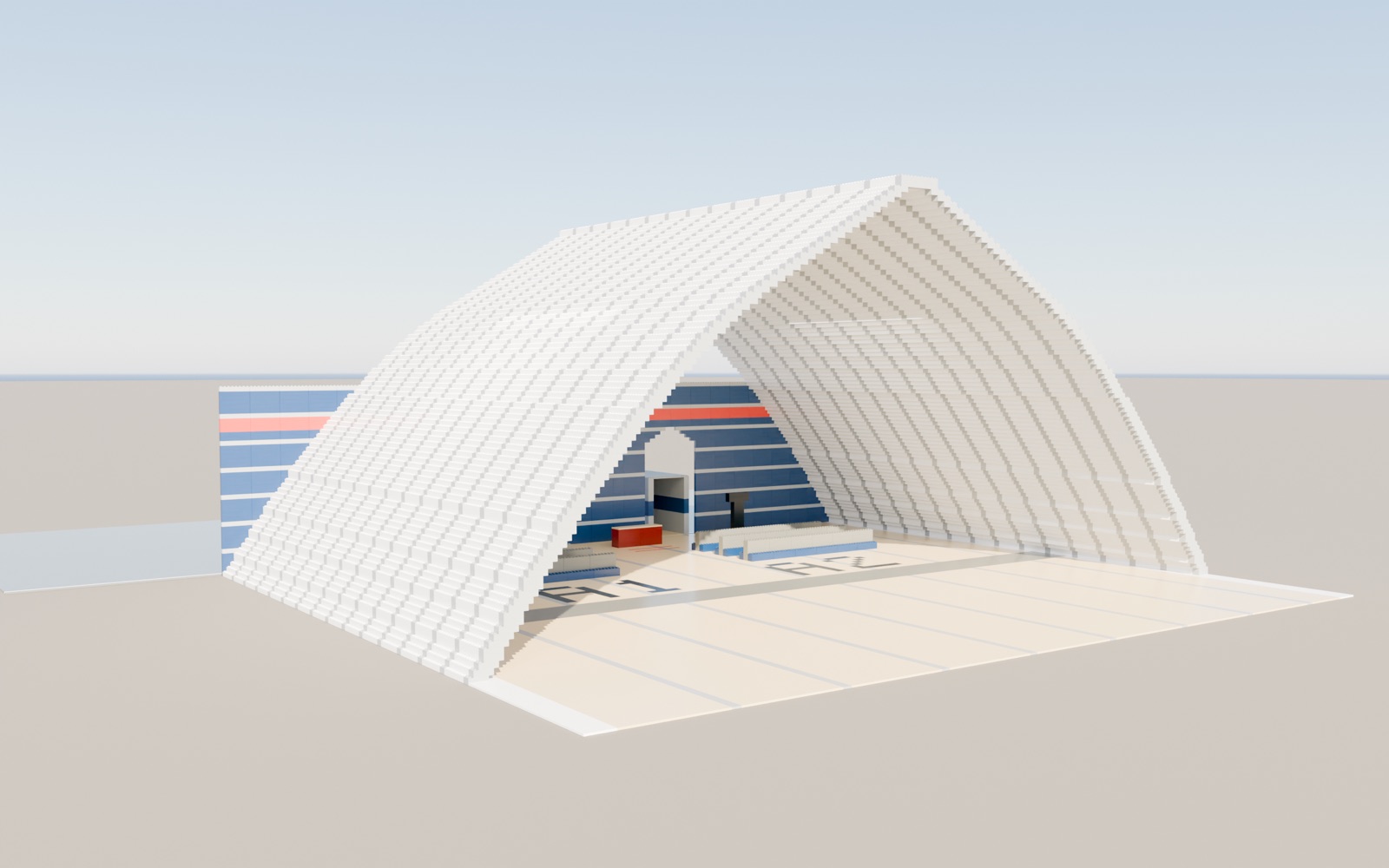
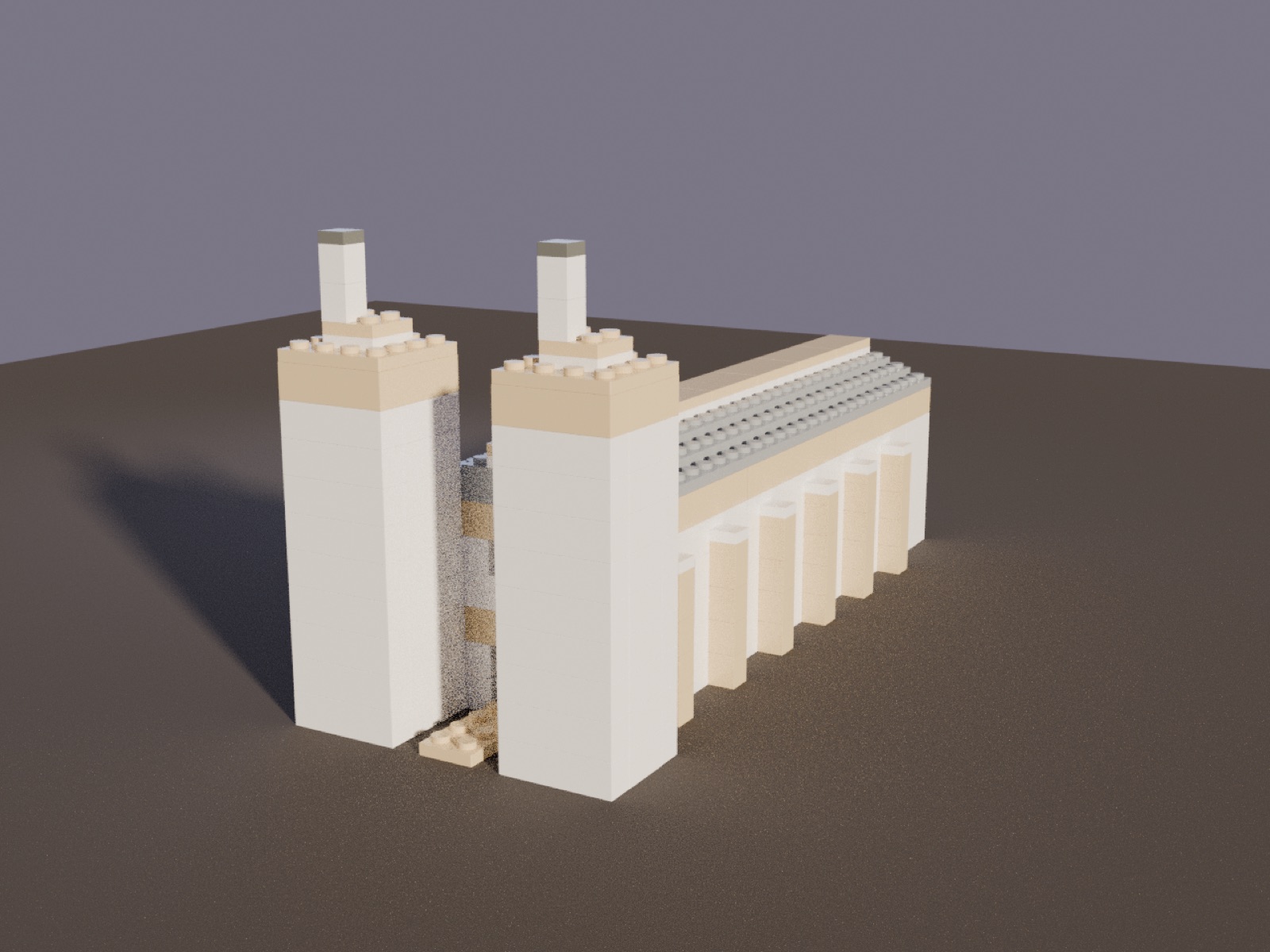
Every piece below was placed by an LLM whose only tools were this server's — each brick validated stud-by-stud, then exported to Blender and rendered. No piece floats, overlaps, or stacks on a tile.
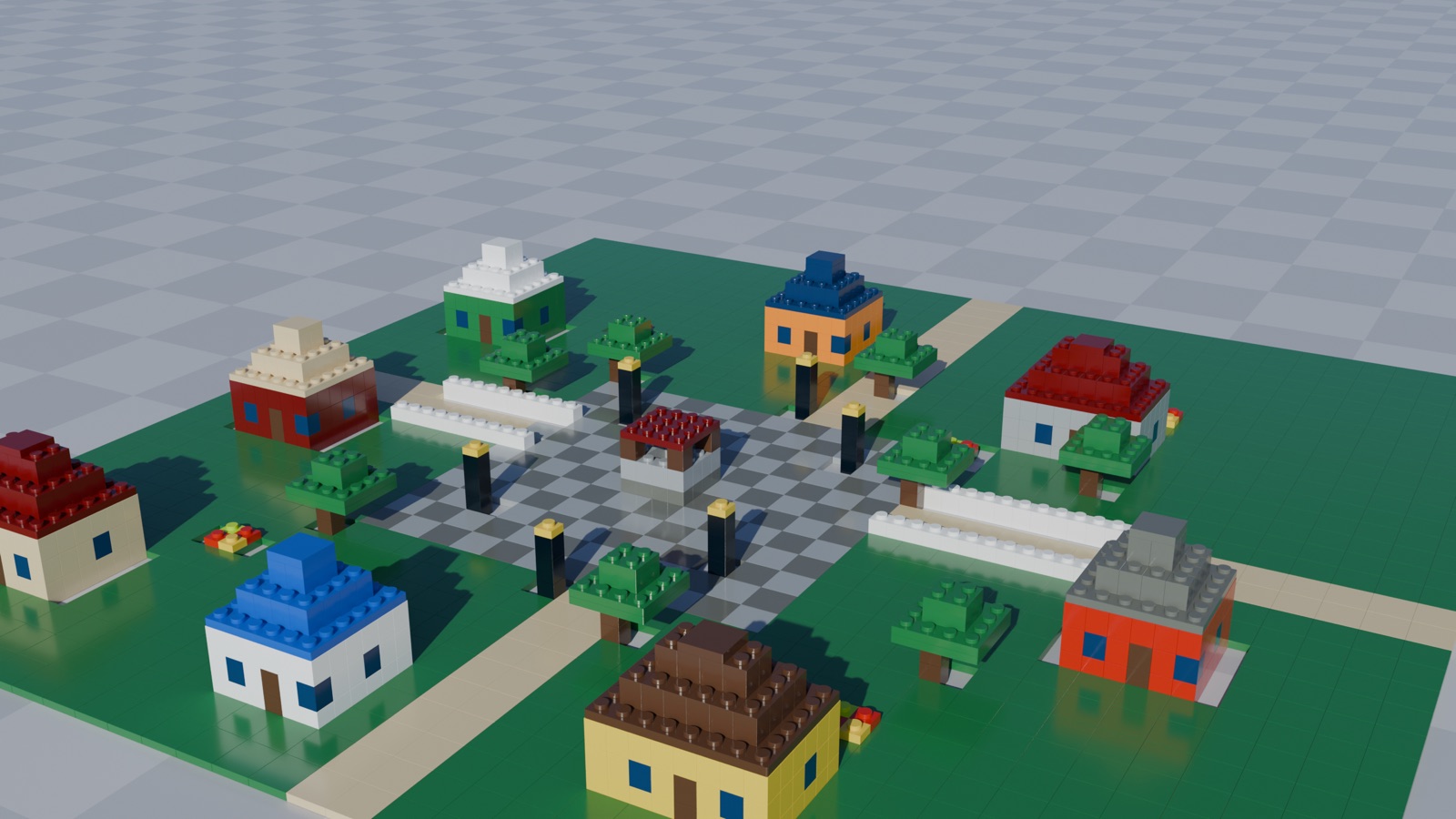
| Corbelled arch | Colonnade |
|---|---|
 |
 |
The corbelled arch is the constraint engine at its most demanding: every course steps inward off the studs of the one below, and the two flanks have to meet at the crown without a single floating brick — the model gets there because each illegal step is bounced back with the reason and a legal alternative.
Coordinates
x,yin studs,zin plates (1 brick = 3 plates tall).z=0is the baseplate; a brick on top of a brick placed atz=0goes atz=3.rotationis 0 or 90 (swaps the footprint).
Tools
| Tool | Purpose |
|---|---|
new_build(name, width, depth) |
fresh baseplate |
list_parts() |
full catalog + colors |
place_brick(part, x, y, z, rotation, color) |
validated placement |
remove_brick(piece_id) |
validated removal |
get_build() |
full state as JSON |
view_layers(z_from, z_to) |
top-down ASCII map per plate layer |
load_build(name) |
reload a saved build (re-validated on load) |
export_build(fmt) |
ldraw → .ldr (BrickLink Studio / LeoCAD), blender → bpy script |
State auto-saves to <state>/<name>.json after every mutation and the latest
build is resumed on server restart. The state directory is, in order:
$LEGO_MCP_HOME/builds if set, else the repo's builds/ when run from a
writable checkout, else ~/.lego-mcp/builds when installed. Set
LEGO_MCP_HOME to keep builds wherever you like.
Install
lego-mcp is a standard stdio MCP server,
so any MCP-capable host can run it. It's packaged as a normal Python
distribution — the only thing a host needs is a command that launches it.
Run it with no install (recommended)
uvx fetches and runs it in a throwaway environment, so there's nothing to maintain:
uvx --from "git+https://github.com/Axel-Jalonen/lego-mcp" lego-mcp   # straight from this repo
uvx --from ./dist/lego_mcp-0.1.0-py3-none-any.whl lego-mcp           # from a built wheel
Or install it as a tool
pipx install "git+https://github.com/Axel-Jalonen/lego-mcp"   # or: pip install ...
lego-mcp                     # the `lego-mcp` command is now on PATH
Or grab the prebuilt wheel from the latest
release and
pipx install lego_mcp-0.1.0-py3-none-any.whl.
Build the distributable yourself
uv build # -> dist/lego_mcp-0.1.0-py3-none-any.whl (+ .tar.gz)
The .whl is the portable artifact: copy it anywhere, uvx --from <the.whl> lego-mcp, done. No source checkout, venv, or absolute paths needed.
Wiring it into a host
Every MCP host takes the same shape — a command + args. Use uvx so the host
doesn't need Python set up:
{
  "mcpServers": {
    "lego": {
      "command": "uvx",
      "args": ["--from", "git+https://github.com/Axel-Jalonen/lego-mcp", "lego-mcp"],
      "env": { "LEGO_MCP_HOME": "~/lego-builds" }
    }
  }
}
- Claude Desktop →
claude_desktop_config.json(Settings → Developer). - Claude Code →
claude mcp add lego -- uvx --from git+https://github.com/Axel-Jalonen/lego-mcp lego-mcp(this repo also ships a dev .mcp.json). - Cursor / Windsurf / VS Code MCP → the same
mcpServersblock. - Ollama → Ollama's own runtime doesn't load MCP servers directly; run it
through an MCP host that talks to Ollama, e.g.
mcphost or Open WebUI.
mcphostreads the identical config above, so pointing it at the sameuvxcommand gives your local model the eight Lego tools.
Development
python3 -m venv .venv
.venv/bin/pip install -e . pytest          # editable install
.venv/bin/python -m pytest tests/          # 15 constraint tests
Pointing a small model at it
agent/build_agent.py runs an agent loop where a model's only tools are this server's — no filesystem, no bash, no repo access. The constraint engine rejects every invalid move with a corrective hint, so even a small model can only ever produce physically valid builds:
export ANTHROPIC_API_KEY=sk-ant-...
.venv/bin/python agent/build_agent.py "build a small watchtower"
.venv/bin/python agent/build_agent.py --model claude-sonnet-5 "build a bridge"
Defaults to claude-haiku-4-5. The final state is reported by the engine
(get_build), not by the model's own claims, and builds land in builds/.
Layout
- lego_mcp/catalog.py — part definitions (footprint, height in plates, stud availability, LDraw ids) and colors
- lego_mcp/engine.py — occupancy grid, connection rules, orphan detection, ASCII views, save/load
- lego_mcp/export.py — LDraw + Blender exporters
- lego_mcp/server.py — FastMCP tool layer
Установка Lego
У этого сервера нет опубликованного пакета — он собирается из исходников. Открой репозиторий и следуй инструкции в README.
▸ github.com/Axel-Jalonen/lego-mcpFAQ
Lego MCP бесплатный?
Да, Lego MCP бесплатный — установка в пару кликов через Unyly без оплаты.
Нужен ли API-ключ для Lego?
Нет, Lego работает без API-ключей и переменных окружения.
Lego — hosted или self-hosted?
Self-hosted: сервер запускается локально на твоей машине командой из раздела установки.
Как установить Lego в Claude Desktop, Claude Code или Cursor?
Открой Lego на unyly.org, выбери вкладку своего клиента (Claude Desktop, Claude Code, Cursor) и нажми Install — конфиг сгенерируется автоматически, без правки JSON.
Похожие MCP
GitHub
PRs, issues, code search, CI status
 автор: GitHub
Filesystem
Secure file operations with configurable access controls.
Memory
Knowledge graph-based persistent memory system.
Template MCP Server
A CLI tool to create a new Model Context Protocol server project with TypeScript support, dual transport options, and an extensible structure
 автор: mcpdotdirect
Compare Lego with
Не уверен что выбрать?
Найди свой стек за 60 секунд
Автор?
Embed-бейдж для README
Похожее
Все в категории development