
Magi Council
БесплатноНе проверенMAGI council of three AI heads (Melchior/Balthasar/Casper) that deliberate, vote and execute plans — local-first multi-agent deliberation with a memory graph, w

Описание
MAGI council of three AI heads (Melchior/Balthasar/Casper) that deliberate, vote and execute plans — local-first multi-agent deliberation with a memory graph, worktree-isolated production mode and auto-merge. Evangelion-style web UI; swappable providers (kimi/codex/claude/Ollama).
README
A MAGI council of three heads (Melchior / Balthasar / Casper — the persona lives in the seat, the provider is swappable: kimi, codex, claude, Ollama, any CLI or OpenAI-compatible API) that deliberate on your questions and vote on decisions, with a ruling, minority report, mind changes between rounds and human arbitration. With memory: a local knowledge graph that ingests your agent sessions and decisions and injects them into every deliberation. And in production mode: the council approves a plan, an executor implements it on a dedicated branch, the council reviews the diff and — on unanimous approval — it merges itself.
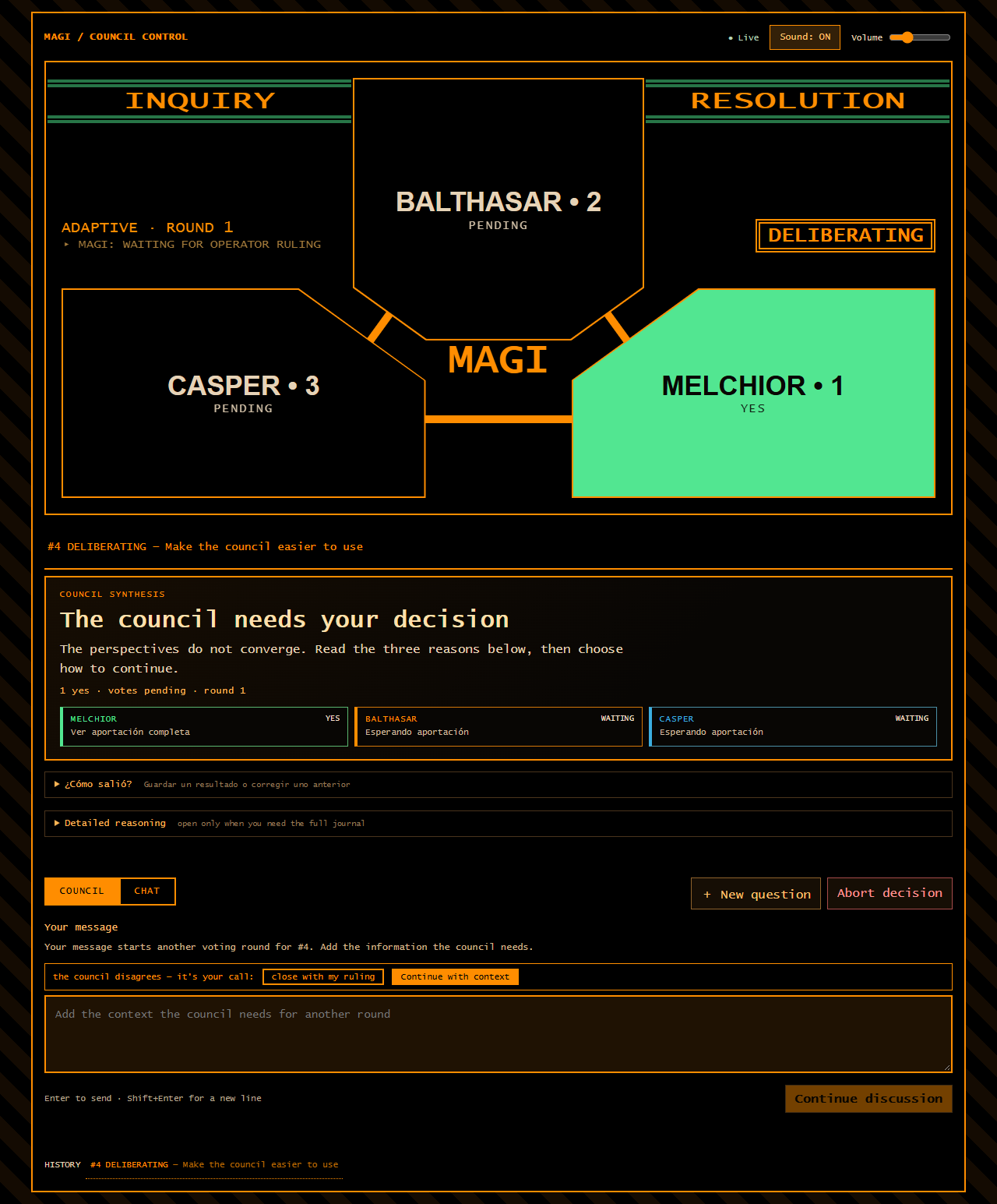
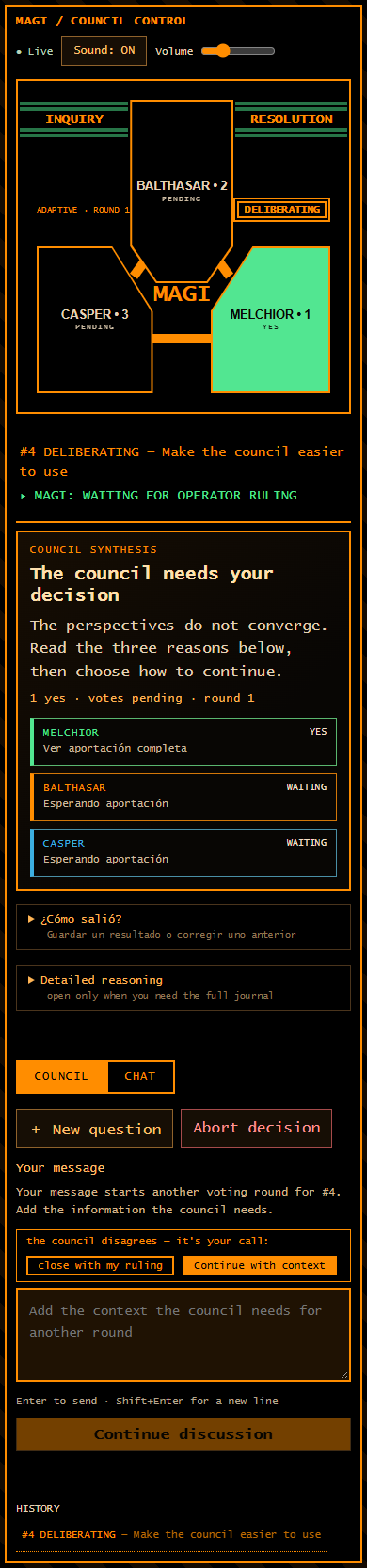
The UI is a MAGI-style web app (design based on TomaszRewak/MAGI) with a single text box, like a CLI. Runs on Windows, macOS and Linux.
What you need to get started (from scratch, on any machine)
- Python 3.14+.
- A reachable Postgres (any standard install; the system default is
dbname=debate host=localhost, port 5432, user = your OS user). If you have none, on Windows the repo ships a portable postmaster inexperiments/pgandbin\start-magi.batstarts it. - At least one head (with no heads the system runs "degraded" and only
you can close decisions):
- kimi (or another MCP-capable agent CLI: claude, …) — investigates the repo with tools and votes via MCP;
- codex or another plain-text CLI — votes with the journal inlined in
the prompt (
journal: "inline"mode); - API heads:
type: "api"withprovideranthropic (Messages API,claude-*), openai or moonshot (kimi, OpenAI-compatible), the key in the environment variable named byapi_key_env(defaultsANTHROPIC_API_KEY,OPENAI_API_KEY,MOONSHOT_API_KEY); or Ollama / LM Studio / any OpenAI-compatible endpoint with justbase_urlandmodel, at no cost. An API head votes, reviews and synthesizes over the inlined journal and the repository brief; it cannot run tools.debate-mcp/heads.example.jsonshows a mixed council (one CLI head with tools, two API heads). All configured indebate-mcp/heads.json; you don't need all three.
- Optional: an OpenAI account (codex) and/or Moonshot (kimi) if you use those cloud heads.
CLI heads can report real usage too, with the accounts you already have:
"output_format": "claude-json" on a claude seat and "codex-jsonl" on
a codex seat make the relay ask for JSON, take the answer from it and
record the tokens of the turn (claude also gives its list-price cost; the
22k-token context the CLI loads on every start is part of it). kimi has no
usage output. API heads report the tokens the provider actually billed; with a
pricing block on the seat (USD per million input/output tokens, copied
from the provider's price page) metrics.py adds a costo column and a
period total, next to the character-based estimates that are all a CLI
head can offer. 429, 5xx, timeouts and refused connections are retried
three times with exponential backoff (Retry-After wins when present);
401/400 are configuration errors and fail at once. A seat whose last three
voting turns of the day all failed is quarantined: new decisions open
without it (journal note, quarantined in the dossier, WARN in
healthcheck.py) until one of its turns succeeds or the day changes.
Install and first run
One step, idempotent (run it again to repair a half-finished install):
git clone https://github.com/Adrian-Sandwich/magi-council.git
cd magi-council

# Windows: venv, dependencies, database, schema, heads.json, diagnostics
powershell -ExecutionPolicy Bypass -File install.ps1
#   -WithPostgres  downloads a portable Postgres (~350 MB) and creates the cluster
#   -Schedule      registers startup, healthcheck and the weekly quality panel

# macOS/Linux (uses your local Postgres, or DEBATE_CONNINFO)
./install.sh --start
It ends by running the doctor, which is also how you debug a machine that won't start: every problem comes with the command that fixes it.
debate-mcp/.venv/bin/python debate-mcp/doctor.py     # install: venv, DB, seats, permissions
debate-mcp/.venv/bin/python debate-mcp/healthcheck.py # running system: Postgres, relay, graph
The Diagnóstico button in the UI toolbar runs the doctor without a
terminal. docs/operacion.md is the runbook: what to do when Postgres is
down, the relay freezes, a head is in ERROR, a merge is pending or the
graph goes stale — every healthcheck alert links to its section. The
manual path (venv, schema/migrate.py, smoke_test.py) still works and
is what the installer runs underneath.
Per-OS shortcuts:
- Windows: double-click
Iniciar MAGI.batin the repository root. It starts portable Postgres (if needed), migrates, starts relay + UI in the background, and opens your browser. Logs are indebate-mcp/logs/.debate-mcp\bin\start-magi.batalso uses this launcher. The three processes are created through WMI, so they do not belong to the console (or agent session) that started them and survive its closing.debate-mcp\bin\stop-magi.batshuts everything down. - macOS/Linux:
./install.sh --start, or.venv/bin/python relay.pyand.venv/bin/python magi_ui.pyby hand.debate-mcp/launchd/*.plistare templates for launchd (relay, healthcheck and graph refresh); they have not been re-tested since the monorepo move, so treat them as a starting point, not a finished install.
Then open http://127.0.0.1:8051.
Registering the MCP in your agents (so CLI heads can see the board): the
repo ships .mcp.json at the root — any agent running from the repo loads it
automatically (on Windows it points to .venv/Scripts/python.exe; on
macOS/Linux change it to bin/python). The same file also ships the
codebase-memory server: local structural code intelligence — search, trace,
architecture and dead-code queries over this repo. The first session indexes
the repo once, then it keeps itself fresh; no API key and no data leaves the
machine. Its command points to a local install path, so adjust it if cbm
lives elsewhere on your machine. For a global config, your agent
usually has a command like kimi mcp add / claude mcp add pointing at
debate-mcp/server.py with the venv's python.
Memory graph (optional but recommended): run memory-graph/refresh.sh
once (ingests your agents' sessions, decisions and READMEs into
memory-graph/memory.db) and schedule it (Windows:
schtasks /create /tn "ClaMi-memory-refresh" /tr "...bash... refresh.sh" /sc hourly
— the task name is yours to pick; macOS/Linux: cron or launchd). Without the
graph the system works, but the heads remember nothing. The 3D export
(export_kgraph.py) is optional: without a Node_visualizer checkout it
prints a notice and the refresh still succeeds. Each ingestor records its
last run in memory.db, and healthcheck.py reports the age of every
source separately — the relay's 30-second conversation sync keeps the file
fresh, so the file's mtime alone says nothing about sessions, docs or code.
The relay also syncs conversations and decisions into the graph continuously
(the heartbeat and healthcheck.py show the last sync). Retrieval is
keyword-based by default; semantic retrieval (local multilingual
embeddings — no text leaves the machine) is optional: install it once with
debate-mcp/.venv/bin/pip install -r debate-mcp/requirements-semantic.txt
and debate-mcp/.venv/bin/python debate-mcp/semantic_memory.py --download
(model goes to memory-graph/models/). MEMORY_SEMANTIC=0 disables it;
without the model the system falls back to keyword search. Explicit
declarations you write in chat (Objetivo: …, Restricción [datos]: …,
Pendiente [pruebas]: …) are kept per conversation as sourced, versioned
facts.
System status at any time: .venv/bin/python healthcheck.py (Postgres, relay,
stuck decisions, graph freshness per source, and seats whose failure rate over
the last week exceeds 30 % in their current role). On Windows schedule it
every 15 minutes with a toast on failure:
powershell -ExecutionPolicy Bypass -File debate-mcp\bin\schedule-healthcheck.ps1
(-Remove unregisters; log in debate-mcp/logs/healthcheck.log).
Three more from the same folder: schedule-magi.ps1 drops a ClaMi-magi.cmd
into your Startup folder so MAGI starts at logon (after a reboot nothing
else does), schedule-backup.ps1 dumps the board daily, and
schedule-quality.ps1 schedules metrics.py --quality --notify every Monday
at 9:00 with a toast; each accepts -Remove. The board is the only
irreplaceable thing here: backup.py writes a compressed, verified
pg_dump to debate-mcp/backups/ — it re-reads the dump and refuses to keep
one without the board's tables — keeps the last 14, and is what doctor.py
checks the age of. Restoring 66 decisions took 4 seconds; the procedure is in
docs/operacion.md#respaldo. Latency, error
and timeout rates per seat and turn type (from logs/trigger_events.jsonl):
.venv/bin/python metrics.py --days 30 — including approximate tokens per
turn (prompt, output and memory block, at 4 characters per token; what a
head reads on its own with tools is not visible). A CLI head that dies
within seconds of starting with no output is retried once before its turn
is marked ERROR. metrics.py --quality is the weekly quality panel: closed
decisions by verdict, how many have an outcome and which, how many of the
decisions that saw memory were rated and how often it helped, wall time and
tokens per decision, failed head turns — against the targets of
docs/plan-madurez.md.
What a head receives per turn: the journal (last 15 messages, 18 000
characters at most), the memory block (at most 5 dossiers and 4 500
characters, only sources that share the thread, the title, enough topic
terms or semantic similarity — a dossier from the same repository with no
topic in common is not memory, it is padding), and in round 1 of a decision
with a repository a repository brief built from the code graph (size,
folders, HTTP entry points, most-referenced and most recently changed
files) so heads with tools read what matters instead of exploring. Retrieval quality against your own
board's real follow-ups: memory-graph/eval_retrieval.py (leave-one-out
recall, plus the precision of each source the council saw, from your 👍/👎
ratings; see docs/memory-evolution.md).
How you use it (the web, in 30 seconds)
A single text box with two modes (tabs at the top left):
COUNCIL — decisions with a vote
Your message goes to the council. If there's no open decision, it opens a new one: the three heads investigate (CLI heads can read the repo; all of them see the journal and the memory graph) and vote in parallel:
- APPROVED / REJECTED: 2/3 majority or unanimous.
- CONDITIONAL: approved with conditions (kept in the dossier).
- STALEMATE: no agreement. The council writes you a query: choose Continue with context for another round or Close with my ruling to close it with your decision. Type the context or ruling and press send.
Unanimous info votes go straight to the evaluation of one shared answer
(until 2026-09-18 a contrast round was forced first, costing ~2.5 minutes
and ~12k tokens per question even when the three answers already agreed;
INFO_MIN_ROUNDS in decision.py restores it). Editorial fidelity and acceptance of its content are separate.
Substantive objections feed another debate round, up to three rounds per human
continuation. At the limit, or if a reviewer fails, the answer is explicitly
provisional; matching INFO votes alone never establish content consensus.
If you selected an open or STALEMATE decision, your message goes to it: context while it's deliberating; on a STALEMATE you explicitly choose to continue or close. Continue is the initial option and the buttons keep your text.
The UI sends the selected decision's ID. A follow-up to a closed decision reopens the same dossier on its existing thread, preserving the journal and memory context; New question is the explicit way to start a separate decision. If a selected decision disappeared before your message arrived, you get an error instead of having it land on another decision. On a decision in execution, text adds context and "retry" enables the retry after a failure. The failure history is preserved. New question prepares another query without sending it. The send button shows Ask council, Implement approved plan, Add context or the selected action. The repo field is only offered when opening a decision. During a disconnect sending pauses; errors keep your draft and never auto-retry.
Each head's polygon carries the vote word (YES, NO, CONDITIONAL,
INFO, PENDING, ERROR) as well as the colour, so colour is never the
only channel. On phones the triangle turns square so its labels stay legible
and the live activity line moves to the status bar; touch targets are at
least 44 px on coarse pointers.
Sound: OFF / ON enables original 100% synthesized industrial cues: contactors once the server accepts your message (the result, not the click), a pneumatic press when a head votes, a motor starting for execution, a three-impact verdict, a short two-pulse plant alert when the council is stuck waiting for you, and a distinct falling-tone failure cue when execution or merge fails, a head errors out, or a send is rejected. It starts off, offers volume and remembers your preference locally. It plays no Evangelion recordings or music: everything is synthesized on the fly with WebAudio. First load and reconnections don't replay old notifications. The triangles keep the MAGI aesthetic, are keyboard-accessible and open the reasoning in a dialog that closes with Escape. The UI adapts to mobile and respects the system reduced-motion preference.
The optional browser tests live in tests/test_ux_browser.py: they need
Playwright and CLAMI_BROWSER_PATH pointing at Chrome or Chromium. They
intercept every request and never send messages to the real board.
CHAT — open conversation with the three heads
Your message opens a round in a shared thread and the heads answer in turn, each from its axis (Melchior: technical truth · Balthasar: risk and care · Casper: what you actually want). Think "asking three colleagues at once", not a vote. Chat also closes with two crossed verdicts or when you arbitrate.
Which one when? COUNCIL when you want a decision with backing (should I do X?, do we merge?, which approach?) — it's audited with confidence and minority report. CHAT when you want to explore ideas, opinions or discussion without formality.
The #n (the row of colored chips)
Each decision has a number: #12. The chips at the bottom are your
history — click one and you're back in that deliberation with its
conversation. The color is the verdict: green APPROVED, red REJECTED, orange
CONDITIONAL, blue INFO, gray STALEMATE. #4 CONDITIONAL means "decision 4
closed with conditions".
Synthesis and outcomes
For the most recently active closed, split or executing decision, the relay
prepares a joint synthesis: one head drafts the answer and every expected
head reviews it for fidelity to the sources (up to two correction cycles).
The UI shows the answer, shared points, differences and open questions; a
draft that didn't clear every review is marked partial with the
outstanding objections. The editor writes under fixed style rules — the
council's voice in the third person (never "my axis"), plain language, at
most 120 words and five sentences, at most three items per list, no
commentary on the journal or the process, at most five consolidated
conditions each a single verifiable sentence, and no conditions at all for
a question without a repository — and a draft that breaks them is rewritten
once before the fidelity review. python council_synthesis.py --retry <id>
regenerates the synthesis of a decision by hand. The vote percentage is labeled as vote agreement,
not factual certainty.
The synthesis card also lists which memory-graph sources the council saw in
the round, with 👍 Sirvió / 👎 No sirvió: your rating is stored with a
snapshot of those sources, feeds the graph, and gives eval_retrieval.py a
hand-labeled set. It never changes votes or reopens anything.
¿Cómo salió? lets you record how a decision turned out — worked, failed, partial or unconfirmed — with an observation, an evidence reference and an optional learning. Reports stay on the decision (it never reopens, never re-arms executions), sync to the memory graph, and new context flags when earlier reports disagreed. When you open a new question and the last closed decision has no outcome yet, one line above the box asks for it («¿Cómo salió la #41?») with one button per result: a click stores a quick rating without observation or evidence; Después hides the line for that decision.
The memory roadmap and its known limits live in docs/memory-evolution.md.
Switching repo or working folder
The Repository field under the box: paste a path (C:\src\my-repo)
or browse and click use this folder. Selecting a folder prepares a new
question, even when viewing a closed decision. The intent line shows its
target before sending; CLI heads investigate with cwd there. Repository
selection alone requests analysis. Without a repo, decisions use the
system's repo (this one) or the relay's default (DEBATE_DEFAULT_CWD).
Execution evolves from the conversation
There is no production mode switch. A request starts as one conversation. If it already asks to implement something, MAGI treats the approved result as an executable plan. If it began as analysis, continue the closed dossier with a natural instruction such as "vamos con tu plan", "arréglalo" or "aplica la propuesta"; "apruebo tu plan" is understood as the same execution intent. The intent line announces the transition before sending. Execution is only allowed for an approved decision; its selected repository or the configured default repository becomes the isolated worktree:
- The council deliberates the plan (like any decision).
- If approved, the executor (the seat with
"executor": truein heads.json, Balthasar/Codex by default) implements it on branchmagi/d<n>in its own worktree, from the saved base commit. Your directory and your uncommitted files stay out of that execution. - A review opens on the exact produced commit. The heads inspect the worktree; the dossier stores the review ID, base SHA and reviewed SHA. If the executor leaves uncommitted changes, execution fails before review. Review votes are scoped to the approved plan: unrelated findings and work explicitly deferred to another decision may be recorded, but do not block this merge.
- Unanimous → a
--no-ffmerge is prepared in an integration worktree and your branch advances with--ff-only. It requires the same base branch, the same base commit, clean directories and the reviewed commit intact. The merge content must match what was approved. MAGI supplies a local commit identity for the integration commit; it does not require or modify your global Git identity. 2/3 majority, rejection or later changes → MERGE PENDING, with the reason in the journal. When the review approved with 2 of 3, the UI offers Mergear con 2/3: your explicit authorization is recorded as arbitration in the journal and the relay then integrates with the same checks as a unanimous merge. A seat whose turn fails (a CLI crash, a session limit) is recorded as an ERROR that never becomes a vote; if the seats that did vote are a majority and agree, the round closes degraded with majority confidence (the dossier keeps who failed and why), so a review with two approvals and one dead head reaches Mergear con 2/3 instead of waiting forever. Two different votes plus an error wait for your retry. An executor failure records its cause (timeout,crash,error,sin_cambios,sin_commit,entorno) and the last lines of the executor's log in the journal; a process that dies within seconds of starting with no output is retried once.
When a review closes conditional, approving that review does not execute the
review as a new plan and does not reopen it for another debate round. Its
in-scope conditions return to the original production decision, the executor
continues in the same worktree, and MAGI opens a new review for the new exact
commit. The previous reviews and votes remain in the journal.
After production is already merged, an informational follow-up such as "qué sigue y qué se hizo" opens a linked follow-up decision. It cannot reopen or re-execute the completed production dossier; the new decision keeps the repository context and records which completed decision it follows.
Once a merged objective has a reviewed synthesis, MAGI may surface one bounded next move supported by the dossier. The proposal states its reason, expected result, scope, risk and recommendation. Vamos con esto opens a linked production decision that must earn fresh council approval before execution; Discutámoslo opens a linked analysis. Guardar para después and Terminar only record the operator's choice. A completed objective never authorizes the next one by itself, and a proposal can be resolved only once.
Until you ask to implement it, a decision is only decided. The conditions from conditional
votes in the approved round are preserved for the executor, including the
majority's. If execution fails, it
waits for an explicit retry; failures are never deleted from the journal.
Worktrees are kept in <git-common-dir>/magi-worktrees/ for inspection and
recovery until the plan is merged; then the plan worktree, the integration
worktree and the magi/d<n> branch are removed (a failed cleanup is only
logged). After an executor failure, "retry" reuses the execution worktree
and opens a new review; after a merge failure, it retries only the already
approved merge and does not run the executor again. It never silently changes
the plan's base. If your base branch moved, open a new plan on that base or
resolve the integration manually. A Postgres lock per
repository coordinates executors and merges across relays sharing that
database. Avoid manual Git operations concurrently during the final
integration step: that lock only coordinates relays.
The live line below ADAPTIVE · ROUND is always present in the original MAGI
display: it reports standby, deliberation, synthesis, execution, review,
completion or a next move awaiting authorization. It has a reserved foreground
layer so Casper and Balthasar cannot cover it. While heads, synthesis reviewers
or the executor are running, the active seat polygons pulse in their own
colors. Runtime events carry stable per-seat tokens, so parallel
heads remain distinguishable. Inline journal prompts are bounded by both
message count and character count; a long late-round transcript cannot grow
without limit or overwhelm a CLI process.
Stale reviews — without a commit and review ID bound to the plan — don't enable auto-merge. They're kept for manual resolution. No schema migration needed: the new data lives in the existing JSON dossier.
Configuring the heads (debate-mcp/heads.json)
{
  "seats": [
    { "seat": "melchior", "name": "kimi", "type": "cli",
      "bin": "~/.kimi-code/bin/kimi.exe", "args": ["-p"],
      "executor": true },               // <- executes approved plans
    { "seat": "balthasar", "name": "codex", "type": "cli",
      "journal": "inline",              // <- no MCP: vote parsed from stdout
      "bin": "C:/.../debate-mcp/bin/codex.cmd", "args": ["exec"] },
    { "seat": "casper", "name": "qwen2.5-coder", "type": "api",
      "model": "qwen2.5-coder:1.5b",
      "base_url": "http://127.0.0.1:11434/v1", "timeout_secs": 600 }
  ]
}
- type
cli(default): a tool-using process. If the agent loads the repo's MCP (like kimi/claude), it votes withcast_position."journal": "inline"is for CLIs that don't load MCP (codex exec): the relay inlines the journal into the prompt and parses thePOSITION:tag from stdout. Pin the model inargswhen your provider supports explicit model selection — e.g. codex:"args": ["exec", "-m", "gpt-5.6-luna"]for the fast/affordable tier. Which models your account supports depends on the provider (codex debug modelslists the catalog; the checked-in seats deliberately use plain"args": ["exec"]so the account default applies). without a flag it uses your CLI's default. - type
api: POST to an OpenAI-compatible endpoint (Ollama, LM Studio, llama.cpp). The journal is inlined; same vote contract.
The configured Kimi seat also uses journal: "inline" and tools: true:
it investigates the selected repository, while the relay supplies the journal
and records its explicit vote. This works outside MAGI's own directory without
requiring a project-local MCP configuration. prompt_transport: "file" passes
Kimi a UTF-8 task file through -p, avoiding Windows command-length limits;
the default transport for other inline CLIs remains stdin.
Casper uses Claude Code with --model opus --effort medium, replacing one
of the two GPT seats. Install Claude Code and run claude auth login --claudeai
with your Claude subscription before enabling this configuration. Its current
Windows executable path matches the WinGet installation; adjust bin for
other installations. prompt_transport: "stdin-only" feeds claude -p the
journal without a positional -. The seat uses plan permissions for analysis
and the relay records the vote, so no project-local MCP setup is required.
A decision head that times out, exits unsuccessfully, or finishes without a
valid vote is marked ERROR, with its reason visible in the UI and journal.
It stays paused across relay restarts. Reintentar cabezas fallidas resumes
pending heads after the cause is corrected, preserving votes already received.
CLI output is retained in the bounded per-head logs under debate-mcp/logs/.
Missing POSITION tags no longer turn into implicit info votes.
The personas (axes and biases) live in debate-mcp/personas.py — the
provider is just wiring. Switching models is editing heads.json, nothing
more. MAGI_PERSONA_MODE selects how much of the persona reaches the prompt:
off (no axis, a control), rhetorical (axis, guiding question and bias) or
behavioral (the same plus one verifiable obligation per seat before voting:
Melchior must verify and cite a fact, Balthasar must list who is harmed and
what is irreversible with a mitigation each, Casper must say what the operator
actually wants and the cheapest path). The obligations are domain-agnostic —
a quoted passage or a source counts as much as file:line — because the
council is used for documents and open questions as much as for code; without
a selected repository the heads are told not to search their working
directory at all. persona_ab.py re-votes past decisions with one model in
all three seats under each mode and reports vote agreement, unanimity, how
often the axis is merely recited, and argument diversity (1 − vocabulary
Jaccard between heads). On 2026-09-17, with Claude in all three seats over 8
past decisions (4 with a repository, 4 open questions): argument diversity
83 % (off) / 87 % (rhetorical) / 88 % (behavioral); pairwise vote agreement
75 / 67 / 79 %. With n=8 the vote differences are noise; the consistent
effect is on what the heads look at, not on how they vote — the dissent seen
on the live board comes from the different providers. behavioral is the
default because it keeps the diversity and makes each head's work
verifiable; --resume continues a run cut short by a provider session
limit.
Architecture at a glance
                 ┌─────────────────────────────── http://127.0.0.1:8051
   you ──────────┤  magi_ui.py (stdlib+SSE)  ────┐
                 └───────────────────────────────┤
        ┌───────────────────────────────────────┴───────────┐
        │              Postgres "debate"                    │
        │   decisions · positions · messages (journal)      │
        └───────────────────────────────────────┬───────────┘
                                     LISTEN/NOTIFY│ decision_all / debate_all
        ┌───────────────────────────────────────┴───────────┐
        │  relay.py — turn orchestrator (daemon)            │
        │  fires the 3 heads in parallel · executor         │
        │  (production mode) · auto-merge · memory          │
        └───────────────────────────────────────┬───────────┘
        ┌───────────┬───────────┬───────────────┴───┐
     kimi (CLI)  codex (CLI)  qwen (API/Ollama)   executor
     MCP tools   journal inline  POSITION: tag    (kimi, magi/d<n> branch)
        └───────────┴───────────┴───────────────────┘
        ┌───────────────────────────────────────────┐
        │  memory-graph: SQLite + hourly ingestors  │
        │  (sessions, decisions, docs → memory)     │
        └───────────────────────────────────────────┘
The decision engine (decision.py) is pure and testable; the board
(board.py) concentrates writes; server.py exposes the MCP; the relay
orchestrates processes with per-seat locks, trigger caps and a short wake
loop while work is pending.
Tests
debate-mcp/.venv/bin/pip install -r debate-mcp/requirements-dev.txt
debate-mcp/.venv/bin/pytest
The suite spins up temporary Git repositories to verify worktrees, retries
and merges. To also verify the full cycle against Postgres, set
CLAMI_TEST_POSTGRES_DSN before running pytest. Those tests create private
temp tables and restrict search_path to pg_temp; they never write to the
board's tables. Without that variable they're skipped.
Operational notes
- The web UI requires a per-session token (printed at startup by
magi_ui.py) on every endpoint except the index page — any local process without it gets 403. After a restart, reload open browser tabs to pick up the new token. - Connecting to another database/server:
DEBATE_CONNINFO(standard libpq conninfo). The default pins no user: it uses the OS user. - The UI and the relay take as long as the heads take: cloud models (kimi/codex) run ~15s–5min per turn; Ollama on CPU depends on model size (1.5–3B answer in seconds, 7–8B in minutes). The THINKING indicator shows who's deliberating.
healthcheck.pywatches Postgres, the relay (heartbeat), old open decisions and a stale graph. Exit 0/1/2 to schedule it.- The
test_canary_*skip themselves when there are no real agent logs. - Security: CLI heads run with write permissions on the cwd — that's why production mode works on its own branch and the relay has per-thread / per-decision trigger caps.
Установка Magi Council
У этого сервера нет опубликованного пакета — он собирается из исходников. Открой репозиторий и следуй инструкции в README.
▸ github.com/Adrian-Sandwich/magi-councilFAQ
Magi Council MCP бесплатный?
Да, Magi Council MCP бесплатный — установка в пару кликов через Unyly без оплаты.
Нужен ли API-ключ для Magi Council?
Нет, Magi Council работает без API-ключей и переменных окружения.
Magi Council — hosted или self-hosted?
Self-hosted: сервер запускается локально на твоей машине командой из раздела установки.
Как установить Magi Council в Claude Desktop, Claude Code или Cursor?
Открой Magi Council на unyly.org, выбери вкладку своего клиента (Claude Desktop, Claude Code, Cursor) и нажми Install — конфиг сгенерируется автоматически, без правки JSON.
Похожие MCP
Postgres
Query your database in natural language
 автор: Anthropic
wenb1n-dev/SmartDB_MCP
Connect to multiple databases at once (MySQL, PostgreSQL, SQL Server, MariaDB, Dameng, Oracle) for operations, health analysis and SQL optimization.
 автор: wenb1n-dev
Postgres Server
This server enables interaction with PostgreSQL databases through the Model Context Protocol, optimized for the AWS Bedrock AgentCore Runtime. It provides tools
 автор: madhurprash
PostgreSQL
Read-only database access with schema inspection.
автор: modelcontextprotocolRedis
Interact with Redis key-value stores.
автор: modelcontextprotocolSQLite
Database interaction and business intelligence capabilities.
автор: modelcontextprotocolmxcp
Open-source framework for building enterprise-grade MCP servers using just YAML, SQL, and Python, with built-in auth, monitoring, ETL and policy enforcement.
 автор: raw-labs
julien040/anyquery
Query apps with SQL from a single local-first binary; also connects to PostgreSQL, MySQL and SQLite-compatible databases.
 автор: julien040
drakonkat/wizzy-mcp-tmdb
Search and retrieve movie, TV show and person information from The Movie Database (TMDB) API.
 автор: drakonkat
longevity-genie/opengenes-mcp
Query the OpenGenes database for aging and longevity research.
 автор: longevity-genie
Compare Magi Council with
Не уверен что выбрать?
Найди свой стек за 60 секунд
Автор?
Embed-бейдж для README
Похожее
Все в категории data