
MicroMCP
БесплатноНе проверенMicro‑MCP is a novel architecture pattern for the Model Context Protocol that composes many single‑purpose MCP servers behind a lightweight gateway. It brings s

Описание
Micro‑MCP is a novel architecture pattern for the Model Context Protocol that composes many single‑purpose MCP servers behind a lightweight gateway. It brings security isolation, independent deployability, and unified access to tools/resources/prompts with discovery, policy, and audit.
README
Micro‑MCP: A Microservice Architecture Pattern for the Model Context Protocol

Micro‑MCP is a theory and reference implementation for composing many small, single‑purpose MCP servers into a secure, observable, and easily deployable "context mesh" for LLMs and agents. Instead of one monolithic MCP server, each capability lives in its own micro‑service and is aggregated at the edge by a lightweight gateway with discovery, policy, and audit.
This repository contains both the conceptual write‑up and an MVP skeleton that demonstrates the pattern end‑to‑end.
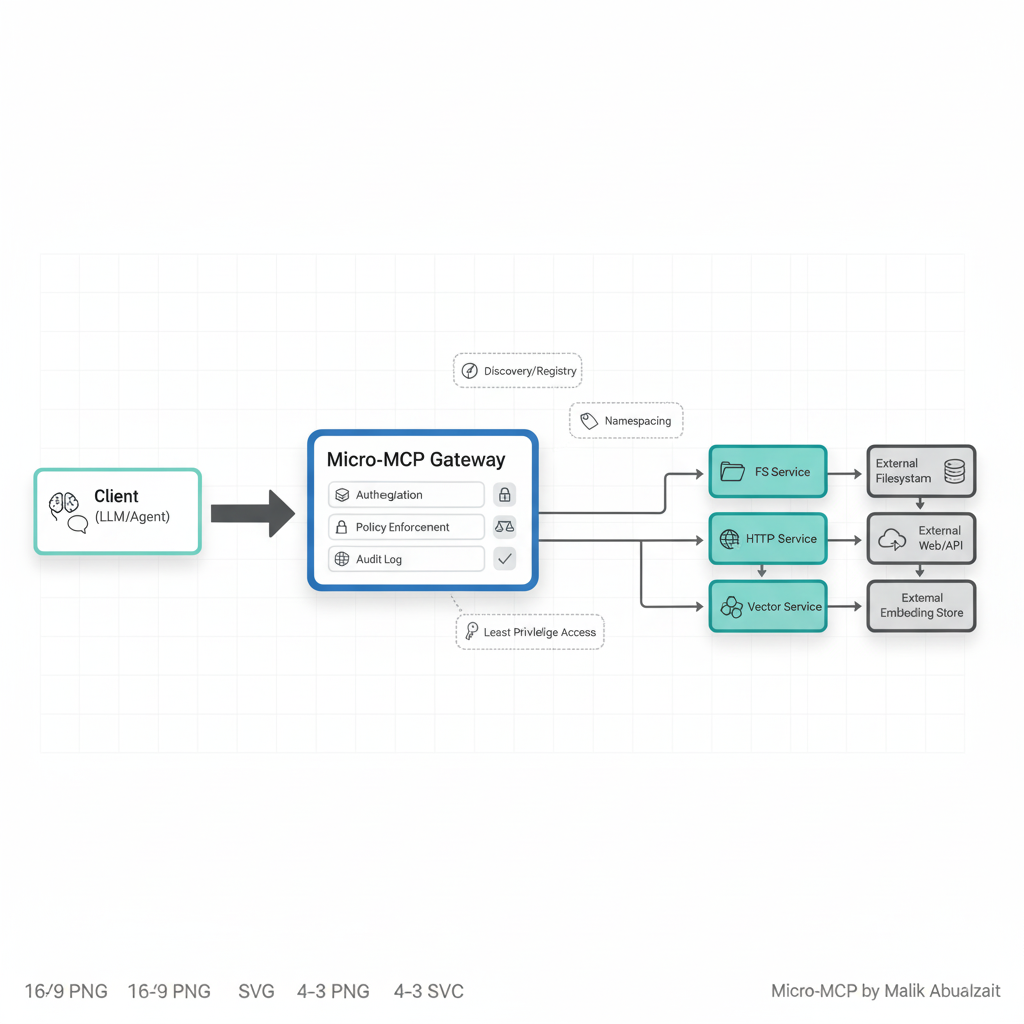 High-level concept: Client → Gateway → Micro‑MCP services (fs, http, vector) with discovery/policy/audit.
Why Micro‑MCP (theory)
- Composition: MCP already standardizes tools/resources/prompts. Micro‑MCP adds a composition layer so many small servers can be plugged together without tight coupling.
- Boundaries: Split capabilities across independent processes with clear security and blast‑radius boundaries.
- Operability: Ship, scale, and roll back capabilities independently, with per‑service logs/metrics/traces.
- Interop: Keep the on‑wire protocol MCP‑compatible so any compliant client/server benefits.
Core ideas
- Single‑purpose servers: Each micro‑service exposes a narrow set of MCP tools/resources/prompts.
- Aggregation gateway: A thin gateway fronts multiple services, merges capability catalogs, and routes calls by namespace.
- Discovery & policy: A registry or manifest defines which services exist, how to reach them, and which methods are allowed.
- Observability & audit: Cross‑cutting audit logs and metrics at the gateway; local logs/health per service.
Architecture (high level)
- Client (LLM/agent) connects to the gateway via an MCP‑compatible transport.
- The gateway discovers registered micro‑services and names their capabilities (e.g.,
fs.*,http.fetchText). - Client calls are routed by namespace to the right service; responses are streamed back.
- Policy (allowlist/scopes) and authentication are enforced at the gateway; services enforce their own outbound permissions.
In this MVP we model the data plane with simple NDJSON JSON‑RPC over stdio for ease of local experimentation.
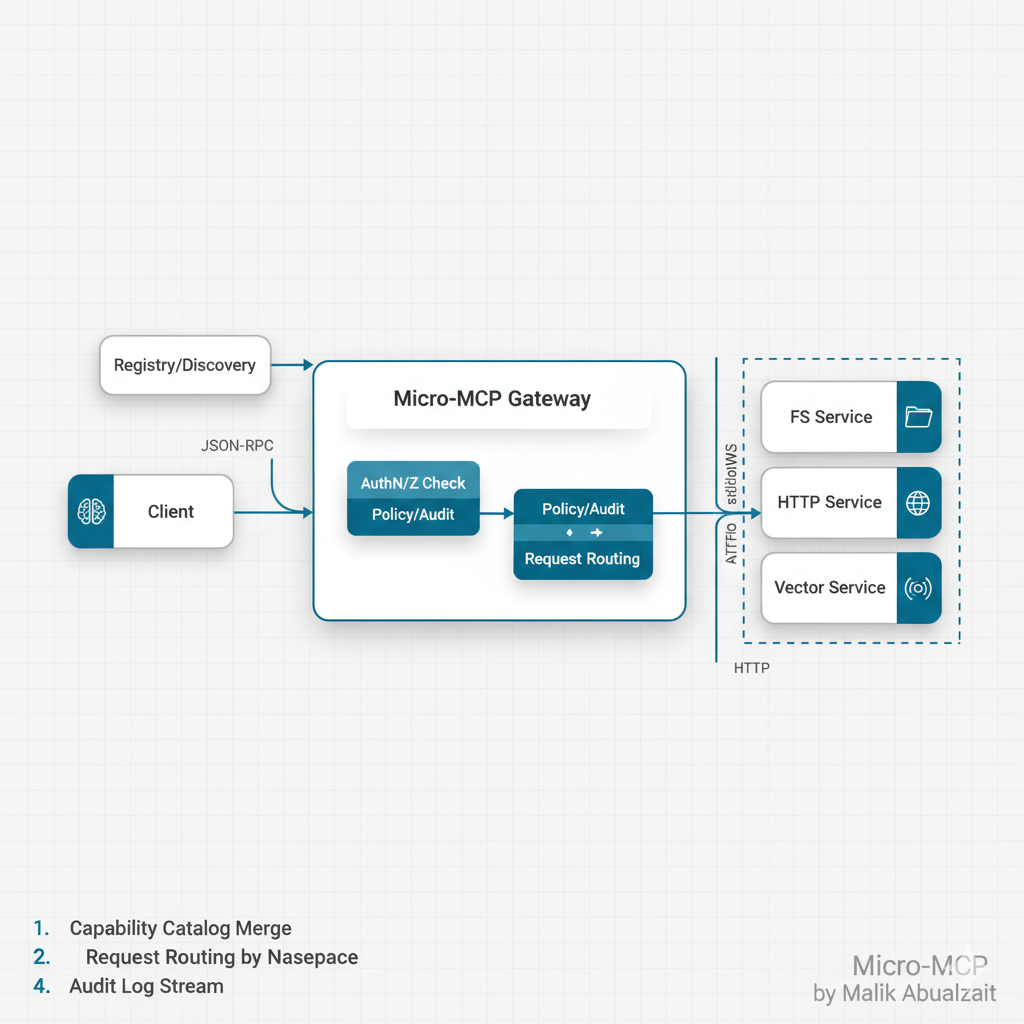 Components and interfaces: Gateway, Registry/Discovery, Policy/Audit, and services.
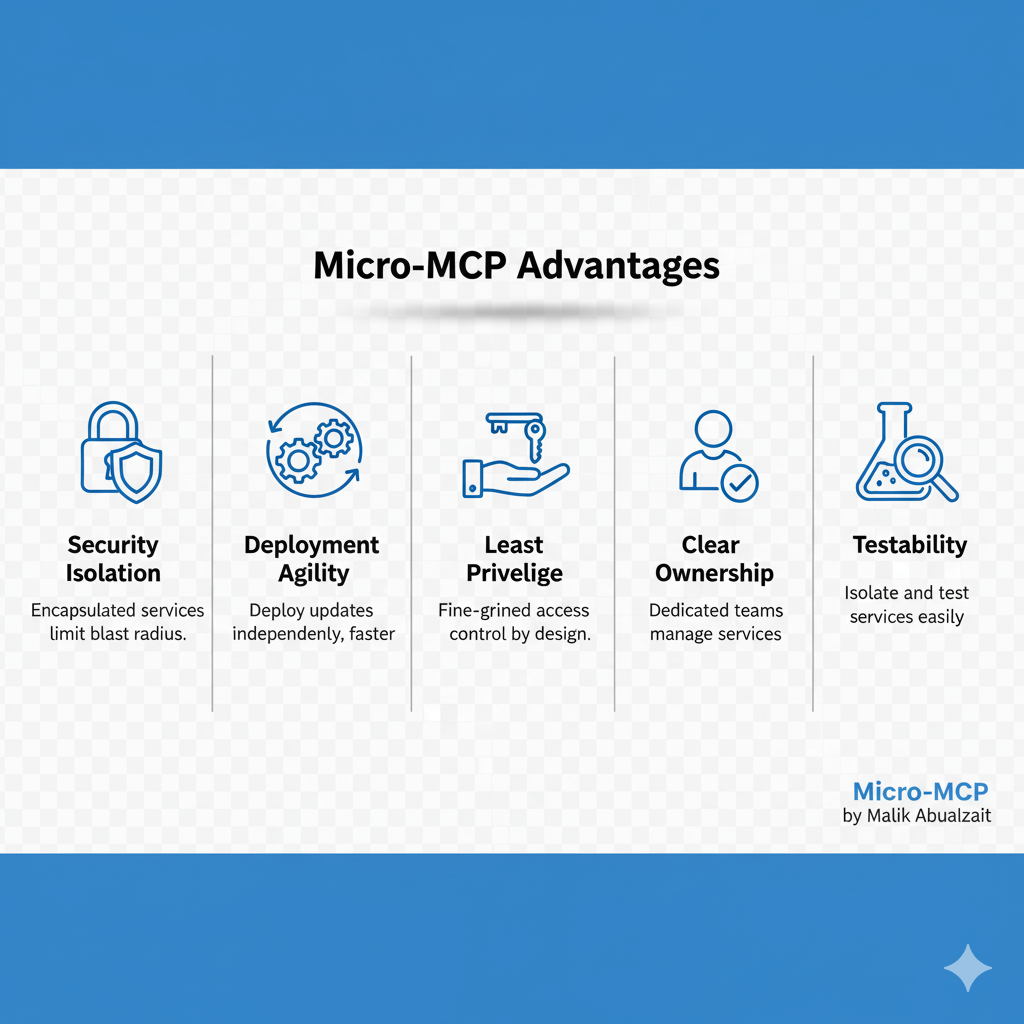
Advantages
- Security isolation: Compromise or overload of one service does not cascade to others.
- Deployment agility: Independent versioning, scaling, and rollback per capability.
- Least privilege: Per‑service credentials and fine‑grained gateway policy (scopes/allowlists).
- Clear ownership: Teams own their micro‑MCP service lifecycles and SLOs.
- Testability: Contract tests per tool/resource; conformance tests at the gateway.
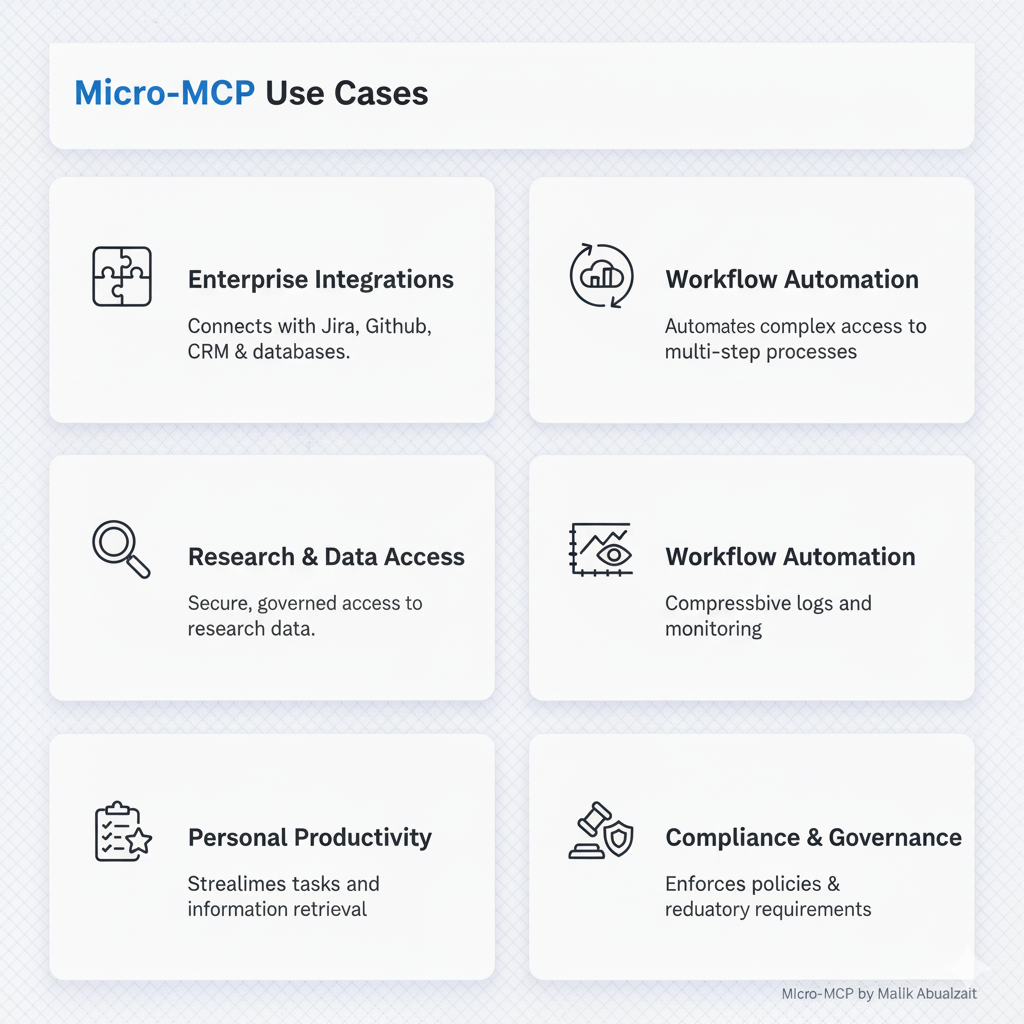
Use cases
- Enterprise integration: Wrap SaaS/internal systems (Jira, GitHub, CRM, DB) as isolated micro‑MCP services.
- Research/data: Controlled access to corpora, web fetchers, and vector stores with policy guardrails.
- Automation: Repeatable task services (release notes, triage, report generation) with deterministic IO.
- Personal productivity: Local file/calendar services with strict least‑privilege.
How the MVP works (code overview)
gateway/src/index.js: Spawns micro‑services via stdio, routes JSON‑RPC by namespace, enforces a static token and an allowlist policy, writes audit logs to stderr.gateway/discovery.example.json: Declares three services (fs,http,vector) and how to start them.gateway/gateway.config.example.json: Static token and policy allowlist (e.g.,fs.*,http.fetchText).services/fs/server.js:fs.listDir,fs.readFileTexton the local filesystem.services/http/server.js:http.fetchTextwith a domain allowlist viaALLOWLISTenv var.services/vector/server.js: Minimal in‑memoryvector.addDocumentandvector.searchusing cosine similarity over token counts.
Execution model (NDJSON JSON‑RPC):
- The gateway reads JSON‑RPC messages from stdin and authenticates/authorizes them.
- It rewrites the
idto an internal correlation id and forwards to the target service stdio. - It reads the service response, restores the client
id, and writes to stdout. - All calls and replies are audited to stderr.
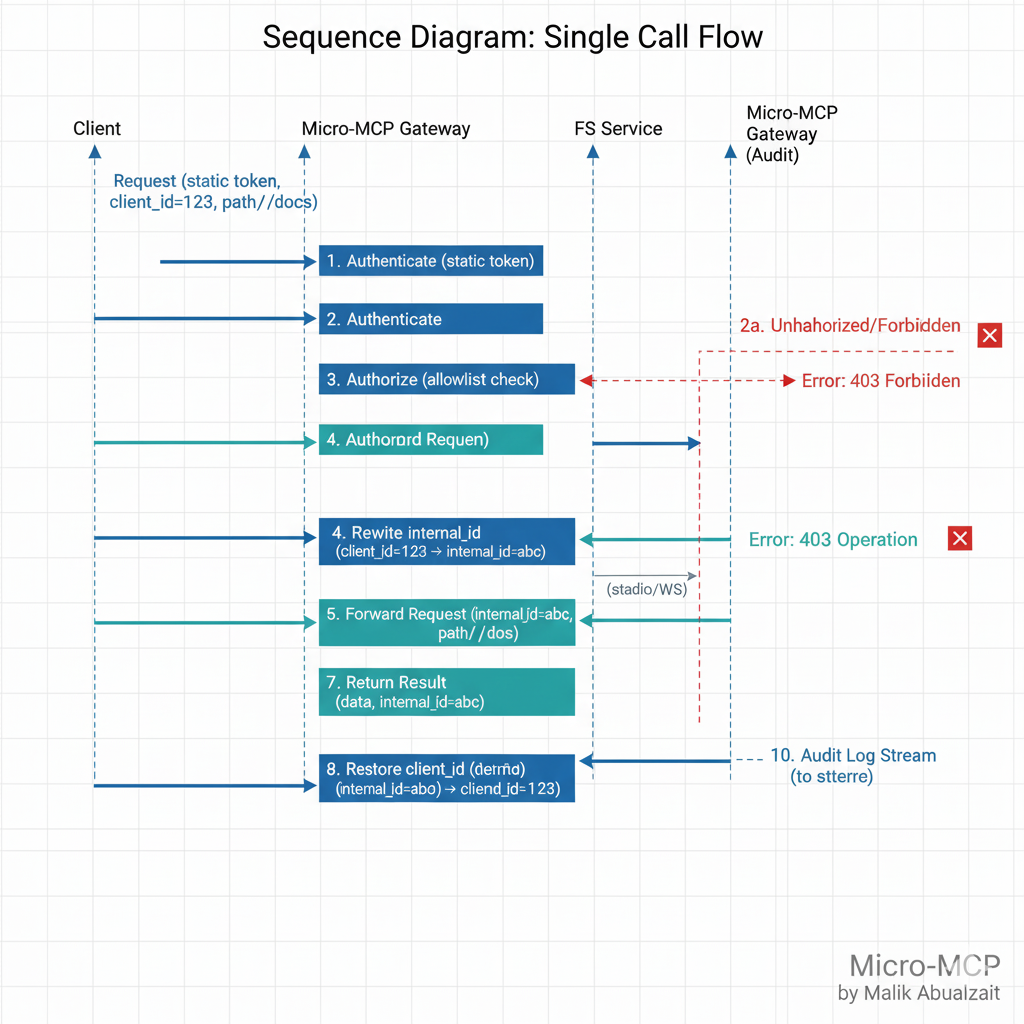 Authentication, policy, routing, correlation, and audit in the request/response path.
See docs/QUICKSTART.md for run instructions and an end‑to‑end demo script.
For a deeper dive into components and flows, read docs/ARCHITECTURE.md.
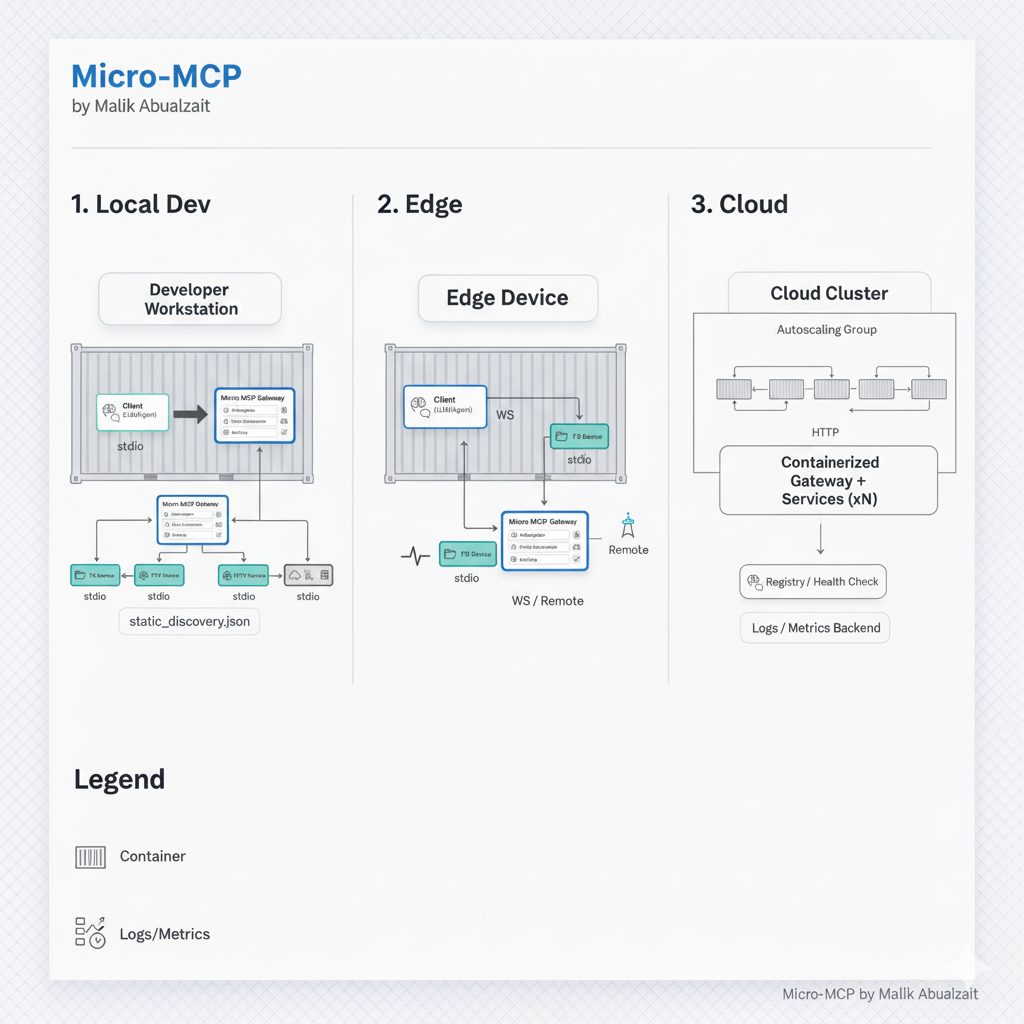 Local, edge, and cloud deployment patterns.
Prior Art & Novelty
- Micro‑MCP is a new architecture pattern building on the Model Context Protocol (MCP): a gateway aggregates multiple single‑purpose MCP servers with discovery, policy, and audit.
- To the best of our knowledge, there is no established public standard or widely used term for this gateway/registry composition pattern in MCP. This repository proposes and demonstrates that pattern.
Observations & limitations (MVP)
- Transport: The MVP uses stdio NDJSON for simplicity; production deployments should use MCP transports (e.g., WebSocket) and hardened process isolation.
- Policy: The allowlist is minimal; a full solution should implement scopes, consent prompts, and contextual policy engines.
- Discovery: Static manifest today; future work includes dynamic registry/health and version negotiation.
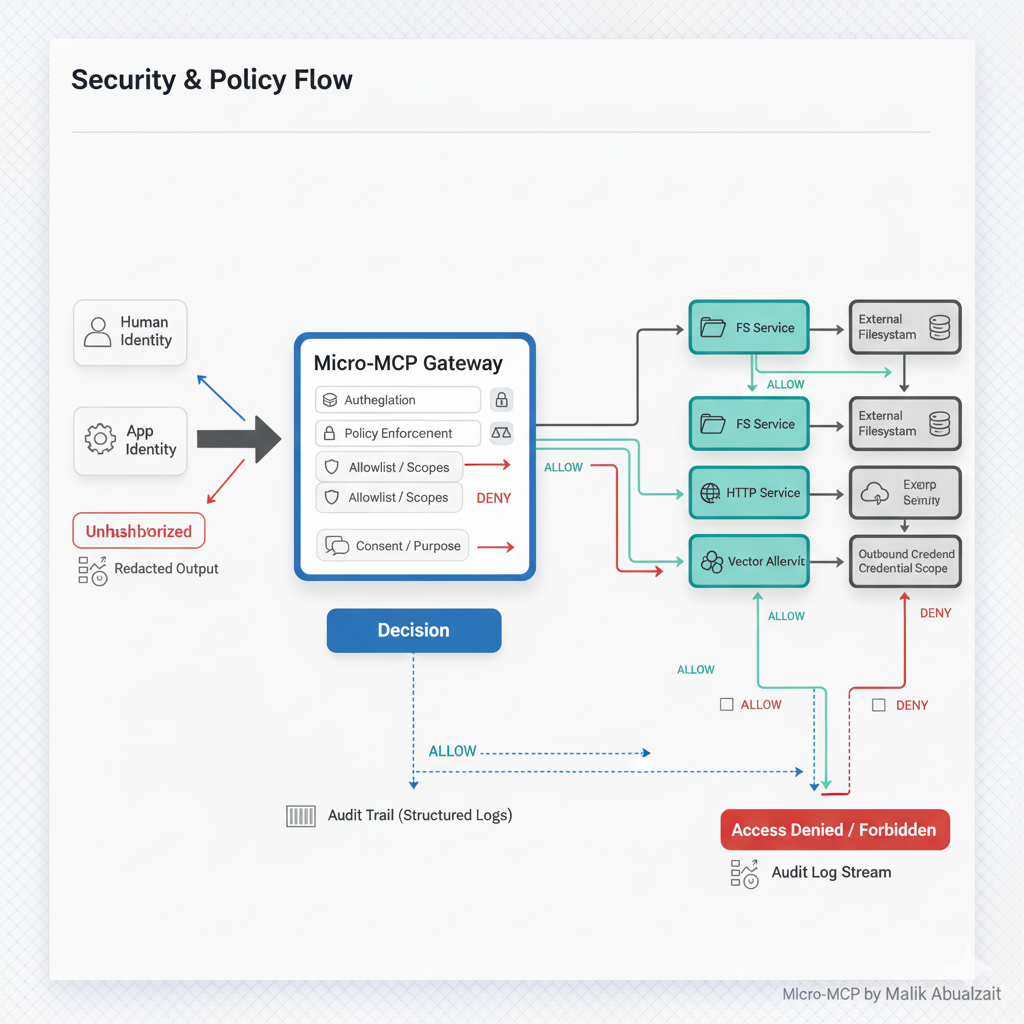 Security and policy checks across gateway and services.
Repository layout
gateway/– aggregator that fronts multiple micro‑MCP servicesservices/– example micro‑services:fs/,http/,vector/templates/– TypeScript and Python service templatesdocs/– guides, quickstarts, architecture
See MICRO-MCP-ROADMAP.md for the longer‑form plan and milestones.
Project links
- License:
LICENSE(MIT) - Security policy:
SECURITY.md - Contributing guidelines:
CONTRIBUTING.md
Authorship and Origin
- The Micro‑MCP concept and this reference implementation are introduced by Malik Abualzait (2025).
- Preferred reference: "Micro‑MCP: A Microservice Architecture Pattern for the Model Context Protocol," Malik Abualzait, 2025. Repository: this GitHub project.
Suggested citation:
Abualzait, M. (2025). Micro‑MCP: A Microservice Architecture Pattern for the Model Context Protocol. GitHub repository.
Установка MicroMCP
У этого сервера нет опубликованного пакета — он собирается из исходников. Открой репозиторий и следуй инструкции в README.
▸ github.com/mabualzait/MicroMCPFAQ
MicroMCP MCP бесплатный?
Да, MicroMCP MCP бесплатный — установка в пару кликов через Unyly без оплаты.
Нужен ли API-ключ для MicroMCP?
Нет, MicroMCP работает без API-ключей и переменных окружения.
MicroMCP — hosted или self-hosted?
Self-hosted: сервер запускается локально на твоей машине командой из раздела установки.
Как установить MicroMCP в Claude Desktop, Claude Code или Cursor?
Открой MicroMCP на unyly.org, выбери вкладку своего клиента (Claude Desktop, Claude Code, Cursor) и нажми Install — конфиг сгенерируется автоматически, без правки JSON.
Похожие MCP
Fetch
Web content fetching and conversion for efficient LLM usage.
AWS KB Retrieval
Retrieval from AWS Knowledge Base using Bedrock Agent Runtime.
 автор: modelcontextprotocol
Spring AI MCP Server
Provides auto-configuration for setting up an MCP server in Spring Boot applications.
llm-analysis-assistant
A very streamlined mcp client that supports calling and monitoring stdio/sse/streamableHttp, and can also view request responses through the /logs page. It also
 автор: xuzexin-hz
Compare MicroMCP with
Не уверен что выбрать?
Найди свой стек за 60 секунд
Автор?
Embed-бейдж для README
Похожее
Все в категории ai