
Multi Agent Python Code Auditor
БесплатноНе проверенMulti-Agent AI Code Auditor is a Python-based code review system that uses AST parsing, Bandit, Radon, and LLM-based agents to analyze code for security, qualit

Описание
Multi-Agent AI Code Auditor is a Python-based code review system that uses AST parsing, Bandit, Radon, and LLM-based agents to analyze code for security, quality, and complexity. The findings are summarized into a final report, saved as JSON, and benchmarked across multiple Python programs.
README
A Python Code Auditor built using a Multi-Agent architecture and Model Context Protocol (MCP). The project analyzes Python source code by combining AST parsing, an orchestrator, MCP client-server communication, and multiple AI agents to generate code analysis reports through a Sequential LLM Pipeline.
Technologies Used
- Python
- Model Context Protocol (MCP)
- Abstract Syntax Tree (AST)
- Orchestrator
- Sequential LLM Pipeline
- AI Agents
- Groq API
- Radon
- Bandit
Project Structure
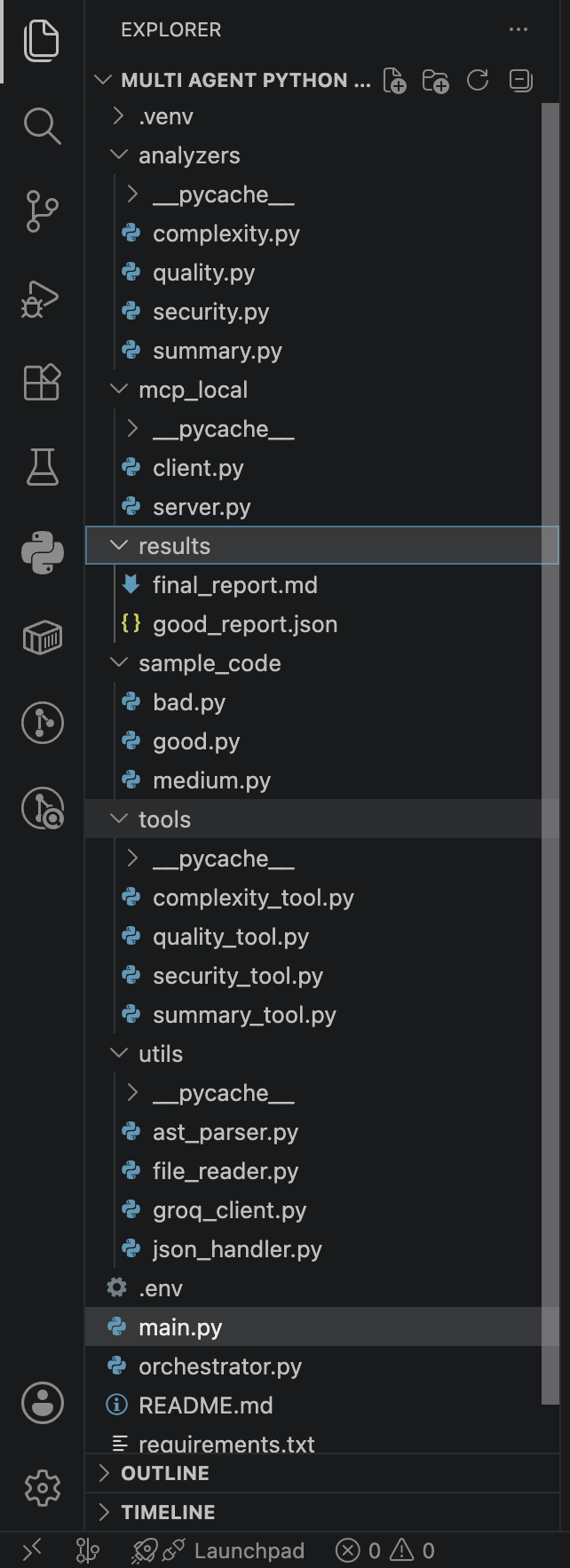
Project Workflow
Step 1 – Read Python Source Code
The File Reader reads a sample Python file and converts it into a string.
Step 2 – AST Parsing
The source code is parsed using Python's Abstract Syntax Tree (AST).
The AST parser extracts information such as:
- Functions
- Classes
- Imports
- Loops
- Conditional Statements
- Exception Handling Blocks
Instead of analyzing raw source code repeatedly, the agents use this AST summary as a structured representation of the program.
Step 3 – Orchestrator
The orchestrator decides which analysis tool (agent) should be executed.
This acts as the decision-making component before invoking the MCP communication and initiating the Sequential LLM Pipeline.
Step 4 – MCP Communication
The project follows an MCP-based client-server architecture.
- The Client acts as a messenger.
- It requests the required tool from the MCP Server.
- The Server executes the requested tool.
- The result is returned back through the Client.
Step 5 – AI Agents
Each MCP tool contains a dedicated AI Agent.
Each agent performs one specific task.
The available agents are:
- Security Agent
- Quality Agent
- Complexity Agent
- Summary Agent
Each agent receives the AST information and performs only its assigned analysis.
Together, these agents form a Sequential LLM Pipeline, where each stage performs a dedicated analysis before passing the results to the next stage.
Step 6 – AI Model
Each agent sends its prompt to the configured LLM API (Groq).
The generated response is returned back through the following flow:
LLM API
   ↓
Agent
   ↓
Tool
   ↓
MCP Server
   ↓
MCP Client
   ↓
Orchestrator
This completes one stage of the Sequential LLM Pipeline, allowing each analysis to be generated independently and combined into the final report.
Analysis Performed
The project currently performs:
- Security Analysis
- Code Quality Analysis
- Complexity Analysis
- Final Summary Generation
Output
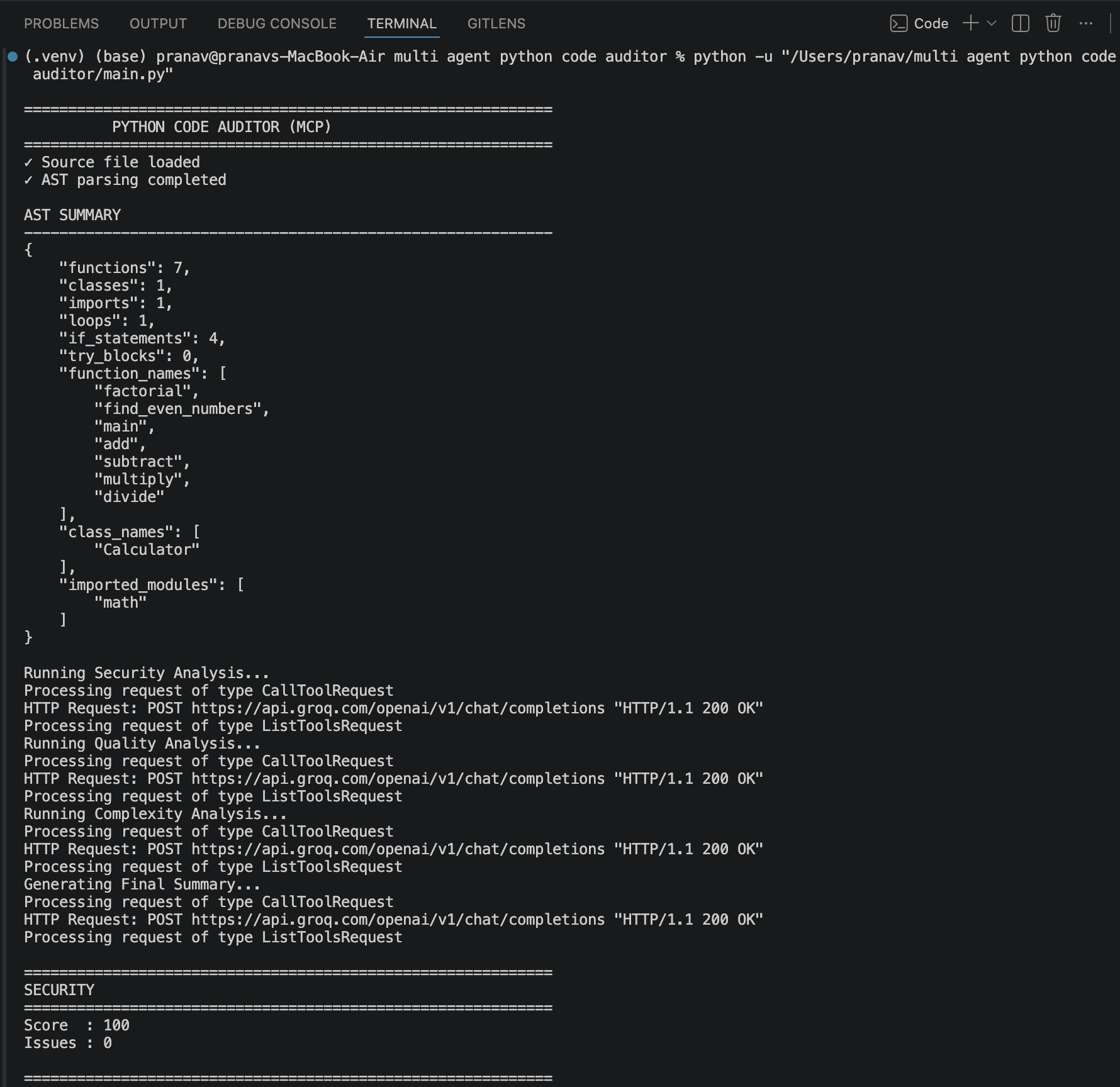
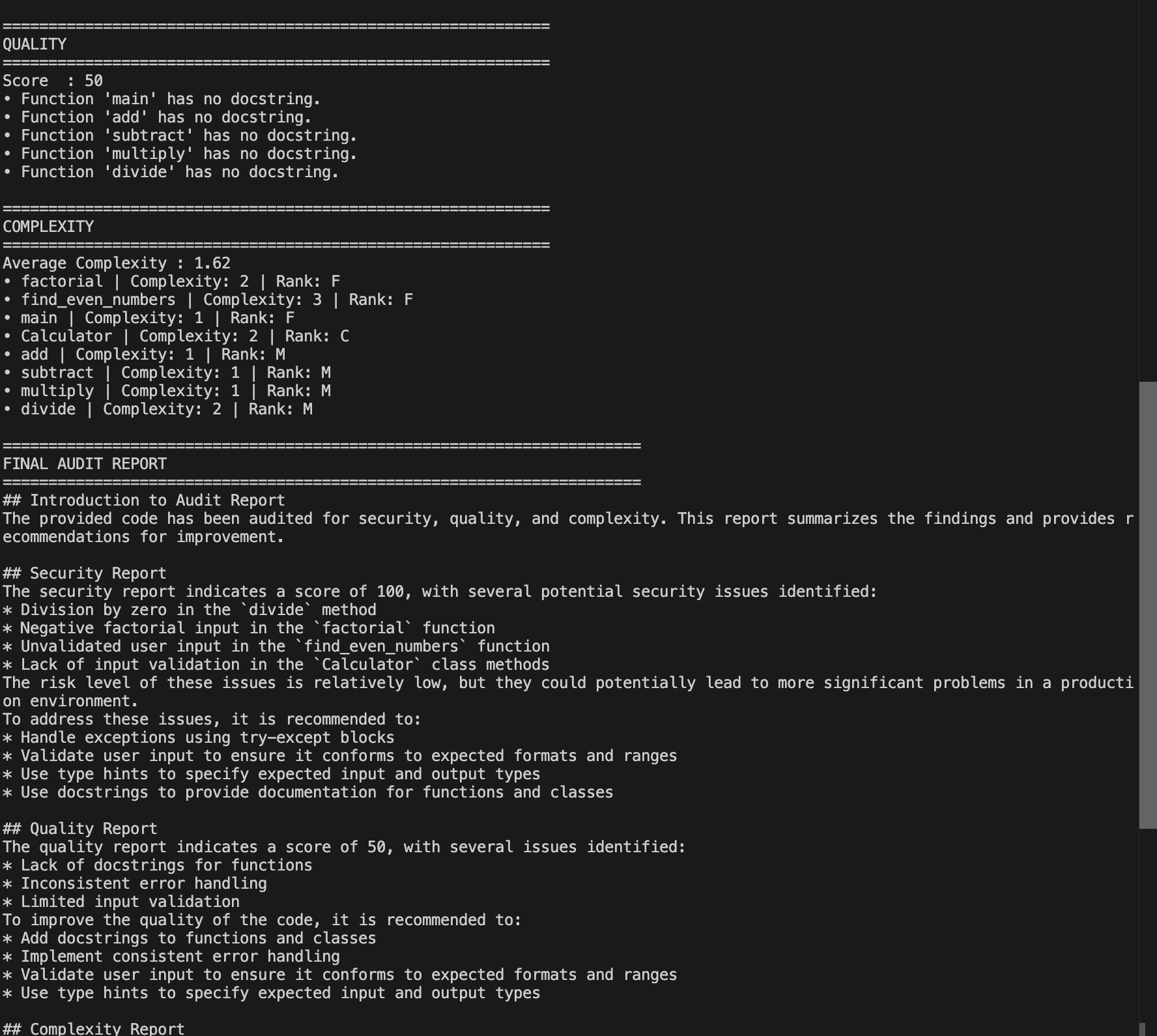
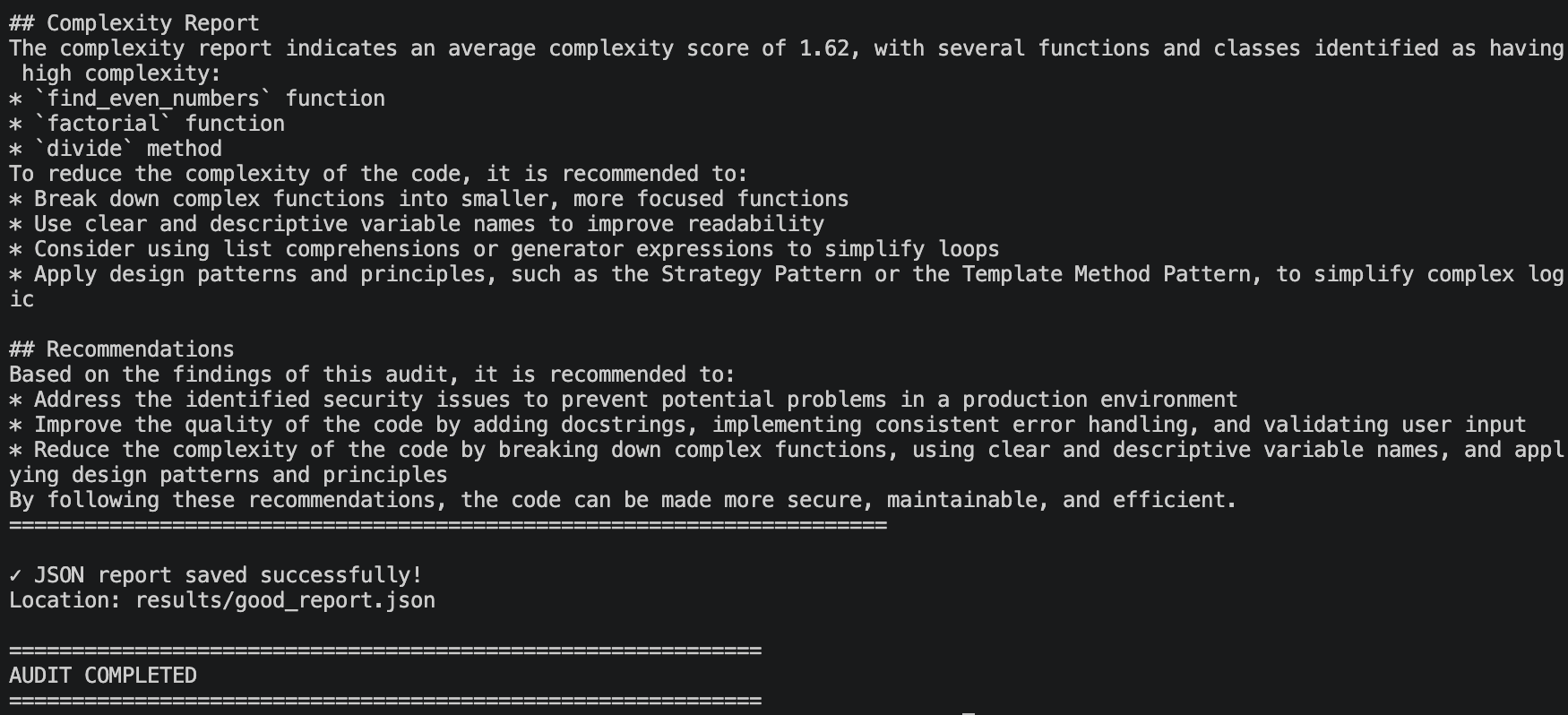
Tools Used
AST
Used to generate a structured representation of the Python code.
MCP
Provides client-server communication between the orchestrator and analysis tools.
Orchestrator
Determines which analysis tool or agent should be executed before starting the Sequential LLM Pipeline.
Bandit
Used for security-related code analysis.
Radon
Used for complexity analysis.
Execution Flow
Sample Python File
        │
        ▼
File Reader
        │
        ▼
AST Parser
        │
        ▼
Orchestrator
        │
        ▼
MCP Client
        │
        ▼
MCP Server
        │
        ▼
Security Tool
        │
        ▼
Security Agent
        │
        ▼
Quality Tool
        │
        ▼
Quality Agent
        │
        ▼
Complexity Tool
        │
        ▼
Complexity Agent
        │
        ▼
Summary Tool
        │
        ▼
Summary Agent
        │
        ▼
Groq API
        │
        ▼
Analysis Reports
This execution represents a Sequential LLM Pipeline, where each specialized agent performs its task and contributes to the final consolidated audit report.
Repository
The project demonstrates how AST parsing, MCP, an orchestrator, and a Sequential LLM Pipeline of specialized AI agents can be combined to analyze Python code and generate security, quality, complexity, and summary reports through a client-server architecture.
Установка Multi Agent Python Code Auditor
У этого сервера нет опубликованного пакета — он собирается из исходников. Открой репозиторий и следуй инструкции в README.
▸ github.com/spranavk-03/Multi_Agent_Python_Code_AuditorFAQ
Multi Agent Python Code Auditor MCP бесплатный?
Да, Multi Agent Python Code Auditor MCP бесплатный — установка в пару кликов через Unyly без оплаты.
Нужен ли API-ключ для Multi Agent Python Code Auditor?
Нет, Multi Agent Python Code Auditor работает без API-ключей и переменных окружения.
Multi Agent Python Code Auditor — hosted или self-hosted?
Self-hosted: сервер запускается локально на твоей машине командой из раздела установки.
Как установить Multi Agent Python Code Auditor в Claude Desktop, Claude Code или Cursor?
Открой Multi Agent Python Code Auditor на unyly.org, выбери вкладку своего клиента (Claude Desktop, Claude Code, Cursor) и нажми Install — конфиг сгенерируется автоматически, без правки JSON.
Похожие MCP
GitHub
PRs, issues, code search, CI status
 автор: GitHub
Filesystem
Secure file operations with configurable access controls.
Memory
Knowledge graph-based persistent memory system.
Template MCP Server
A CLI tool to create a new Model Context Protocol server project with TypeScript support, dual transport options, and an extensible structure
 автор: mcpdotdirect
Compare Multi Agent Python Code Auditor with
Не уверен что выбрать?
Найди свой стек за 60 секунд
Автор?
Embed-бейдж для README
Похожее
Все в категории development