
Multiple Servers Framework
БесплатноНе проверенProvides a framework for running multiple MCP servers using FastAPI, stdio, and streamable-http transports, with an echo tool for testing and integration with M

Описание
Provides a framework for running multiple MCP servers using FastAPI, stdio, and streamable-http transports, with an echo tool for testing and integration with MCP Inspector.
README
This project provides a framework for running multiple Model Context Protocol (MCP) servers using different transport mechanisms: FastAPI-based HTTP servers, standalone streamable-http servers, and stdio-based servers.
✅ Supported MCP Transports:
- stdio
- streamable-http
- FastAPI-mounted
It includes three main scripts:
mcp-server-with-stdio.py➡️ A standalone MCP server usingstdiotransport.mcp-server-with-streamable-http.py➡️ A standalone MCP server usingstreamable-httptransport.mcp-server-fastapi.py➡️ A FastAPI server hosting two MCP instances (McpServer1andMcpServer2) withstreamable-httptransport.
Each server implements a simple echo tool for testing and demonstration, and the framework supports robust logging, environment configuration, and graceful shutdown handling. The servers are compatible with the MCP Inspector for interactive testing. 🕵️♂️
📑 Table of Contents
- 🎯 Purpose
- 🗂️ Project Structure
- ✨ Features
- 🛠️ Prerequisites
- 📦 Required Packages
- ⚙️ Installation
- 🚀 Usage
- 🧩 Workflow
- 📝 Logging
- 🛑 Graceful Shutdown
- 🧭 Notes
- 🛠️ Troubleshooting
🎯 Purpose
The MCP Server Framework is designed to:
- Demonstrate the flexibility of MCP servers using different transports (
streamable-httpandstdio). - Provide a production-ready FastAPI server hosting multiple MCP instances under a single application.
- Support standalone MCP servers for simpler use cases or environments requiring
stdiocommunication. - Ensure robust logging, configuration management, and graceful shutdown for all server types.
- Enable easy integration with the MCP Inspector for testing and tool interaction.
🗂️ Project Structure
The project is organized as follows:
/
├── src/
│   ├── mcp-server-fastapi.py                # FastAPI server hosting two MCP instances
│   ├── mcp-server-with-streamable-http.py   # Standalone MCP server with streamable-http
│   ├── mcp-server-with-stdio.py             # Standalone MCP server with stdio
│   ├── fastapi_mcp_servers/                 # MCP server implementations for FastAPI
│   │   ├── __init__.py
│   │   ├── mcp_server_1.py                  # First MCP server with echo1 tool
│   │   └── mcp_server_2.py                  # Second MCP server with echo2 tool
│   ├── config/                              # Configuration and logging utilities
│   │   ├── __init__.py
│   │   ├── app_settings.py                  # Environment variable and settings management
│   │   └── logging_config.py                # Logging setup with file rotation and cleanup
│   └── util/
│       └── mcp_server_shutdown_handler.py   # Graceful shutdown handler for MCP servers
├── .env                                     # Environment variables (e.g., PORT, LOG_DIR)
├── pyproject.toml                           # Project dependencies
└── README.md                                # Project documentation
✨ Features
- Multiple MCP Servers:
- Standalone MCP server using
stdiotransport for direct stdin/stdout communication. - Standalone MCP server using
streamable-httptransport athttp://0.0.0.0:8001/mcp/. - FastAPI server hosting two MCP instances at
/echo1/mcp/and/echo2/mcp/withstreamable-httptransport.
- Standalone MCP server using
- Echo Tool: A simple tool that echoes input messages, implemented across all servers for testing.
- Transport Flexibility: Supports
streamable-http(recommended for HTTP-based communication) andstdio(for Inspector-driven communication). - Robust Logging: Configurable logging with file rotation and console output, stored in a specified log directory.
- Environment Configuration: Loads settings from a
.envfile (e.g.,PORT,LOG_DIR,API_KEY). - Graceful Shutdown: Handles
SIGINTandSIGTERMsignals to ensure clean termination of MCP servers. - Lifespan Management (FastAPI): Manages startup and shutdown of MCP session managers in the FastAPI server.
- MCP Inspector Compatibility: All servers are compatible with the MCP Inspector for interactive tool testing.
🛠️ Prerequisites
To run the project, ensure you have the following installed:
- Python: Version 3.8 or higher
- Node.js: Required for running the MCP Inspector
- uv: A Python package manager for installing dependencies
- npx: For running the MCP Inspector
- Operating System: Compatible with Windows, macOS, or Linux
- Recommended: a modern terminal that supports UTF-8
📦 Required Packages
The project depends on the following Python packages:
mcp[cli]: Provides the MCP server and CLI tools.fastapi: The FastAPI framework for themcp-server-fastapi.pyscript.uvicorn: ASGI server implementation for running FastAPI.python-dotenv: For loading environment variables from a.envfile.
⚙️ Installation
Clone the Repository:
git clone https://github.com/ahmad-act/Multiple-MCP-Servers-Using-FastAPI-and-Testing-with-Inspector.git
cd Multiple-MCP-Servers-Using-FastAPI-and-Testing-with-Inspector
Set Up a Virtual Environment (optional but recommended):
uv venv
source venv/bin/activate  # On Windows: venv\Scripts\activate
Install Dependencies:
Install the required Python packages using
uv:uv syncAlternatively,
uv add mcp[cli] fastapi uvicorn python-dotenvConfigure Environment Variables:
Create a
.envfile in the project root with the following content:PORT=10000 LOG_DIR=logs
Usage
1️⃣ Standalone Stdio MCP Server (mcp-server-with-stdio.py)
Starting the MCP Server
You do not need to manually run the MCP server for stdio transport. MCP Inspector runs the MCP Server for stdio transport.
Starting the MCP Inspector
The stdio server is typically launched by the MCP Inspector, not manually. Run the Inspector with the following command, adjusting the --directory path to your src/ directory:
npx @modelcontextprotocol/inspector uv --directory "<your-src-directory>" run mcp-server-with-stdio.py --debug
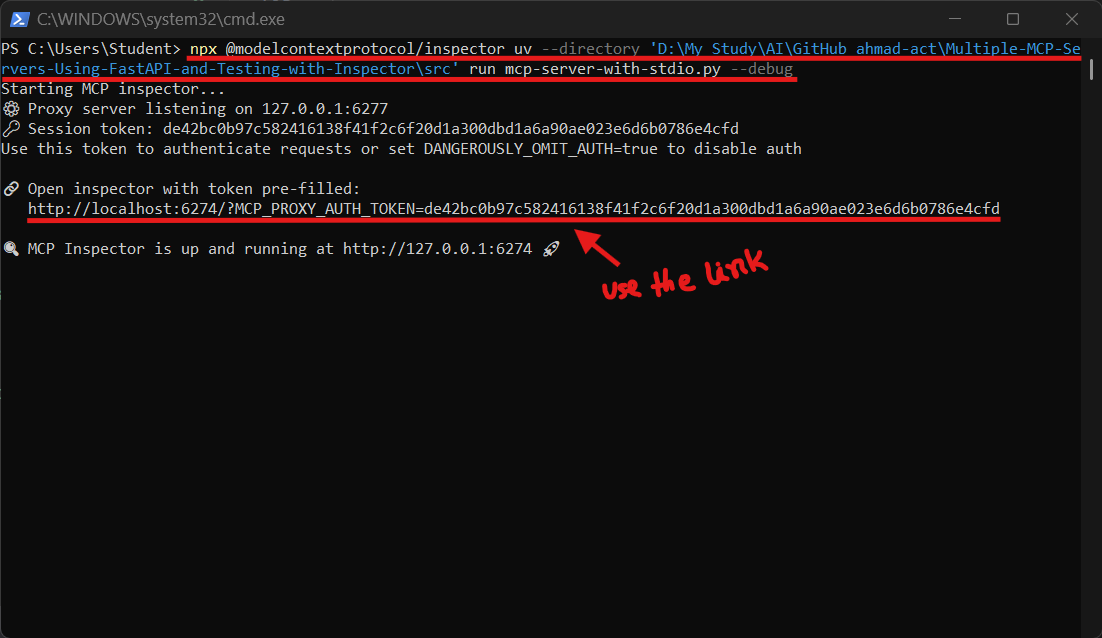
The Inspector will manage the server lifecycle and communicate over stdio.
Opening the MCP Inspector
Open the link http://localhost:6274/?MCP_PROXY_AUTH_TOKEN=XXXXXXXXXXXXXXXXXX with its token in your browser:
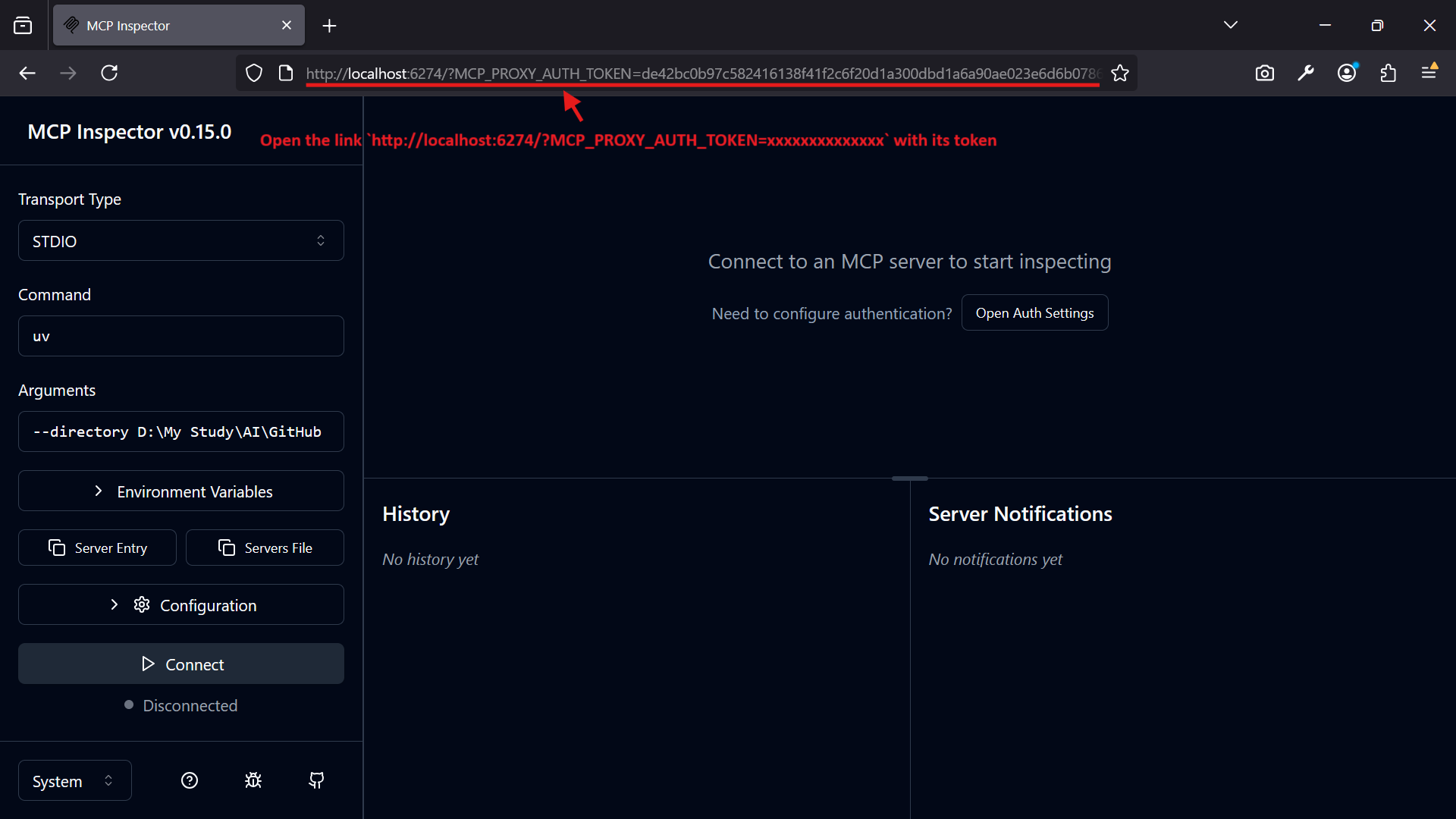
Using the MCP Inspector
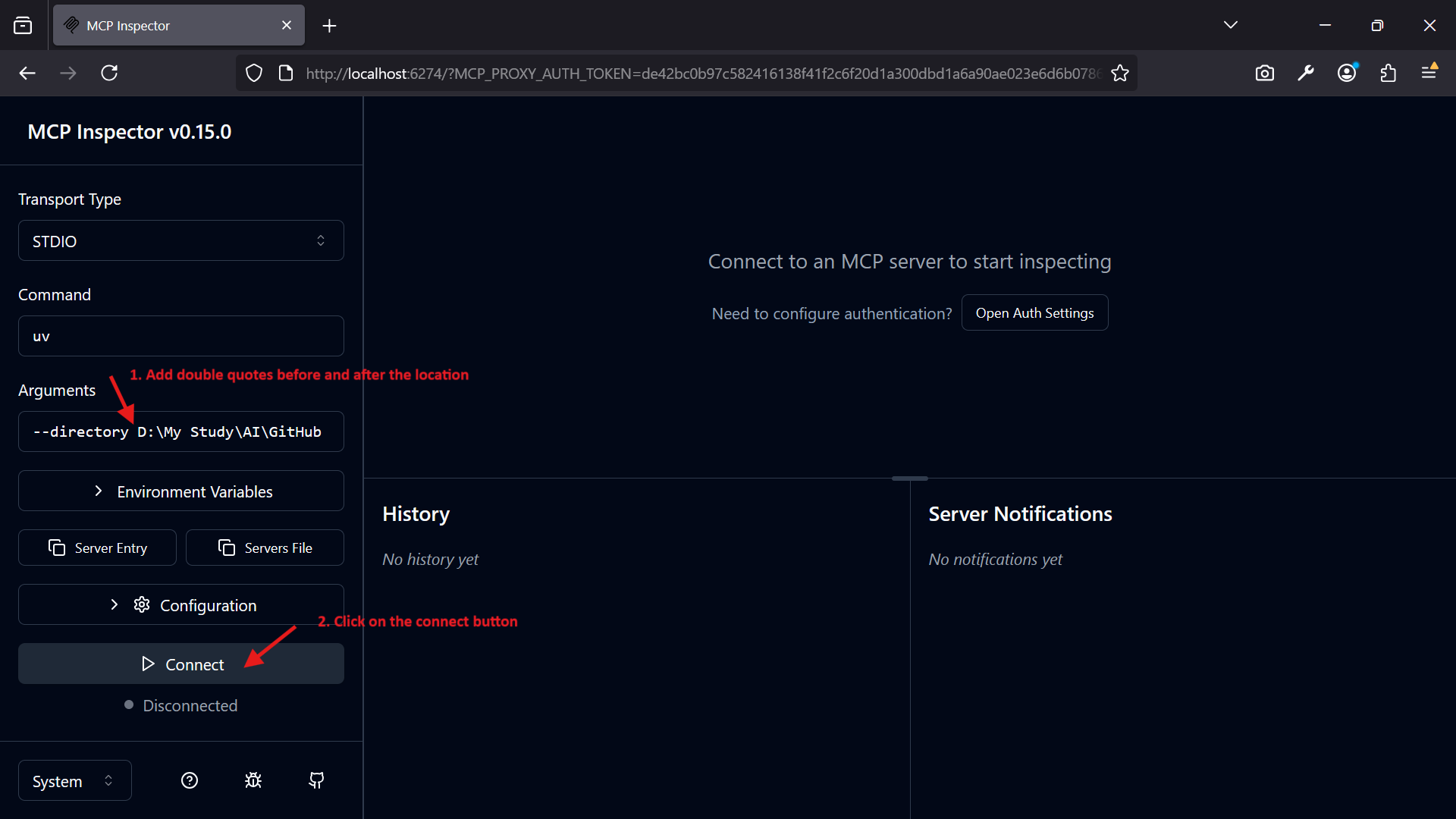
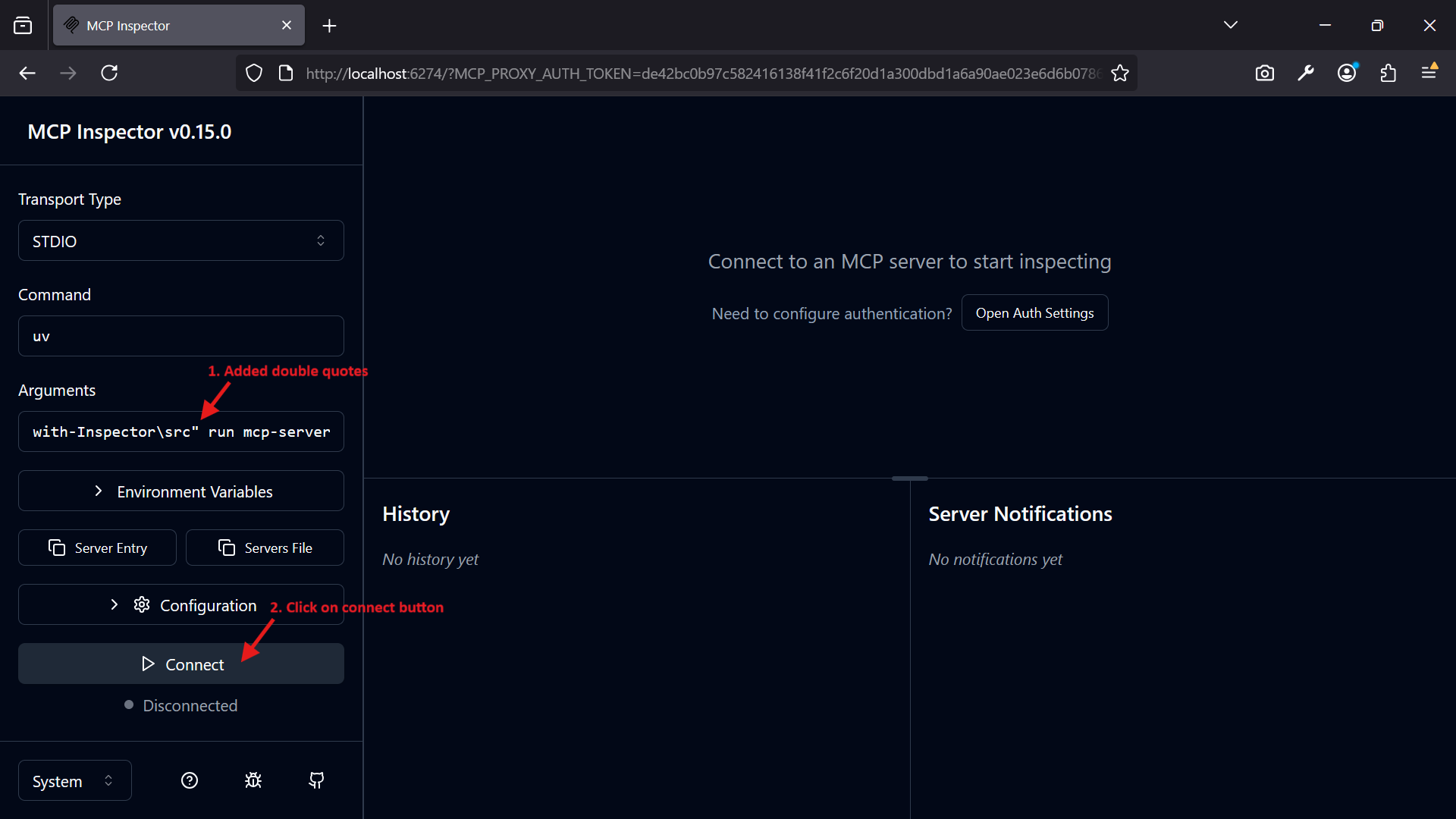
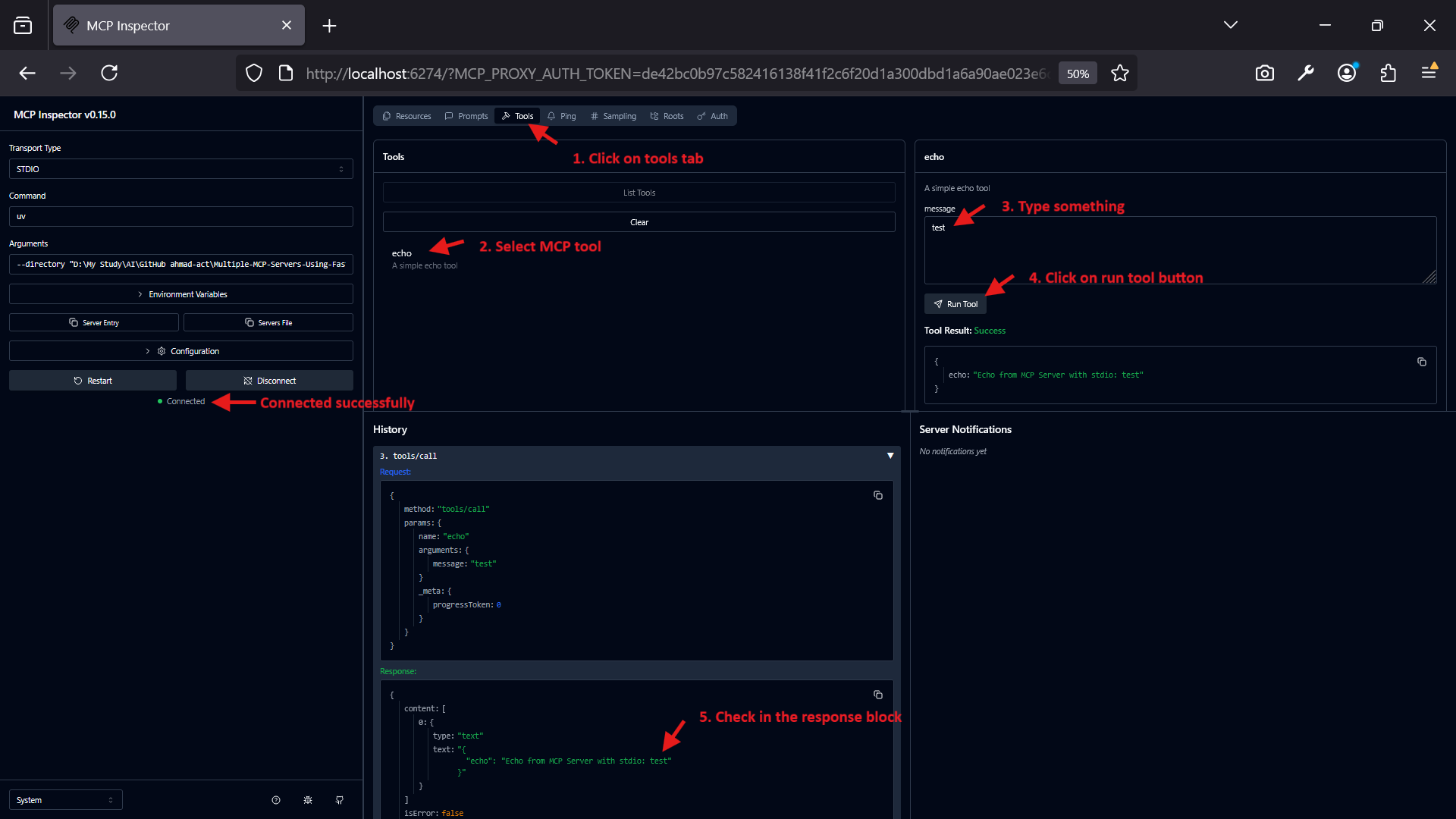
After running the above command, the Inspector will start and automatically connect to the
stdio-based server.In the Inspector UI (
http://127.0.0.1:6274), inspect the available tools (e.g.,echo).Test the
echotool:Input:
{
  "message": "test"
}
Expected Output:
{
  "echo": "Echo from MCP Server with stdio: test"
}
2️⃣ Standalone Streamable-HTTP MCP Server (mcp-server-with-streamable-http.py)
Starting the MCP Server
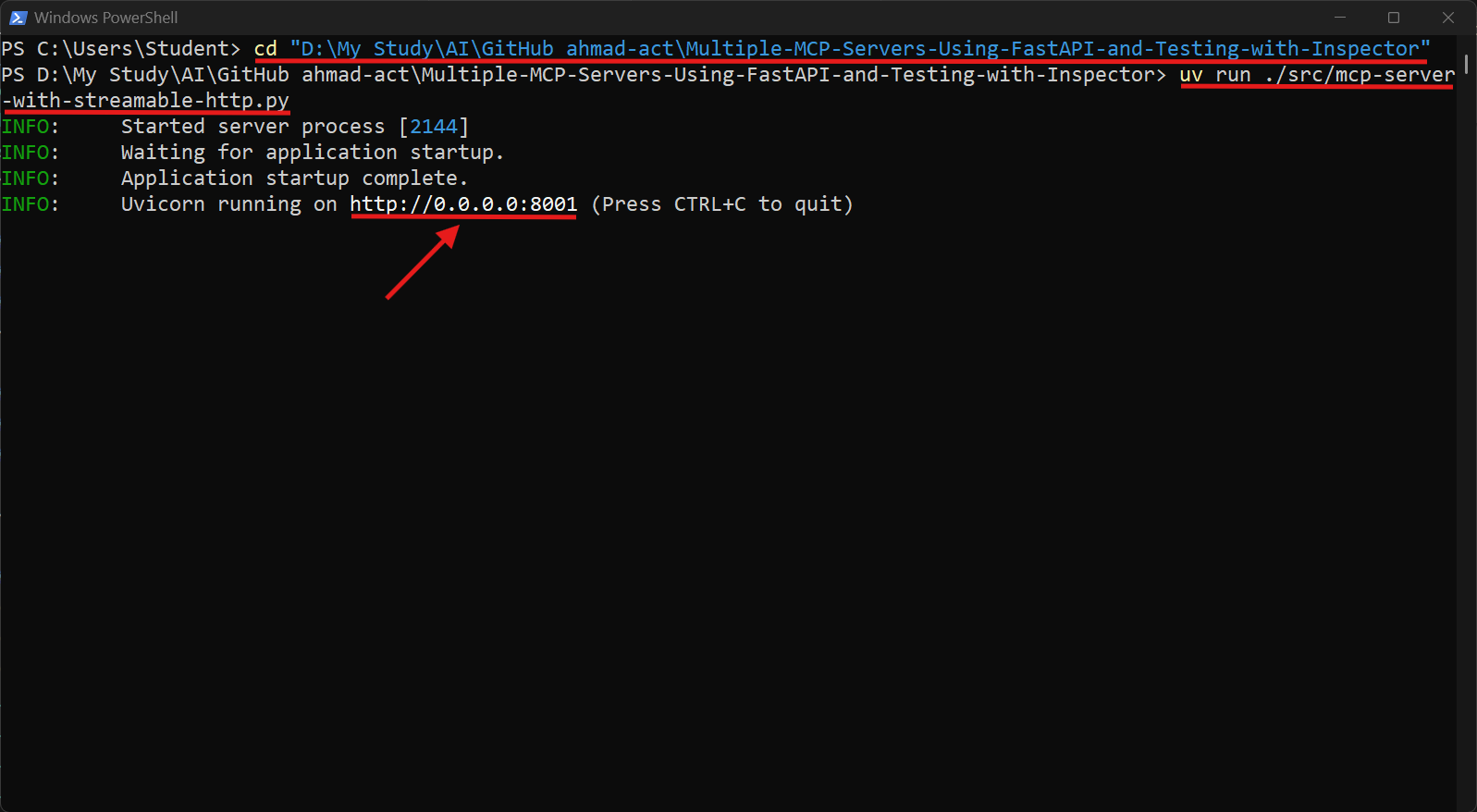
Open new terminal and go to the project root folder:
cd "D:\My Study\AI\GitHub ahmad-act\Multiple-MCP-Servers-Using-FastAPI-and-Testing-with-Inspector"
Run the standalone MCP server:
uv run ./src/mcp-server-with-streamable-http.py
The server will start on http://0.0.0.0:8001/mcp/.
Starting the MCP Inspector
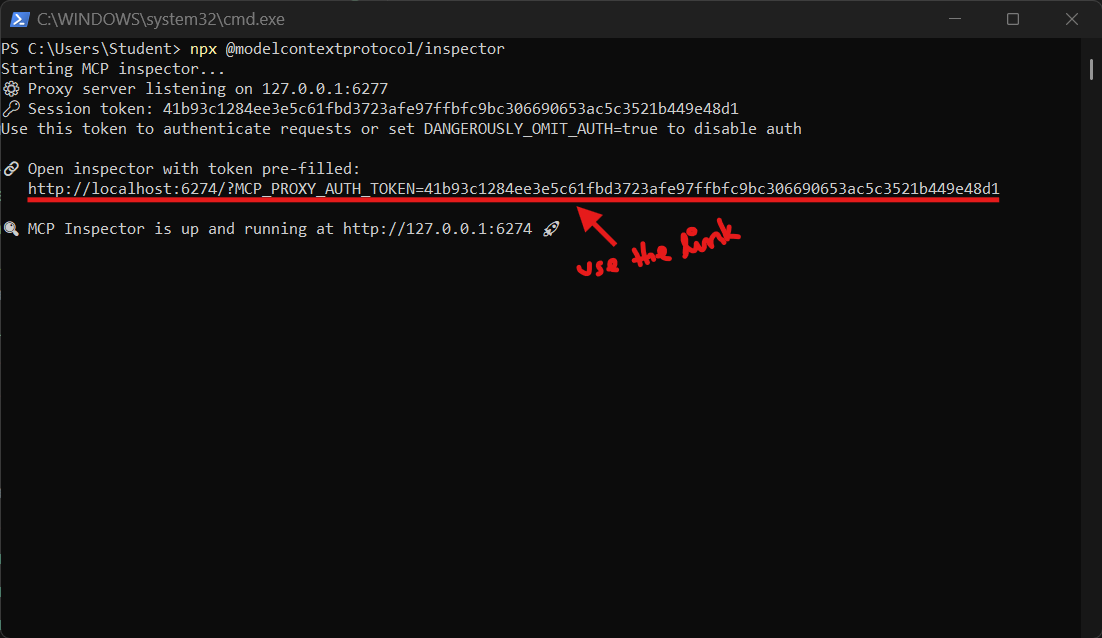
Run the MCP Inspector:
Open new terminal and run the command:
npx @modelcontextprotocol/inspector
Opening the MCP Inspector
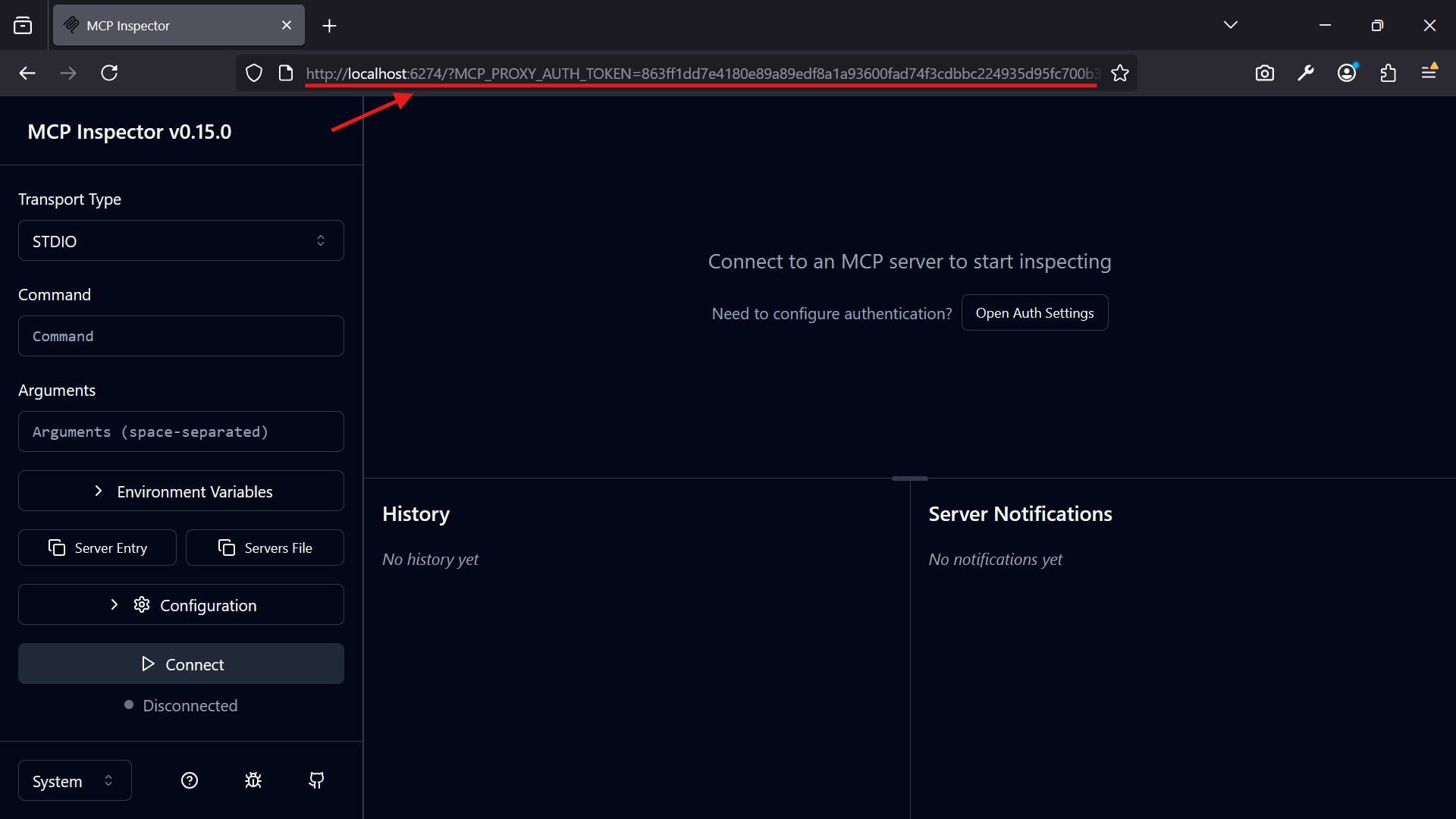
Open the Inspector in your browser at http://127.0.0.1:6274.
http://localhost:6274/?MCP_PROXY_AUTH_TOKEN=XXXXXXXXXXXXXXXXXXXXXXXXXXXXXXXXXXXXXXXXXXXXXX
Using the MCP Inspector
Configure the Inspector to connect to
http://0.0.0.0:8001/mcp/.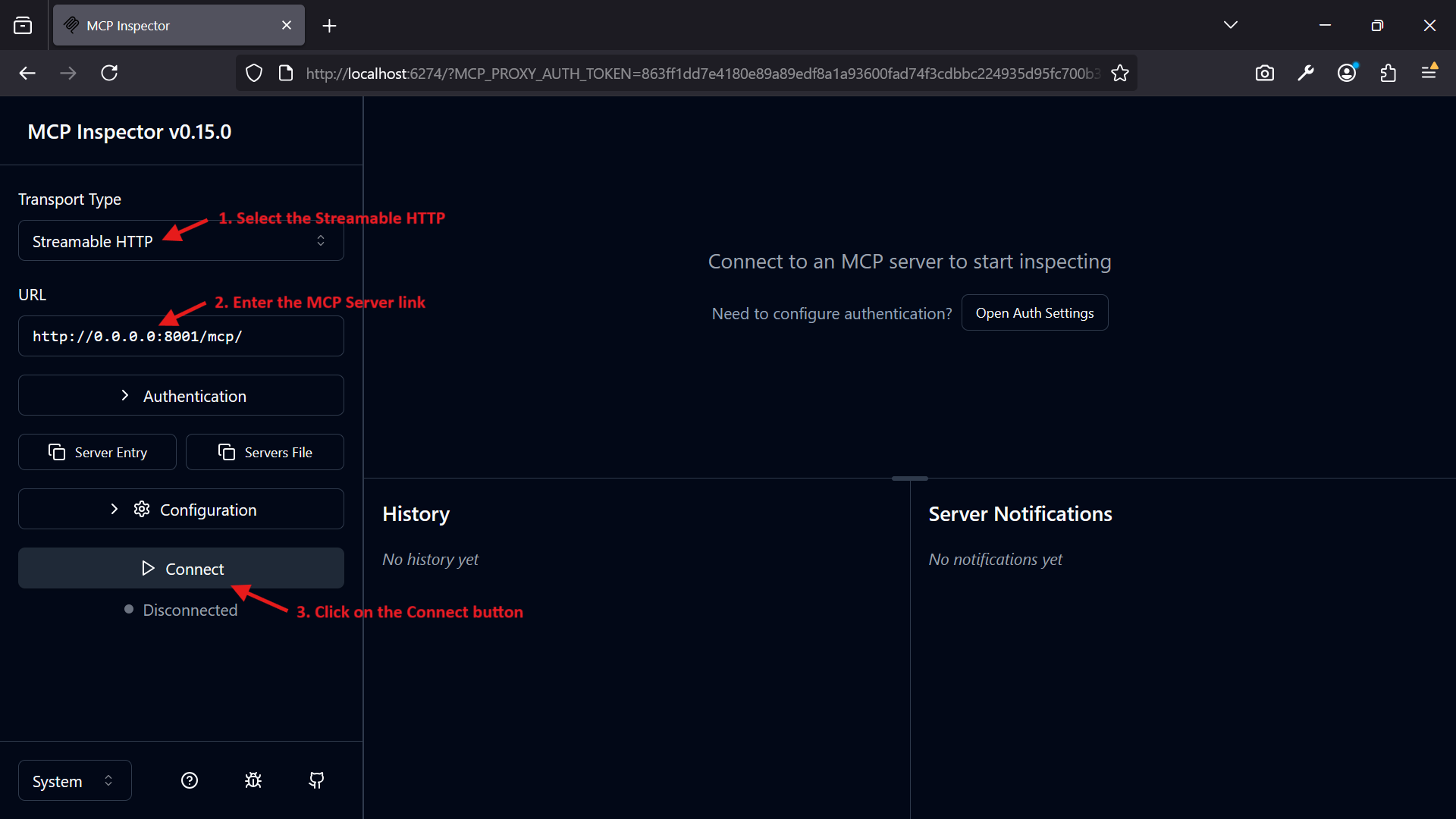
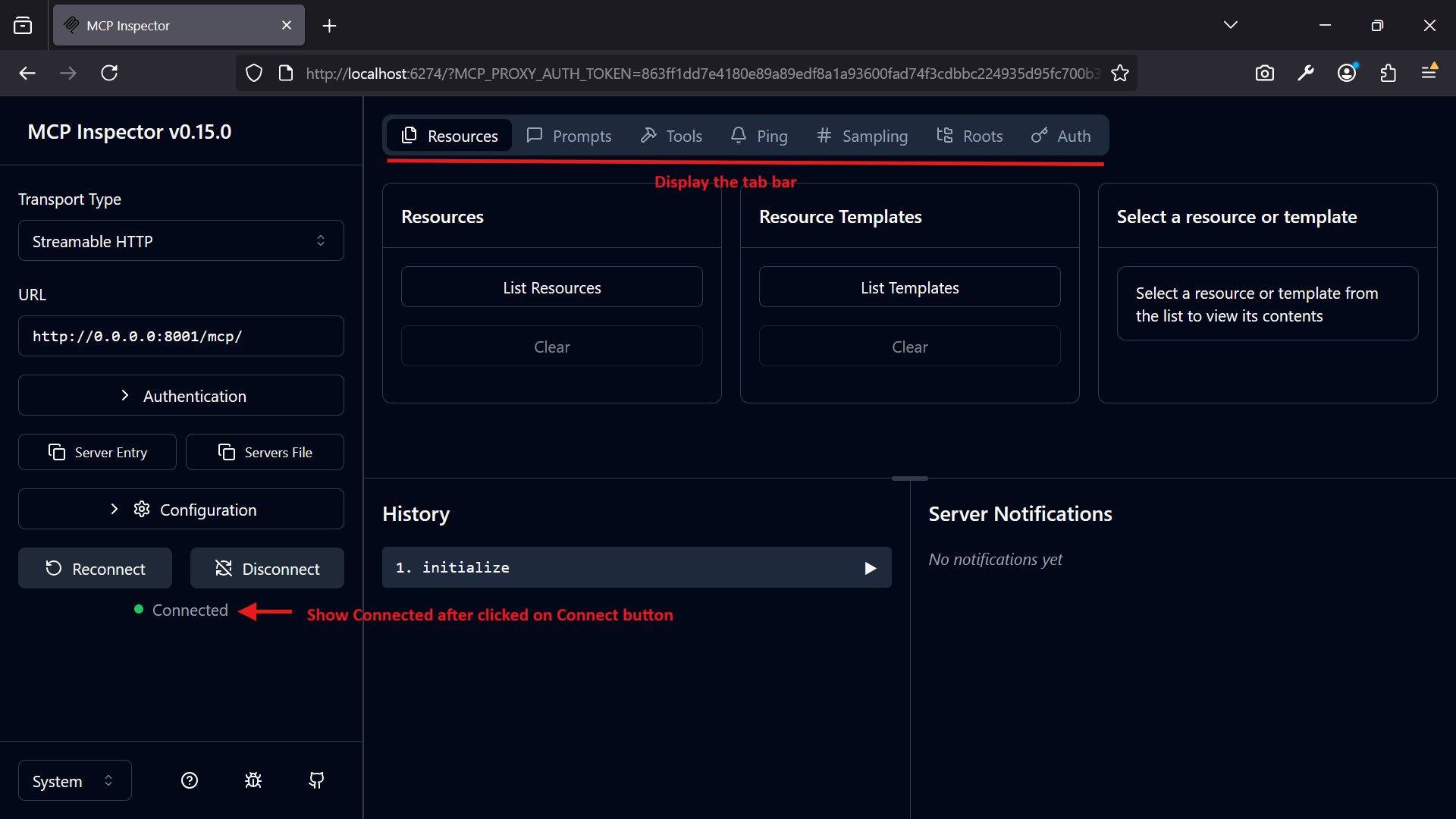
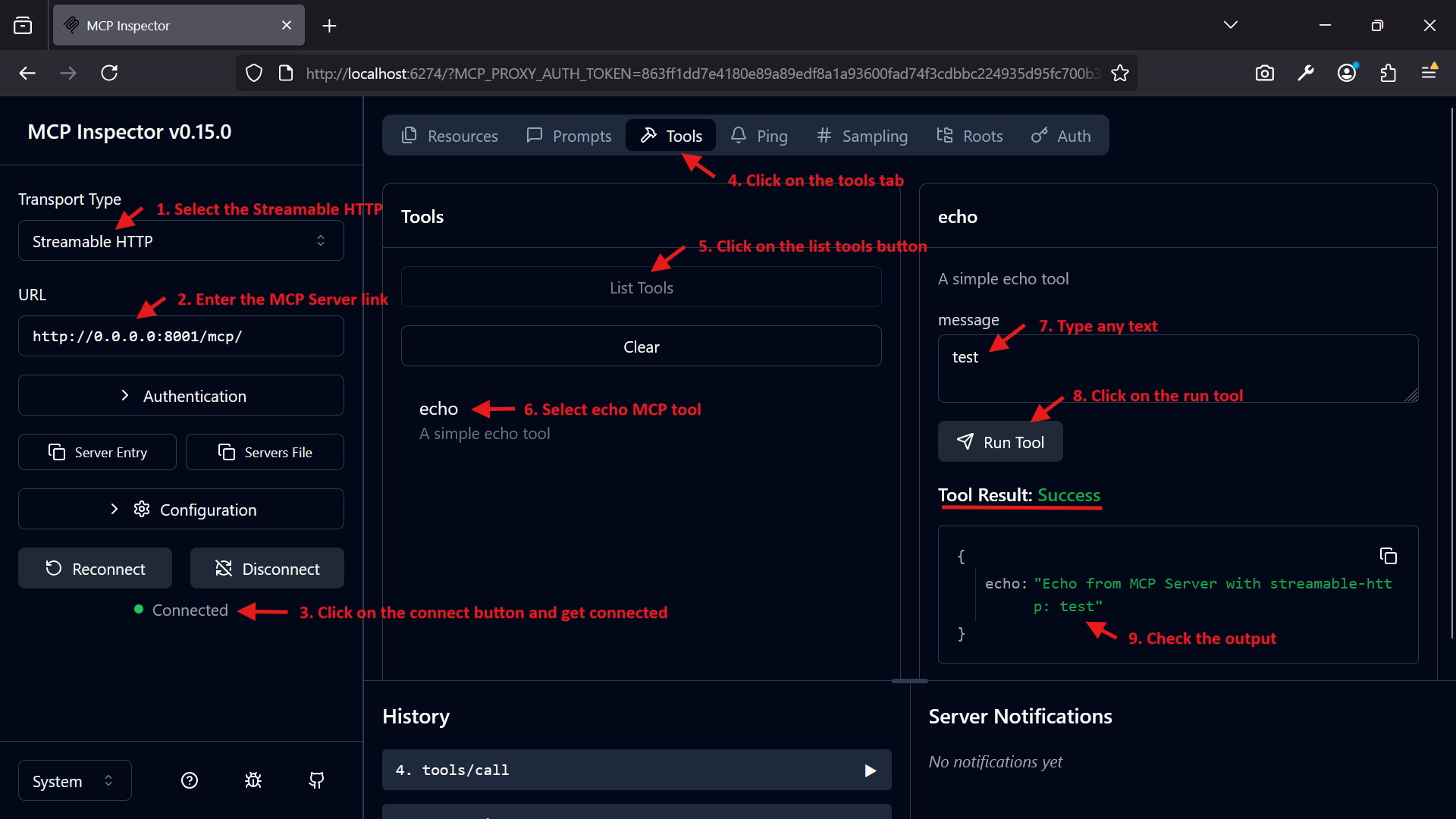
Test the
echotool:- Input:
{ "message": "test" } - Expected Output:
{
  "echo": "Echo from MCP Server with streamable-http: test"
}
- Input:
3️⃣ FastAPI-Based MCP Server (mcp-server-fastapi.py)
Starting the MCP Server
Open new terminal and go to the project root folder:
cd "D:\My Study\AI\GitHub ahmad-act\Multiple-MCP-Servers-Using-FastAPI-and-Testing-with-Inspector"
Run the FastAPI server:
uv run ./src/mcp-server-fastapi.py
The server will start on http://0.0.0.0:10000 (or the port specified in the PORT environment variable). The MCP endpoints will be available at:
http://0.0.0.0:10000/echo1/mcp/http://0.0.0.0:10000/echo2/mcp/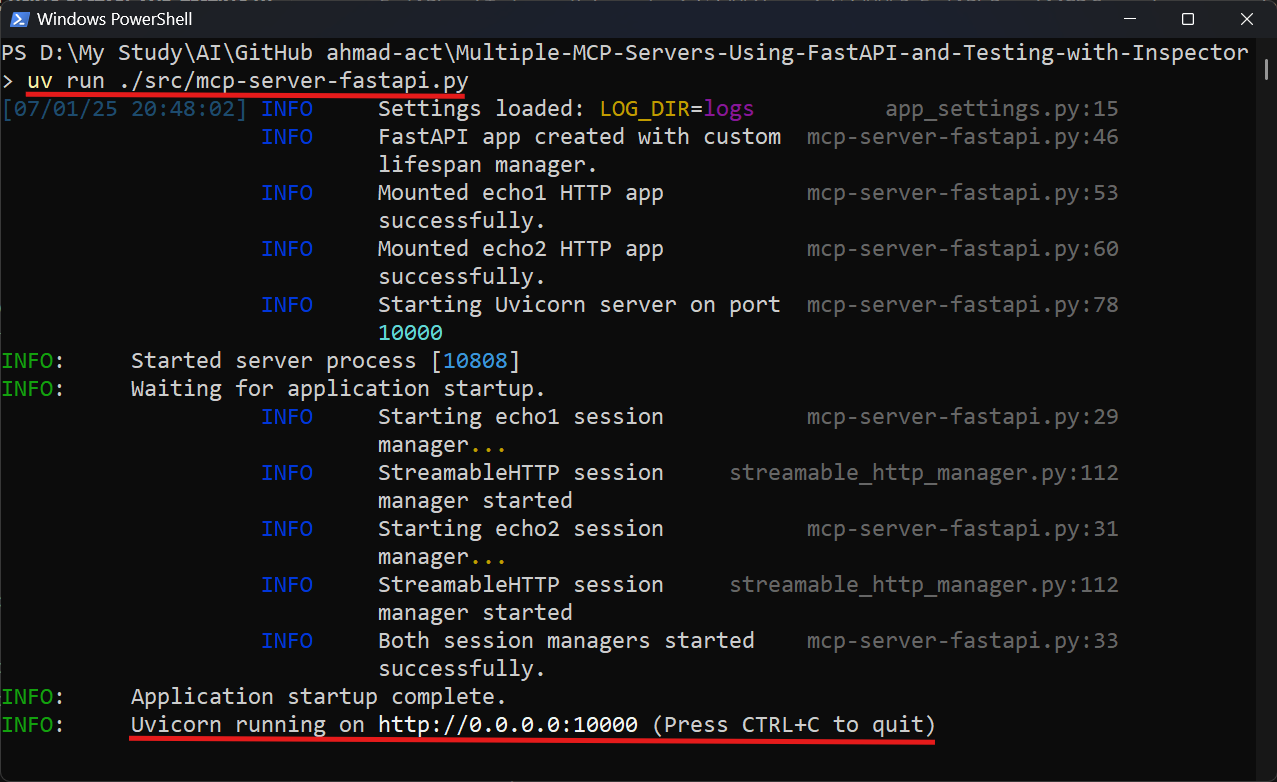
Starting the MCP Inspector
Run the MCP Inspector:
Open new terminal and run the command:
npx @modelcontextprotocol/inspector
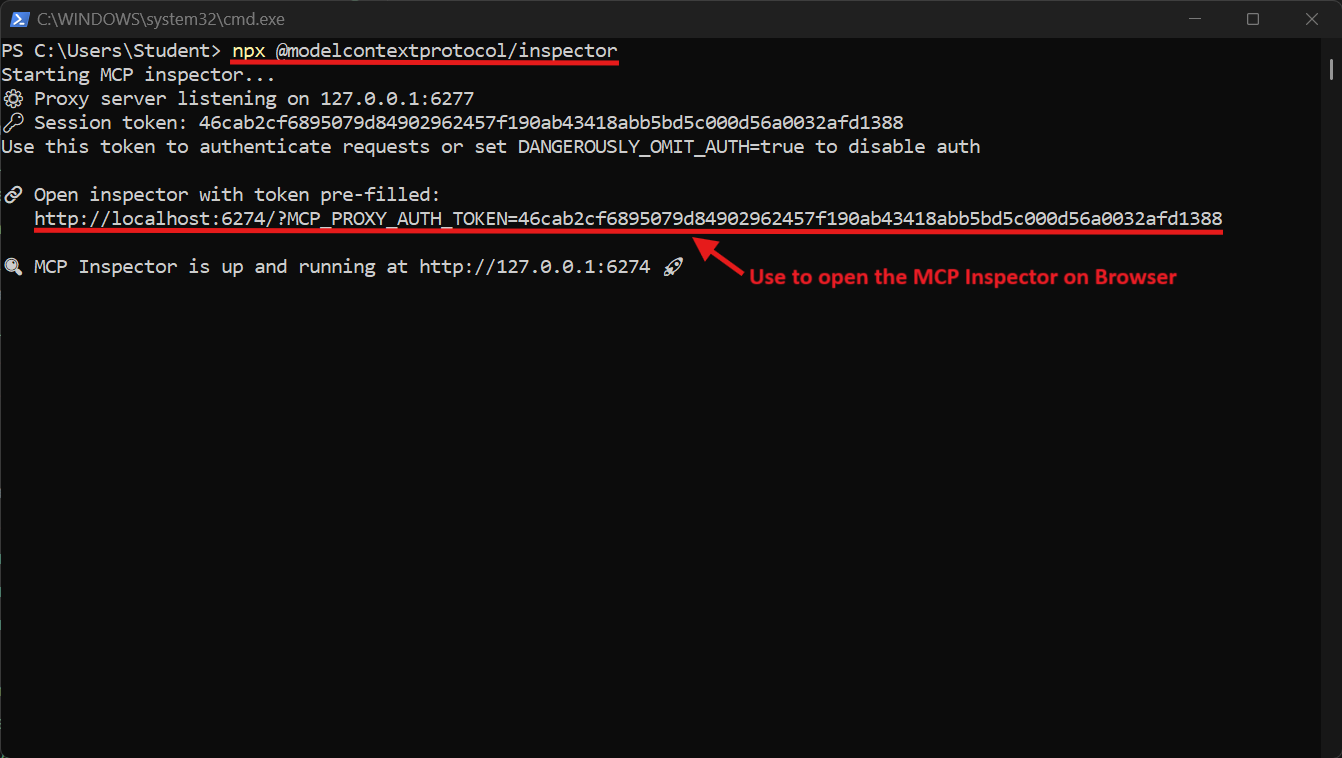
Opening the MCP Inspector
Open the Inspector in your browser at http://127.0.0.1:6274.
http://localhost:6274/?MCP_PROXY_AUTH_TOKEN=XXXXXXXXXXXXXXXXXXXXXXXXXXXXXXXXXXXXXXXXXXXXXX
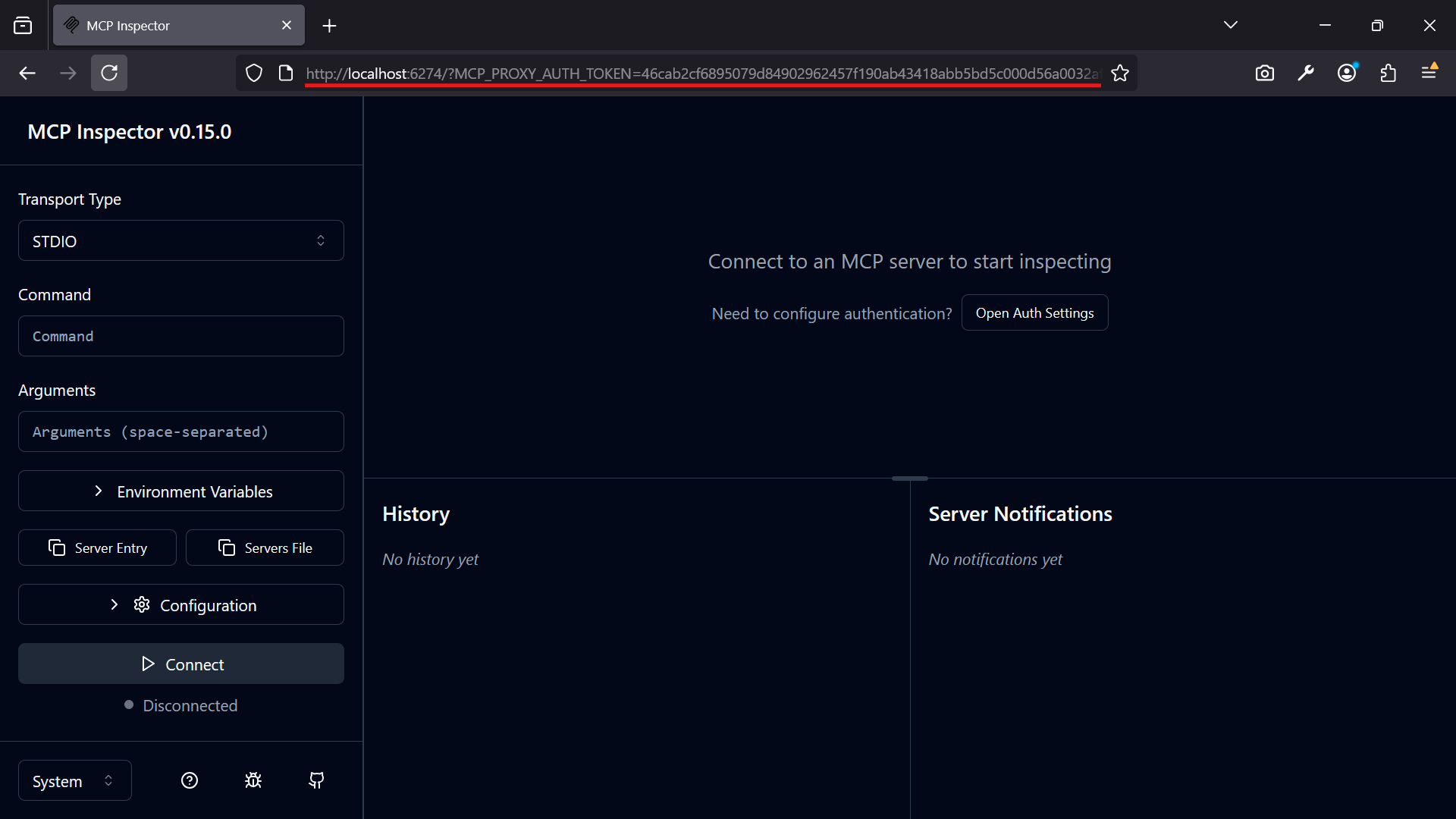
Using the MCP Inspector
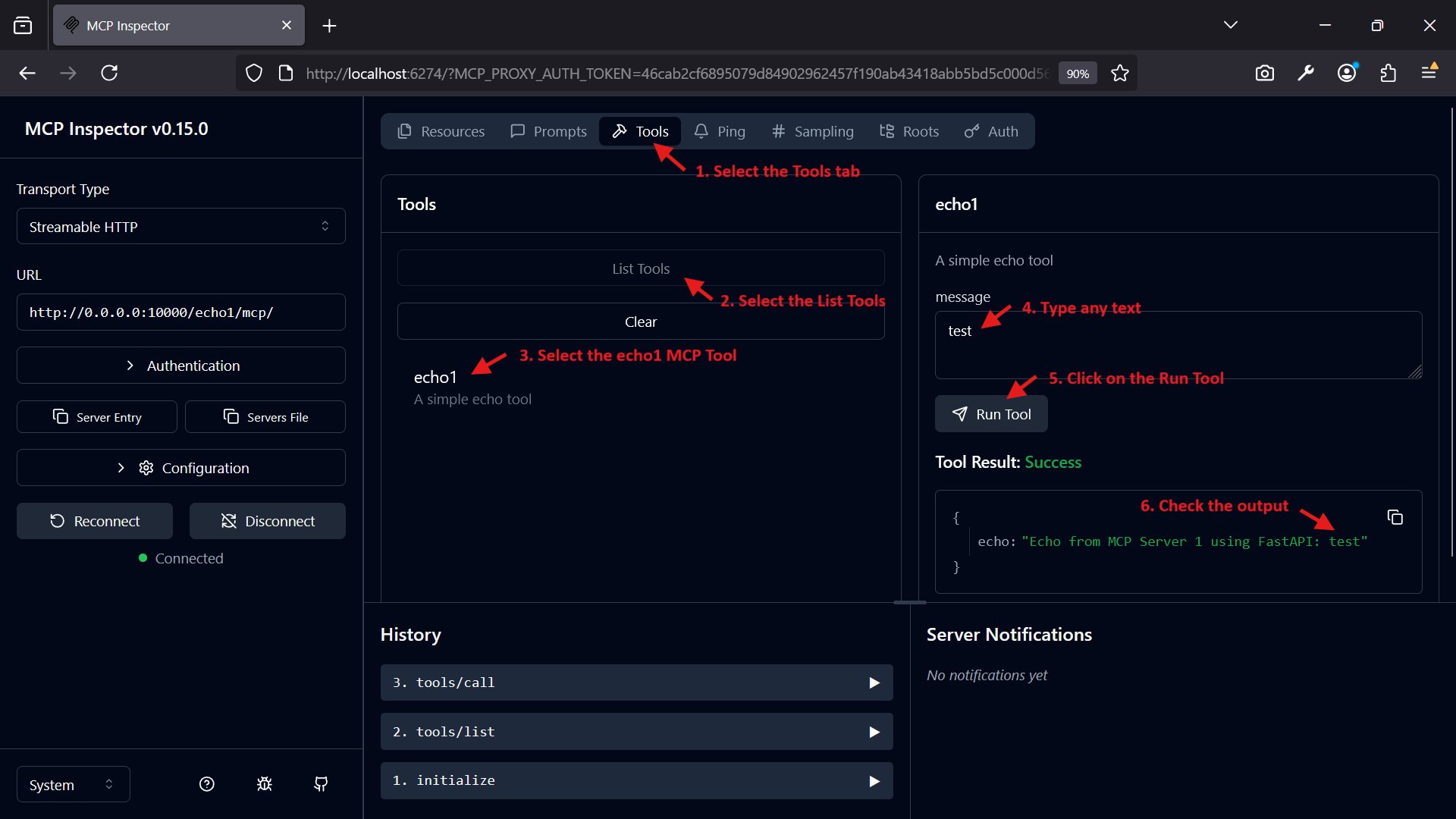
Configure the Inspector to connect to
http://0.0.0.0:10000/echo1/mcp/forMcpServer1.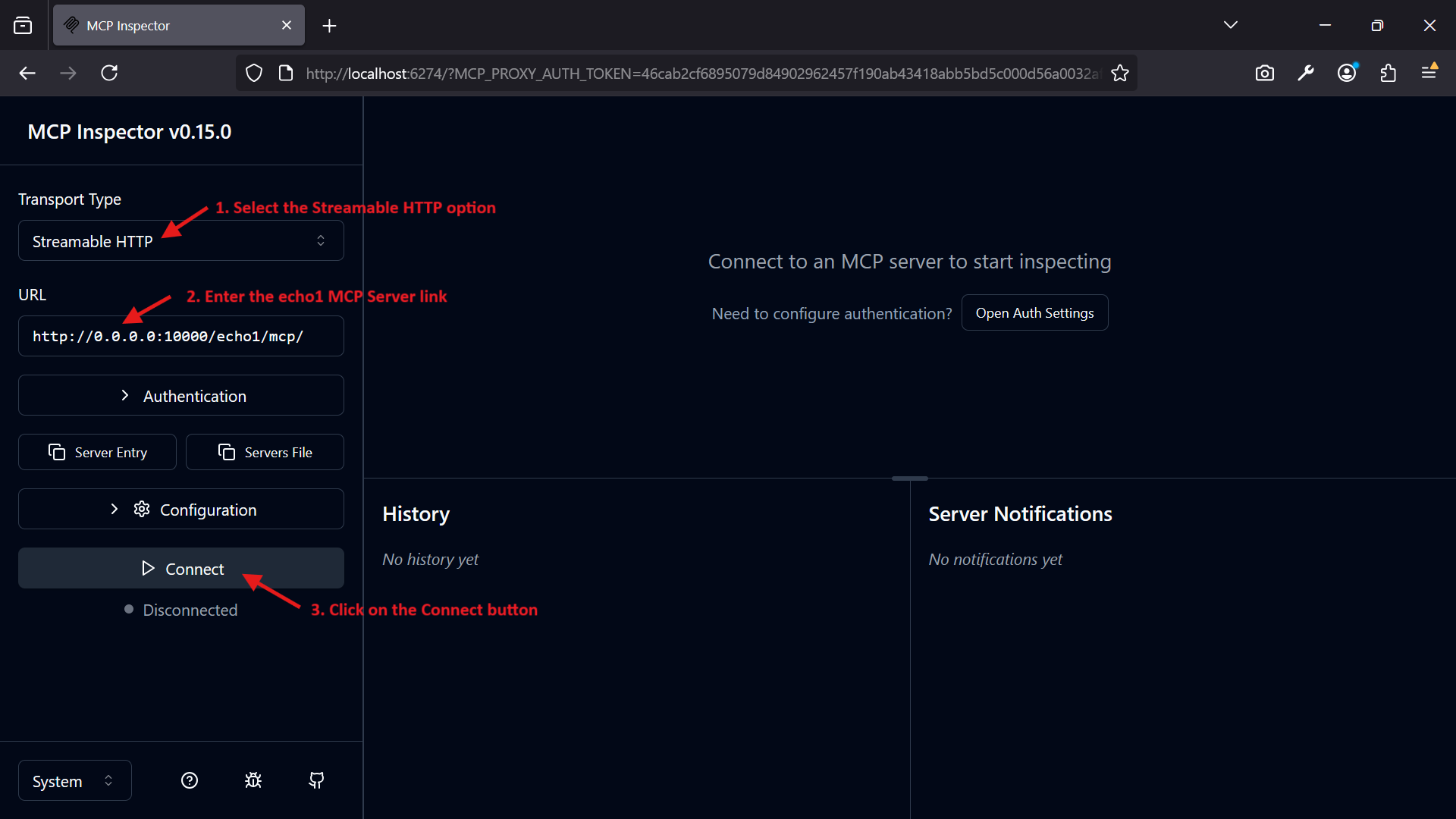
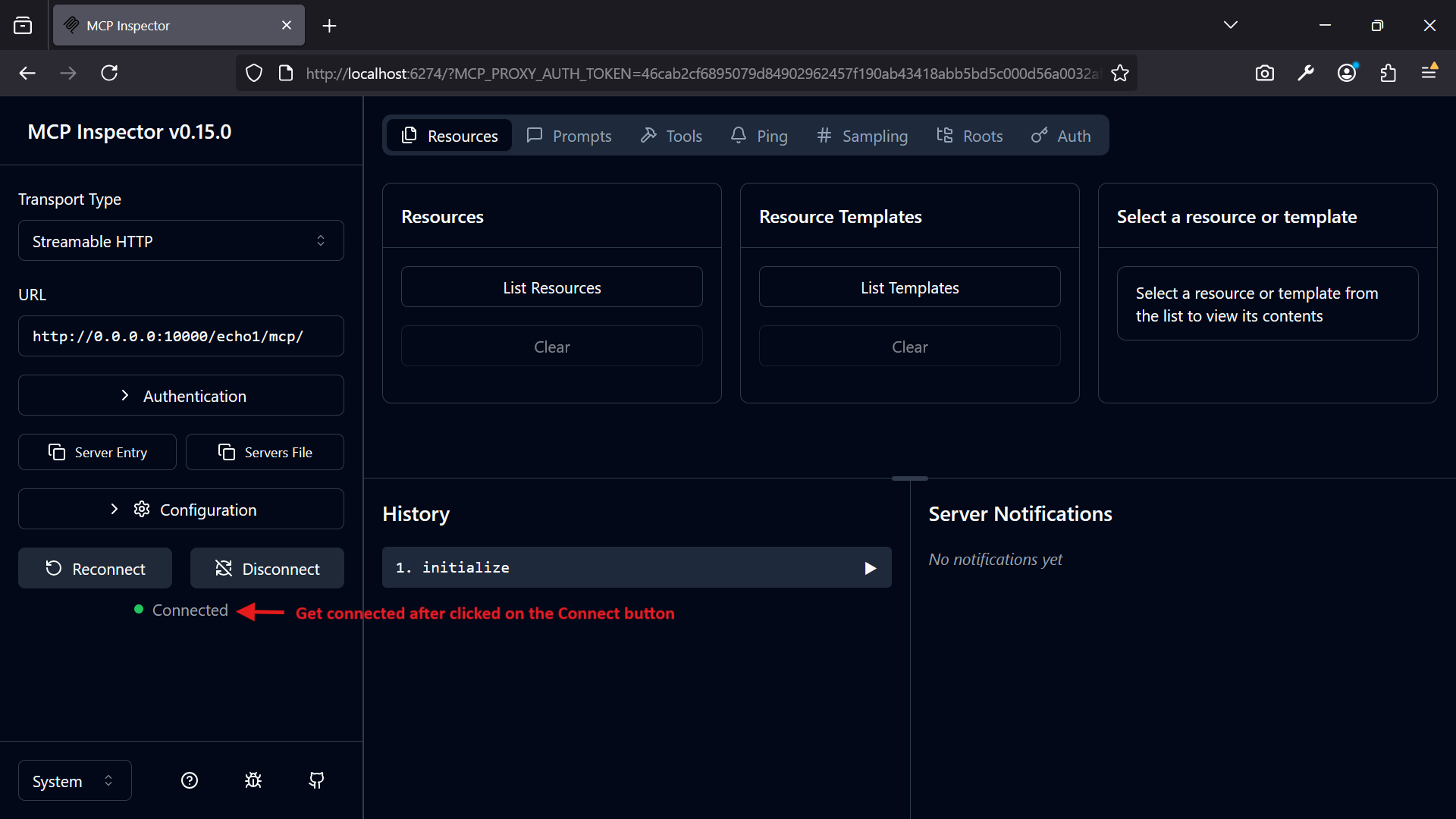
Test the
echotool:- Input:
{ "message": "test" } - Expected Output:
{
  "echo": "Echo from MCP Server 1 using FastAPI: test"
}
- Input:
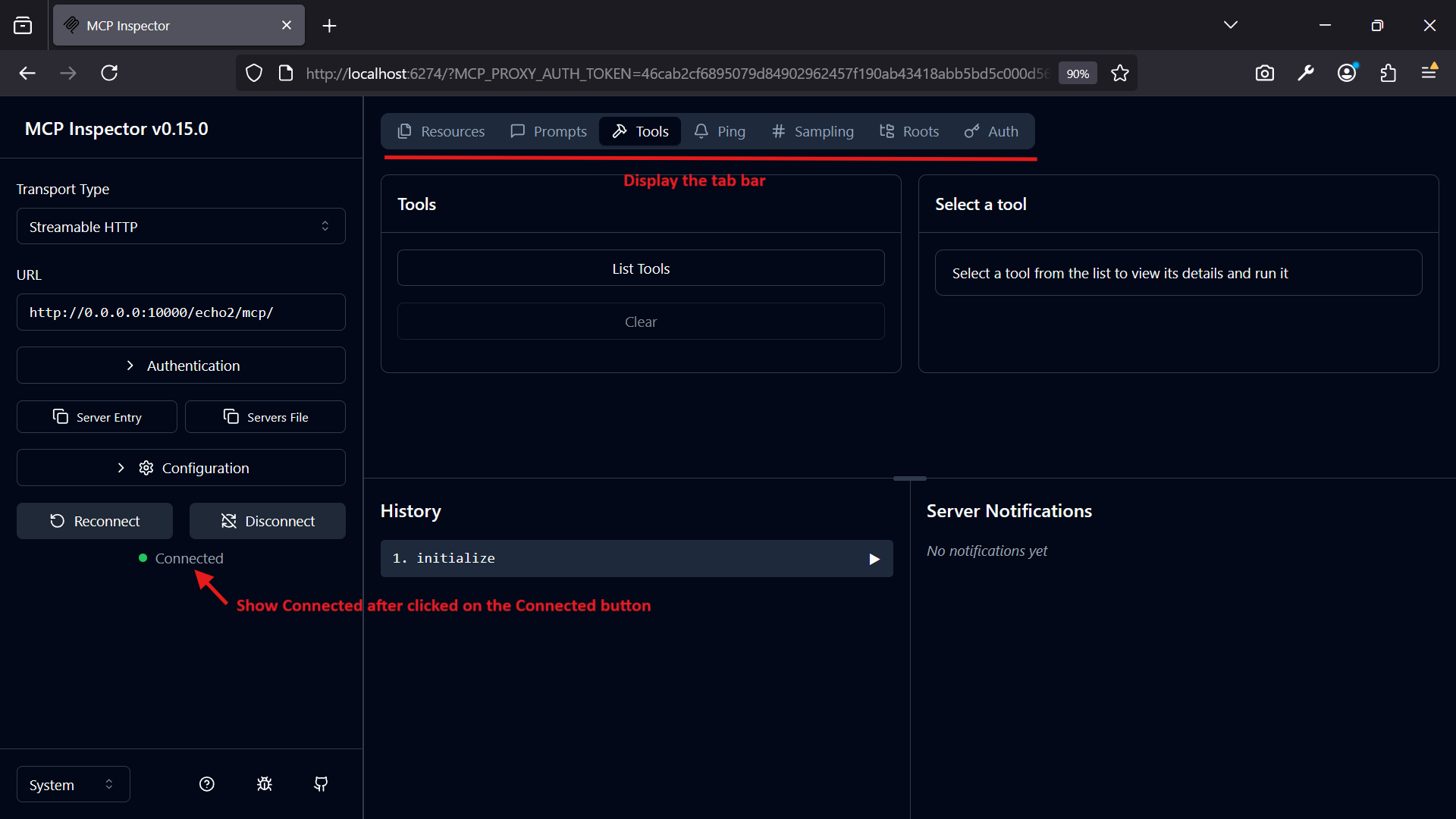
Configure the Inspector to connect to
http://0.0.0.0:10000/echo2/mcp/forMcpServer2.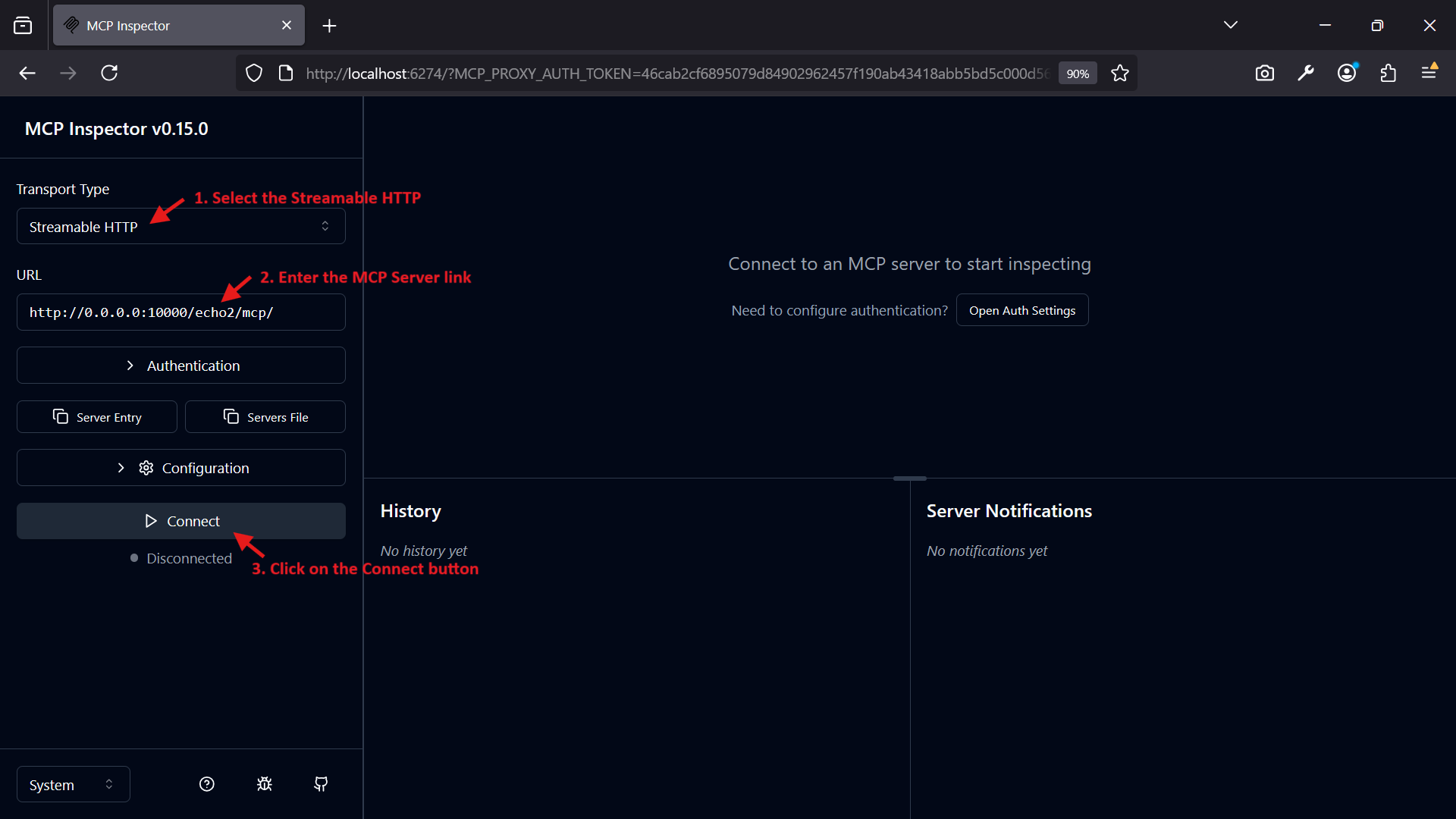
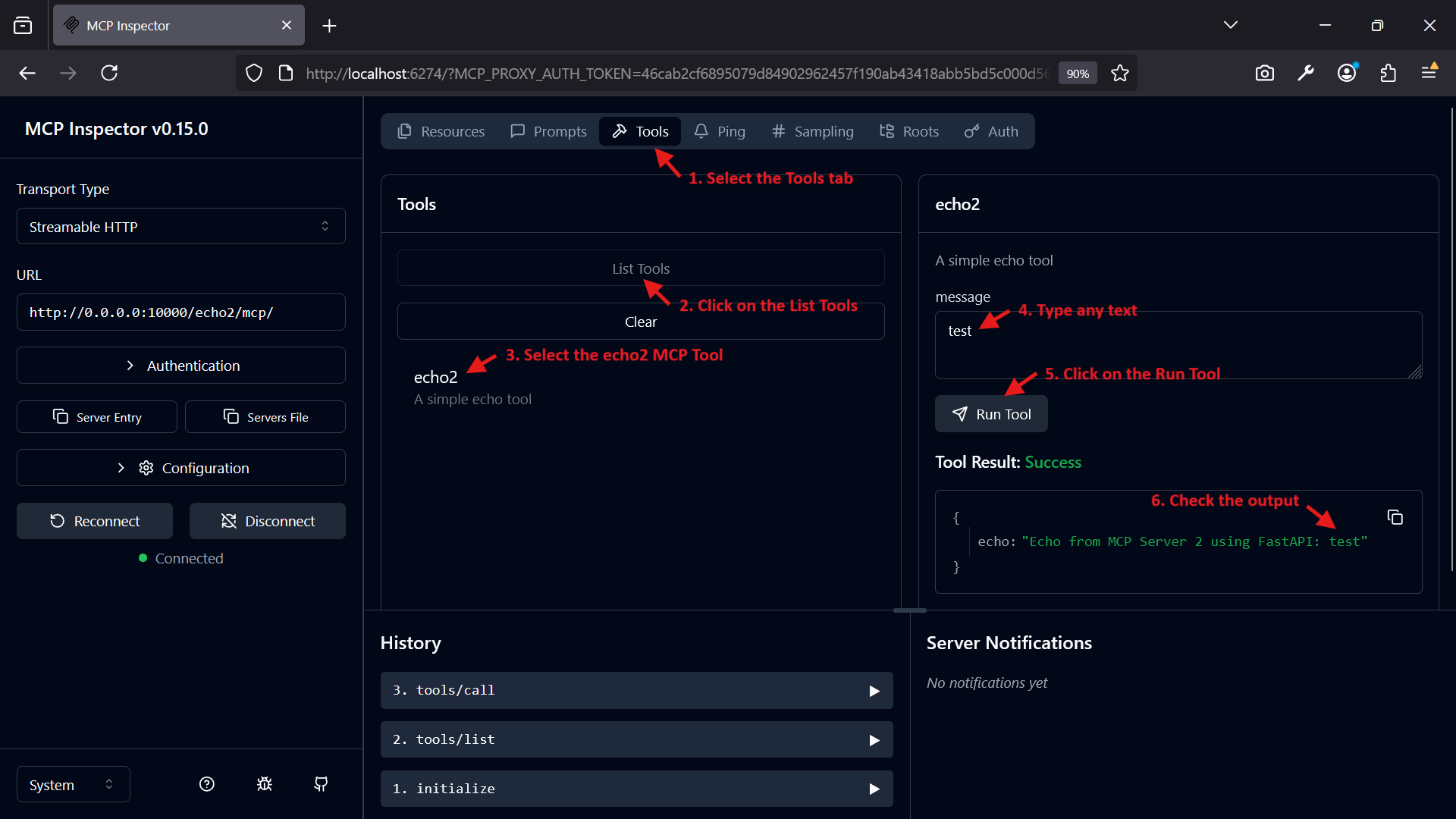
Test the
echotool:- Input:
{ "message": "test" } - Expected Output:
{
  "echo": "Echo from MCP Server 2 using FastAPI: test"
}
- Input:
🧩 Workflow
- Choose the Server Type:
- Use
mcp-server-fastapi.pyfor a multi-MCP HTTP server. - Use
mcp-server-with-streamable-http.pyfor a standalone HTTP-based MCP server. - Use
mcp-server-with-stdio.pyforstdio-based communication, typically managed by the MCP Inspector.
- Use
- Start the Server:
- For FastAPI or streamable-http servers, run the respective script with
uv run. - For the stdio server, use the MCP Inspector to launch the server.
- For FastAPI or streamable-http servers, run the respective script with
- Interact with MCP Tools: Use the MCP Inspector to connect to the server and test the
echotool. - Monitor Logs: Check logs in the
logs/directory (or the directory specified inLOG_DIR) for debugging and monitoring. - Graceful Shutdown: Press
Ctrl+Cor send aSIGTERMsignal to shut down HTTP-based servers gracefully. For thestdioserver, shutting down the Inspector will terminate the server.
📝 Logging
- Logs are stored in the directory specified by the
LOG_DIRenvironment variable (default:logs/). - Log files are named in the format
YYYYMM.log(e.g.,202507.logfor July 2025). - Logs rotate when they reach 5 MB, with up to 5 backup files.
- Old log files can be cleaned up using the
cleanup_old_logsfunction inlogging_config.py.
Example log output:
2025-07-01 13:06:00,123 - __main__ - INFO - Starting FastMCP server with streamable-http transport...
2025-07-01 13:06:00,125 - __main__ - INFO - FastMCP server initialized successfully.
🛑 Graceful Shutdown
All servers handle SIGINT (e.g., Ctrl+C) and SIGTERM signals to ensure graceful shutdown:
- MCP servers are shut down cleanly.
- Logs are updated with shutdown status.
- The process exits with a status code of
0.
🧭 Notes
- Transport Options:
streamable-httpis recommended for HTTP-based communication due to its efficiency.stdiois suitable for environments where direct stdin/stdout communication is preferred, typically with the MCP Inspector.
- Port Configuration:
- The FastAPI server uses port
10000by default (configurable viaPORT). - The streamable-http server uses port
8001(hardcoded). - The stdio server does not use a network port.
- The FastAPI server uses port
- MCP Inspector: Required for testing all servers. Ensure it is running to interact with MCP tools.
🛠️ Troubleshooting
- Server Fails to Start:
- Check logs in the
logs/directory for errors. - Ensure the
PORTenvironment variable is a valid integer for HTTP-based servers. - Verify that port
8001(for streamable-http) or10000(for FastAPI) is not in use.
- Check logs in the
- MCP Inspector Cannot Connect:
- For HTTP servers, verify the server is running and the endpoint URLs are correct.
- For the stdio server, ensure the Inspector command includes the correct
--directorypath.
- Log Files Not Created: Ensure the
LOG_DIRdirectory exists and is writable. - Dependency Issues: Run
uv syncto ensure all required packages are installed.
from github.com/ahmad-act/Multiple-MCP-Servers-Using-FastAPI-and-Testing-with-Inspector
Установка Multiple Servers Framework
У этого сервера нет опубликованного пакета — он собирается из исходников. Открой репозиторий и следуй инструкции в README.
▸ github.com/ahmad-act/Multiple-MCP-Servers-Using-FastAPI-and-Testing-with-InspectorFAQ
Multiple Servers Framework MCP бесплатный?
Да, Multiple Servers Framework MCP бесплатный — установка в пару кликов через Unyly без оплаты.
Нужен ли API-ключ для Multiple Servers Framework?
Нет, Multiple Servers Framework работает без API-ключей и переменных окружения.
Multiple Servers Framework — hosted или self-hosted?
Доступен hosted-вариант: Unyly запускает сервер в облаке, локальная установка не обязательна.
Как установить Multiple Servers Framework в Claude Desktop, Claude Code или Cursor?
Открой Multiple Servers Framework на unyly.org, выбери вкладку своего клиента (Claude Desktop, Claude Code, Cursor) и нажми Install — конфиг сгенерируется автоматически, без правки JSON.
Похожие MCP
GitHub
PRs, issues, code search, CI status
 автор: GitHub
Filesystem
Secure file operations with configurable access controls.
Memory
Knowledge graph-based persistent memory system.
Template MCP Server
A CLI tool to create a new Model Context Protocol server project with TypeScript support, dual transport options, and an extensible structure
 автор: mcpdotdirect
Compare Multiple Servers Framework with
Не уверен что выбрать?
Найди свой стек за 60 секунд
Автор?
Embed-бейдж для README
Похожее
Все в категории development