
MultiService IA
БесплатноНе проверенA local MCP server that provides a sovereign memory substrate for LLMs, enabling capture, recall, explanation, and anticipation of conversation turns with bi-te

Описание
A local MCP server that provides a sovereign memory substrate for LLMs, enabling capture, recall, explanation, and anticipation of conversation turns with bi-temporal events and a strict read-only query surface.
README
LLMs forget. Your memory shouldn't.
A sovereign memory substrate for LLMs — a force, not a dependency.

Same question. Same history. Two different answers. The difference? One knows a decision has been corrected. MultiService IA turns a stateless chat into a memory you own — a local, append-only, bi-temporal journal that restores (recall), explains (why / replay), economizes (caching / windowing) and anticipates (pre-heating) every turn, under a strict read-only contract, without ever shipping your data anywhere.
flowchart TD
    U["LLM · agent · human"]
    U -->|"capture — MCP / REST / files"| MS["MultiService IA"]
    MS -->|"append-only · sourced · bi-temporal (C3)"| J[("journal .jsonl<br/>single source of truth · never deleted")]

    J --> R["recall · brief<br/>(find)"]
    J --> P["replay · why<br/>(explain)"]
    J --> F["forecast · economy<br/>(anticipate)"]
    J --> C["curation · review<br/>(observe)"]

    R -.->|read-only| U
    P -.->|read-only| U
    F -.->|read-only| U
    C -.->|read-only| U

    EMB["local embeddings · bge-m3 (Ollama)"] -.->|hybrid recall| J
    H(["human decides · C1"]) ==>|correct · note| J
What it does, in four lines:
- Never serves a decision that has become wrong — corrections are first-class, bi-temporal events (C3); the old truth stays queryable "as it was then," it's just no longer served.
- Every answer can explain where it came from — provenance and freshness on every hit;
why/replayreconstruct the causal chain. - Cuts the token snowball — exact + semantic caching and context windowing, with the savings measured, not claimed.
- 100% local & sovereign — inference and embeddings run on your machine (Ollama); nothing is required to leave it.
Jump to: Quick start · 5-minute tutorial · Connect any LLM · (Version française)
(The sections below are collapsed — click any ▸ to expand the full detail.)
🧭 Why it exists & the principles — the problem, the one idea, and the non-negotiable contract
What problem does it solve?
Without memory: agents repeat abandoned decisions · context is re-sent every turn · past reasoning disappears.
With MultiService IA: stale facts are detected · corrections become first-class events · every answer can explain where it came from.
Why
Conversations with an LLM are ephemeral by default: context is re-sent every turn, knowledge is lost between sessions, and you can't ask why the model said something three days ago. MultiService IA fixes this with a single, simple idea borrowed from event sourcing: append every turn to a local, append-only journal, and never delete anything. From that journal, everything else (search, explanation, economy, forecasting) is a pure read.
Traditional memory answers "what do I know?" MultiService IA can also answer "what is still true?", "what was corrected?", "why?" and "has this decision been validated?" — through
reasoning(),lessons()andreplay_event().
In 30 seconds
Without memory          →  still recommends the NEMA-17 (first idea that comes up)
With MultiService IA    →  detects the NEMA-17 was corrected
                        →  recommends the MG996R + 2:1 gearbox
                        →  explains why (the arm was stalling)
                        →  shows provenance and freshness
Most agent memories show diagrams. This one shows a concrete consequence: never serving a decision that has become wrong — without ever losing the history.
Principles (non-negotiable)
These are enforced in code and guarded by tests:
- Provenance is mandatory. Every event carries a non-empty
source. No fact without an origin. - Bi-temporality, never deletion. Events have a
valid_from; a correction closes a fact (valid_to) but never erases it. Yesterday's truth stays queryable "as it was then." - The memory observes; it does not judge or act. Capture is faithful and total. Filtering happens later, at promotion and serving, gated by a human.
- Read paths are read-only. Recall, replay, forecasting and briefing never write the journal, never mutate state. A structural test enforces it.
- Sovereignty. Inference and embeddings are 100% local (via Ollama). No hosted inference or embedding API is required or used.
- Tamper-evident. An optional hash chain over the journal (
--seal/--verify) makes any past edit detectable — the history isn't just un-deleted, it's provably un-rewritten.
The healthy separation the project preserves:
Capture stores · Recall restores · Replay explains · Preheat anticipates · the Human decides.
How it works (detailed flow)
 chat turn ──▶ router ──▶ AetherEvent(s) ──▶ append-only journal (.jsonl)
                                                   │
                          ┌────────────────────────┼─────────────────────────┐
                          ▼                         ▼                          ▼
                   recall / brief            replay / replay_event       forecast / economy
                   (find, read-only)         (explain, read-only)        (anticipate, read-only)
                                                   │
                                          local embeddings (bge-m3)
                                          for hybrid semantic recall
Every turn becomes one prompt, one completion and one token_usage event, all sharing a
turn_id and a session_id. The journal is the single source of truth; the rest of the system is
a set of pure functions (List[AetherEvent] → result). The only component with side effects
is the inference/embedding backend, deliberately isolated.
🎬 See it work — demos — DunkBot 3000, dogfooding, and memory→knowledge
Concrete demo — DunkBot 3000 🥞🤖
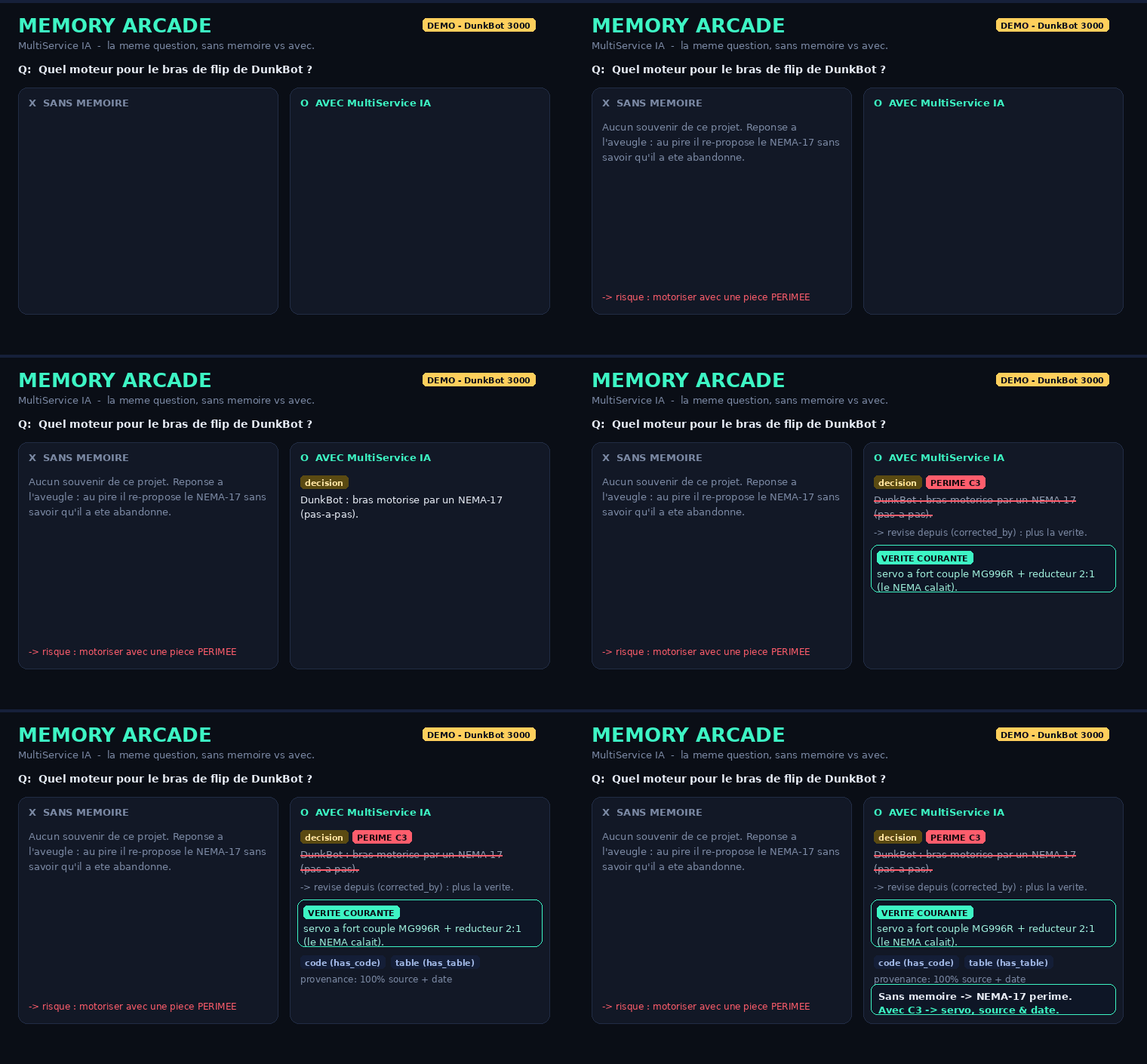
A 100% fictional demo (no real data) shows the value in one shot: the same question, without memory then with. We're building a pancake-flipping robot; on day 1 we decide on a NEMA-17 motor, on day 3 the field corrects it ("it stalls → use an MG996R servo").
python examples/memory_demo/compare.py
WITHOUT MultiService IA  (agent with no memory)
  -> Answers blind. At worst, re-recommends the NEMA-17, unaware it was dropped.

WITH MultiService IA  (local memory, read-only)
  brief() — one single call:
    DECISION  [STALE C3 !] : DunkBot ... NEMA-17 ...
    -> revised since (corrected_by): the decision above is NO LONGER the truth.
  CURRENT TRUTH (correction): ... switch to an MG996R servo + 2:1 gearbox.
  Code found (has_code) / Bill of materials (has_table) ... sourced and dated.
The moral: without memory, the agent may re-recommend the stale motor; with memory plus the bi-temporal C3 flag, it serves the current truth, sourced and dated.
There's also a fun, self-contained GUI (no server): open examples/memory_demo/arcade.html
in a browser — type a question, see both panels side by side, the stale fact struck through (C3),
and the append-only timeline. Details: examples/memory_demo/.
Dogfooding: the memory remembers its own development
MultiService IA is used to track MultiService IA itself. When the project license changed from
MIT to Apache-2.0, the old decision was closed, never deleted, and lessons() surfaced
the current truth.

Thirty days later, recall("license") returns the current truth (Apache-2.0) and flags MIT as
STALE (C3), while lessons() still explains the why. Every frame in that clip is a real
event from the journal — not a fictional demo. (Full 34s video: docs/license-demo.mp4.)
From Memory to Knowledge
MultiService IA is not just a chat history. Over weeks and months, the journal accumulates decisions, corrections, hypotheses, observations and validations — all typed, sourced and dated. That lets a fresh agent session, with no prior context, reconstruct the state of a project from memory alone.

The agent is no longer recalling isolated facts — it is reconstructing the intellectual history of a project: what was believed, what was wrong, what was corrected, what was validated, and why. A search engine returns documents; this returns a briefing. That is why events are typed, sourced, dated and never deleted: knowledge emerges from the journal, and the journal stays the single source of truth.
🧰 The memory surface — the full read-only tool set (recall, replay, forecast, curation…)
The substrate exposes a read-only surface (e.g. over MCP to an MCP-capable client). All results carry provenance and a freshness flag.
| Tool | Purpose |
|---|---|
recall(query, …) |
Relevant memories. Filters: type, source, and structure (has_code, has_table). Each hit carries superseded / corrected_by (was it revised later?). |
recall_semantic(query, …) |
Hybrid recall: lexical coverage + local semantic embedding, fused and floored to suppress noise. explain mode exposes the sub-scores. |
sources() |
Map of the whole memory: every namespace/source (project:*, llm:*, …) with its event count — to see what exists before searching. |
browse(source, type, k) |
Enumerate without a query: entries filtered by source/type, most recent first — to explore a whole project where lexical recall wouldn't match. |
why(turn_id) |
The events of a single turn — "why the agent saw/said this." |
replay(session_id, digest=True) |
Replays a session: a compact one-line-per-turn digest by default, or the full dump. |
replay_event(event_id, depth) |
The causal chain of an event: focus turn + preceding turns + C3 closure/corrections. |
forecast(session_id) |
Pre-heating: projects the next turn's cost (snowball vs windowed), read-only estimate. |
brief(query, k) |
A composed topic brief in one call: memories + bearing decisions + revised items + sessions. |
recent(days) |
"What's new": recent decisions, corrections and latest events — the entry point when resuming work. |
reasoning(session_id) |
Reasoning chain of a session: hypothesis → observation → decision → correction → validation, ordered, with present/missing stages (e.g. a decision with no validation). |
lessons() |
Lessons learned from C3 corrections: what was revised/abandoned + the truths that still stand. Empty until a correction is logged. |
curation(source, …) |
Health report (read-only): exact/near duplicates, unfilled templates, stale decisions, contradiction candidates — each with cited evidence and ready closure proposals (pending_human). |
project_review(project, …) |
Composed project review (read-only): reconstructs a project's state from memory alone — valid vs corrected decisions (with the why), refuted / standing hypotheses, validations, lessons. Bounded, bi-temporal. |
health() |
Substrate health (read-only): availability, event count, latest event, distinct sources — the entry point when resuming (health → recent → recall). |
index_status() |
Freshness of the semantic index (eligible / indexed / fresh). Tells you when semantic recall is partial. |
usage() |
Reuse instrumentation: how many turns were served from memory (cache, no model call) and input tokens saved. Measures, doesn't predict. |
resource briefing/today |
Daily usage briefing (tokens, compaction savings, by model). |
Two human-gated write paths live in the chat loop (not in the read-only surface):
/correct <note>— records acorrection, marking prior memories of the session as revised (C3)./note <text>— records an agent-proposed note (source=agent:claude), validated by the human who runs the command (C1). This lets the memory compound from the agent's own reasoning, while the query surface stays strictly read-only.
⚙️ Capabilities — agentic memory, multi-provider routing, local web console, self-curation
Agentic memory — the model searches (and remembers) itself
Beyond the read-only surface, a local model (via Ollama function-calling) can drive the memory
itself: it decides when it needs a memory, calls recall / sources / browse / recent / …,
reads the results and answers — no host-side injection. Every tool call is journaled (tool_call /
tool_result), so you can audit what the model searched for.
It can also write, through one guarded tool — remember(text, kind):
- source is forced to
project:ollama(the model can't spoof another source), - append-only / bi-temporal — it records, never deletes,
- non-authoritative — kinds limited to
observation/note; authoritative kinds (decision/validation/correction) stay human-gated (C1). Model writes are never auto-promoted to skills nor served by the decisional cache, - deduplicated.
The model gets a real read+write surface without breaking "the memory observes, the human
decides": its writes are source-isolated, non-destructive and non-authoritative. Run it in the chat
loop with --memory-tools, or from the local web console (below).
Tool sovereignty. Memory tools are exposed only for a local turn. If a turn is routed to a cloud provider, no memory tool is exposed and nothing sensitive is embedded in the tool context — the memory never leaves the machine.
Multi-provider routing (optional — local-first)
By default everything is local. Optionally, a cloud backend can be enabled behind the same
Backend interface, governed by a hybrid "sensitive → local only" policy:
- local by default; a turn goes to the cloud only if you explicitly allow it and a deterministic detector finds nothing sensitive (secrets, PII, unauthorized-access intent). When in doubt: local.
- if the cloud backend fails, it falls back to local — a turn is never lost,
- every routed turn carries explicit provenance in the journal (
routed_to,routing_reason,sensitivity_reasons) — you can always ask why a turn went local or cloud.
A PerplexityBackend (OpenAI-compatible) ships as the first cloud provider; the interface is
pluggable. Enable with --cloud (key via PPLX_API_KEY). Opt-in — the sovereign default is 100%
local.
Local dev console (web)
A tiny local-only web page (Python stdlib, binds 127.0.0.1 — never exposed) to try the model +
memory in a browser: chat with a local model, watch the model's memory tool calls live
(recall / remember + results), and toggle memory-tools / recall-injection / cloud.
python -m multiservice.webchat # http://127.0.0.1:8765
The model field accepts an Ollama name or a path to a .gguf — GGUF models load in-process
(EmbeddedGGUF, llama-cpp) as a fully-local alternative to Ollama. Everything stays on your machine.
The memory curates itself
Over months the journal accumulates duplicates, reworded re-logs and stale facts. MultiService IA keeps it clean with a curation layer that stays constitutional — it observes and proposes; the human decides. Nothing is auto-deleted; a "fix" is a C3 closure, never a deletion.
- Deterministic detectors (
curation()tool /multiservice.curation_report) — read-only: exact duplicates, near-duplicates, unfilled templates, stale decisions, contradiction candidates, each citing its evidence. A scheduled daily report stays quiet unless something is actionable. - Prevention at the source — the remote-write path (
ingest) refuses secret values (API keys / tokens — a secret in an append-only journal is unerasable), unfilled templates and exact live duplicates (same source + kind + text), so that class of pollution can't re-enter (--forcebypasses — human only, C1). - A local-LLM comparator (
multiservice.curation_llm) — a local model (Ollama, never the cloud) judges the noisy near-duplicate / contradiction candidates: it de-noises false positives and proposes consolidations (keep the richest existing fact, close the variant). It proposes, never writes — every proposal ispending_humanwith a ready closure command.
Approving one is a C3 closure (memlog-http … --closes): the variant is closed, never deleted;
the canonical stays the current truth. The loop: detect → judge (local LLM) → prevent → monitor →
the human approves.
📉 Token economy & measured recall quality — savings and recall accuracy you can reproduce
Real measurements on live conversations showed that up to 98.5% of input tokens were context re-sends (the "snowball" of growing context) rather than new information. MultiService IA attacks this waste with three read-only-friendly levers:
- Exact result cache — identical requests are served without calling the model (C3-guarded: a later correction invalidates the entry).
- Semantic cache — near-paraphrases of an already-answered prompt are served without the model. Decisional, so a deliberately high similarity threshold ("when in doubt, don't serve").
- Context windowing — keeps the last N turns in clear, bounding the snowball.
Crucially, the savings aren't claimed — they're measured, read-only, by the usage() tool:
how many turns were served from memory, and how many input tokens were actually saved.
Live measurement (one real journal): 199 turns · 595 input tokens saved by windowing · 16 saved by the semantic cache (only recently enabled). Your numbers depend on usage patterns — the point is that they are measured, not asserted.
Recall quality, measured too. A built-in eval (
python -m multiservice.memeval --compare) scores recall on a golden set auto-built from the journal's own corrections (each correction points at the facts it revises). On one real journal (93 corrections, k=5), semantic recall found the referenced fact in the top-5 for 73% of them, vs 39% for lexical — nearly 2×. Nobody publishes this on their own data; you can reproduce it on yours.
🔒 Sovereignty & privacy — where your data lives and why it stays put
- Everything runs on your machine. The journal lives in a local append-only file.
- Inference and embeddings go through a local Ollama instance — no hosted API.
- A routing policy keeps sensitive content off hosted providers: anything flagged as a secret/credential or an unauthorized-access intent is never routed to a cloud inference/embedding API, and is never served from cache. (When in doubt: local.)
- Sovereignty vs. replication. The claim above is about inference routing. The optional central server replicates the journal to a host you control (opt-in, union-by-id merge) — not a third party; it does not filter on sensitivity, but the write path refuses secret values, so credentials never enter the journal to begin with.
- This repository ships no data. Your journal is yours and stays on your disk.
Quick start
Requirements: Python 3.11+, Ollama running locally.
# 1. install
pip install -r requirements.txt

# 2. pull a local chat model and an embedding model
ollama pull <your-chat-model>      # any local model; set via OLLAMA_MODEL
ollama pull bge-m3                  # local embeddings for hybrid recall

# 3. chat (capture is automatic; exact + semantic cache and windowing are ON by default)
python -m multiservice.chat --ollama --recall     # add --recall for live memory injection

# 4. (re)build the semantic index after chatting
python -m multiservice.index

# 5. run the tests
pytest -q
Configuration lives in multiservice/config.py and is overridable via environment variables
(OLLAMA_MODEL, EMBED_MODEL, JOURNAL_PATH, KEEP_TURNS, …).
Tutorial — write → correct → recall in 5 minutes
The heart of MultiService IA is the bi-temporal loop: log a fact, correct it later, and watch the
memory serve the current truth while keeping the old one queryable. No cloud, no API keys — and
this walkthrough writes to a throwaway tuto.jsonl, so it never touches your real journal.
1. Install (and make projlog available everywhere)
pip install -r requirements.txt
pip install -e .
pytest -q                 # optional — watch the invariants pass
2. See the payoff instantly (no model needed — a fictional demo, same question without vs with memory)
python examples/memory_demo/compare.py
3. Log your own decision — then let reality correct it
projlog "Use a NEMA-17 motor for the arm" --kind decision \
  --source project:tuto --session arm --journal ./tuto.jsonl
# a day later, the field corrects it:
projlog "NEMA-17 stalls -> switch to an MG996R servo + 2:1 gearbox" --kind correction \
  --source project:tuto --session arm --journal ./tuto.jsonl
4. Watch bi-temporality — the old decision is no longer served, the correction is, and nothing was deleted
python -c "import json; from multiservice.journal import read_events; from multiservice import memory; \
print(json.dumps(memory.lessons_learned(read_events('tuto.jsonl'), source_prefix='project:tuto'), indent=2, ensure_ascii=False))"
You'll see the lesson (what was revised + the current truth). The NEMA-17 decision fell; the
correction stands — but the original is still there in tuto.jsonl, queryable as of any past date.
5. Chat with your memory injected (needs a local Ollama model)
ollama pull <your-chat-model> && ollama pull bge-m3
python -m multiservice.chat --ollama --recall     # capture is automatic; --recall injects memories
6. Keep it clean — validate curation in one click
python -m multiservice.curation_inbox --journal ./tuto.jsonl # http://127.0.0.1:8766
7. Plug your own LLM in — MCP / REST / files: see docs/INTEGRATION.md.
🔌 Connect any LLM — MCP client, hosted HTTP, authenticated remote write, web REST API
Plug any LLM in. Full connection guide — MCP / REST / files, read + supervised write, tools, provenance rules, writeback policy, modes — in docs/INTEGRATION.md.
Run the read-only memory server:
python -m multiservice.mcp_server
Then point an MCP-capable client at it. A minimal client config looks like:
{
  "mcpServers": {
    "multiservice-memory": {
      "command": "/absolute/path/to/python",
      "args": ["-m", "multiservice.mcp_server"],
      "env": { "PYTHONPATH": "/absolute/path/to/this/repo" }
    }
  }
}
The server caches modules at import; restart the client after adding tools.
Remote access (hosted HTTP server) — optional
Optional, opt-in. By default the memory is local and sovereign — the stdio server above keeps everything on your machine and nothing requires a server. Centralizing the journal on a VPS is only for those who want to reach one shared journal from several machines/networks.
If you opt in, the same read-only surface is served over HTTPS — one central journal, no copy on the clients (the data stays on a host you control). Run the streamable-HTTP entrypoint (behind a reverse proxy that terminates TLS and authenticates):
multiservice-mcp-http # read-only tools over streamable-HTTP (default 0.0.0.0:8302)
DNS-rebinding protection stays on: declare the public Host(s) you serve via
MULTISERVICE_HTTP_ALLOWED_HOSTS (comma-separated, e.g. mem.example.com). Put it behind a reverse
proxy adding TLS + a bearer token + an IP allowlist, then connect any machine:
claude mcp add --transport http multiservice-memory https://mem.example.com/mcp \
  --header "Authorization: Bearer <token>"
A ready-to-use recipe (Docker with the journal mounted read-only + nginx) is in deploy/.
Semantic is local; a GPU-less central stays lexical. Embeddings (
bge-m3) are computed on the machine that has the GPU — your workstation. A central server without a GPU serves the read-only surface with lexical recall (still sourced, dated, C3-aware); hybrid semantic recall is a local capability. This is by design: the sovereign path is local, and the central server is an option for reaching one shared journal — not a requirement, and not where the model runs.
Authenticated remote write (ingest). Remote machines can also write to the central journal over
mTLS + HMAC (nonce + timestamp anti-replay); the source is imposed server-side from the client
certificate's CN — a client can never spoof it. Client command: memlog-http. Recipe in
deploy/ (Dockerfile.ingest, gen-mtls.sh).
Web REST API (for web LLMs). A separate public, token-authenticated REST surface lets web
assistants (ChatGPT / Custom GPT, connectors) read and write the central memory: GET /recall,
POST /remember, GET /recent, plus an auto OpenAPI schema (/openapi.json) for GPT Actions.
Each client's bearer token maps to a source (imposed server-side). Central-only, rate-limited. Recipe
in deploy/ (Dockerfile.webapi) and deploy/SETUP-POSTE-CLIENT.md.
⌨️ CLI reference — every entry point and the chat-loop commands
python -m multiservice.chat        # chat loop (captures + journals every turn)
python -m multiservice.chat --memory-tools --cloud   # agentic memory + optional cloud routing
python -m multiservice.webchat     # local-only web console (Ollama/GGUF + live memory activity)
python -m multiservice.inspect     # usage observability (read-only)
python -m multiservice.economy     # token accounting: prefix re-send, windowing savings
python -m multiservice.index       # incremental local embedding (re)index
python -m multiservice.maintenance # incremental reindex, schedulable (keeps the index fresh)
python -m multiservice.curation_report  # daily curation health report (deterministic, read-only)
python -m multiservice.curation_llm     # local-LLM review: de-noise + consolidation proposals
python -m multiservice.curation_inbox   # local web inbox: approve/reject curation proposals in one click
python -m multiservice.preheat     # pre-heating: projected cost of the next turn
python -m multiservice.mcp_server  # read-only MCP memory server
python -m multiservice.integrity   # tamper-evident hash chain: --seal / --verify the journal
python -m multiservice.procedural  # procedural memory: recurring successful tool-sequences -> playbooks
python -m multiservice.memeval     # memory eval: recall@k on a golden set auto-built from corrections
python -m multiservice.projlog "<decision>" --kind decision --session <topic>   # log a project decision
In the chat loop: /correct <note>, /note <text>, /model <name|path.gguf>, /reset, /quit.
Keeping the index fresh, automatically.
multiservice.maintenancereindexes only what changed and is meant to be scheduled (a Windows scheduled task / cron), so hybrid recall stays fresh with no manual step. Semantic embeddings are a local (GPU) capability — see the note under Remote access on why a GPU-less central server stays lexical.
Shared memory across projects. Run
pip install -e .to make theprojlogcommand available everywhere on the machine; any project can then feed the same local journal with a namespaced source (projlog "…" --source project:<name> --session <topic>), isolable viarecall(source="project:<name>"). The query surface stays read-only — only capture writes. See docs/CAPTURE-CONVENTION.md.
Dogfooding.
projlogwrites the project's own decisions/corrections into the journal, sorecall/brief/recentcan ground future work in past reasoning — the memory remembers its own development. It's a capture (append-only); the MCP query surface stays read-only.
📊 Project status & roadmap — what's shipped and what's next
Project status
Working engine with a full read-only memory surface, agentic memory (the model searches and
writes its own project:ollama namespace, guarded), local-first multi-provider routing (optional
Perplexity cloud behind a "sensitive → local" policy), a local web console (Ollama + GGUF), exact
- semantic caching, context windowing, emergent-skill scaffolding, append-only backup with SHA-256 manifests, local hybrid recall, schedulable reindexing, and a self-curating layer (deterministic detectors + scheduled report, ingest-time dedup/template guards, and a local-LLM comparator that de-noises and proposes consolidations — all human-gated, C3). Everything runs locally by default; the hosted central server (HTTP read + mTLS ingest + web REST API) is an opt-in option for sharing one journal across machines. Covered by a growing pytest suite (currently green). Each feature ships with a permanent regression test; every issue surfaced by real usage becomes a test.
Roadmap — shipped
- ✅ Multi-provider routing — optional cloud backend (Perplexity) behind the same interface, governed by the "sensitive → local only" policy, with explicit routing provenance.
- ✅ Agentic memory — the local model drives the memory tools itself and can write to a guarded,
non-authoritative
project:ollamanamespace; memory tools stay local-only. - ✅ Local web console —
multiservice.webchat, Ollama/GGUF + live memory activity. - ✅ Schedulable reindexing —
multiservice.maintenance, incremental, keeps recall fresh. - ✅ Self-curating memory — deterministic detectors + scheduled report, ingest guards (exact-dedup + unfilled-template), and a local-LLM comparator (de-noise + consolidation proposals), all human-gated (C3 closure, never deletion).
- ✅ A second (hosted) read-only surface — streamable-HTTP server, see deploy/.
- ✅ Authenticated remote write (ingest) — mTLS + HMAC + anti-replay,
memlog-httpclient. - ✅ Web REST API for web LLMs — public, token-authenticated FastAPI (recall/remember/recent
- OpenAPI), Custom GPT-ready. See deploy/.
- ✅ Project review (Synthesis role) —
project_review(project)reconstructs a project's bi-temporal state (valid vs corrected decisions with the why, hypotheses, validations, lessons). - ✅ Secret guard at write — the write path refuses credential values (a secret in an
append-only journal is unerasable);
--forcebypasses (human, C1). - ✅ Integration guide — docs/INTEGRATION.md — plug any LLM in (MCP / REST / files, read + supervised write).
Roadmap — on the horizon
- At-rest encryption of the local journal (append-only + encryption — a deliberate effort).
- Multi-node hardening — per-client certificate revocation and rate-limiting.
- Scaling to very large, long-lived journals — indexed / paginated storage (optional graph back-end).
- Comparator calibration — honor rejects, ignore versioned / distinct-location variants.
Design lineage
The constitutional principles (mandatory provenance, bi-temporal closure-never-deletion, human-in-the-loop) are inherited from a companion bi-temporal event-sourcing system and applied here to LLM exchanges. The result is a memory that is faithful by capture and trustworthy by construction.
License
Apache License 2.0 — see LICENSE and NOTICE. Permissive (free for commercial use), with an explicit patent grant. © 2026 MultiService IA authors.
A note on your data
MultiService IA is designed so that your conversation history never leaves your control. The code
in this repository describes the system, not your memory: no journal content is bundled, and none
should be committed. Keep your *.jsonl journals out of version control (add them to
.gitignore).
Установка MultiService IA
У этого сервера нет опубликованного пакета — он собирается из исходников. Открой репозиторий и следуй инструкции в README.
▸ github.com/wilf974/MultiServices-AIFAQ
MultiService IA MCP бесплатный?
Да, MultiService IA MCP бесплатный — установка в пару кликов через Unyly без оплаты.
Нужен ли API-ключ для MultiService IA?
Нет, MultiService IA работает без API-ключей и переменных окружения.
MultiService IA — hosted или self-hosted?
Self-hosted: сервер запускается локально на твоей машине командой из раздела установки.
Как установить MultiService IA в Claude Desktop, Claude Code или Cursor?
Открой MultiService IA на unyly.org, выбери вкладку своего клиента (Claude Desktop, Claude Code, Cursor) и нажми Install — конфиг сгенерируется автоматически, без правки JSON.
Похожие MCP
GitHub
PRs, issues, code search, CI status
 автор: GitHub
Filesystem
Secure file operations with configurable access controls.
Memory
Knowledge graph-based persistent memory system.
Template MCP Server
A CLI tool to create a new Model Context Protocol server project with TypeScript support, dual transport options, and an extensible structure
 автор: mcpdotdirect
Compare MultiService IA with
Не уверен что выбрать?
Найди свой стек за 60 секунд
Автор?
Embed-бейдж для README
Похожее
Все в категории development