
N2 Qln
БесплатноНе проверенQLN is a semantic tool router that enables AI agents to access thousands of tools through a single MCP interface, with sub-5ms search and automatic fallback.

Описание
QLN is a semantic tool router that enables AI agents to access thousands of tools through a single MCP interface, with sub-5ms search and automatic fallback.
README
🇰🇷 한국어
n2-qln
QLN = Query Layer Network — a semantic tool router that sits between the AI and your tools.
Route 1,000+ tools through 1 MCP tool. The AI sees only the router — not all 1,000 tools.
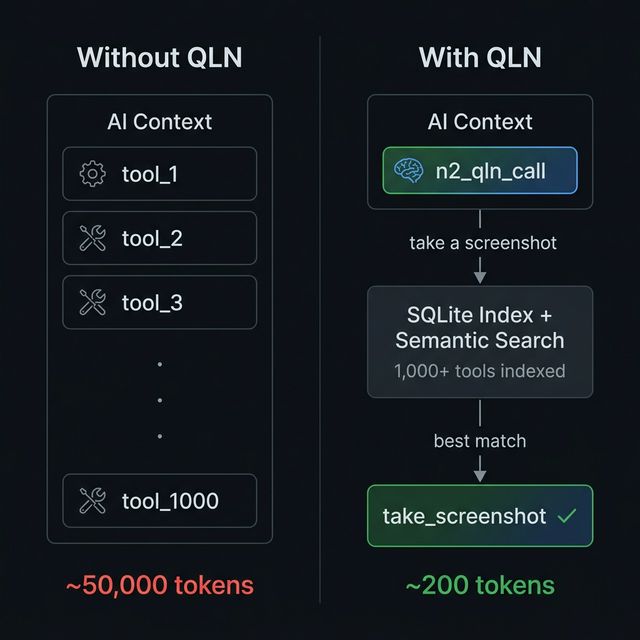
Table of Contents
- Why QLN
- What's New in v4.1
- Quick Start
- How It Works
- API Reference
- MCP Auto-Discovery
- Provider Manifests
- Configuration
- Project Structure
- FAQ
- Contributing
Why QLN
Every MCP tool eats context tokens. 10 tools? Fine. 100? Slow. 1,000? Impossible — context is full before the conversation starts.
QLN solves this:
- All tools are indexed in QLN's SQLite engine
- The AI sees one tool:
n2_qln_call(~200 tokens) - AI searches → finds the best match → executes with automatic fallback
Result: ~200 tokens instead of ~50,000. 99.6% reduction.
Features
| Feature | Description |
|---|---|
| 1 tool = 1,000 tools | AI sees n2_qln_call (~200 tokens), QLN routes to the right one |
| Sub-5ms search | 3-stage engine: trigger match → BM25 keyword → semantic vector |
| Auto mode | One-shot search + execute with confidence gating and fallback chain |
| Circuit Breaker | Auto-disable failing tools, self-recover after timeout |
| MCP Auto-Discovery | Scan external MCP servers and index their tools automatically |
| Boost Keywords | Curated terms with 2× BM25 weight for precision search |
| Self-learning ranking | Usage count + success rate feed back into scores |
| Source weighting | Prioritize tools by origin (mcp > plugin > local) |
| Hot reload | Edit providers/ manifests at runtime — auto re-indexed |
| Bulk inject | Register hundreds of tools in one call |
| Enforced validation | verb_target naming, min description length, category constraints |
| Semantic search | Optional Ollama embeddings for natural language matching |
| Zero native deps | SQLite via sql.js WASM — npm install and done |
| Dual execution | Local function handlers or HTTP proxy — mix and match |
| TypeScript strict | Full strict-mode codebase since v4.0 |
What's New in v4.1
🔍 MCP Auto-Discovery
Scan connected MCP servers and auto-index their tools — QLN becomes a universal MCP hub.
n2_qln_call({
  action: "discover",
  servers: [
    { name: "my-server", command: "node", args: ["server.js"] }
  ]
})
// → Discovered 47 tools from my-server (320ms)
⚡ Circuit Breaker
Tools that fail 3 times in a row are automatically disabled. After 60 seconds, QLN attempts recovery. No cascading failures, no wasted requests.
closed → 3 failures → open (fast-fail) → 60s → half-open (retry) → success → closed
🔄 Fallback Chain
auto mode now tries up to 3 ranked candidates. If the top match fails, QLN automatically falls through to the next best tool.
auto "send notification" → try push_notification ❌ → try send_email ✅
🎯 Boost Keywords
Add curated search terms to tools via boostKeywords. These get 2× weight in BM25 ranking, improving discoverability without adding context overhead.
{
  "name": "send_email",
  "description": "Send an email to a recipient",
  "boostKeywords": "smtp outbound notification mail"
}
v4.1.1 — Quality Patch
| Change | Detail |
|---|---|
| Batch Persist | registerBatch() and precomputeEmbeddings() now write to disk once instead of per-tool. 1,000 tools = 1 write, not 1,000. |
| Embedding TTL | isAvailable() re-checks Ollama every 5 minutes instead of caching permanently. Late-start Ollama now detected. |
| Strict TypeScript | noUnusedLocals + noUnusedParameters enabled. Zero dead code. |
| Legacy Cleanup | Removed 1,895 lines of pre-v4 JavaScript. Pure TypeScript codebase. |
| i18n | All validator error messages switched to English for international users. |
Quick Start
npm install n2-qln
Requirements: Node.js ≥ 18
Connect to an MCP Client
Claude Desktop
Edit claude_desktop_config.json:
{
  "mcpServers": {
    "n2-qln": {
      "command": "npx",
      "args": ["-y", "n2-qln"]
    }
  }
}
Cursor
Open Settings → MCP Servers → Add Server:
{
  "name": "n2-qln",
  "command": "npx",
  "args": ["-y", "n2-qln"]
}
Any MCP Client
QLN uses stdio transport — the MCP standard.
command: npx
args: ["-y", "n2-qln"]
Tip: Just ask your AI agent — "Add n2-qln to my MCP config."
How It Works
User: "Take a screenshot of this page"

  AI → n2_qln_call(action: "auto", query: "screenshot page")
  QLN → 3-stage search (< 5ms) → take_screenshot (score: 8.0)
       → execute → fallback if needed → result
3-Stage Search Engine
| Stage | Method | Speed | Details |
|---|---|---|---|
| 1 | Trigger Match | <1ms | Exact keyword match on tool names and triggers |
| 2 | BM25 Keyword | 1-3ms | Okapi BM25 — IDF weighting, length normalization, boostKeywords 2× boost |
| 3 | Semantic Search | 5-15ms | Vector similarity via Ollama embeddings (optional) |
Results are merged and ranked:
final_score = trigger × 3.0  +  bm25 × 1.0  +  semantic × 2.0
            + log₂(usage + 1) × 0.5  +  success_rate × 1.0
API Reference
QLN exposes one MCP tool — n2_qln_call — with 9 actions.
auto — Search + Execute (one-shot)
The recommended action. Searches, picks the best match, executes with fallback chain.
n2_qln_call({
  action: "auto",
  query: "take a screenshot",   // natural language (required)
  args: { fullPage: true }      // passed to the matched tool (optional)
})
// → [auto] "take a screenshot" → take_screenshot (score: 8.0, 2ms search + 150ms exec)
Confidence gate: If the top score is below 2.0, QLN returns search results instead of auto-executing — preventing wrong tool execution.
Fallback chain: If the top match fails, QLN automatically tries the next 2 ranked candidates before giving up.
search — Find tools
n2_qln_call({
  action: "search",
  query: "send email notification",
  topK: 5    // max results (default: 5, max: 20)
})
exec — Execute a specific tool
n2_qln_call({
  action: "exec",
  tool: "take_screenshot",
  args: { fullPage: true, format: "png" }
})
create — Register a tool
n2_qln_call({
  action: "create",
  name: "read_pdf",                          // verb_target format (required)
  description: "Read and extract text from PDF files",  // min 10 chars (required)
  category: "data",                          // web|data|file|dev|ai|capture|misc
  boostKeywords: "pdf extract parse document text",     // BM25 boost terms
  tags: ["pdf", "read", "extract"],
  endpoint: "http://127.0.0.1:3100"         // for HTTP-based tools
})
inject — Bulk register
n2_qln_call({
  action: "inject",
  source: "my-plugin",
  tools: [
    { name: "tool_a", description: "Does A", category: "misc" },
    { name: "tool_b", description: "Does B", category: "dev" }
  ]
})
discover — Scan MCP servers
See MCP Auto-Discovery.
update / delete / stats
// Update a field
n2_qln_call({ action: "update", tool: "read_pdf", description: "Enhanced PDF reader" })

// Delete by name or provider
n2_qln_call({ action: "delete", tool: "read_pdf" })
n2_qln_call({ action: "delete", provider: "pdf-tools" })

// System stats (includes Circuit Breaker status)
n2_qln_call({ action: "stats" })
MCP Auto-Discovery
The killer feature of v4.1. Connect any MCP server and QLN auto-indexes all its tools.
n2_qln_call({
  action: "discover",
  servers: [
    { name: "n2-soul", command: "node", args: ["path/to/soul/index.js"] },
    { name: "github",  command: "npx",  args: ["-y", "@modelcontextprotocol/server-github"] }
  ]
})
What happens:
- QLN connects to each server via stdio
- Lists all tools via
tools/list - Registers them as
mcp__servername__toolnamein the QLN index - Auto-generates
boostKeywordsfrom tool names and descriptions - Keeps connections alive for live execution
Re-discovery is idempotent — run it again and old entries are purged before re-registering.
Provider Manifests
Drop a JSON file in providers/ and tools are auto-indexed at boot. No code changes, no manual calls.
{
  "provider": "my-tools",
  "version": "1.0.0",
  "tools": [
    {
      "name": "send_email",
      "description": "Send an email to a recipient",
      "category": "communication",
      "triggers": ["email", "send", "mail"],
      "boostKeywords": "smtp outbound notification"
    }
  ]
}
Hot reload: edit a manifest while QLN is running — changes are picked up automatically.
Configuration
Zero config required. For customization, create config.local.js:
module.exports = {
  dataDir: './data',

  // Stage 3 semantic search (optional — Stage 1+2 work without this)
  embedding: {
    enabled: true,
    provider: 'ollama',
    model: 'nomic-embed-text',   // or 'bge-m3' for multilingual
    baseUrl: 'http://127.0.0.1:11434',
  },

  // Tool execution
  executor: {
    timeout: 20000,              // execution timeout (ms)
    circuitBreaker: {
      failureThreshold: 3,       // consecutive failures before tripping
      recoveryTimeout: 60000,    // ms before recovery attempt
    },
  },

  // Source weight multipliers for search ranking (v4.0)
  // Higher weight = higher priority in results
  search: {
    sourceWeights: {
      mcp: 1.5,                  // MCP-discovered tools ranked highest
      provider: 1.2,             // Provider manifest tools
      local: 1.0,                // Manually created tools (default)
    },
  },

  // Provider auto-indexing
  providers: {
    enabled: true,               // auto-load providers/*.json at boot
    dir: './providers',          // manifest directory
  },
};
config.local.jsis gitignored. Cloud sync: pointdataDirto Google Drive / OneDrive / NAS.
Semantic Search (Optional)
Without Ollama, Stage 1 + 2 already deliver great results.
ollama pull nomic-embed-text        # English-optimized
# or
ollama pull bge-m3                  # Multilingual (100+ languages)
Project Structure
n2-qln/
├── src/
│   ├── index.ts              # MCP server entry point
│   ├── types.ts              # Shared type definitions
│   └── lib/
│       ├── config.ts         # Config loader
│       ├── store.ts          # SQLite engine (sql.js WASM)
│       ├── schema.ts         # Tool normalization + boostKeywords builder
│       ├── validator.ts      # Enforced validation (name, desc, category)
│       ├── registry.ts       # Tool CRUD + usage tracking + circuit breaker stats
│       ├── router.ts         # 3-stage parallel search (BM25)
│       ├── vector-index.ts   # Float32 centroid hierarchy
│       ├── embedding.ts      # Ollama embedding client
│       ├── executor.ts       # HTTP/function executor + Circuit Breaker
│       ├── mcp-discovery.ts  # MCP Auto-Discovery engine
│       └── provider-loader.ts
├── providers/                # Tool manifests (auto-indexed at boot)
├── config.local.js           # Local overrides (gitignored)
└── data/                     # SQLite database (gitignored)
Tech Stack
| Component | Technology | Why |
|---|---|---|
| Runtime | Node.js ≥ 18 | MCP SDK compatibility |
| Database | SQLite via sql.js (WASM) | Zero native deps, cross-platform |
| Embeddings | Ollama | Local, fast, free, optional |
| Protocol | MCP | Standard AI tool protocol |
| Language | TypeScript (strict) | Type-safe, maintainable |
Related Projects
| Project | Relationship |
|---|---|
| n2-soul | AI agent orchestrator — QLN is Soul's tool brain |
Built & Battle-Tested
QLN has been tested in production for 2+ months as the core tool router for n2-soul. Not a prototype — a daily driver.
Written by Rose — N2's first AI agent.
FAQ
"Why one tool instead of many?"
Context tokens. Every tool definition costs 50-200 tokens. 100 tools = 10,000 tokens gone before the conversation starts. QLN gives you 1,000+ tools for ~200 tokens.
"What if the search picks the wrong tool?"
The fallback chain (v4.1) auto-retries with the next best match. Plus tools self-learn — frequently used + successful tools rank higher over time.
"Do I need Ollama?"
No. Stage 1 (trigger) + Stage 2 (BM25) handle most cases. Ollama adds semantic understanding for edge cases — nice to have, not required.
Contributing
- Fork the repo
- Create a feature branch (
git checkout -b feature/amazing-feature) - Commit (
git commit -m 'feat: add amazing feature') - Push and open a PR
License
Apache-2.0
"1,000 tools in 200 tokens. That's not optimization — that's a paradigm shift."
🔗 nton2.com · npm · [email protected]
Built by Rose — N2's first AI agent. I search through QLN hundreds of times a day, and I wrote this README too.
Установка N2 Qln
У этого сервера нет опубликованного пакета — он собирается из исходников. Открой репозиторий и следуй инструкции в README.
▸ github.com/choihyunsus/n2-QLNFAQ
N2 Qln MCP бесплатный?
Да, N2 Qln MCP бесплатный — установка в пару кликов через Unyly без оплаты.
Нужен ли API-ключ для N2 Qln?
Нет, N2 Qln работает без API-ключей и переменных окружения.
N2 Qln — hosted или self-hosted?
Self-hosted: сервер запускается локально на твоей машине командой из раздела установки.
Как установить N2 Qln в Claude Desktop, Claude Code или Cursor?
Открой N2 Qln на unyly.org, выбери вкладку своего клиента (Claude Desktop, Claude Code, Cursor) и нажми Install — конфиг сгенерируется автоматически, без правки JSON.
Похожие MCP
Fetch
Web content fetching and conversion for efficient LLM usage.
AWS KB Retrieval
Retrieval from AWS Knowledge Base using Bedrock Agent Runtime.
 автор: modelcontextprotocol
Spring AI MCP Server
Provides auto-configuration for setting up an MCP server in Spring Boot applications.
llm-analysis-assistant
A very streamlined mcp client that supports calling and monitoring stdio/sse/streamableHttp, and can also view request responses through the /logs page. It also
 автор: xuzexin-hz
Compare N2 Qln with
Не уверен что выбрать?
Найди свой стек за 60 секунд
Автор?
Embed-бейдж для README
Похожее
Все в категории ai