
Nervora
БесплатноНе проверенA secure MCP gateway for enterprise AI tool execution, enabling governed invocation of business tools with authentication, RBAC, audit logging, PII redaction, a

Описание
A secure MCP gateway for enterprise AI tool execution, enabling governed invocation of business tools with authentication, RBAC, audit logging, PII redaction, and async processing.
README
Secure MCP Gateway for Enterprise AI Tool Execution Internal R&D Reference Architecture
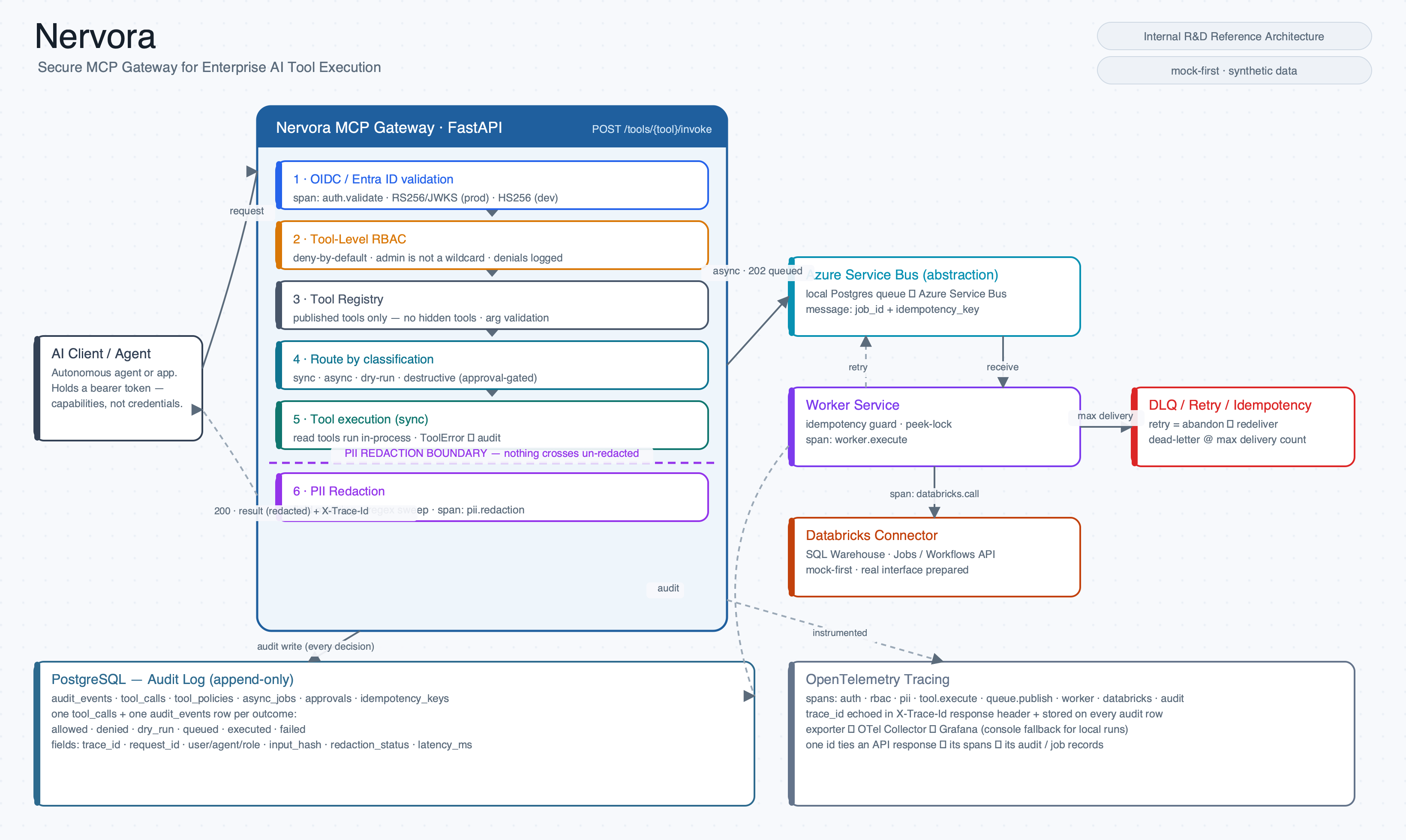
A production-grade reference implementation showing how enterprise AI agents can call real business tools safely, through a governed FastAPI / MCP-style integration layer. It is deliberately not a chatbot demo — it is a demonstration of the control plane that has to sit between an autonomous agent and your systems of record: authentication, tool-level RBAC, audit logging, PII redaction, dry-run for destructive actions, async execution with idempotency, retry/DLQ handling, Databricks integration, OpenTelemetry tracing, and Azure-deployment readiness.
Status: Internal R&D reference architecture. Mock-first by design (no real production systems are touched). Suitable for public GitHub and as a DACH-facing technical trust signal on inovativi.com.
What this project proves
- An AI agent can be given capabilities, not credentials. It calls named, declared tools; it never holds a database connection or a Databricks token.
- Every tool call is authenticated, authorised against tool-level RBAC, PII-redacted, and audited — including the calls that are denied.
- Destructive actions are deny-by-default: they require an explicit human-approved token and are hard-disabled in demo mode.
- Long-running work is decoupled onto a queue with an idempotency key, a worker, retries and a dead-letter path — agents cannot run long jobs synchronously, and duplicate submissions cannot double-execute.
- The whole thing is observable (OpenTelemetry spans around every stage, trace ids echoed into responses and audit rows) and portable (one abstraction for the queue, one for Databricks — local mock today, Azure Service Bus / Databricks tomorrow with a config change).
What this project deliberately does not do
- It does not ship a model or an agent reasoning loop. The "agent" is a thin client; the value here is the gateway, not the LLM.
- It does not connect to real HR/finance/CRM systems. Tool data is synthetic.
- The Databricks and Azure Service Bus connectors run as mocks/local backends by default; the real implementations are present as prepared interfaces, not exercised in the demo.
- It is not a turnkey production deployment. The IaC under
infra/is reference material — networking, secret management (Key Vault) and identity hardening are called out but not fully implemented.
See docs/judgment-block.md for the explicit list of things agents are not allowed to do.
Architecture
                         ┌──────────────────────────────────────────────┐
   AI Agent  ──Bearer──▶ │             Nervora MCP Gateway (FastAPI)      │
   (demo-agent)          │                                                │
                         │  auth ─▶ RBAC ─▶ args ─▶ route ─▶ PII ─▶ audit │
                         └───┬───────────────┬───────────────┬───────────┘
                             │ sync           │ async          │ writes
                             ▼                ▼                ▼
                     Databricks (mock) │  Service Bus     │  PostgreSQL
                     SQL + Jobs API    │  (local | azure) │  audit_events
                                       │      │           │  tool_calls
                                       │      ▼           │  tool_policies
                                       │   Worker ────────┤  async_jobs
                                       │   idempotency    │  approvals
                                       │   retry / DLQ    │  idempotency_keys
                                       └──────┬───────────┘
                                              ▼
                                  OpenTelemetry  ─▶ Collector ─▶ Grafana
Full detail: docs/architecture.md.
Repository layout
apps/
  mcp-gateway/     FastAPI gateway: the governed execution pipeline + API
  worker/          Async job worker: idempotency, retry, dead-letter
  demo-agent/      CLI client that mints dev tokens and runs the scripted demo
  admin-web/       Static, read-only operator console (tools, queue, audit)
packages/
  common/          Settings + id/hash helpers shared by every service
  auth/            OIDC/JWT abstraction (dev HS256 + Entra ID RS256/JWKS)
  rbac/            Roles + deny-by-default tool-level policy evaluation
  audit/           SQLAlchemy schema + the only sanctioned audit writer
  pii/             Field-level + pattern-based redaction
  telemetry/       OpenTelemetry tracer setup + span helpers
  tool_registry/   ToolSpec metadata + the reference tools (incl. demo-flow tools)
  databricks_connector/  Mock + prepared-real SQL / Jobs connector
  servicebus/      Queue abstraction: local Postgres backend + Azure Service Bus
infra/
  docker-compose.yml   Local stack (postgres, gateway, worker, otel, grafana, web)
  terraform/ | bicep/  Azure reference deployment
  grafana/             Dashboard + provisioning
docs/                  Architecture, security model, RBAC matrix, demo script…
tests/                 Pytest suite (RBAC, PII, tools, async/idempotency, API)
Security flow
Every call to POST /tools/{tool_name}/invoke runs this fixed pipeline
(each stage is its own OpenTelemetry span):
- Authenticate — validate the bearer token (dev HS256 locally, Entra ID
JWKS/RS256 in production) →
Principal{subject, agent_id, role}. - Authorise (RBAC) — deny-by-default; the role must be explicitly listed in
the tool's
required_roles. Admin is not a wildcard. Denials are logged. - Validate — arguments are validated against the tool's pydantic schema.
- Route by classification / execution mode:
- destructive → deny unless tool enabled and a valid approval token and an approved approval record exist;
- dry-run-required → execute the read-only diff, create a
pendingapproval, return "human approval required"; - async → reserve idempotency key, create job, publish to the queue (202);
- sync read/write → execute.
- Redact PII — sensitive fields are masked before the output is model-visible, unless policy + role allow raw access. A regex sweep catches leaks in free-text.
- Audit — one
tool_callsrow + oneaudit_eventsrow are written for every outcome, with trace id, input hash, decision, redaction status, error code and latency.
Details: docs/security-model.md.
RBAC matrix
| Tool | Class | Mode | HR | Finance | Sales | Admin |
|---|---|---|---|---|---|---|
get_employee_profile |
read (PII) | sync | ✅ | – | – | ✅ |
check_leave_balance |
read | sync | ✅ | – | – | ✅ |
get_invoice_status |
read | sync | – | ✅ | – | ✅ |
run_budget_variance_report |
read | sync | – | ✅ | – | ✅ |
trigger_databricks_workflow |
write | async | – | ✅ | – | ✅ |
create_crm_update_dry_run |
write (dry-run) | sync | – | – | ✅ | ✅ |
execute_crm_update |
destructive | sync | – | – | – | ✅* |
crm.lookup_customer |
read (PII) | sync | – | – | ✅ | ✅ |
billing.create_invoice_draft |
write (approval) | sync | – | ✅ | – | ✅ |
* disabled in demo mode and gated by an approval token even when enabled.
Full matrix incl. PII class and dry-run flags: docs/rbac-matrix.md.
Local setup
Requirements: Docker + Docker Compose. (For running tests/agents directly:
Python 3.12 recommended — make install then make test. If your default
python3 is a different version, point the Makefile at a 3.12 interpreter, e.g.
make test PY=.venv/bin/python.)
cp .env.example .env

# Full stack: gateway, worker, postgres, otel-collector, grafana, admin-web
make up
# or: docker compose -f infra/docker-compose.yml up --build
Then:
- API docs (Swagger): http://localhost:8000/docs
- Health: http://localhost:8000/health · AI readiness: http://localhost:8000/health/ai
- Admin console: http://localhost:8080
- Grafana: http://localhost:3000 (anonymous admin)
Run the scripted demo against the running stack:
make demo          # or: GATEWAY_URL=http://localhost:8000 python apps/demo-agent/agent.py demo
make token ROLE=finance_agent   # mint a dev bearer token for manual curl/Swagger
Run the tests (SQLite-backed, no Docker needed):
make install       # editable install incl. dev deps
make test          # RBAC, PII, tools, async/idempotency, HTTP API, demo flow
make lint
Nervora demo flow
For a buyer-facing, 5-minute technical walkthrough (with example requests, denied calls, the approval gate, audit output and a Mermaid diagram), see docs/demo-walkthrough.md.
The shortest path that shows the control plane doing its job, using the two
Phase 1 demo tools. Mint tokens with make token ROLE=..., then:
- AI asks for a customer →
POST /tools/crm.lookup_customer/invokeassales_agent→ RBAC allows it → executes → contact PII (email,phone) is redacted in the result → an audit row is written. - Wrong role is blocked → the same call as
finance_agent→ RBAC denies it (403,error_code: role_not_permitted) → the denial is also audited. - AI drafts an invoice →
POST /tools/billing.create_invoice_draft/invokeasfinance_agent→ the approval gate engages: nothing is written, the response isdecision: dry_runwithhuman_approval_required: trueand a pendingapproval_id. - A human approves →
POST /approvals/{approval_id}/approveasadmin_agent(only admin may approve) → the approval flips toapproved. - Status is visible →
GET /health/aishows backing-service modes and the full tool surface: which tools are registered, enabled, and approval-gated.
Every step returns a deterministic JSON envelope (decision, result,
approval_id, error_code, trace_id) and is recorded in the audit trail —
including the denied call. Covered end-to-end by tests/test_demo_flow.py.
Demo script (5–7 min)
A finance agent runs an allowed report, triggers an async Databricks workflow (queued → worker → succeeded), a duplicate submission is de-duplicated by idempotency key, a sales agent is denied HR access and blocked from a destructive write, and the full audit trail is shown. Step-by-step narration in docs/demo-script.md.
Azure deployment notes
Production swaps three things via configuration, no code changes:
AUTH_MODE=entra→ tokens validated against Entra ID tenant JWKS (RS256).QUEUE_BACKEND=azure→ Azure Service Bus (native peek-lock + DLQ).DATABRICKS_MODE=real→ real SQL Statement Execution + Jobs APIs.
Container Apps + PostgreSQL Flexible Server + Service Bus + Application Insights
are provisioned by infra/terraform or infra/bicep. See
docs/azure-deployment.md.
Observability
OpenTelemetry spans wrap auth, RBAC, PII redaction, tool execution, queue
publish, worker execution, the Databricks call and every audit write. The trace
id is returned in the X-Trace-Id response header and stored on every audit
row, so a single id ties an API response to its spans and its audit records.
Grafana dashboard JSON and setup notes: docs/observability.md.
Screenshots checklist
What to capture for the portfolio / inovativi.com write-up: docs/screenshots.md. Website-ready case-study copy: docs/inovativi-case-study.md.
Honest limitations
- Mock-first: Databricks and Service Bus run as local/mock backends by default; the real connectors are prepared interfaces, not battle-tested.
- The local queue is a faithful but simple Postgres-backed stand-in, not a high-throughput broker.
- Dev tokens use HS256 with a shared secret for local convenience; this path is never used in production (Entra ID JWKS is).
- PII redaction is policy- + regex-based; it is defence-in-depth, not a guarantee against every possible leak vector.
- IaC is reference-grade; production networking/secret/identity hardening is documented but not fully implemented.
Roadmap
Phase 2 plan (builds on the Phase 1 controlled execution layer): docs/phase-2.md. Highlights:
- Real Databricks connector implementation + integration tests behind a flag.
- KEDA queue-length autoscaling for the worker on Container Apps.
- Native MCP transport (stdio / streamable HTTP) in front of the tool registry.
- Policy-as-code (OPA/Rego) alternative to the in-code RBAC matrix.
- Approval workflow UI + signed, expiring approval tokens.
- Tempo/Jaeger trace backend wired into the Grafana dashboard out of the box.
License
Apache-2.0. Reference/educational use. Synthetic data only.
Установка Nervora
У этого сервера нет опубликованного пакета — он собирается из исходников. Открой репозиторий и следуй инструкции в README.
▸ github.com/sveselaj/NervoraFAQ
Nervora MCP бесплатный?
Да, Nervora MCP бесплатный — установка в пару кликов через Unyly без оплаты.
Нужен ли API-ключ для Nervora?
Нет, Nervora работает без API-ключей и переменных окружения.
Nervora — hosted или self-hosted?
Self-hosted: сервер запускается локально на твоей машине командой из раздела установки.
Как установить Nervora в Claude Desktop, Claude Code или Cursor?
Открой Nervora на unyly.org, выбери вкладку своего клиента (Claude Desktop, Claude Code, Cursor) и нажми Install — конфиг сгенерируется автоматически, без правки JSON.
Похожие MCP
Fetch
Web content fetching and conversion for efficient LLM usage.
AWS KB Retrieval
Retrieval from AWS Knowledge Base using Bedrock Agent Runtime.
 автор: modelcontextprotocol
Spring AI MCP Server
Provides auto-configuration for setting up an MCP server in Spring Boot applications.
llm-analysis-assistant
A very streamlined mcp client that supports calling and monitoring stdio/sse/streamableHttp, and can also view request responses through the /logs page. It also
 автор: xuzexin-hz
Compare Nervora with
Не уверен что выбрать?
Найди свой стек за 60 секунд
Автор?
Embed-бейдж для README
Похожее
Все в категории ai