
Openscad
БесплатноНе проверенExposes OpenSCAD CLI as MCP tools for validating, rendering, and exporting parametric 3D models. Enables LLM clients to interactively create and manipulate Open

Описание
Exposes OpenSCAD CLI as MCP tools for validating, rendering, and exporting parametric 3D models. Enables LLM clients to interactively create and manipulate OpenSCAD designs.
README
Overview
OpenSCAD MCP Server exposes the OpenSCAD CLI as Model Context Protocol (MCP) tools so MCP-compatible clients (including LLM-based clients) can validate, render, and export parametric 3D models using OpenSCAD.
This repo targets a v1.0 tool surface: stable, minimal, deterministic, and local-first (stdio transport only).
Tools
All tool details (args, options, response payloads) are documented in docs/TOOLING.md.
Core:
ping: server + OpenSCAD discovery metadatalist_formats: supported export/preview formatsvalidate_scad: compile validation + parsed diagnosticsexport_model: exportstl/3mf/offrender_preview: exportpngrender_scad: export model + preview in one callbatch_render_scad: run multiple parameter variants sequentially
Templates & modules:
list_templates/render_template: built-in parametric templates shipped with the serverlist_modules/render_module: render from a simple module registry (OPENSCAD_MCP_MODULE_ROOT)
Artifact ergonomics (opt-in, per call via options):
inline_artifact_bytes: return base64 bytes in responses (size-limited)introspect_artifacts: basic artifact metadata inspection (size-limited)use_cache: content-addressed cache (requiresOPENSCAD_MCP_CACHE_ROOT)
Quickstart (Local)
Prerequisites:
- Python 3.10+
- OpenSCAD installed and
openscadavailable on yourPATH(or setOPENSCAD_MCP_OPENSCAD_PATH)
Install (editable, recommended via venv):
python -m venv .venv
. .venv/bin/activate
python -m pip install -U pip
python -m pip install -e ".[dev]"
Run the MCP server (stdio):
openscad-mcp
Example tool call arguments (conceptual JSON payload):
{
    "tool": "render_scad",
    "args": {
        "scad_source": "cube([w,h,d]);",
        "params": {
            "w": 10,
            "h": 20,
            "d": 5
        },
        "options": {
            "format": "stl",
            "imgsize": [
                512,
                512
            ],
            "inline_artifact_bytes": true
        }
    }
}
Artifacts are produced in a per-request build directory:
- If your MCP client can read local paths, set
OPENSCAD_MCP_KEEP_ARTIFACTS=true(and optionallyOPENSCAD_MCP_ARTIFACT_ROOT) so returnedartifact.pathvalues remain valid after the tool returns. - If your MCP client cannot read local paths, use
inline_artifact_bytes=true(subject toOPENSCAD_MCP_MAX_INLINE_BYTES).- For some clients,
inline_artifact_bytes=truealso results in an image attachment forrender_preview/render_scadresponses.
- For some clients,
When OPENSCAD_MCP_ARTIFACT_ROOT is set, each request writes to a unique subdirectory (for example:
./artifacts/<uuid>/preview.png).
Run tests:
pytest -q
pytest -q -m "not integration"
Run integration tests inside the Docker image (real OpenSCAD):
./scripts/pytest-integration-docker
Docker (Recommended for Isolation)
This server uses MCP stdio transport (no network listener). To run it in Docker while still exposing a stdio MCP process to a host MCP client, use the provided wrapper which forwards stdin/stdout to a container.
Build the image and create a host-visible artifacts directory:
mkdir -p artifacts
docker compose build
Run the MCP server via Docker (stdio passthrough):
./scripts/openscad-mcp-docker
Windows PowerShell:
.\scripts\openscad-mcp-docker.ps1
Artifacts are written inside the container under /artifacts and are volume-mounted to ./artifacts on the host.
If you need to enforce output size limits, set OPENSCAD_MCP_MAX_OUTPUT_BYTES.
Note: the container entrypoint uses an openscad-headless wrapper that prefers xvfb-run for PNG rendering, but
falls back to QT_QPA_PLATFORM (default minimal) if xvfb-run/xauth are unavailable.
MCP Client Configuration Example (JetBrains AI)
Set the working directory to the project root folder.
{
    "mcpServers": {
        "openscad": {
            "command": "powershell.exe",
            "args": [
                "-NoProfile",
                "-ExecutionPolicy",
                "Bypass",
                "-File",
                ".\\scripts\\openscad-mcp-docker.ps1"
            ]
        }
    }
}
Screenshots
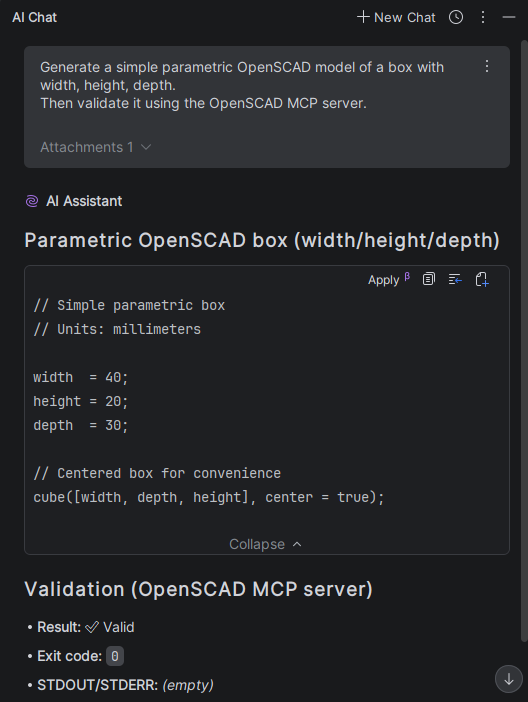
Model generation + validation:
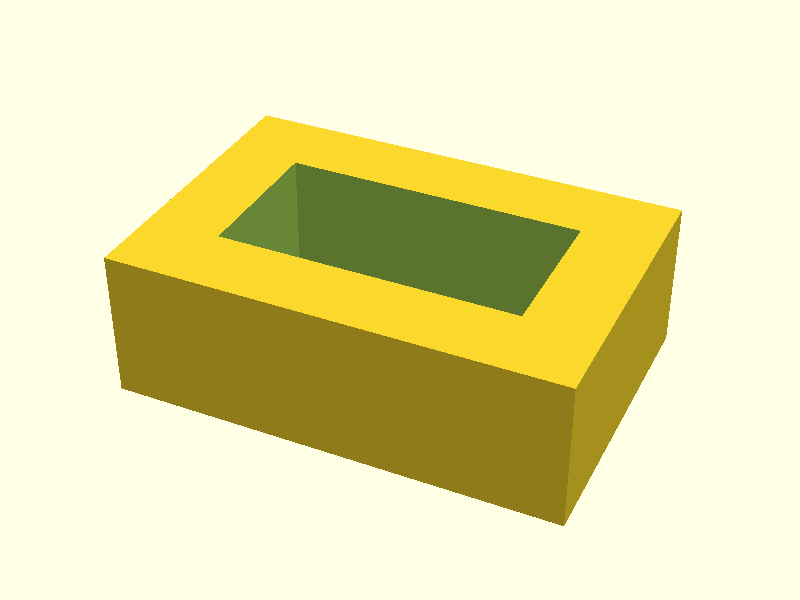
Preview rendering + model export:
Module Registry Format
If OPENSCAD_MCP_MODULE_ROOT is set, it must contain an index.json manifest plus *.scad files:
{
    "modules": [
        {
            "id": "my_part",
            "description": "Example module.",
            "entry": "my_part"
        }
    ]
}
The server will load my_part.scad and call my_part() (or entry if it already includes parentheses).
Configuration
Environment variables:
OPENSCAD_MCP_LOG_LEVEL: log level (defaultINFO)OPENSCAD_MCP_OPENSCAD_PATH: optional path toopenscad(overridesPATHdiscovery)OPENSCAD_MCP_QT_QPA_PLATFORM: Qt platform plugin for headless fallback (defaultminimal)OPENSCAD_MCP_TIMEOUT_S: OpenSCAD subprocess timeout in seconds (default30)OPENSCAD_MCP_ARTIFACT_ROOT: optional root directory for per-request build dirsOPENSCAD_MCP_KEEP_ARTIFACTS: iftrue, keep per-request build dirsOPENSCAD_MCP_MAX_OUTPUT_BYTES: fail if the generated artifact exceeds this sizeOPENSCAD_MCP_MAX_INLINE_BYTES: max bytes to inline wheninline_artifact_bytes=true(default 5 MB)OPENSCAD_MCP_MAX_INTROSPECT_BYTES: max bytes to read for introspection (default 2 MB)OPENSCAD_MCP_CACHE_ROOT: root directory for artifact cache (enablesuse_cache=true)OPENSCAD_MCP_MODULE_ROOT: module registry root containingindex.json+*.scadfilesOPENSCAD_MCP_INCLUDE_ROOTS: comma-separated allowlist foruse/include(best-effort enforcement)
Security Notes
This server is designed to be local-first and run over stdio. Do not expose it directly to the internet.
OpenSCAD compilation should be treated as untrusted workload (CPU/memory heavy models, file use/include, etc). See
docs/SECURITY.md for the project security stance and recommendations.
Documentation & Examples
- Tool surface and payloads:
docs/TOOLING.md - Security posture:
docs/SECURITY.md - Example prompts (copy/paste for MCP clients):
examples/README.md - Contributing:
CONTRIBUTING.md - Code of Conduct:
CODE_OF_CONDUCT.md - Security policy:
SECURITY.md - Changelog:
CHANGELOG.md
Roadmap
The v1.0 tool surface is implemented. Future enhancements are tracked via GitHub issues (e.g. more templates, deeper OpenSCAD diagnostics coverage, additional formats, optional session-like workflows).
License
MIT
Acknowledgement
Pretty much the whole project was generated With ChatGPT 5.1 using Codex CLI inside JetBrains PyCharm. The goal of this project is to investigate the implementation of MCP protocol in Python.
Установка Openscad
У этого сервера нет опубликованного пакета — он собирается из исходников. Открой репозиторий и следуй инструкции в README.
▸ github.com/petrijr/openscad-mcpFAQ
Openscad MCP бесплатный?
Да, Openscad MCP бесплатный — установка в пару кликов через Unyly без оплаты.
Нужен ли API-ключ для Openscad?
Нет, Openscad работает без API-ключей и переменных окружения.
Openscad — hosted или self-hosted?
Self-hosted: сервер запускается локально на твоей машине командой из раздела установки.
Как установить Openscad в Claude Desktop, Claude Code или Cursor?
Открой Openscad на unyly.org, выбери вкладку своего клиента (Claude Desktop, Claude Code, Cursor) и нажми Install — конфиг сгенерируется автоматически, без правки JSON.
Похожие MCP
Fetch
Web content fetching and conversion for efficient LLM usage.
AWS KB Retrieval
Retrieval from AWS Knowledge Base using Bedrock Agent Runtime.
 автор: modelcontextprotocol
Spring AI MCP Server
Provides auto-configuration for setting up an MCP server in Spring Boot applications.
llm-analysis-assistant
A very streamlined mcp client that supports calling and monitoring stdio/sse/streamableHttp, and can also view request responses through the /logs page. It also
 автор: xuzexin-hz
Compare Openscad with
Не уверен что выбрать?
Найди свой стек за 60 секунд
Автор?
Embed-бейдж для README
Похожее
Все в категории ai