
Orionbelt Semantic Layer
БесплатноНе проверенMCP server for the OrionBelt Semantic Layer. Enables LLMs to explore governed semantic models, compile YAML metric definitions into optimized SQL across 8 engin

Описание
MCP server for the OrionBelt Semantic Layer. Enables LLMs to explore governed semantic models, compile YAML metric definitions into optimized SQL across 8 engines (BigQuery, ClickHouse, Databricks, Dremio, DuckDB, MySQL, PostgreSQL, Snowflake), and execute analytics queries via natural language. Works with Claude, Cursor, Windsurf, and Copilot.
README

OrionBelt® Semantic Layer MCP
Thin MCP server that delegates to the OrionBelt® Semantic Layer REST API
Version 2.22.0 OrionBelt® Semantic Layer 2.22 Python 3.12+ License: Apache 2.0 FastMCP Pydantic v2 Ruff
BigQuery PostgreSQL Snowflake ClickHouse Dremio Databricks DuckDB MySQL
Docker Hub Docker pulls Image size
A thin MCP server that delegates all business logic to the OrionBelt® Semantic Layer REST API via HTTP. No embedded engine — pure API pass-through.
Architecture
The OrionBelt® Semantic Layer platform has two deployment modes. This MCP server supports both:
- Standalone — Deploy the OrionBelt® Semantic Layer API anywhere (Cloud Run, Docker, localhost) and point this MCP server at it via
API_BASE_URL. - Hosted — Connect to the public Cloud Run deployment with zero local setup (see Hosted MCP Server below).
┌────────────┐       ┌──────────────────────────────────────────────────────┐
│ LLM Client │       │                OrionBelt® Platform                   │
│            │       │                                                      │
│  Claude,   │──MCP──│──> server.py  ──HTTP /v1──>  Semantic Layer REST API │
│  Cursor,   │       │    (FastMCP                   (FastAPI: parse OBML,  │
│  any MCP   │       │     + httpx)                   validate, compile     │
│  client    │       │                                to SQL)               │
└────────────┘       └──────────────────────────────────────────────────────┘
- No business logic — all tool calls delegate to the REST API (v1 endpoints)
- Dual-mode — auto-detects single-model or multi-model API mode at startup
- Auto-session management — creates an API session on first tool call, caches the ID (multi-model mode)
- 15 tools (single-model mode) or 19 tools (multi-model mode) for querying (QueryObject), execution, batch, discovery, composability (ACR), examples, diagrams, RDF/SPARQL, OSI export, and OBML reference + JSON schemas. (20 distinct tools exist in total; the API mode selects which subset is active — they overlap in 14 — and no client ever sees all 20 at once.) The visible surface is narrowed further in the design-time phase and when query execution is disabled (see Design-time vs run-time tool switching)
- 4 prompts + 2 resources for OBML / OBSQL reference and usage guidance
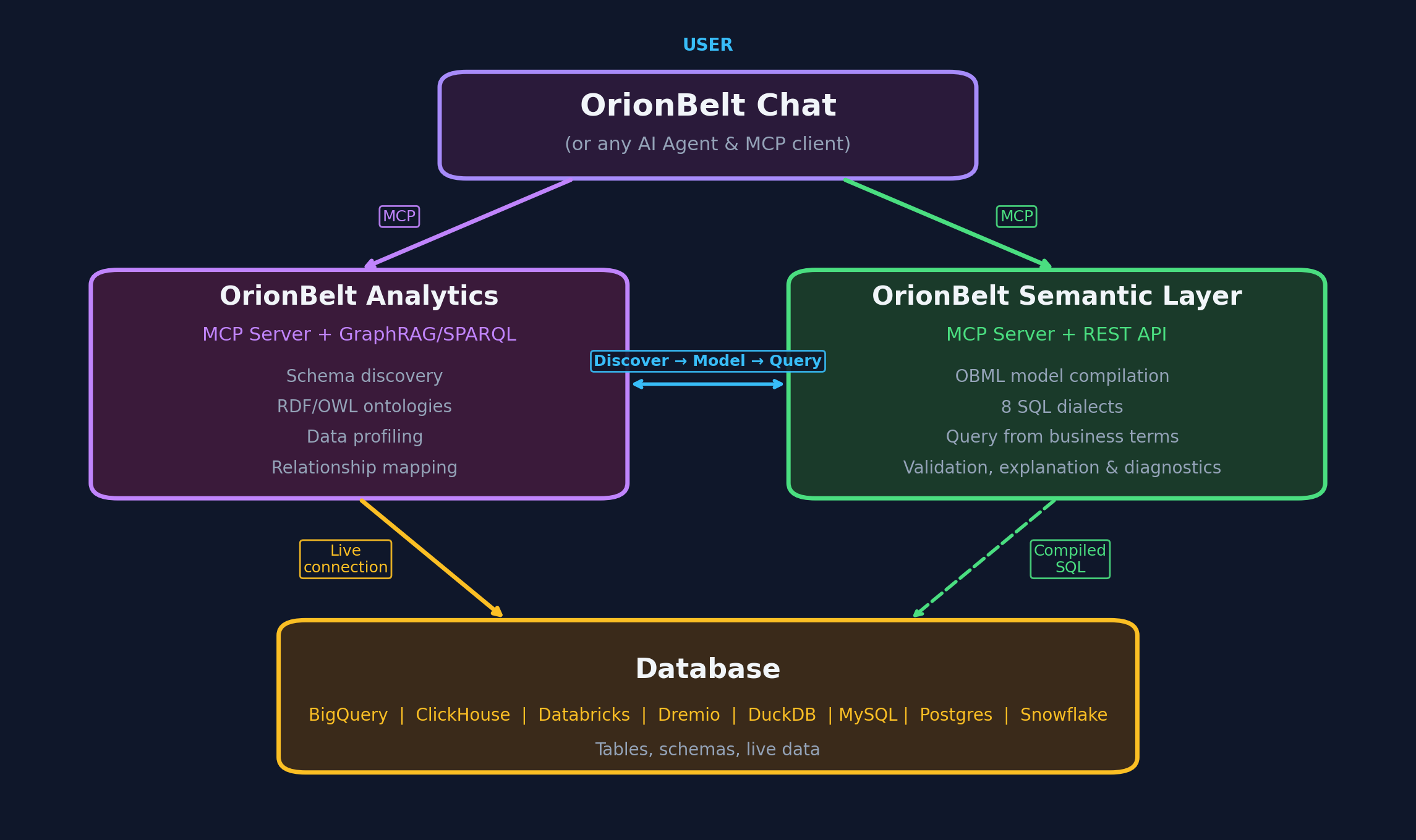
Live Demo
A public demo of the OrionBelt® Semantic Layer API is available at:
API endpoint:
https://orionbelt.ralforion.com— Swagger UI | ReDoc | Gradio UI
Set API_BASE_URL=https://orionbelt.ralforion.com in your .env file to use it (see .env.example).
Installation
uv sync
For development (includes pytest, respx, ruff):
uv sync --all-groups
Usage
stdio (default)
uv run server.py
HTTP transport
MCP_TRANSPORT=http uv run python server.py
MCP client configuration
Add to your MCP client config (e.g. claude_desktop_config.json):
{
  "mcpServers": {
    "orionbelt": {
      "command": "uv",
      "args": ["run", "python", "server.py"],
      "cwd": "/path/to/orionbelt-semantic-layer-mcp"
    }
  }
}
Configuration
Environment variables or .env file (pydantic-settings). See .env.example for defaults.
| Variable | Default | Description |
|---|---|---|
API_BASE_URL |
— (required) | OrionBelt® Semantic Layer REST API URL |
API_KEY |
— (unset) | API credential; required only when the API runs with AUTH_MODE=api_key |
API_KEY_HEADER |
X-API-Key |
Header the credential is sent in; must match the API's API_KEY_HEADER |
MCP_TRANSPORT |
stdio |
stdio, http, or sse |
MCP_SERVER_HOST |
localhost |
Bind host for HTTP/SSE |
MCP_SERVER_PORT |
9000 |
Bind port for HTTP/SSE |
LOG_LEVEL |
INFO |
Logging level |
API_TIMEOUT |
30 |
HTTP timeout in seconds |
Tools
Model lifecycle
| MCP Tool | Description |
|---|---|
get_obml_reference() |
Returns the full OBML format specification |
load_model(model? | osi_yaml?, dedup=True) |
Parse, validate, and store a model (returns health + model_load). Pass model (OBML JSON) or osi_yaml (OSI YAML, converted to OBML server-side) |
describe_model(model_id) |
Inspect data objects, dimensions, measures, metrics |
remove_model(model_id) |
Remove a model from the current session |
list_models() |
List all models loaded in the current session |
export_model_to_osi(model_id, ...) |
Export a loaded model as OSI YAML |
Model discovery
| MCP Tool | Description |
|---|---|
find_artefacts(model_id, query?, kind?, name?) |
Look up artefacts. With query → fuzzy, ranked search (resolve a vague term: exact / synonym / fuzzy). Without query → exact, deterministic lookup (all artefacts, one kind, or one named artefact, full records) |
explain_artefact(model_id, name) |
Explain lineage of a dimension, measure, or metric |
list_examples(model_id, intent?) |
List authored example queries (filterable by intent tag) |
get_example(model_id, name) |
Get one example with query + compiled SQL preview |
get_join_graph(model_id) |
Return the join graph as an adjacency list |
find_composables(query_json?, anchors?, anchor_type?, model_id?) |
ACR — given an in-progress query or named anchor(s), return the dimensions/measures/metrics that still compose into a valid, fanout-free result (plus CFL candidates). Guaranteed to compile |
Query, execution & diagrams
| MCP Tool | Description |
|---|---|
execute_query(...) |
Compile and execute a QueryObject, returning SQL + rows |
run_batch(queries, ...) |
One-shot: load a model + run N queries in parallel |
get_model_diagram(model_id) |
Generate a Mermaid ER diagram for a loaded model |
Semantic graph (RDF / SPARQL)
| MCP Tool | Description |
|---|---|
get_model_graph(model_id) |
Return the model as OBSL-Core RDF (Turtle) |
query_model_graph_by_sparql(query, ...) |
Run a read-only SPARQL query (SELECT / ASK) |
References
| MCP Tool | Description |
|---|---|
get_obml_reference() |
OBML (model authoring) grammar reference |
get_json_schema(name) |
JSON Schema for obml (model) or query (QueryObject) |
Utilities
| MCP Tool | Description |
|---|---|
list_dialects() |
List available SQL dialects and capabilities |
Design-time vs run-time tool switching
The server presents a phase-scoped tool surface: instead of listing all
all tools at once, it shows only the tools that make sense for where you are in
the model lifecycle. About half the tools are meaningless until a model is
loaded (execute_query, describe_model, find_artefacts, …) and the rest are
about authoring or reference (get_obml_reference, get_json_schema,
list_dialects). Splitting them keeps the surface small and prevents a
whole class of error — calling a query tool with no model loaded.
Three buckets, swapped by phase
Tools fall into three buckets. The visible surface is a swap at the load/unload transition, not additive — the run phase does not show the design/reference tools:
| Bucket | Listed when | Tools |
|---|---|---|
| Always | always (both phases) | load_model, remove_model (transition verbs — stay available in the run phase so a second model can be loaded mid-session, up to max_models_per_session); run_batch (self-contained one-shot — loads/references a model inline, so it needs no prior session state); get_json_schema (QueryObject/OBML schemas — needed in both phases) |
| Design-only | only when no model loaded | get_obml_reference, list_dialects |
| Run-only | only when a model is loaded | describe_model, get_model_diagram, find_artefacts, explain_artefact, execute_query, list_examples, get_example, get_model_graph, get_join_graph, find_composables, query_model_graph_by_sparql, list_models, export_model_to_osi |
                       load_model  (returns "re-list" signal)
   ┌─────────────────┐ ────────────────────────────────▶ ┌───────────────┐
   │ design phase    │                                   │ run phase     │
   │ always + design │ ◀───────────────────────────────  │ always + run  │
   └─────────────────┘  remove_model (last model) / TTL  └───────────────┘
                        expiry — back to design phase
So design phase → always + design-only, run phase → always + run-only. Design/reference tools are hidden once a model is loaded, keeping the run surface focused on querying.
Re-listing
The MCP tools/list response is filtered to the active phase. Because the
stateless MCP spec makes push notifications (notifications/tools/list_changed)
unreliable, transitions are pull-based: load_model (design → run) and
remove_model (run → design, once no models remain) return a short signal
telling the client to re-list its tools and pick up the swapped surface.
Guard against premature calls
If a client calls a run-only verb while still in the design phase (e.g. a stale host that hasn't re-listed yet), the server returns a structured error rather than an opaque failure:
No model loaded — '
execute_query' is a run-time tool and is not available yet. Callload_modelfirst, then re-list tools.
Capability gating (orthogonal to phase)
Separately from lifecycle phase, a tool can be hidden because the server is
configured not to support it. The execution tool execute_query is gated on
the API's query_execute capability: when the server runs compile-only it is
dropped from tools/list and calling it returns a structured error. This
composes with phase — a verb is listed only if its phase is active and its
capability is enabled. The mechanism is a general capability registry, so
future "the server can't do X here" flags hide their tools the same way.
Single-model mode
When the API runs in single-model mode a model is pre-loaded at startup, so
the server is permanently in the run-time phase — every applicable tool is
listed from the first request and there is no load_model step.
Note on caching hints. The
2026-07-28MCP spec addsttlMs/cacheScopehints ontools/list(SEP-2549). These are intentionally not set yet — the fields are a release candidate, and FastMCP's list-tools hook exposes only the tool list, not the result envelope. The explicit re-list signal above is the primary (and spec-recommended) transition mechanism in the meantime.
Supported SQL Dialects
postgres, snowflake, clickhouse, databricks, dremio, bigquery, duckdb
Workflow
- Get reference — call
get_obml_reference()to learn OBML syntax - Load model — call
load_model(model_yaml)to get amodel_id - Explore — call
describe_model(model_id)or use discovery tools (find_artefacts,explain_artefact) - Execute — call
execute_query(model_id, query_json='{"select": {"dimensions": [...], "measures": [...]}}')to compile and run SQL, returning rows (requiresQUERY_EXECUTE=trueon the API; seeget_json_schema("query")for the QueryObject shape)
Integration Guides
Use the OrionBelt® Semantic Layer MCP server with popular AI agent frameworks and automation platforms:
| Framework | Transport | Guide |
|---|---|---|
| OpenAI Agents SDK | stdio, HTTP, SSE | docs/integrations/openai-agents-sdk.md |
| LangChain | stdio, HTTP | docs/integrations/langchain.md |
| Google ADK | stdio, HTTP, SSE | docs/integrations/google-adk.md |
| n8n | HTTP, SSE | docs/integrations/n8n.md |
| CrewAI | stdio, HTTP | docs/integrations/crewai.md |
Each guide includes quick-start examples, multi-agent patterns, and connection options for both the hosted demo and self-hosted deployments.
Development
# Run tests
uv run pytest

# Lint and format
uv run ruff check server.py
uv run ruff format server.py tests/

# Set up pre-commit hooks (recommended)
./scripts/setup-hooks.sh
Release Process
The release script (scripts/release.sh) includes comprehensive pre-flight checks to prevent issues like the v2.8.2 formatting problem:
- Code formatting check - Ensures
ruff formatpasses - Linting check - Ensures
ruff checkpasses - CI status check - Warns if CI is not green
- Test suite - Runs all tests
- Version consistency - Verifies version across files
- Changelog - Ensures changelog entry exists
Pre-commit hooks are available to catch issues early. Run ./scripts/setup-hooks.sh to install them.
Hosted MCP Server
A public hosted instance of this MCP server runs on Google Cloud Run, connected to the live OrionBelt® Semantic Layer demo API. No local install, no API key.
Endpoint
https://orionbelt.ralforion.com/mcp
Streamable HTTP (MCP spec 2025-03-26). Stateful — clients should send the
initialize handshake and reuse the returned Mcp-Session-Id header.
Quick start with Claude Desktop
Claude Desktop's config schema accepts only stdio launchers — for a remote
MCP server, use the mcp-remote
stdio↔HTTP bridge (auto-fetched by npx, no manual install).
Edit ~/Library/Application Support/Claude/claude_desktop_config.json (macOS)
or %APPDATA%\Claude\claude_desktop_config.json (Windows) and add:
{
  "mcpServers": {
    "orionbelt": {
      "command": "npx",
      "args": [
        "mcp-remote",
        "https://orionbelt.ralforion.com/mcp",
        "--transport",
        "http"
      ]
    }
  }
}
Fully quit Claude Desktop (⌘Q on macOS — closing the window isn't enough) and reopen. The OrionBelt® tools then appear in the tools menu.
Alternatively, in newer Claude Desktop builds: Settings → Connectors → Add
custom connector, paste the URL above. No file editing or npx required.
Why
mcp-remote? Claude Desktop'sclaude_desktop_config.jsonschema currently only validates stdio entries (command+args). A bare{"url": "…"}entry is rejected with "not valid MCP server configurations and were skipped".mcp-remoteruns a local stdio bridge that forwards to the HTTPS endpoint, so Claude Desktop sees a normal stdio server. Claude Code does support{"type": "url", "url": "…"}natively — see below.
Quick start with Claude Code
Add to .mcp.json in any repo (or ~/.config/claude-code/.mcp.json globally):
{
  "mcpServers": {
    "orionbelt": {
      "type": "url",
      "url": "https://orionbelt.ralforion.com/mcp"
    }
  }
}
Other MCP clients
Any client that supports Streamable HTTP transport (MCP spec 2025-03-26) can
point at the URL above. The endpoint accepts POST /mcp with
Accept: application/json, text/event-stream. See
tests/cloudrun/test_mcp_cloudrun.sh
for a stdlib-only Python smoke test that walks the full handshake.
Notes
- The hosted instance scales to zero when idle, so the first request after a cold period takes ~1–2 seconds longer.
- It connects to the public demo API at
https://orionbelt.ralforion.com— same data, same dialects, no authentication. Don't load production data through it. - For self-hosting, see the Installation section above and the Dockerfile.
License
Copyright 2026 RALFORION d.o.o.
Licensed under the Apache License, Version 2.0. See LICENSE for details.

Copyright © 2026 RALFORION d.o.o.
OrionBelt® is a registered trademark of RALFORION d.o.o.
Установить Orionbelt Semantic Layer в Claude Desktop, Claude Code, Cursor
unyly install orionbelt-semantic-layer-mcpСтавит в Claude Desktop, Claude Code, Cursor и VS Code — сам разбирается с npx, uvx и сборкой из исходников.
Впервые? Поставь CLI: curl -fsSL https://unyly.org/install | sh
Или настроить вручную
Выполни в терминале:
claude mcp add orionbelt-semantic-layer-mcp -- uvx orionbelt-semantic-layer-mcpFAQ
Orionbelt Semantic Layer MCP бесплатный?
Да, Orionbelt Semantic Layer MCP бесплатный — установка в пару кликов через Unyly без оплаты.
Нужен ли API-ключ для Orionbelt Semantic Layer?
Нет, Orionbelt Semantic Layer работает без API-ключей и переменных окружения.
Orionbelt Semantic Layer — hosted или self-hosted?
Self-hosted: сервер запускается локально на твоей машине командой из раздела установки.
Как установить Orionbelt Semantic Layer в Claude Desktop, Claude Code или Cursor?
Открой Orionbelt Semantic Layer на unyly.org, выбери вкладку своего клиента (Claude Desktop, Claude Code, Cursor) и нажми Install — конфиг сгенерируется автоматически, без правки JSON.
Похожие MCP
wenb1n-dev/SmartDB_MCP
A universal database MCP server supporting simultaneous connections to multiple databases. It provides tools for database operations, health analysis, SQL optim
 автор: wenb1n-dev
Postgres Server
This server enables interaction with PostgreSQL databases through the Model Context Protocol, optimized for the AWS Bedrock AgentCore Runtime. It provides tools
 автор: madhurprash
Postgres
Query your database in natural language
 автор: Anthropic
PostgreSQL
Read-only database access with schema inspection.
автор: modelcontextprotocolCompare Orionbelt Semantic Layer with
Не уверен что выбрать?
Найди свой стек за 60 секунд
Автор?
Embed-бейдж для README
Похожее
Все в категории data